

You cannot live easily without a bank account as an adult. You need one for just about every aspect of modern life. That is why banking and financial services need to be available when and where you need them. And this is the raison d’être behind fintech.
Fintech app development services combine the latest technologies to allow banks and financial institutions to provide their services quickly to customers on their mobile devices using the web. Fintech app development requires the fusion of financial acumen with tech expertise to create excellent digital financial products.
Moreover, speed and security are followed religiously in fintech software development. Even a few seconds of delay in a payment platform can cost someone dearly. And wherever there is money involved, security against fraud and theft is the first, second, third, and fourth most important priority.
So, there is a lot to dissect before you build your own custom fintech software. In this guide, we’ll provide a comprehensive overview of fintech app development from every possible angle. Let’s start with the basics.
What is Fintech?
Fintech is short for financial technology. It is the use of digital technologies for automating financial services to make them faster and more easily accessible.
Traditionally, you need to go to a bank to do any sort of transaction. But the rigmarole of conventional banking is unsuitable and frustrating for many reasons. First, you have to wait in queues and then go through clunky paperwork to manage your money.
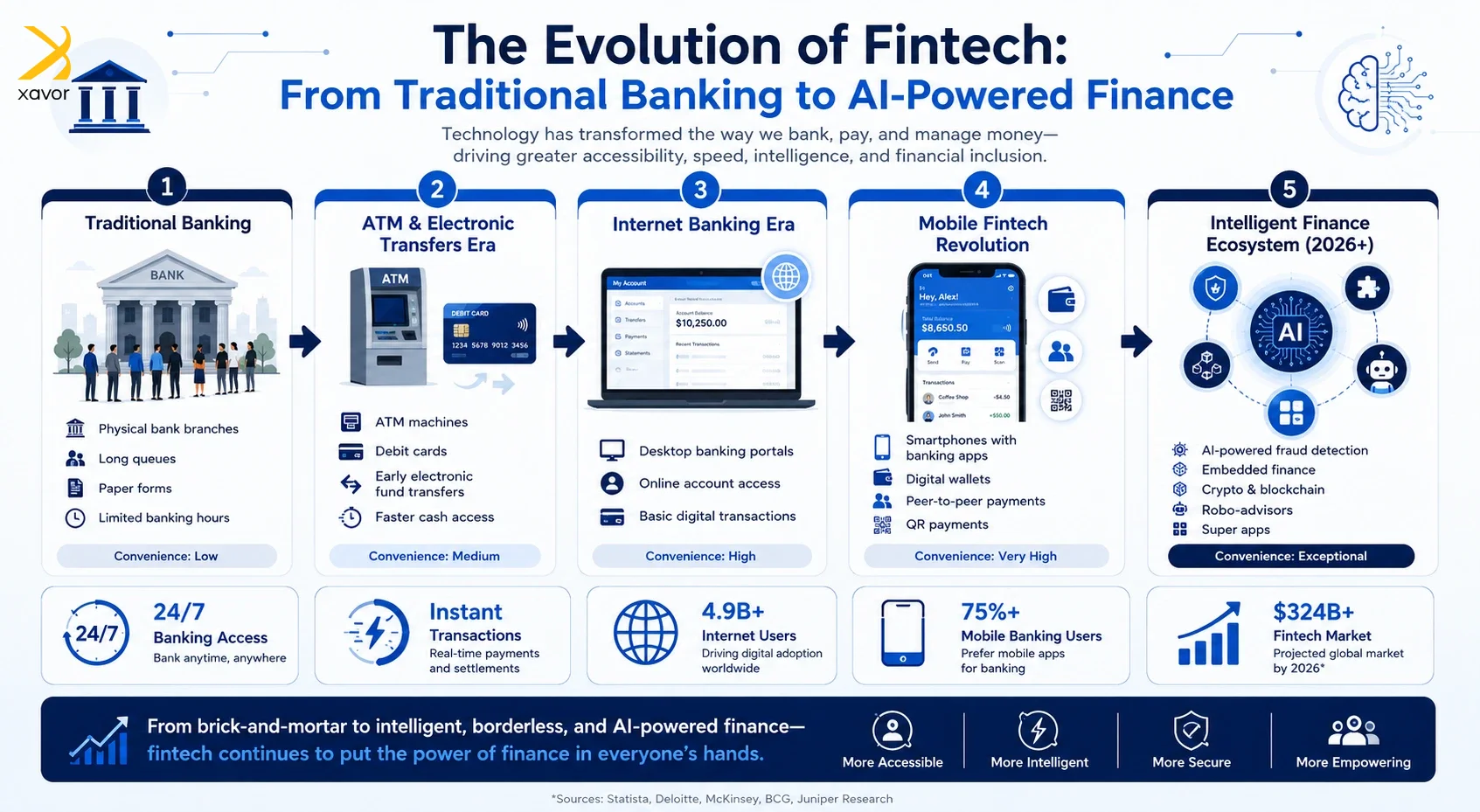
So, there was an impetus to make financial services quick and available outside the confines of financial institutions. ATMs and electronic fund transfers did the former to some extent. But you still had to go to a physical branch.
Fintech then emerged as a solution with the popularity of the internet. Early fintech solutions were just simple online banking portals. Then, early payment processes like PayPal appeared on the scene.
Today, Fintech app development is used for insurance products, investment platforms, lending solutions, and even stock trading.
Types of Fintech app development solutions
Fintech initially started as a niche industry. It was mainly limited to facilitating banking services. However, now it spans across different domains as we mentioned above. Fintech is a whole system of different products to solve particular financial hurdles.
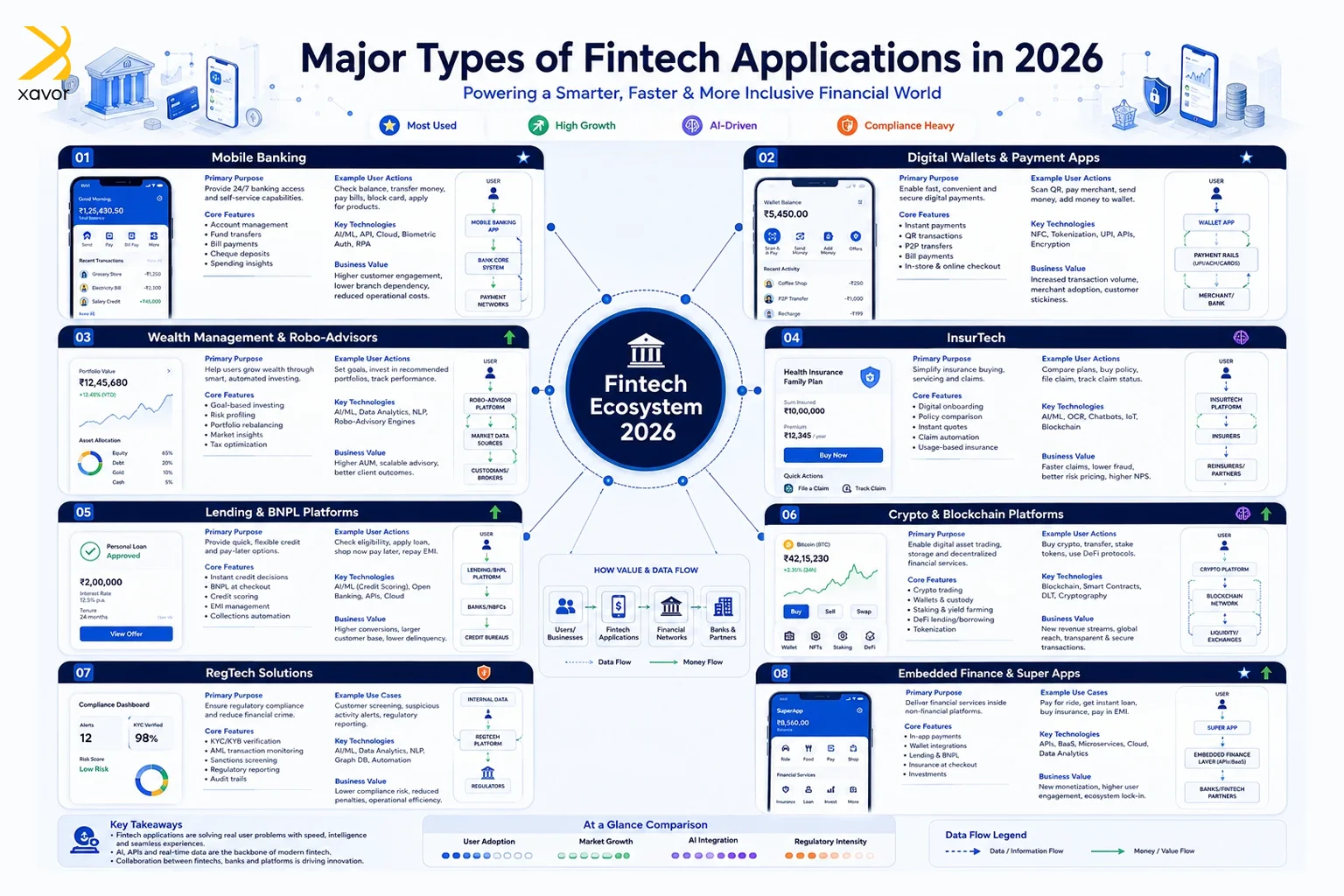
Mobile banking
Digital banking apps are virtual banks inside your pocket. They replicate any banking service on a customer’s mobile device with equal function and safety as a physical branch, such as:
- Transferring funds
- Paying bills
- Managing deposits
- Apply for loans
All major banks now have their own mobile banking apps. In fact, there are now digital-only banks with no physical locations called neobanks. These fintech software solutions make banking available 24/7 from anywhere in the world. Building this kind of digital-only banking infrastructure is its own specialty — companies like DashDevs work with neobanks and challenger banks specifically, engineering compliance and payment orchestration into the core architecture rather than adding it after launch. Asia leads the world in digital banking adoption, and Hong Kong stands out as one of its most advanced hubs, with over 90% of its population actively using virtual banking.
Digital wallets and payment apps
Digital wallets are also a very popular use case of Fintech app development. They are payment processing platforms that are usually not linked to your bank account.
Instead, they use your ID and other credentials to send or receive payments between parties. Their utility is in their convenience to make fast payments for everyday transactions without exposing sensitive banking details. Apple Pay and Venmo are very popular payment apps in the United States. Businesses looking to expand payment offerings can explore the Maverick payments ISO program to partner with a payment processor and offer merchant solutions.
Furthermore, they are even more common than banking apps in many developing, low-income countries where a noticeable percentage of the population is still unbanked.
Wealth management and robo-advisors
WealthTech and robo-advisors are two fintech application development solutions for managing your personal finances.
Robo-advisors are platforms that use algorithms to plan and manage your financial investments. You can use them to build a basic investment portfolio with no prior experience.
Some businesses also work with a fintech software development company to build apps that track their expenses and plan budgets.
A custom fintech software for wealth management can provide professional-level advice and help without the costs of commissions and fees that come with human advisors.
InsurTech
There are dedicated fintech software development services for insurance because it is a very intricate domain. Traditional insurance operations involve a lot of red tape with tons of policies and conditions.
Such fintech solutions use AI and data analytics to improve insurance claims and processing. It cuts down administrative workload and improves customer experience. InsuTech apps have features like instant claims for faster processing times and happy customers.
Lending platforms
Lending and credit fintech software have several offerings. Their common goal is to make the whole process of lending and borrowing super easy and quick.
- P2P lending apps act as a marketplace between borrowers and lenders. They skip conventional banking hurdles and connect the parties directly. And things like credit assessment and repayments are all managed by the apps. Though P2P platforms take a fee on each transaction.
- Buy Now, Pay Later (BNPL) services allow customers to pay for their purchases in installments. Many e-commerce sites now integrate BNPL options in their checkout sections.
Cryptocurrency and blockchain
The crypto scene in fintech app development is very active these days. Fintech platforms allow the trading of cryptocurrencies and other digital assets, like NFTs and tokens.
These are very extensive software that include everything you need to trade in cryptocurrencies safely. For users prioritizing privacy, there are also fintech platforms that support peer-to-peer options that let users buy BTC without ID verification, avoiding KYC processes that link wallet addresses to personal identities. Once acquired, securely storing those coins in a self-custodial wallet adds another layer of privacy and security for cryptocurrency users.
RegTech
RegTech Fintech software manages fraud detection and compliance issues for financial institutions. Manually ensuring compliance for transactions worth millions is redundant and simply not possible to do it in real time. RegTech solutions handle compliance issues with real-time monitoring.
If there is any suspicious activity, they immediately flag it and report it to the relevant authorities. This same monitoring extends to payment disputes, where chargeback fraud prevention helps merchants spot and stop fraudulent chargebacks before they cause revenue loss. For example, the agentic AI, Pindrop, and Anonybit framework is very useful to prevent AI voice scams.
Embedded finance
Embedded finance integrates financial services into primarily non-financial apps or platforms. The best expression of this aspect of Fintech app development is super apps.
Super apps like WeChat in China provide a ton of services in a single app. WeChat is a ride-hailing, e-commerce, social media, and instant messaging app all in one. So, it has in-app wallets and payment options to pay for the many services it offers.
Major technologies used in Fintech application development
Now, let’s discuss the tech stack that makes all these different fintech software solutions possible. Fintech app development requires the implementation of different technologies according to the use case.
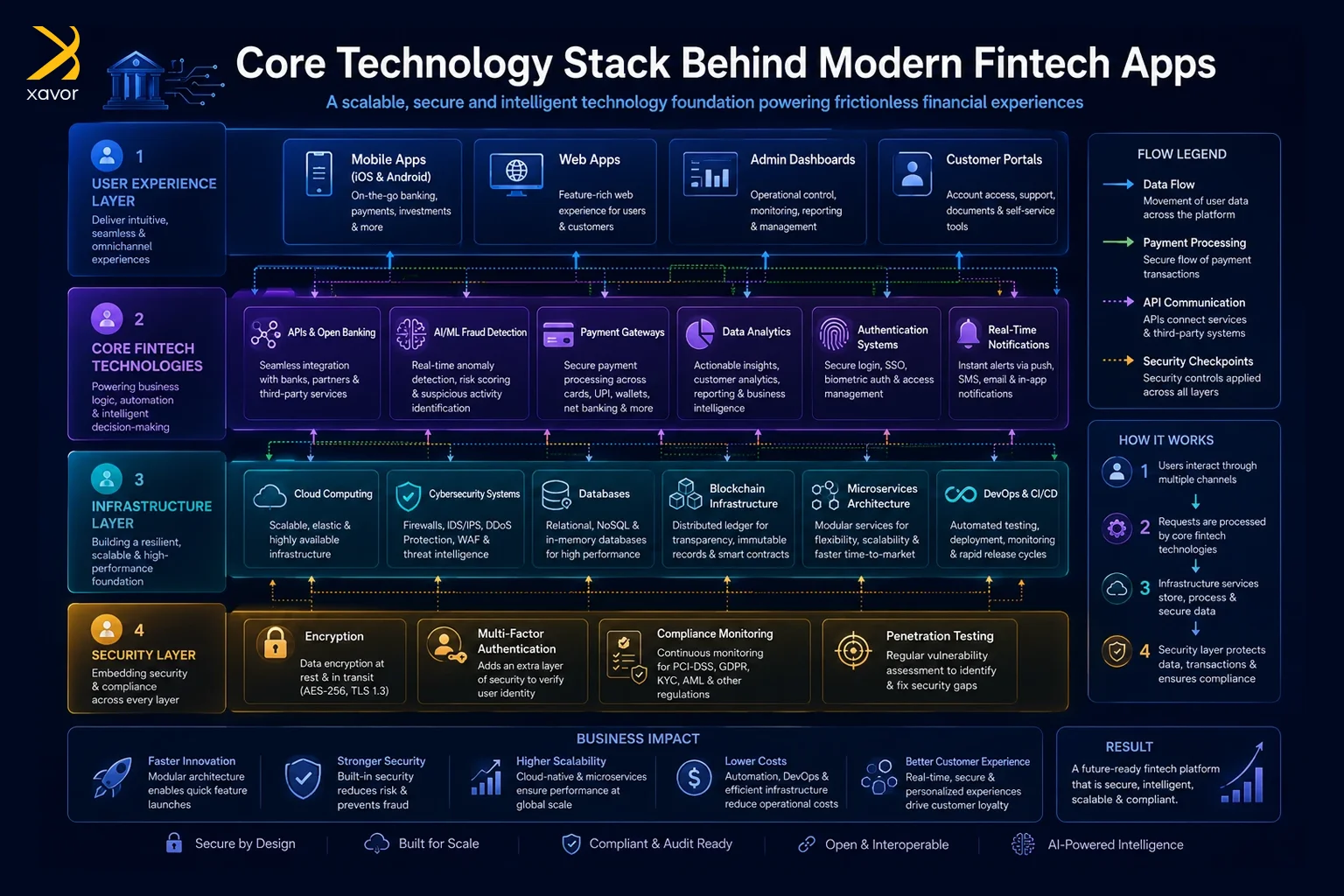
But the following are some of the most routinely used by fintech software developers:
- Cloud computing scales banking platforms and payment systems to maintain uptime.
- AI/ML is used for fraud detection and personalized financial recommendations.
- APIs connect banks and wallets safely to ensure secure data interoperability.
- Mobile technologies like iOS and Android are needed to create mobile apps.
- Data analytics find insights and market forecasting to make better decisions.
- Cybersecurity secures payments and financial information for safe transactions.
- Blockchain is used in smart contracts and transactions of crypto and digital assets to keep things transparent.
- RPA automates compliance back-office financial operations to reduce dependence on repetitive manual processes
Xavor’s Fintech app development philosophy
Our Fintech app development services treat every aspect of Fintech software as a dedicated category of its own. App development companies with Fintech expertise treat every financial software solution as a specialized category. From secure payment systems and digital wallets to lending platforms and investment apps, they approach each project with precision, compliance, and industry-specific knowledge to deliver reliable and scalable solutions. Here’s how we undertake Fintech projects with extreme levels of precision and expertise.
No room for error
We design every custom Fintech software with no room for error. There is no second chance in Fintech because you’re dealing with actual money. That is why we value trust and reliability as the number one priority in our digital financial products.
Everything is regulated
Fintech is a very tightly regulated industry like healthtech. As a professional Fintech software development company, we make sure financial software remains compliant with a dense web of government regulations.
Our fintech software developers weave compliance into every single design and engineering decision.
Designed for scale
Millions of people make transactions simultaneously around the clock. Therefore, Xavor develops systems that process all of it instantly, without slowing down or cracking under pressure.
Our Fintech mobile app development squad creates apps that are built to scale for major platforms, including:
- Android and iOS
- Cross-platform apps
- Hybrid and web apps
Zero downtime
Downtime in Fintech app development is almost like a cardinal sin. Financial markets operate 24/7, and even a few minutes of outage can mean massive losses and shattered confidence.
So, we make sure your custom Fintech software remains active all the time with techniques such as load balancing and backward-compatible APIs.
Fintech software development features we guarantee
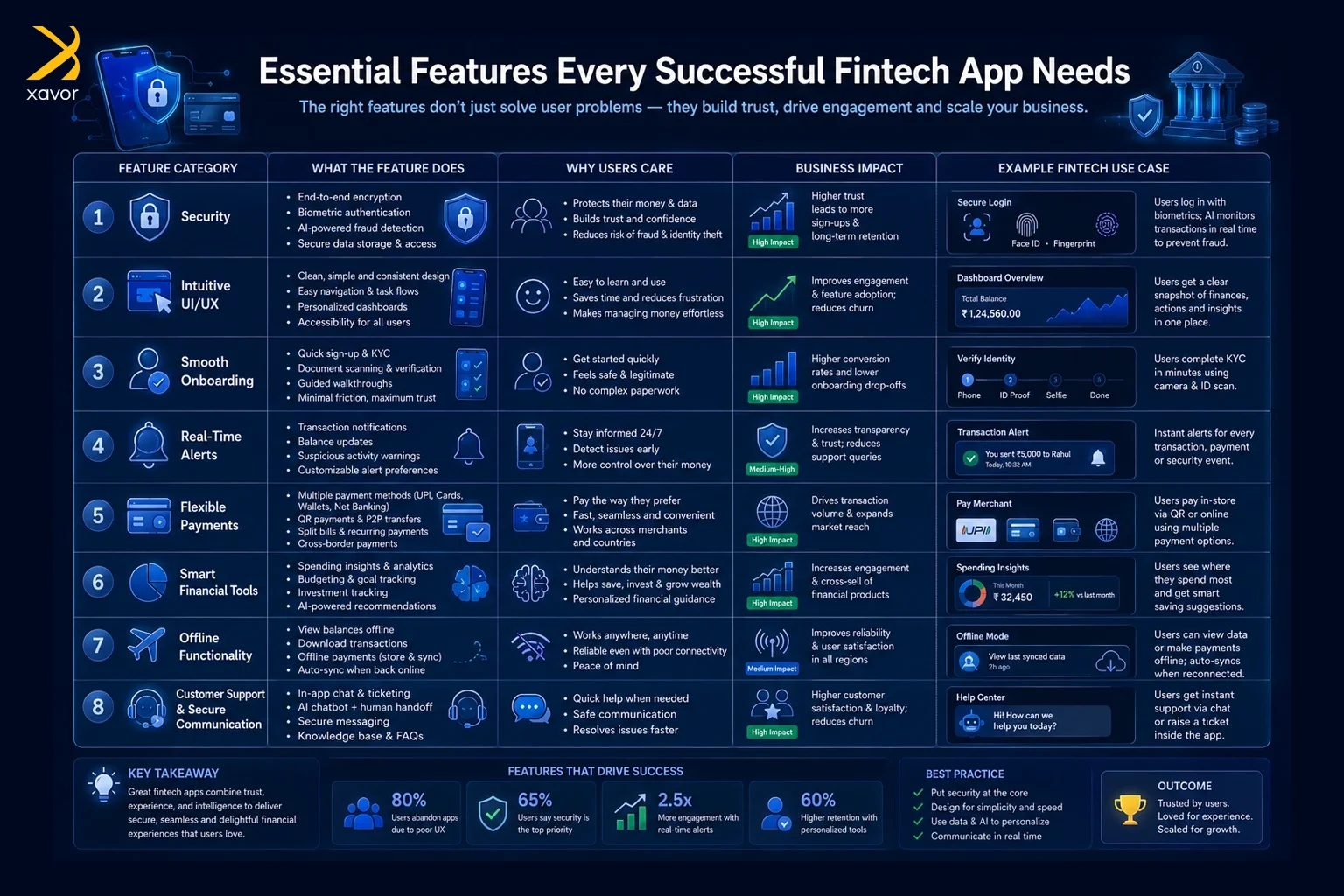
Xavor’s digital Fintech products come with a range of features that make sure your product is great to use. We don’t just add any feature just for the sake of it. Fintech app development is too intricate for that.
Our developers make sure every feature serves some core purpose and adds value while improving user experience.
Security
We add multiple layers of protection for your Fintech app. First is encryption to shield data, along with multi-factor and biometric authentication to verify identity.
Then, AI-powered fraud detection to catch threats in real time, and regular penetration testing to find cracks before attackers do.
Xavor makes sure security is the foundation on which everything else is built in Fintech app development.
Clean, intuitive UI
Users shouldn’t need a finance degree to navigate your app. That is why we design your custom Fintech software to be easy to use, regardless of whether someone is checking their balance or applying for a loan.
Our Fintech software developers make the experience feel effortless. We create well-designed, personalized dashboards that turn raw financial data into something actually useful.
Smooth onboarding
First impressions matter. Xavor gives your users an excellent first impression of your app with features, such as:
- Auto-fill forms
- Instant KYC verification
- Frictionless sign-up process
It builds immediate trust while still meeting compliance requirements. A complicated onboarding experience loses users before they’ve even started.
Real-time alerts
Everyone wants to feel in control of their money. That is why Xavor does Fintech app development with a focus on instant notification features. We implement instant alerts for transactions or low balances. Suspicious activities are also promptly noted and notified to the user.
And if there are any upcoming bills, we keep them informed and build platform trust. Moreover, letting users customize what alerts they receive makes it feel personal.
Flexible payment options
We don’t limit how people can pay. You have read that there are multiple types of Fintech solutions. In some parts of the world, credit cards are used a lot, while in others, digital wallets are more preferred and convenient to use.
So, we make sure multiple payment platforms are integrated into your custom Fintech software. Credit cards, digital wallets, QR codes, P2P transfers, and we even perform crypto integrations to broaden your reach and remove friction. The more seamless the payment flow, the better the experience.
Smart financial tools
Money management is a very important life skill. But not many people are good at it, to be honest. That is why great FinTech apps help users make better financial decisions as well.
Xavor enables apps to do that with features like spending pattern analysis and personalized budgeting advice. We also use AI/ML for investment suggestions if you want your users to plan big.
Offline functionality
Yes, being always connected to the internet is now expected. However, many people don’t want to be connected all the time, and internet connections aren’t always reliable.
So, Xavor designs core features like viewing balances to remain accessible offline. It’s a small detail that prevents a genuinely frustrating user experience at the worst possible moment.
Support and secure communication
Financial transactions gone wrong are some of the most frustrating experiences for anyone. After all, it’s someone’s hard earned money that is mishandled.
Therefore, Xavor understands users need to trust that help is available when something goes wrong. We design secure in-app chat and AI chatbots for customer support to reinforce confidence in the platform.
Our Fintech app development process
Lastly, we want to finish with Xavor’s fintech app development process. It is how we deliver financial products to our customers efficiently. Our process is based on industry-standard best practices followed by top Fintech companies worldwide.
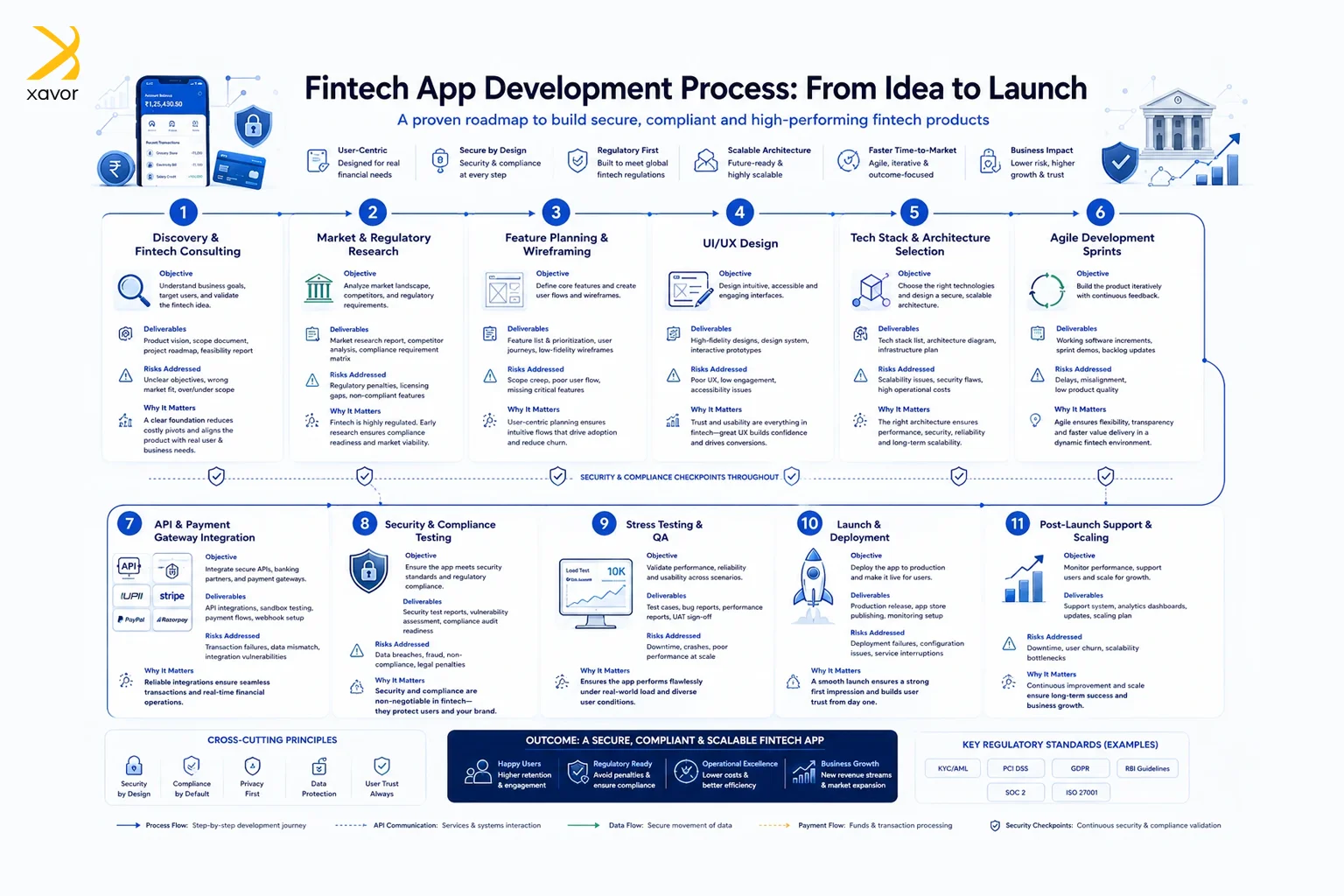
Understanding your niche and goals
We start by getting crystal clear on what your app does and who it’s for. Fintech consulting is necessary to know your industry and ambitions. The clearer our understanding, the easier every decision of Fintech app development that follows becomes.
Market and regulatory research
Before writing a single line of code, Xavor does research on two things:
- Competitive landscape of your market
- Legal obligations relevant to your niche
Knowing your competitors and market scope is part and parcel of Fintech app development. And what regulations apply to you vary by region. Really, discovering a compliance gap after launch is far more expensive than addressing it upfront.
Featuring planning
You can call the first two steps part of the homework. But with your niche and compliance requirements clear, our next step is to decide what your app actually needs to do.
Our Fintech software developers prioritize everything. They separate what’s essential for launch from what can come later. Furthermore, our squads build out user stories and wireframes for a realistic path forward.
Fintech app development needs to be focused. And feature planning is necessary to prevent the classic trap of building too much too soon.
UI/UX design
A Fintech app can have powerful technologies but still fail if users find it confusing. So, we design every screen to be intuitive and accessible to people of all financial literacy levels.
Our UI/UX experts build clickable prototypes and test them with real users. The feedback is useful to refine features before development begins.
Tech stack and architecture selection
In this step, we select technologies and the architecture that are pertinent for your use case. If you want to target both iOS and Android, we go with frameworks like React Native or Flutter development.
On the backend, there are several architectures to choose from in Fintech app development. Usually, microservices are an excellent option for an app that can grow to millions of users.
Agile development sprints
Xavor follows an agile process with built-in sprints. Short, iterative cycles with continuous testing help us integrate third-party services during development.
And that is a great relief because things like payment gateways or banking APIs can be tricky to integrate. Mapping the main banking API integration steps, from customer consent and authentication to token handling, data requests, and error recovery, helps teams catch issues early and avoid costly rework.
Pre-launch testing
Quality assurance in Fintech app development is one of the last but must-have steps before going live. Xavor uses the latest testing tools and technologies to vet the app in every way.
Our QA teams do functional testing to ensure everything works and penetration testing to find vulnerabilities. We have dedicated compliance verification experts well-versed in financial services to confirm you meet regulatory standards.
And stress testing helps to see how the system holds up under heavy load.
Post-launch support
Xavor monitors the performance of your Fintech app around the clock. We fix bugs that may have slipped through fast before they make any impact. Furthermore, we release regular security patches for your custom Fintech software.
And as more users download and use your app, we update features based on real feedback.
Conclusion
Fintech app development is different from other types of software products. It is a high-stakes, more complex domain. That is why you need specialists for almost every factor to build Fintech software.
Therefore, the smarter and safer option to approach Fintech app development is to work with a dedicated Fintech company. And Xavor is a California-based Fintech software development company that has solved Fintech problems for clients across 15+ industries.
We know the technical and regulatory requirements to build Fintech solutions that are user-friendly and fully reliable. Contact us at [email protected] to share your Fintech goals, and we’ll architect your product starting with a free consultation session.

FAQs
Fintech apps typically make money through a combination of transaction fees, subscription plans, and interest on lending or savings products. Many also earn revenue from interchange fees when users make purchases with their cards, or by selling premium features and financial products like insurance or investments.
Fintech apps rely on multi-layered security including end-to-end encryption, two-factor authentication (2FA), and biometric login to protect user accounts and data. They also use real-time fraud detection, secure APIs, and compliance with standards like PCI-DSS and GDPR to safeguard transactions and personal information.
The development timeline for a fintech app typically ranges from 3 to 9 months for an MVP, depending on the complexity of features and integrations required. A full-featured app with advanced capabilities like AI-driven insights, multi-currency support, or lending modules can take 12 to 18 months or more.