

Automation is the grease that runs modern businesses. But now enterprise automation has gone even better with AI on the scene. Prior to that, most autonomous systems followed only fixed rules and instructions like robotic process automation. That meant they stopped working if they encountered anything they weren’t programmed to handle. Obviously, this was very limiting for complex business operations where out of the ordinary problems are part of the job.
Therefore, AI for automation is a really big improvement. Artificial intelligence adds a layer of intelligence to automated systems. Modern AI automation solutions enable them to interpret data and recognize patterns to make informed in real time.
In this blog, we’ll explore AI automation in detail from A to Z. Read till the end to gain an in-depth understanding of the current wave of automation, and what it can do for your company.
What is AI automation?
AI automation refers to the use of intelligent software systems to perform tasks that traditionally required human judgment or manual effort. Unlike conventional rule-based automation, AI automation learns from data to adapt to changing conditions. Having this ability improves its performance over time.
However, keep in mind that AI automation isn’t some standalone technology. It just builds on regular automation systems with AI-based technologies, such as:
- Machine learning (ML)
- Natural language processing (NLP)
- Computer vision
AI automation is an intelligent decision-making engine that gels into a unified, adaptive system. Converging this way allows organizations to automate not only repetitive, structured tasks but also nuanced, context-dependent processes that require interpretation and reasoning. This same approach can be applied to everyday knowledge work, where AI helps users process and organize information more efficiently. For example, GoodNotes uses AI-powered features such as AI notes to help users work with their notes and turn information into more useful, organized content.
The evolution of automation
Automation is not new. Its history can be traced back to eons. The 12th century Arab polymath Ismail al-Jazari is often considered as the father of modern automata and robotics. He wrote some famous treatises on mechanical devices.
But automation truly started becoming ubiquitous with the Industrial Revolution. And since then, factories have used mechanical automation. What makes the current era transformative is the convergence of three forces: exponential growth in computing power, vast datasets generated by digital activity, and breakthroughs in machine learning algorithms.
The journey from simple scripts to intelligent autonomous agents spans three generations:
- Rule-Based Automation (1980s–2010s): Scripts, macros, and fixed workflows. It was fast but brittle as any unexpected input broke the process.
- Robotic Process Automation (2010s): Software robots that mimic human interaction with interfaces, enabling cross-system automation without API integration.
- AI-Augmented Automation (2020s–present): Systems that learn, reason, and self-correct. Handles unstructured data, adapts to exceptions, and improves continuously. This generation includes sophisticated applications like AI Virtual Try-On, which leverages AI to provide personalized visual experiences for consumers.
Core benefits of AI automation
Organizations that successfully implement AI automation consistently report measurable improvements across five dimensions:
| Benefit | Impact and Detail |
| Operational Efficiency | Eliminates manual bottlenecks; processes run 24/7 at machine speed. Studies show 40–80% reduction in process cycle time. |
| Cost Reduction | Reduces labor costs for repetitive tasks by 25–50%, reallocating human capital to higher-value creative and strategic work. |
| Accuracy and Consistency | AI systems eliminate human error in data processing, compliance checks, and calculations — achieving 99.9%+ accuracy on structured tasks. |
| Scalability | Instantly scale throughput to match demand spikes without hiring. A single automation system can process millions of transactions simultaneously. |
| Data-Driven Intelligence | Every automated interaction generates data, creating feedback loops that surface insights invisible to human operators. |
| Employee Experience | Removes tedious, low-value work from employee roles, boosting morale and enabling focus on creative problem-solving. |
Real-world applications across industries
AI automation has permeated virtually every sector of the global economy. The following sections detail transformative use cases across key industries, along with adoption rates and measurable outcomes.
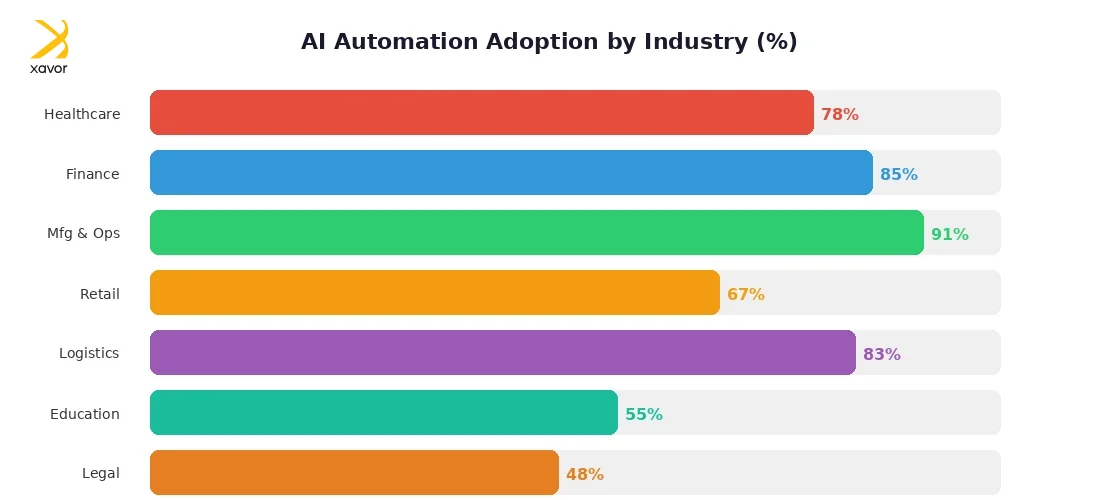
1. Healthcare and Life Sciences
AI in healthcare represents one of the highest-stakes and fastest-growing domains for AI automation, with applications spanning clinical operations, drug discovery, and patient engagement.
Diagnostic Support Systems
AI models trained on millions of medical images now assist radiologists in detecting tumors, lesions, and abnormalities in CT scans, MRIs, and X-rays. Systems like those deployed at major hospitals achieve diagnostic accuracy that matches or exceeds specialist physicians, while reducing reading time by up to 60%.
Clinical Workflow Automation
- Prior authorization processing: Automated review of insurance requirements reduces approval time from days to minutes.
- Medical coding (ICD/CPT): NLP engines extract diagnoses from clinical notes and assign codes with 95%+ accuracy, cutting coder workload by half.
- Appointment scheduling and reminders: Conversational AI manages complex multi-resource scheduling and reduces no-show rates by 30–40%.
Drug Discovery and Development
Pharmaceutical companies use AI to screen billions of molecular compounds for therapeutic potential.It is a process that once took years now completes in weeks. Automation platforms like those used in target identification, ADMET prediction, and clinical trial matching are accelerating time-to-market for new drugs by an estimated 30–50%.
2. Financial services and banking
The financial sector leads all industries in AI automation investment, driven by the need for speed, accuracy, and regulatory compliance in high-volume transaction environments.
Fraud Detection and prevention
Real-time transaction monitoring systems analyze hundreds of behavioral signals simultaneously — purchase location, device fingerprint, spending pattern deviations — to flag fraudulent transactions in under 50 milliseconds. Modern payment fraud prevention reduces false positives by 70% compared to legacy rule-based systems, dramatically improving the customer experience.
Automated Underwriting and credit
- Loan decisions that once took days now complete in seconds using ML models that assess thousands of data points.
- Alternative credit scoring expands financial access to thin-file customers by analyzing non-traditional signals like utility payments and rental history.
- Dynamic pricing models automatically adjust rates based on real-time risk assessments and market conditions.
Regulatory Compliance and reporting
Know Your Customer (KYC), Anti-Money Laundering (AML), and regulatory reporting processes are prime automation targets. Automated document verification, transaction monitoring, and suspicious activity report generation reduce compliance costs by 30–50% while improving detection rates.
3. Manufacturing and industrial operations
Manufacturing was the birthplace of automation and today represents the most mature AI automation ecosystem, combining physical robotics with intelligent software control systems.
Predictive maintenance
IoT sensors embedded in industrial equipment stream real-time performance data — vibration, temperature, pressure, acoustic signatures — to AI models that predict component failures days or weeks in advance. This approach reduces unplanned downtime by up to 50% and extends equipment lifespan by 20–40%, delivering ROI that typically pays back investment within 6–12 months.
Quality Control and Inspection
Computer vision systems in manufacturing can help inspect products at speeds and resolutions impossible for human inspectors. A single camera system running AI can inspect thousands of parts per minute with sub-millimeter defect detection accuracy, reducing scrap rates and warranty claims.
Supply Chain Optimization
- Demand forecasting: ML models incorporating weather, social trends, and economic indicators improve forecast accuracy by 15–30% vs. traditional methods.
- Inventory optimization: Automated reorder systems maintain optimal stock levels, reducing carrying costs while eliminating stockouts.
- Logistics routing: AI dispatching reduces delivery miles, fuel consumption, and last-mile costs by 10–20%.
Retail and e-commerce
Personalization at Scale: Recommendation engines analyze browsing behavior, purchase history, and demographic signals to present hyper-personalized product suggestions. Top e-commerce platforms attribute 35–40% of total revenue to AI recommendation systems.
Inventory and Demand Planning: Automated inventory management systems synchronize purchasing, warehousing, and distribution in real time. AI demand planners incorporate granular factors to achieve inventory turnover improvements of 15–25%.
Customer Service Automation
- AI chatbots handle 60–80% of first-contact customer inquiries without human escalation.
- Automated returns processing reduces resolution time from 3–5 days to under 2 hours.
- Dynamic pricing engines adjust millions of prices daily in response to demand signals.
5. Logistics, transportation and supply chain
Autonomous vehicles, smart warehousing, and AI-optimized routing are reshaping global logistics. Amazon, FedEx, and DHL have invested billions in automation infrastructure, with warehouse robots that can process 3x more orders per hour than fully manual operations.
6. Legal and compliance services
Contract analysis and document reviews were once the most labor-intensive billable activities at law firms, including the modern AI-native law firm, but they are now being transformed by AI. NLP systems can review thousands of documents in hours, identifying relevant clauses, risks, and precedents with accuracy that matches junior associates. By adopting automation for legal processes, firms can dramatically reduce turnaround times, allowing their legal teams to shift their focus from manual data entry to higher-value strategic advisory work.
How AI automation systems work
Understanding the technical architecture of AI automation systems is essential for leaders evaluating, implementing, or governing these technologies. This section demystifies the core components and their interactions.
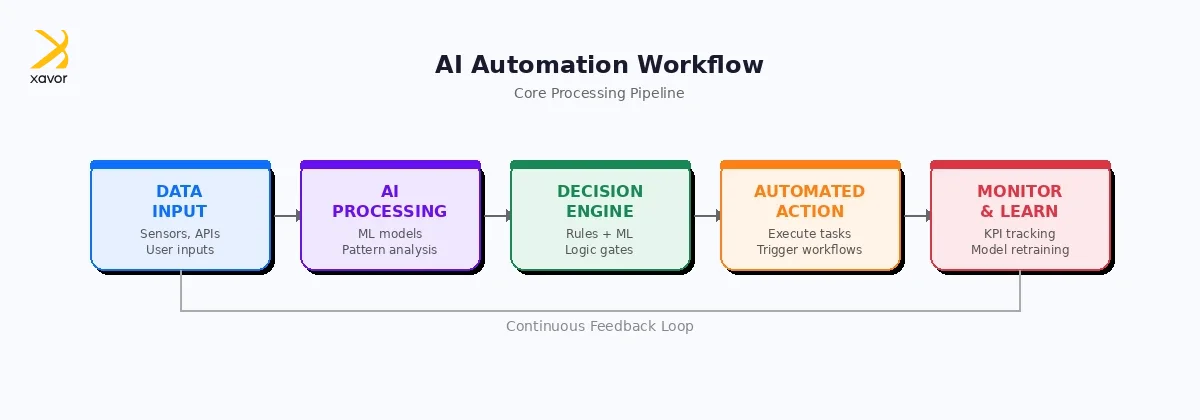
The Five core components
Component 1: Data Ingestion and Sensing
Every AI automation system begins with data. Input mechanisms span a vast range: IoT sensors capturing physical-world measurements, API feeds from enterprise systems, document uploads, user interface interactions, and real-time event streams.
Data ingestion layers perform initial validation, deduplication, and normalization. It converts diverse raw inputs into consistent formats suitable for downstream AI processing. The quality and breadth of ingested data directly determines the capability of the system.
Component 2: AI Processing Engine
The processing engine is where intelligence resides. Depending on the task domain, this may involve:
- Natural Language Processing (NLP): Understanding and generating human language in documents, emails, and conversations.
- Computer Vision: Interpreting images, video, and visual data streams for inspection, recognition, and analysis.
- Machine Learning Models: Classifying inputs, predicting outcomes, detecting anomalies, and identifying patterns in numerical and categorical data.
- Large Language Models (LLMs): Generative AI capable of reasoning, summarization, code generation, and complex dialogue.
Component 3: Decision Engine
The decision engine translates AI outputs into actionable determinations. Modern automation platforms combine ML-generated recommendations with human-defined business rules, creating hybrid decision logic that is both adaptive and governed. Confidence thresholds determine when the system acts autonomously versus when it escalates to human review.
Component 4: Action Execution
Once a decision is reached, the automation executes the corresponding action and updates a database record, sends a notification, triggers a downstream workflow. It can also control a physical equipment, or generate a document. Modern automation platforms connect to hundreds of enterprise systems through pre-built integrations and standard APIs.
Component 5: Monitor, Feedback and Learn
Closed-loop AI systems continuously monitor their own performance, tracking accuracy metrics, exception rates, processing times, and business outcomes. This telemetry feeds retraining pipelines that keep models accurate as data distributions shift, and operational dashboards that give human operators visibility and control.
Integration patterns
AI automation systems integrate with existing enterprise infrastructure through three primary patterns:
| Integration Pattern | Description and Use Case |
| API-First Integration | Real-time bidirectional data exchange with existing systems through REST or GraphQL APIs. Preferred for modern cloud applications. |
| RPA Bridge | Software robots that interact with legacy system user interfaces where no API exists — mimicking keyboard/mouse actions. |
| Event-Driven Architecture | Message queues and event streams (Kafka, RabbitMQ) decouple systems, enabling async automation triggered by real-time events. |
| Embedded AI Services | AI capabilities consumed as microservices within existing applications via cloud APIs (AWS, Azure, GCP AI services). |
The role of human-in-the-loop
Contrary to the narrative of full automation replacing humans, the most effective AI automation systems are designed around human-in-the-loop (HITL) principles. This means:
- Humans define policies, thresholds, and escalation rules that govern when AI acts autonomously.
- Low-confidence or high-stakes decisions are routed to human reviewers rather than automated. In marketing, MYSITEBUDDY applies this pattern to website work: AI agents handle SEO audits and fixes, a second model cross-checks the output, and a senior reviewer approves anything before it is deployed.
- Human feedback on AI decisions continuously improves model accuracy over time.
- Audit trails and explainability features ensure transparency and accountability.
Furthermore, it is a best practice to start automation at the lowest-risk decision points where AI confidence is highest. Gradually expand automation scope as models demonstrate consistent accuracy. Always maintain human override capabilities at every stage of the pipeline
Practical guide: controlling automation through apps and platforms
Successfully deploying AI automation requires not just the right technology, but a structured approach to configuration, monitoring, and governance. This section provides a practical guide for setting up and controlling automation using modern platforms.
Leading automation platforms
The automation platform landscape has matured significantly, with clear categories emerging for different use cases and technical sophistication levels:
Enterprise Automation Platforms
| Platform | Capabilities and Best Fit |
| UiPath | Industry-leading RPA platform with AI capabilities. Offers Studio (visual designer), Orchestrator (deployment/monitoring), and attended/unattended bots. Best for large enterprises with complex legacy system integrations. |
| Microsoft Power Automate | Deep integration with Microsoft 365 ecosystem. Low-code interface with AI Builder for custom ML models. Ideal for organizations standardized on Microsoft stack. |
| Automation Anywhere | Cloud-native RPA with IQ Bot for intelligent document processing. Strong compliance features for regulated industries. |
| ServiceNow | IT and business process automation with Now Intelligence AI embedded throughout workflows. Dominant in IT service management automation. |
Integration and API Automation Tools
| Tool | Profile |
| Zapier | Consumer-friendly no-code automation connecting 6,000+ apps. 2-minute setup for common integrations. Limited for complex logic. |
| Make (Integromat) | Visual workflow builder with advanced data transformation. Better for complex multi-step automations than Zapier. |
| n8n | Open-source, self-hosted automation platform. Full customization, no per-task pricing, strong developer community. |
| Workato | Enterprise integration platform with AI-powered recipe suggestions. Strong in connecting business and technical systems. |
Step-by-step: setting up your first automation
This practical walkthrough applies to most modern automation platforms and illustrates the standard configuration process:
Phase 1: Define and Design
- Identify the target process: Document the current manual process, decision points, exception paths, and stakeholders. Calculate current process cost in time and labor.
- Define the automation scope: Determine which steps will be automated vs. human-managed. Start with the highest-volume, most rule-based steps.
- Map data sources: Identify all input sources and output destinations. Confirm API availability or design RPA workaround.
- Set acceptance criteria: Define measurable success metrics to process time target, accuracy threshold, exception rate limit.
Phase 2: Build and Configure
- Design the workflow canvas: Use the platform’s visual workflow builder to map out the automation sequence. Most platforms offer drag-and-drop components for triggers, conditions, actions, and error handling.
- Configure triggers: Specify what initiates the automation. It could be a scheduled time, a form submission, an API event, an email received, or a database record change.
- Add AI processing steps: Connect AI services for tasks requiring intelligence, like document parsing, classification, sentiment analysis, or generative responses.
- Define branching logic: Configure conditional paths for different input scenarios, including exception handling and human escalation routes.
- Set up integrations: Authenticate and connect to all required external systems using OAuth, API keys, or database connectors.
Phase 3: Test and Validate
- Unit testing: Test each individual step in isolation with known test data, including edge cases and exception scenarios.
- End-to-end testing: Run complete test scenarios through the full automation, validating outputs at each stage.
- Parallel running: Operate the automation alongside the manual process for a defined period, comparing outputs to validate accuracy.
- Load testing: Verify the automation performs correctly at peak expected transaction volumes.
Phase 4: Deploy and Monitor
- Staged rollout: Begin with a limited user group or transaction subset. Monitor closely before full deployment.
- Configure monitoring dashboards: Set up real-time KPI dashboards tracking throughput, error rates, processing time, and exception queues.
- Define alert thresholds: Configure automated alerts for anomalies, such as error rate spikes, queue buildup, system unavailability.
- Establish governance protocols: Assign ownership, define change management procedures, and schedule regular performance reviews.
Key configuration areas in automation platforms
Workflow Designer
The visual canvas where automation logic is constructed. Modern platforms offer:
- Drag-and-drop components for triggers, actions, conditions, loops, and error handlers.
- Pre-built connectors for popular enterprise systems (Salesforce, SAP, Microsoft 365, Slack, etc.).
- Version control and deployment management for tracking configuration changes.
AI Model Configuration
For AI-enhanced automations, configuration includes:
- Model selection: Choosing the appropriate AI service. Usually, the choice is between pre-trained vs. custom fine-tuned models.
- Confidence thresholds: Setting the minimum AI confidence score required for autonomous action vs. human review.
- Training data management: Curating and labeling training examples to improve model accuracy over time.
Access Controls and Security
Enterprise automation platforms provide granular access management:
- Role-based access control (RBAC) defining who can create, modify, or deploy automations.
- Credential vaults for secure storage of API keys, passwords, and certificates.
- Network isolation options for sensitive data environments.
- Complete audit logs recording every automation action for compliance purposes.
Monitoring and optimization
Continuous monitoring is as important as the initial deployment. Below are some key metrics track. But before that, we want to share a very good optimization tip. It is good to review exception queues weekly to identify patterns in transactions that consistently require human intervention.
These patterns represent opportunities to improve AI model training or refine business rules. Each improvement incrementally reduces the human workload and increases automation coverage.
Key metrics to track:
| KPI | Description and Target |
| Throughput | Transactions/tasks processed per hour. Primary capacity metric. |
| Processing Time | End-to-end cycle time per transaction. Target: 80–95% reduction vs. manual baseline. |
| Accuracy Rate | Percentage of transactions processed correctly without requiring correction. |
| Exception Rate | Percentage of transactions routed to human review. High rates signal automation gaps. |
| System Availability | Uptime percentage. Enterprise targets are typically 99.9%+. |
| ROI and Cost per Task | Total automation cost divided by transactions processed. Benchmark against manual cost. |
Future trends in AI automation
AI automation is an ongoing journey of capability expansion. It will only improve with more organizational adaptation and strategic reinvention. The organizations that will lead their industries in the coming decade are those building automation competencies today.
Key trends shaping the next era
Trend 1: Agentic AI and Autonomous Agents
The next wave of automation moves beyond executing predefined workflows to deploying AI agents capable of setting sub-goals, using tools, and completing open-ended tasks autonomously. Platforms like Anthropic’s Claude, OpenAI’s GPT-4, and Google’s Gemini are being embedded into automation orchestration layers, enabling agents that can research, reason, draft, review, and execute multi-step business processes with minimal human instruction.
Trend 2: Hyperautomation at Enterprise Scale
Hyperautomation is becoming a board-level strategic initiative. It is the systematic, rapid identification and automation of as many business and IT processes as possible. Gartner projects that by 2027, organizations will reduce operational costs by 30% by combining RPA, AI, process mining, and analytics into unified automation ecosystems. Process mining tools automatically discover automation opportunities by analyzing system logs and event data.
Trend 3: Edge AI and Real-Time Automation
As IoT sensors proliferate and latency requirements tighten, AI automation is moving to the edge — directly embedded in manufacturing equipment, retail environments, and transportation infrastructure. Edge AI enables real-time decision-making without round-trips to cloud servers, unlocking automation in contexts where even milliseconds matter.
Trend 4: Human-AI Collaborative Workspaces
Rather than replacing humans, advanced automation is creating new hybrid work models where AI handles high-volume, analytical, and routine cognitive tasks while human workers focus on relationship management, creative strategy, ethical oversight, and exception handling. Organizations designing for this collaboration model report higher automation ROI and stronger employee acceptance.
Trend 5: Self-Healing and Self-Optimizing Systems
Next-generation automation platforms will incorporate meta-learning capabilities — monitoring their own performance and autonomously adjusting parameters, retraining models, and reconfiguring workflows when performance degrades. This represents the emergence of truly autonomous operational AI that manages itself within human-defined guardrails.
Strategic recommendations
For organizations planning their AI automation journey, the following strategic priorities are essential:
- Build automation literacy organization-wide: Invest in training employees at all levels to understand, work alongside, and improve AI automation systems.
- Adopt a platform-first mindset: Standardize on a small number of well-supported automation platforms rather than accumulating point solutions.
- Prioritize data quality as infrastructure: Automation quality is bounded by data quality. Invest in data governance, standardization, and enrichment as foundational work.
- Design for governance and explainability: As automation scope expands, stakeholders — regulators, customers, employees — will demand transparency. Build audit trails and explainability into every automation from day one.
- Measure ROI rigorously and iteratively: Track automation performance against clear baselines, and use data-driven insights to prioritize the next wave of automation investments.
- Treat automation as a capability, not a project: The most successful automation programs are sustained, evolving capabilities — not one-time IT projects with a fixed end date.
Conclusion
AI automation represents the most significant shift in how organizations create value since the introduction of enterprise software. The question for every organization is no longer whether to automate, but how to do so with speed, intelligence, and responsibility. Those who build strong automation foundations today will be the architects of tomorrow’s most competitive enterprises.
Xavor helps you build those foundations with its expert AI services spanning across full ambit of AI technologies. Our GenAI, agentic AI, conversational AI, and machine learning services develop advanced solutions according to your business needs.
Build your AI foundation now. Contact us at [email protected].

FAQs
AI automation uses artificial intelligence to perform tasks that normally require human decision-making. It combines automation with machine learning, data analysis, and natural language processing to handle workflows faster, reduce manual effort, and improve accuracy.
Common examples of AI automation include customer support chatbots, AI-powered document processing, fraud detection systems, predictive maintenance in manufacturing, and automated prior authorization workflows in healthcare. These systems reduce manual work and speed up decision-making.
The best AI for automation depends on the use case. Generative AI models like GPT are effective for content, chat, and workflow assistance, while platforms like UiPath, Microsoft Power Automate, and Automation Anywhere are widely used for enterprise process automation and AI-driven workflows.