
We all think that we are too smart to be tricked by phone scams. Maybe a scammer pretending to be a government agent can bilk an old grandma out of her retirement money. But not you, right? Well, you might want to swallow your pride because audio deepfakes are super lethal.
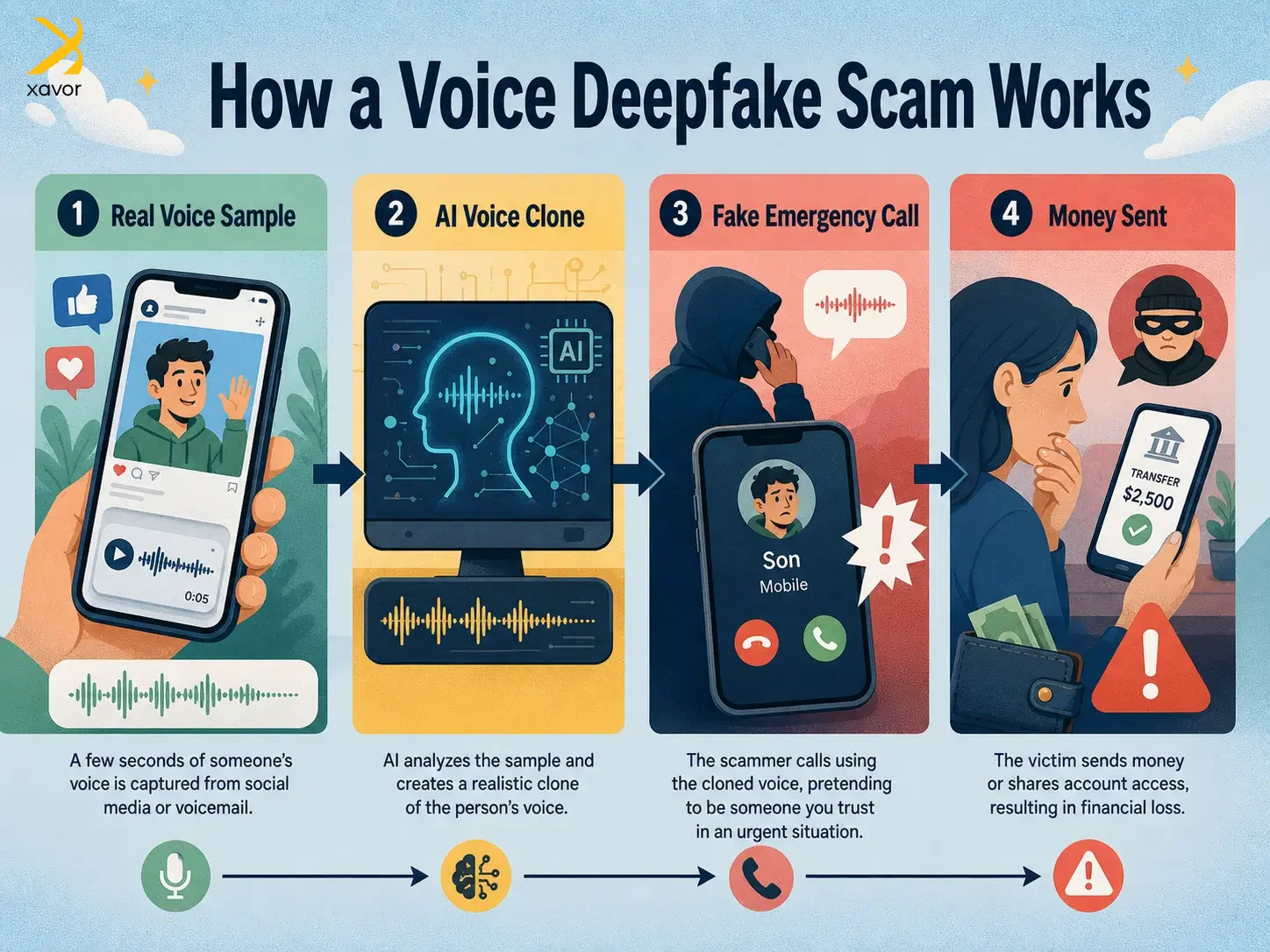
Scammers are using AI to create highly realistic voice clones of real people. Imitating human voices to swindle people or their family and friends.
Pindrop and Anonybit are two companies that have stepped up to solve these impersonation frauds. Together, they represent a new wave of agentic AI solutions for identity security, building smarter layers of protection against these evolving threats.
In this blog, we’ll explore these identity security solutions in detail. How they work together to keep criminals at bay.
Deepfakes are running amok
Deepfakes are among the most surreal dangers posed by AI to our society. Criminals use AI systems to fabricate these images, videos, or audios that mimic real people and events. Deepfakes are unbelievably realistic, almost uncanny in imitation.
The average person can’t tell deepfakes from the real thing. And they have become a serious security and governance risk. Not to mention the heated ethical debates they have raised about the future of AI.
In 2019, a fraudster scammed the CEO of a UK-based company of $243,000 using a voice deepfake of the parent company’s head. Similarly, there has been an uptick in criminals using voice deepfakes of people’s loved ones, feigning distress to trick them into sending money.
According to the US Federal Trade Commission, there were 2.6 million such fraud cases in 2024 alone.
The failure of traditional identity security solutions
Impersonating someone’s identity is one of the most egregious crimes. Imagine that someone sounds like you and has your ID credentials. They can bypass any security protocol to access your most sensitive information. It will turn your world upside down.
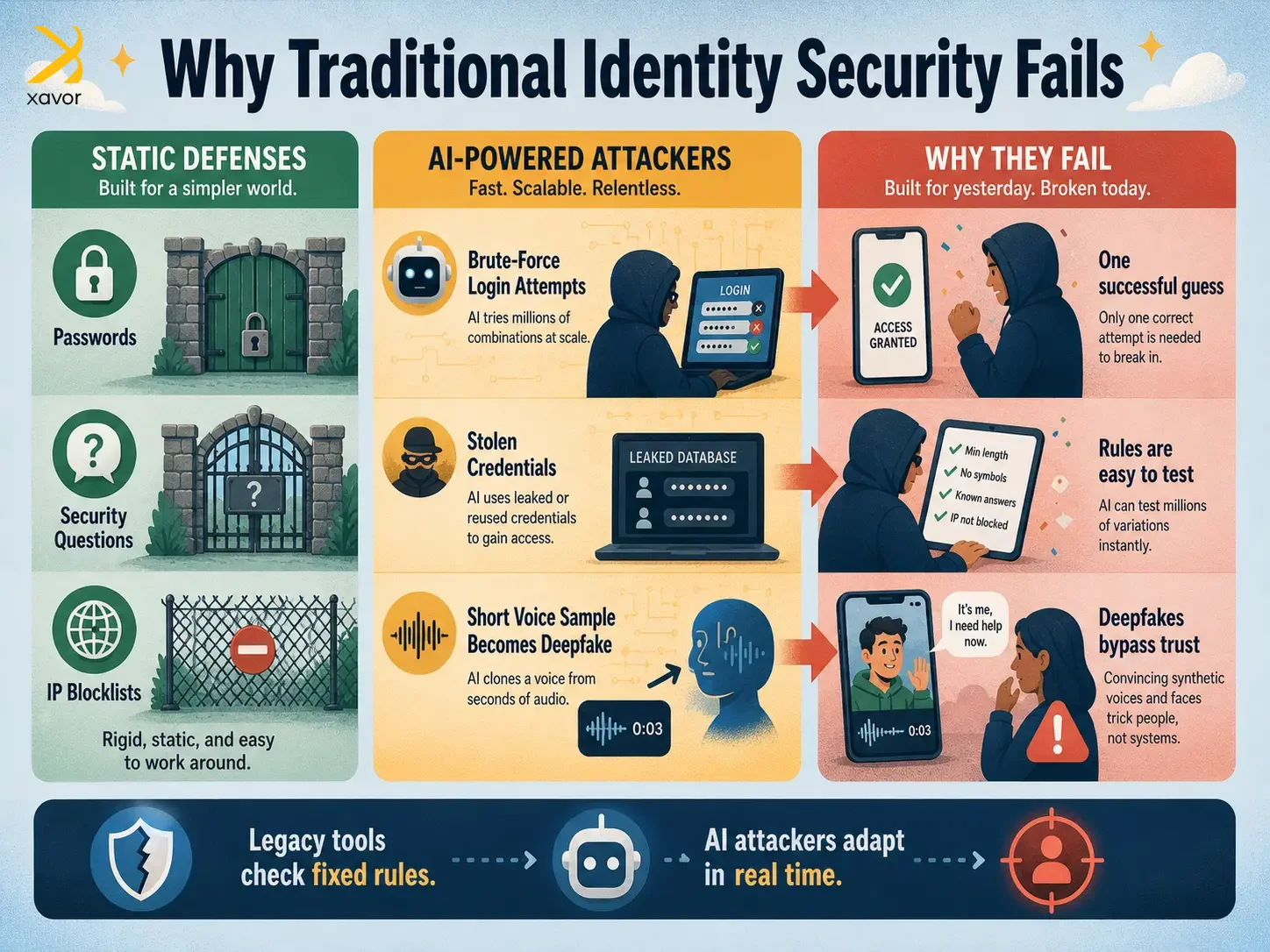
Unfortunately, traditional identity security solutions can’t cope with the menace of deepfakes. Static defenses form the basis of these legacy security solutions, such as:
- Passwords
- Security questions
- IP blocklists
These are rules-based identity and access management tools that crumble against the dynamic threats of AI. Hackers need just one successful attempt to figure out the exact conditions or limits that trigger these systems.
For example, someone can use generative AI to launch thousands of attacks to find your password. And after that, they only need three or four seconds of your audio from your phone to create voice deepfakes that will perfectly mimic you.
Agentic AI has better identity decisioning
Agentic AI security systems are fundamentally different. They have contextual awareness of threats. A platform or framework with agentic AI security goes beyond fixed rules and reasons for several things on its own.
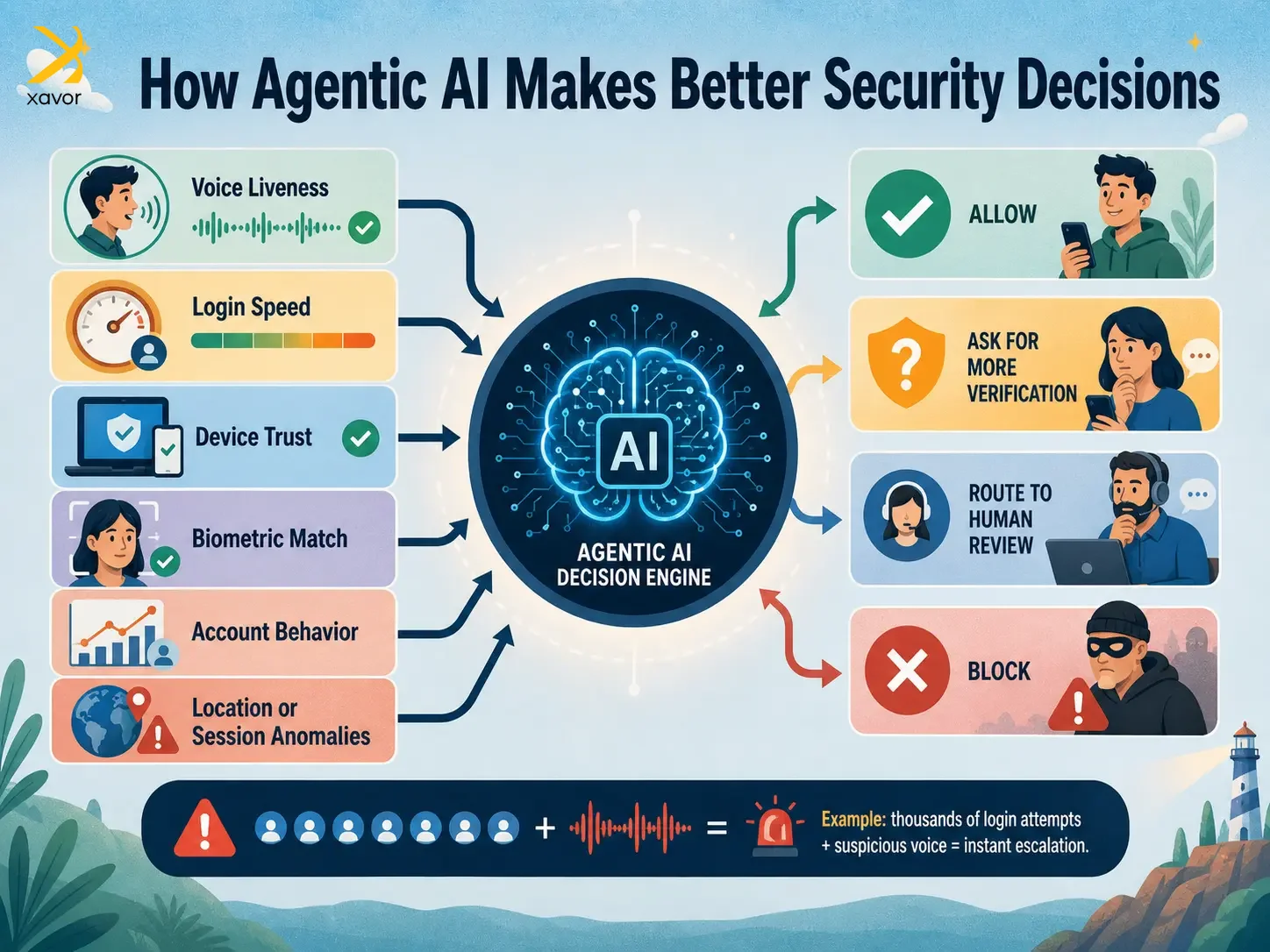
Identity security solutions that use AI agents don’t rely solely on password matching or OTPs. They process multiple factors to determine the best course of action.
Take the above example; a hacker uses AI to launch thousands of attacks at once to crack your password. An agentic AI security system will notice thousands of login attempts in a short time as suspicious, odd behavior. And flag or block any further action immediately. Businesses seeking to build intelligent applications that analyze complex data, recognize patterns, and automate decision-making can benefit from AI-driven application development tailored to their specific requirement
The agentic AI Pindrop Anonybit security stack
In the trifecta of agentic AI Pindrop Anonybit, each one solves a different part of identity security, namely: Real-time voice analysis, biometric authentication solutions, and autonomous decision making.
We’ll get into how they work in tandem shortly. But first, here’s a brief introduction to Pindrop and Anonybit.
Pindrop
Pindrop is a cybersecurity company that specializes in voice authentication and fraud detection for phone calls. It uses AI to identify callers and detect deepfake voices to prevent fraud.
Its identity security solutions look at 1,300+ voice, device, and behavior signals. Then gives the call a liveness score within seconds to spot signs of deepfakes.
Pindrop security checks whether audio sounds like it came from a real person or synthetic AI by detecting tiny patterns humans usually miss, such as:
- Odd compression
- Unnatural frequencies
- Missing background cues
Since contact centers face frequent fraud attempts, this fast detection helps stop risky calls before they turn into compromised sessions.
Anonybit
Anonybit is another cybersecurity company that provides decentralized biometric authentication solutions. Practically, that means Anonybit stores biometric data, like fingerprints or facial recognition, across multiple locations, such as:
- Multiple cloud providers
- Different data centers
People call this approach zero-knowledge proof. And it makes it much harder for attackers to steal or misuse identity data since everything isn’t stored in one central location.
Anonybit uses identity and access management tools that check the fragments cryptographically without rebuilding the full biometric record. This helps enterprises use biometrics with better privacy and stronger alignment with data-minimization rules like GDPR.
How agentic AI Pindrop Anonybit work together?
Now, let’s see how agentic AI Pindrop Anonybit delivers real value to enterprises. As mentioned earlier, each one of them handles one layer of security.
| Layer | What it handles | Purpose |
| Pindrop | Verifies if the caller’s voice is of the account owner or is it a deepfake | Audio verification |
| Anonybit | Checks biometric identity without exposing the actual data | Identity management |
| Agentic AI | Understands context to decide what action to take after a risk signal appears | Decision making |
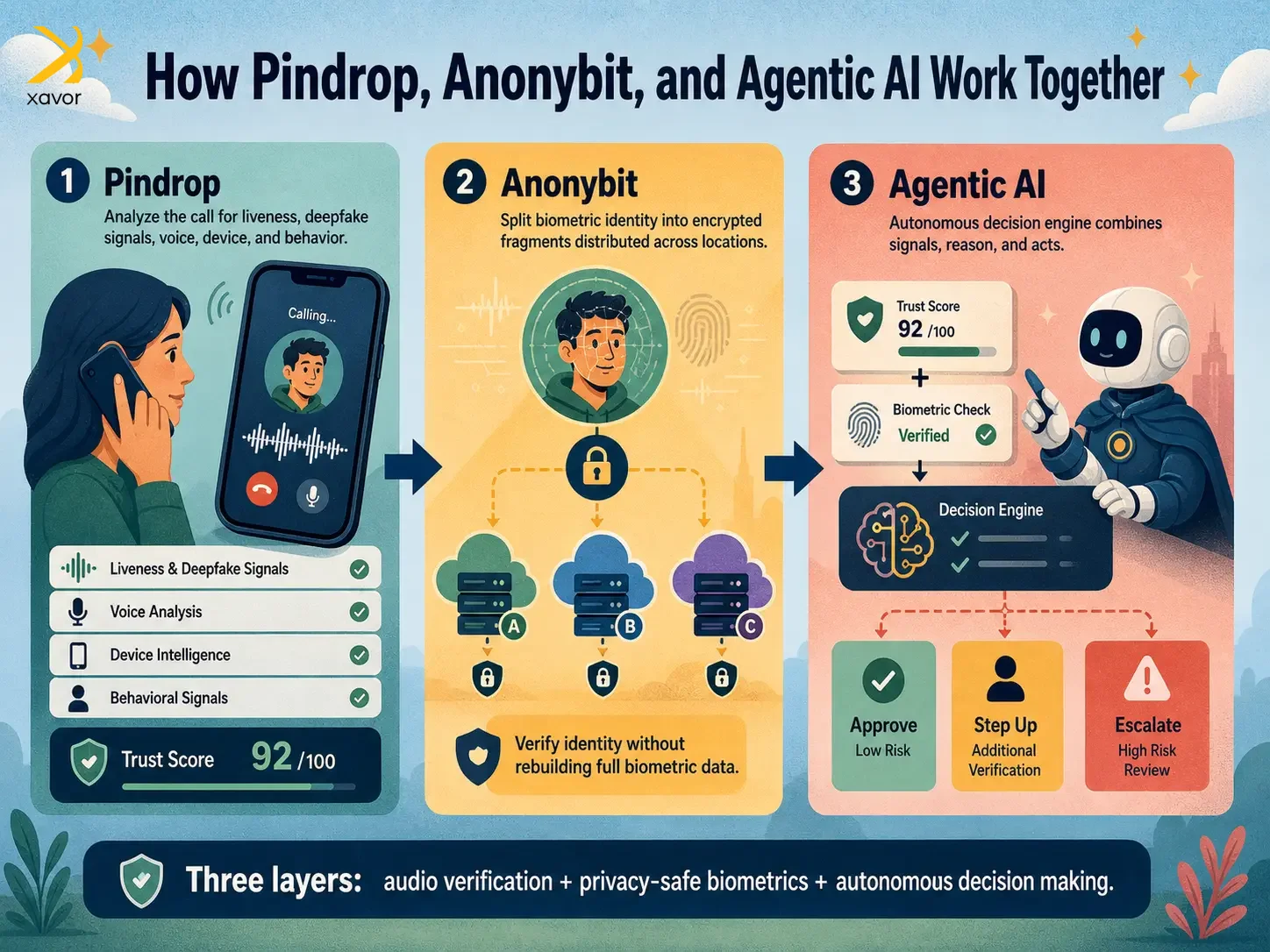
This three-layered approach works like a charm in high-value transactions. Agentic AI Pindrop Anonybit share data between them to become an aegis for your enterprise security.
1. Pindrop
Pindrop checks whether a voice is of a real human and trustworthy by detecting fraud signals. Its Pulse product can analyze audio in about two seconds and give a liveness score, which helps teams quickly decide whether a caller is likely genuine or suspicious.
2. Anonybit
Anonybit breaks the fingerprint, facial, or voice data into anonymized pieces and spreads them across multiple cloud environments. Therefore, the system can still verify identity, but it does so without rebuilding a complete biometric record.
Managing cloud identity management this way reduces the risk of a single database breach exposing everyone’s data.
3. Agentic AI
Agentic AI looks at all the signals from Pindrop and Anonybit together. Then it decides what should happen next, such as allowing the interaction, asking for more verification, routing the case, or sending risky activity to a human team.
Industry use cases of agentic AI Pindrop Anonybit
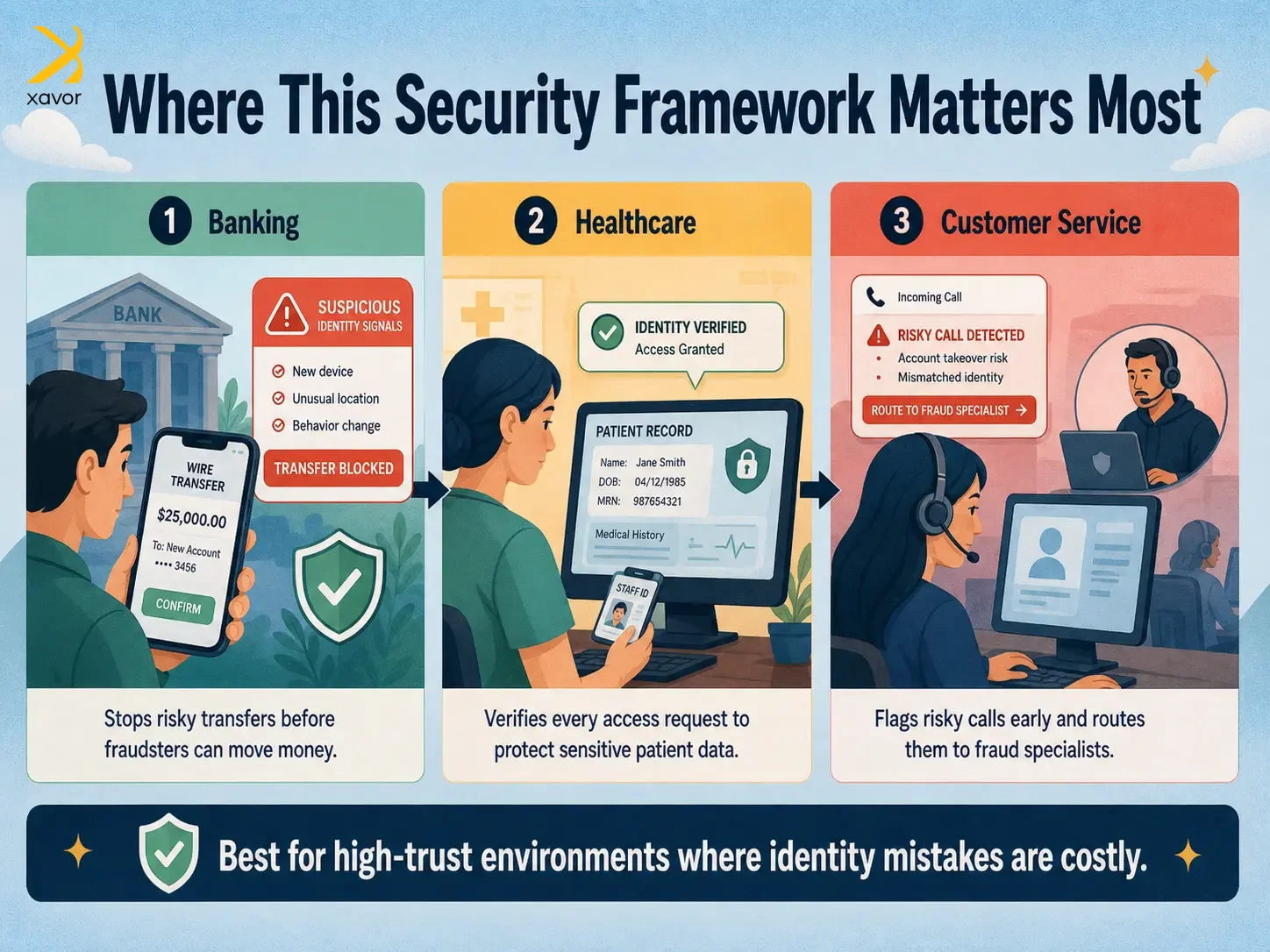
The agentic AI Pindrop Anonybit framework is most useful in industries where trust is everything. The top of the list industries include financial services, healthcare, and customer service.
Banking and financial services
Financial institutions have been the prime targets of identity fraud for eons. Like wealthy Romans used seals as identity markers to do financial transactions. But fraudsters would forge these seals to impersonate individuals to steal their money.
So, naturally, banks and financial services are one of the earliest adopters of the Agentic AI Pindrop Anonybit framework. They use it for things like wire transfer and high-value transactions where millions or billions are involved.
You won’t find any major bank publicly claiming to use this exact tech stack due to policy reasons. But rest assured, some very big names have invested in agentic AI Pindrop Anonybit as part of their AI-based fraud prevention systems.
Healthcare
Protecting patient treatment histories and records is an ethical and legal duty of healthcare organizations. A breach of electronic healthcare records (EHRs) carries serious repercussions for both the patient and healthcare providers.
Hospitals can use the agentic AI Pindrop Anonybit framework to prevent healthcare data breaches. Agentic AI can detect patterns in EHRs to flag unusual data access attempts. Anonybit prevents complete sabotage of patient records, even if some data is compromised.
Customer service
Call centers are one of the easiest targets for scammers because agents are trained to be helpful, but that helpfulness can get exploited. Agentic AI Pindrop Anonybit tackles this by shifting security before a call reaches a human.
Your voice is analyzed automatically during the opening phone menu, so suspicious callers get flagged without ever getting the chance to manipulate a real person. On top of that, the AI watches the entire session for unusual patterns. A scammer who says all the right things can still get caught if their overall behavior doesn’t add up.
Similarly, high-risk calls then get routed to dedicated fraud specialists rather than a general service agent.
Conclusion
Frauds and online scams are a cat-and-mouse game. It’s a constant cycle where cybersecurity professionals come up with upgraded defenses. And hackers adapt their methods, often using the same technologies.
AI too is not immune to fraudsters. But the agentic AI Pindrop Anonybit framework can beat scammers in their own game. It can detect AI voice scams with an accuracy that is almost impossible for humans.
That is not to say that it is an impenetrable defense. Any security system can be breached if it is not set up properly. You need expertise to deploy agentic AI Pindrop Anonybit for your specific business environment.
And Xavor’s AI services provide you with that expertise. Contact us at [email protected] to discuss your security needs with our AI team.

FAQs
Traditional voice authentication relies on matching a user’s voice to a stored voiceprint to verify identity. Pindrop, on the other hand, analyzes a wide range of signals to detect fraud or deepfakes in real time.
Yes, Anonybit is designed to support compliance with privacy regulations like GDPR and HIPPA. It uses a decentralized, privacy-by-design architecture that protects sensitive biometric data.
Yes, you can extend the agentic AI Pindrop Anonybit framework to video calls. Pindrop’s technology has already been integrated into platforms like Zoom to provide real-time deepfake voice detection and authentication during live video meetings.