
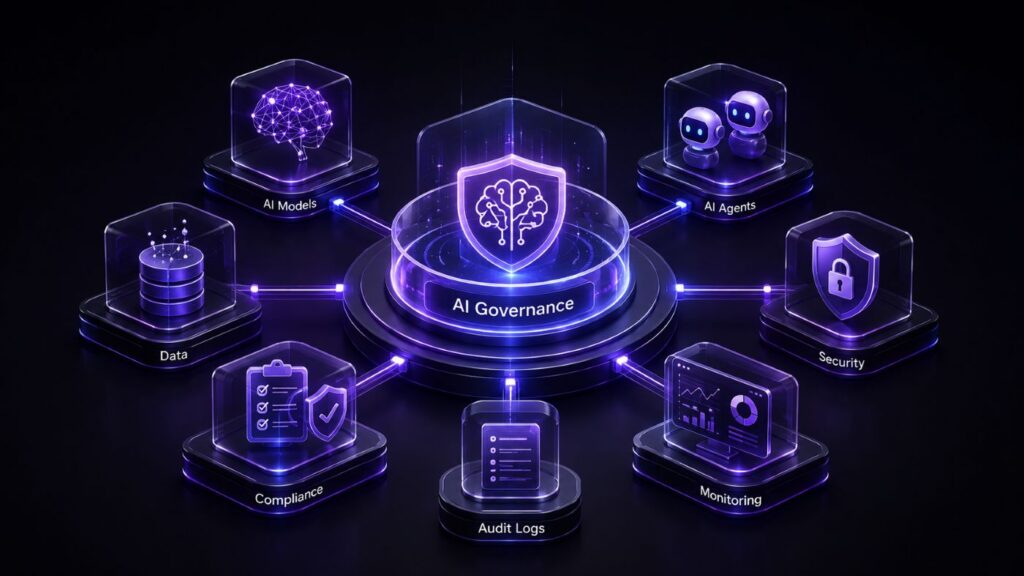
AI governance consulting is an engagement that evaluates an organization’s AI systems against a recognized standard and delivers the policies, controls, and evidence needed to operate them within it. At Xavor Corporation, we sell that engagement through our enterprise AI governance and compliance services, and we scope it around what gets implemented rather than what gets documented.
The engagement delivers four artifacts: a scored inventory of AI systems, a risk tier for each, a control set mapped to a recognized standard, and the evidence trail those controls produce. The market sells three different things under this label, and the difference between them is when your controls start binding a running system. Outside help earns its place when the controls must cross systems no single internal team owns end to end. Pricing follows engagement scope, from short diagnostic assessments to multi-quarter regulatory programs.
A governance control binds a system when it is specified in the build, not when it is described in a document.
Why AI risk management stalls after the policy is written
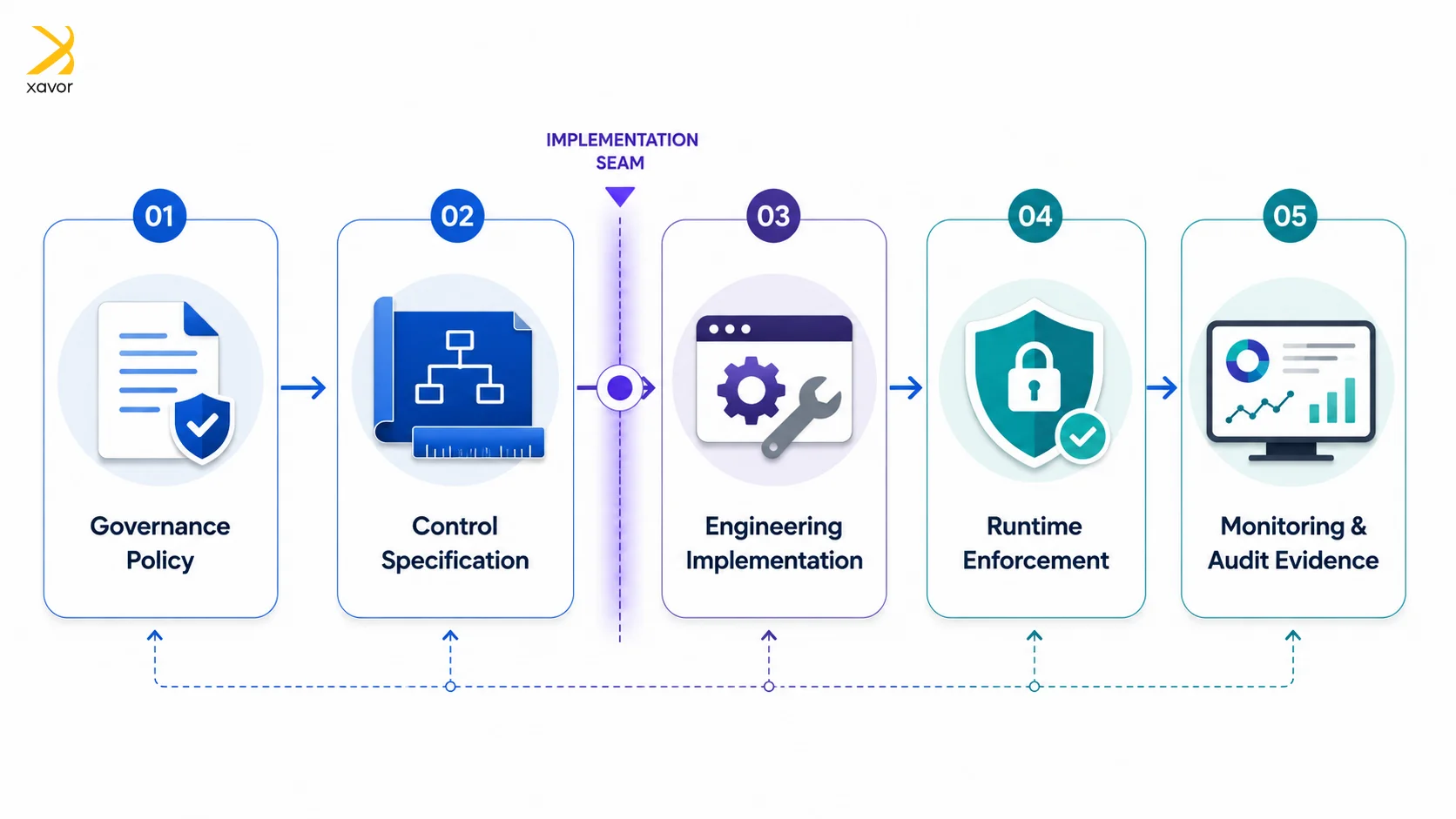
Most enterprise AI risk programs stall not at the policy stage but at the point where someone has to implement the controls that the policy describes.
The pattern is consistent across the risk leaders we work with. The policy passes review. The oversight structure gets named. Then the work of putting access controls, audit logs, and drift detection into the systems that actually run models lands on an engineering backlog that nobody funded. This is often where an AI risk management framework breaks down in practice, since a framework designed for documentation and review rarely maps cleanly onto engineering backlogs and sprint cycles.
You may already have both the framework and the operating model in place. We wrote the CIO’s playbook for governing AI agents at scale for exactly that stage. The question this article answers sits one step later: who specifies and implements the controls those documents call for.
The seam between the firm that designs governance and the team that implements it is where most governance programs go quiet.
That seam is not a competence problem. It is an ownership problem, and it opens because the party who wrote the requirement and the party who can satisfy it were engaged separately.
What does an AI governance consulting engagement deliver?
An AI governance consulting engagement delivers four artifacts: a scored inventory of AI systems, a risk tier assigned to each one, a control set mapped to a recognized standard, and the evidence trail those controls produce in operation. A diagnostic engagement scoped to a defined AI estate runs two to four weeks.
- AI system inventory: every model, agent, and vendor tool in production or pilot, including the ones no team registered.
- Risk tier per system: each system classified by consequence, so oversight scales with impact rather than applying uniformly.
- Control set mapped to a standard: the specific controls each tier requires, mapped to the NIST AI Risk Management Framework or ISO/IEC 42001, with EU AI Act obligations flagged where they apply.
- Evidence trail: the audit logs, access records, and validation documentation that demonstrate the controls operated as specified.
A fifth item decides whether the first four matter. Name who implements each control and by when, or the deliverable set becomes a requirements document waiting for an owner.
An engagement that ends with a policy set and no named implementation owner has told you what to do without telling you who will do it.
Xavor builds AI systems with hallucination controls and audit trails in place from day one, so the controls a governance engagement specifies are controls our engineers implement. If you need the internal structure behind those decisions, we cover how to build an AI governance framework from mandate to monitoring separately.
A framework defines what your organization decides. An engagement decides who specifies, builds, and evidences those decisions in the systems.
Advisory firm, governance platform, or build partner: Which one you need
The AI governance market sells three different things, and the difference between them is when your controls start binding to a running system.
IBM Consulting and Accenture Responsible AI lead the advisory lane, which produces strategy, policy, and framework design. Credo AI and comparable governance platforms lead the tooling lane, which monitors models and enforces rules already written. Both do what they say. Neither closes the seam between them.
| Advisory firm | Governance platform | Build partner | |
| What it hands over | Policy and framework | Monitoring and enforcement | Controls inside the system |
| Who implements | Your team | Your team | The engagement team |
| When controls exist | After the engagement | After configuration | During the build |
| Evidence produced | Documentation | Runtime logs | Both, by design |
| After it ends | You own the gap | You own the config | Controls are running |
A platform enforces the rules you already wrote, and an advisory firm writes rules someone else has to enforce, and the gap between those two sentences is where the work actually lives.
Xavor Corporation occupies the third column because we integrate enterprise systems and have done so for 30 years. When we specify a control, the same engineering pod implements it. Our write-up on how we build governed AI agents on Snowflake Cortex shows what that produces: agents operating on trusted data, with governance designed into the platform rather than layered over it afterward.
How does AI governance consulting connect to AI management tooling?
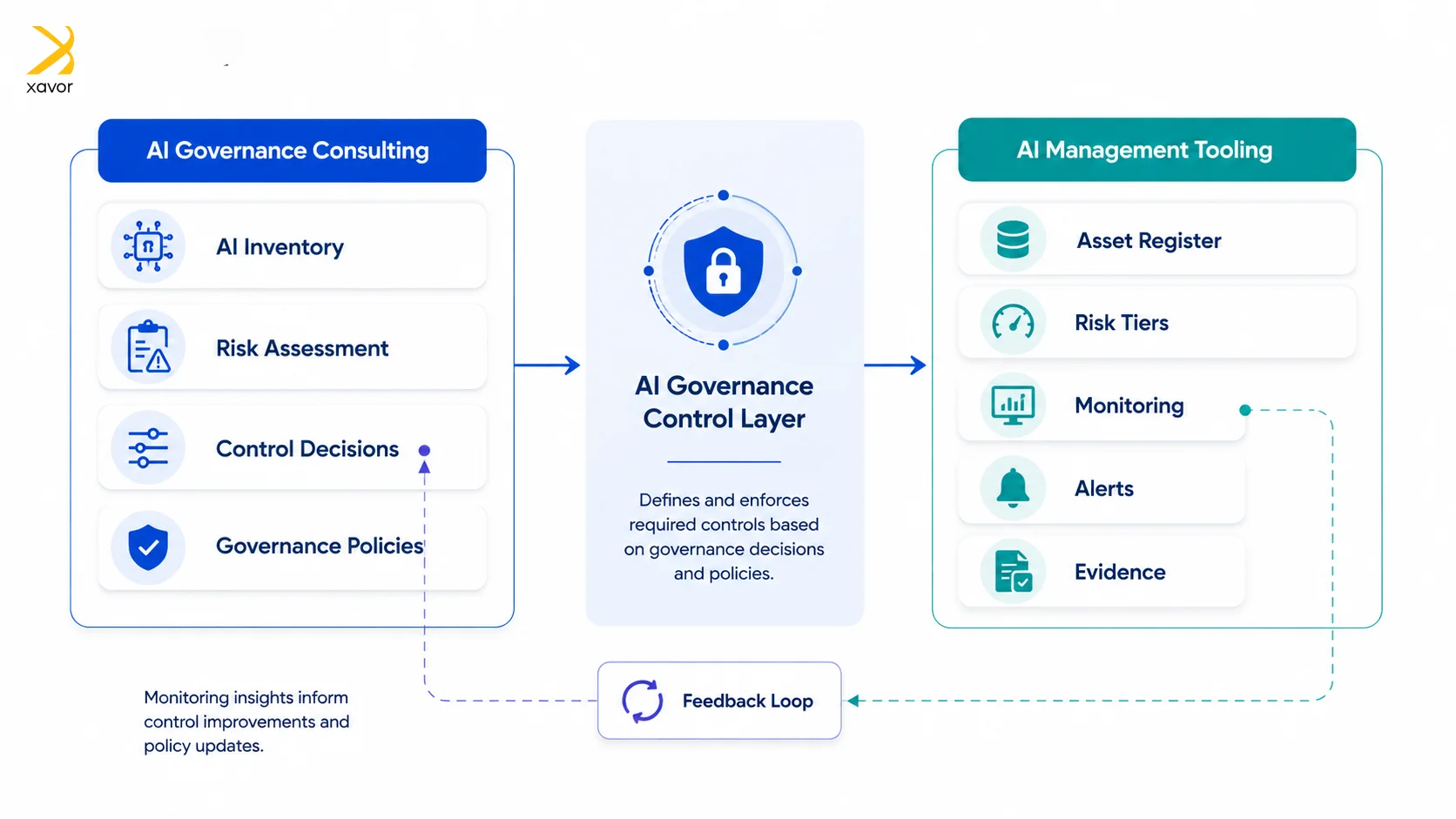
AI governance consulting decides which controls a system needs, and AI management tooling is where those controls get registered, monitored, and evidenced.
The inventory an engagement produces has to live somewhere that updates when your AI estate changes. A control tower application serves that function, holding the asset register, the risk tiers, and the monitoring signals in one place. We use ServiceNow ITSM for our own internal AI risk surveys, and we cover what an AI control tower does for AI inventory and oversight in a dedicated guide.
The sequence matters. Tooling enforces decisions; it does not make them.
When should you bring in AI governance consulting?
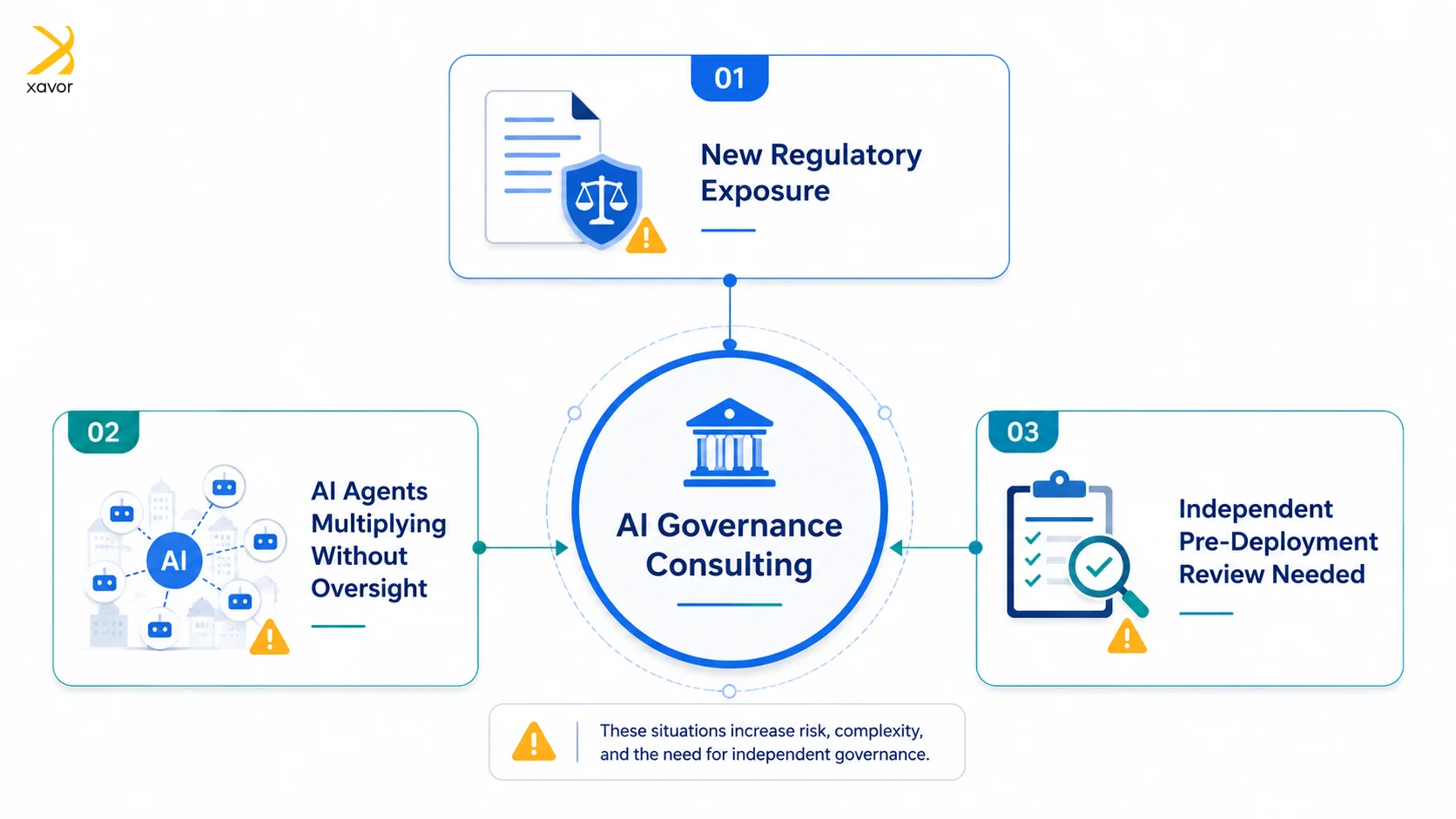
Outside AI governance consulting earns its place when the controls must cross systems no single internal team owns end-to-end. Three conditions trigger the engagement, and each one describes a gap authority cannot close from inside.
- New regulatory exposure: the EU AI Act or a sector regulator imposes documentation and risk-tiering obligations your current evidence cannot satisfy.
- Agents multiplying without central oversight: departments adopt AI tools independently, and nobody holds a complete register of what runs where.
- A pre-deployment review you cannot conduct on yourselves: the team that built the system is the team being assessed.
Internal teams score the systems they own accurately and score the seams between them poorly, because nobody is accountable for a seam.
The second trigger is the most common one we see, and reducing AI agent sprawl is usually the first measurable outcome an engagement produces. We mapped that failure pattern in detail in what AI sprawl looks like once agents multiply.
How much does AI governance consulting cost?
AI governance consulting is priced by engagement scope, and published ranges span short diagnostic assessments through multi-quarter regulatory programs. Scope, model count, and regulatory exposure move the number far more than provider size does.
Published market ranges cluster into three tiers:
- Diagnostic or gap assessment: a two-to-four-week review of current AI use cases, risk scoring, and a compliance roadmap.
- Framework build: policy creation, human-in-the-loop workflow design, and logging across a defined set of systems.
- Enterprise regulatory program: multi-jurisdiction alignment or certification against a standard such as ISO/IEC 42001.
Scope drives price far more than provider size, which is why a two-week diagnostic and a nine-month program are both sold as governance consulting.
Ask any provider which tier a quote sits in before comparing two quotes against each other.
When AI governance consulting is the wrong purchase
AI governance consulting is the wrong purchase when no one internally has been made accountable for the outcome, because an external engagement cannot create authority it was never given.
Two other conditions call for a different first move. When the objective is to satisfy a steering committee rather than to ship a governed system, the engagement will be measured by the document it produces. When AI use is limited to a handful of low-consequence internal tools, the risk tiering that justifies the spend will not find much to tier.
An engagement bought to satisfy a steering committee produces a document, and an engagement bought to ship a system produces controls.
Ask who implements before you sign
The value of an AI governance engagement is decided by what is running in your systems when it ends.
Ask the provider one question before you sign: on the last day of this engagement, which controls will be operating in production, and who implemented them? The answer separates a governance program from a governance report. Our AI-driven data governance work for a real estate enterprise shows what the implemented version looks like.
Contact us at [email protected] to find out which governance controls Xavor would put live in your systems, and who would build them.

FAQs
AI governance consulting is a paid engagement that evaluates an organization's AI systems against a recognized standard, then delivers an inventory, risk tiers, a mapped control set, and the evidence trail those controls generate. Scope ranges from a short diagnostic to a full regulatory program.
Rates vary by provider type and specialization, with independent practitioners and boutique firms at one end and global consultancies at the other. Ongoing advisory is more often sold as a monthly retainer than hourly.
Governance should begin while the system is being specified, not after it reaches production. Controls written into a build are enforceable at launch; controls documented afterward depend on a separate implementation effort that frequently never gets funded.