
Retail has the misconception of an ‘easy business.’ It only looks simple from the outside, but it’s a brutal business that is financially unforgiving. Profit margins are usually so thin that small mistakes in pricing or service can be a death knell for retailers.
The most demanding job of any retail CFO is to grow the company’s revenue while protecting margins. Salesforce Revenue Cloud greatly helps in this regard to increase sales without sacrificing profitability.
It helps CFOs manage every aspect of revenue lifecycle management that matters in retail. We’ll explain that in this blog in detail as we break down the different features of Revenue Cloud to optimize your retail growth with the right Salesforce services.
What is Salesforce Revenue Cloud?
Revenue Cloud is Salesforce’s offering for managing the revenue lifecycle of a sold product or service. It’s now rebranded as Agentforce Revenue Management as part of Salesforce’s broader marketing campaign towards AI-based solutions.
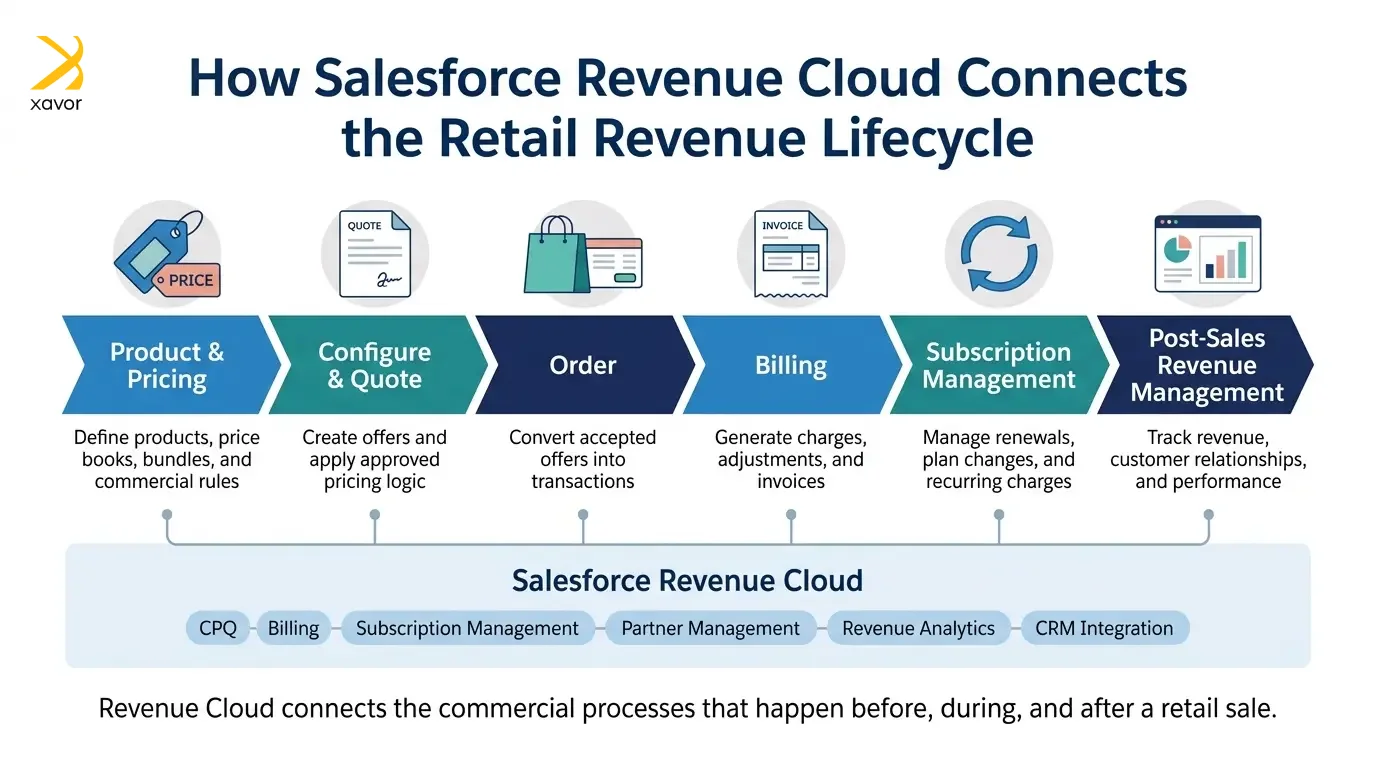
The platform provides you with a suite of tools for various revenue management processes, all the way to getting paid and post-sales customer relationships.
Salesforce Revenue Cloud is a comprehensive revenue lifecycle management platform that covers:
- Configure, Price, Quote (CPQ)
- Billing
- Subscription management
- Partner Relationship Management
- Revenue analytics
Revenue Cloud also provides integration solutions to connect the platform with your CRM functions.
How does retail revenue actually work?
People usually have a jejune understanding of how businesses actually make money. They think that if a business sells something, then the bulk of their profit comes from its sales. But that’s not how many business revenue models work.
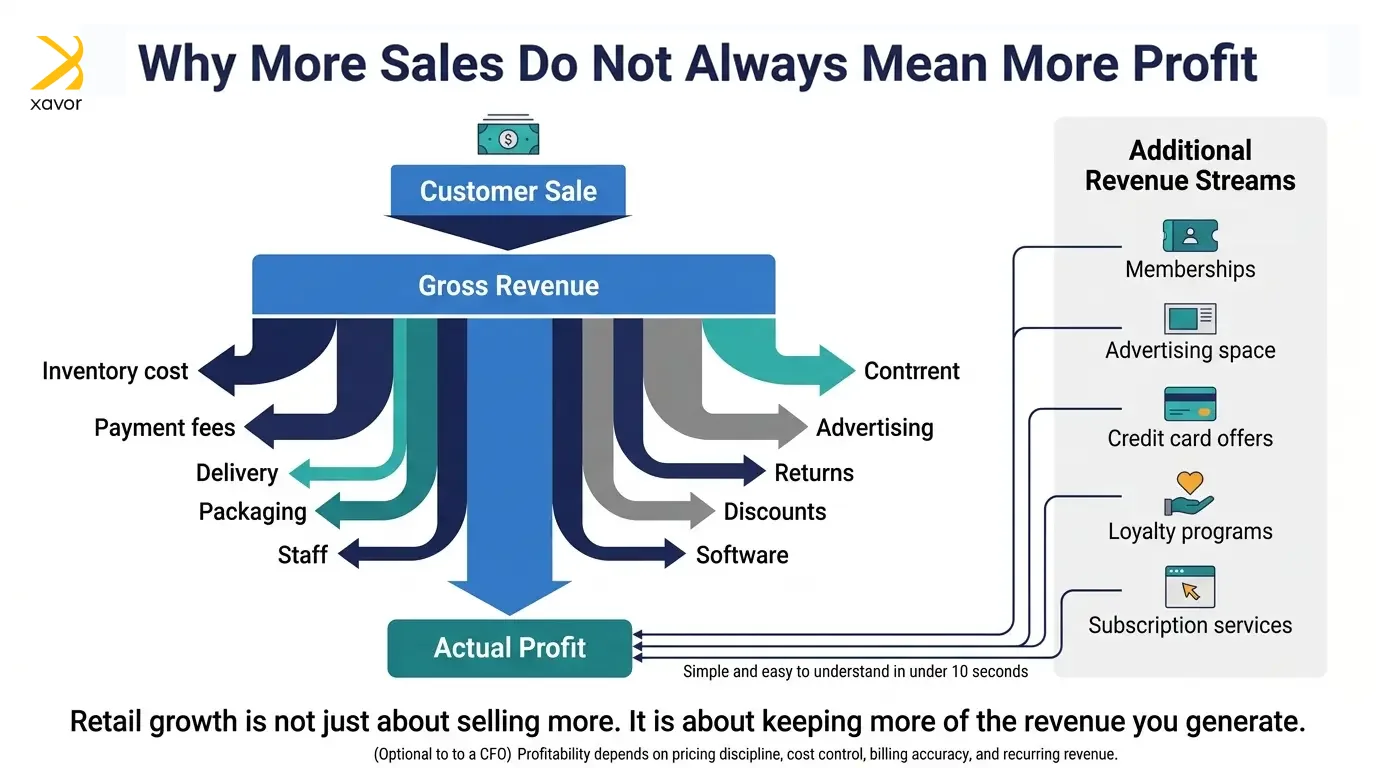
Airlines, for example, don’t make money by selling air tickets. The revenue generated by flight sales is mostly spent on covering massive operational expenses, like fuel costs and crew maintenance. The profit that keeps them afloat actually comes from auxiliary features, such as loyalty programs and onboard food.
Similarly, retail businesses don’t simply make money by buying things at wholesale and selling them at a higher price. There are many secondary factors that are their real profit machines, such as:
- Membership cards
- Advertisement spaces
- Credit card offers
Where do retail stores leak profits? And how Salesforce Revenue Cloud stops it
Now that you know the fact that high sales do not automatically mean high profit in retail, it will be clearer to understand how Salesforce Revenue Cloud brings value in retail.
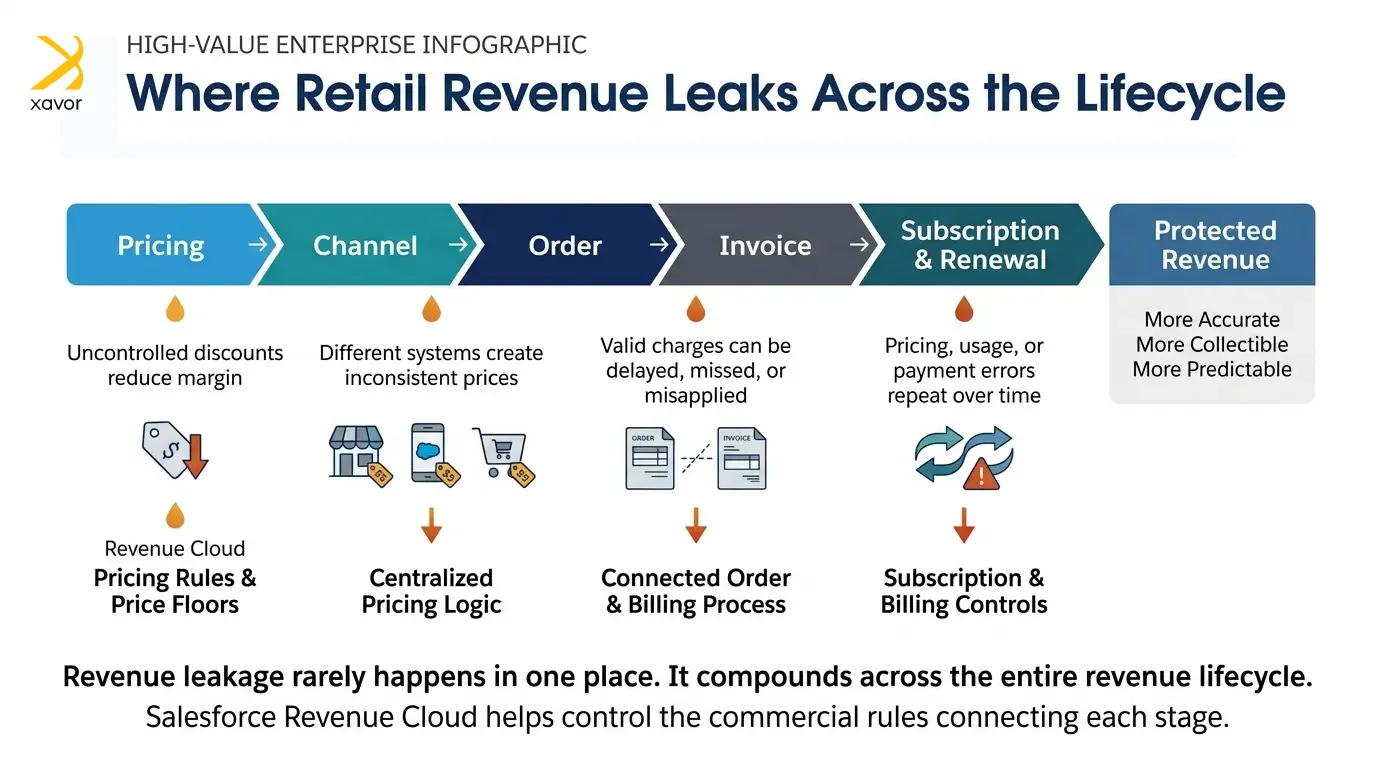
Retail profit margins are even thinner than airlines in most cases. A store may sell a lot, but every order comes with costs on inventory, advertising, payment fees, packaging, delivery, staff, returns, software, and discounts. Therefore, what matters is how much money is left after all those costs are paid.
Poor revenue lifecycle management is the reason why a retail store sells more but keeps less at the end of the day. Usually, the profit is eroded during the following different stages of the revenue lifecycle.
1. Poor pricing strategies erode margins
Retailers rely on discounts to boost sales. It’s a time-tested strategy. But poorly planned discounting can quietly destroy your profits. A small price cut can reduce profit by much more than the discount itself, especially when product costs stay the same.
Over time, constant promotions can also train customers to wait for deals and weaken the perceived value of the regular price.
Salesforce Revenue Cloud helps set prices
Discounts should be applied with the right balance to prevent them falling into mundanity and becoming a financial burden.
Revenue Cloud has built-in features to make discounts rule-based rather than something salespeople apply casually. Its Discount Distribution Service lets a business apply a discount to an entire quote and automatically spread that discount across eligible quote lines.
The discount can be given as a fixed amount, percentage, or target quote total. It can be distributed equally across products, or proportionally, so higher-value items receive more of the discount. Businesses can also decide which products are allowed to receive discounts.
A key feature is the ability to set a minimum price floor for individual products. For example, if a product normally costs $200 but should never sell below $100, Revenue Cloud will stop discounting once it reaches that $100 floor. If part of the requested discount cannot be applied because of these limits, the system records the remaining unapplied discount.
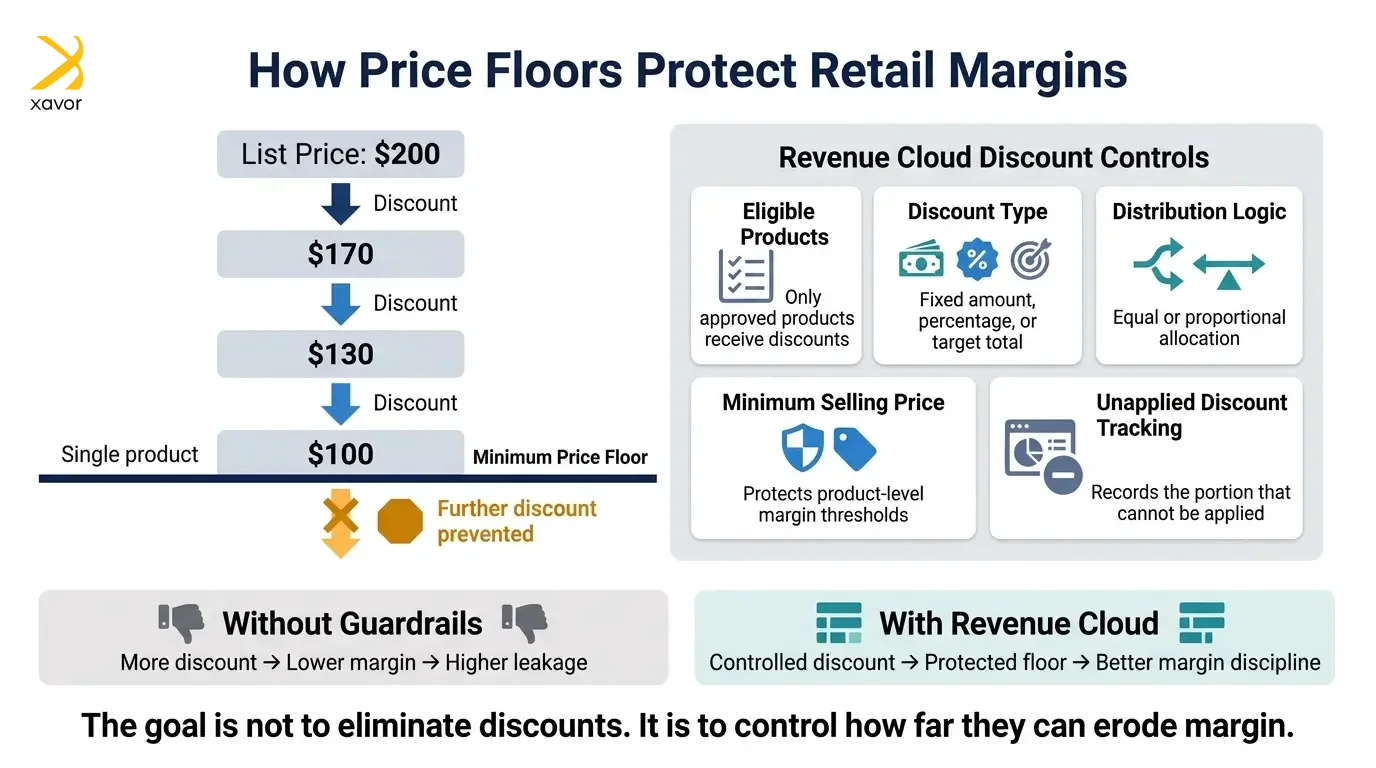
Retail owners get discount control with Revenue. So, sales teams can negotiate and offer incentives without freely discounting products below acceptable margin thresholds.
2. Inconsistent prices across channels
Retail businesses have to compete in a fierce competition to provide customers with an omnichannel experience. They create different channels to offer their products, such as eCommerce websites and mobile applications.
However, retailers often have separate POS and marketing systems to manage prices and promotions differently on each channel. So, price discrepancies can happen due to manual updates and disconnected systems. The air purifier you just put a discount on might still be showing the old price on the app.
Inconsistent prices confuse customers and is bad for brand reputation foremost. Large pricing differences can also trigger price wars and create conflict between retail partners.
Salesforce Revenue Cloud for omnichannel retail
Revenue Cloud helps bring more discipline by centralizing the commercial rules behind products and pricing. Retailers can define base prices, price books, discount structures, product configurations, and pricing procedures in a more controlled environment.
Instead of individual channels deciding how a price should be calculated, the same pricing logic can be reused across transactions. This does not mean every customer or channel must always receive exactly the same price. Retailers may still want loyalty members to receive a special offer, certain regions to have different pricing, or a mobile campaign to include an exclusive discount.
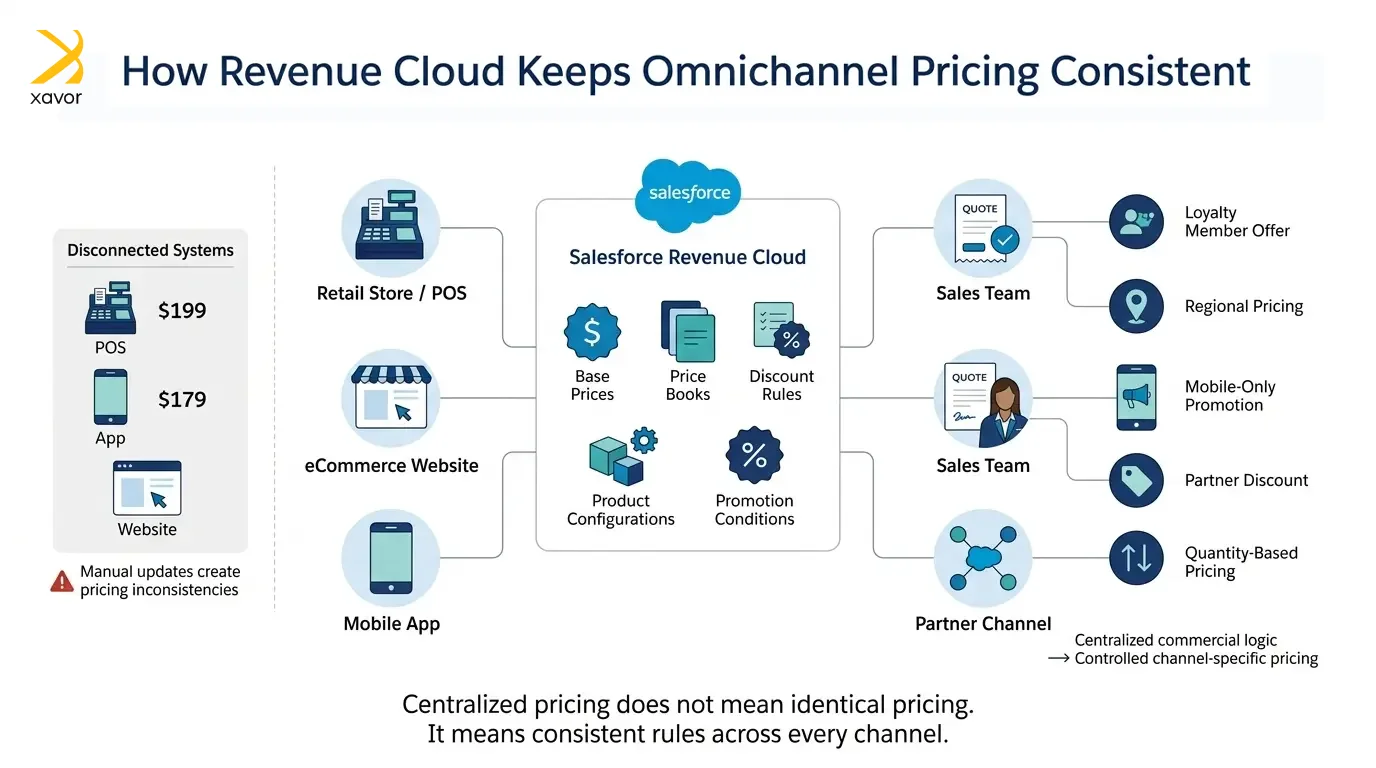
Salesforce Revenue Cloud also helps automate how discounts and price adjustments are applied. If a promotion only applies to a certain product, customer segment, quantity, or bundle, the system can evaluate those conditions before calculating the final price. This makes it easier for retailers to run more complex promotions without relying on staff to remember every rule manually.
3. Revenue leaks between the order and the invoice
Getting the price right at checkout does not guarantee that the retailer will collect the right amount.
Revenue can leak when order and billing systems operate separately. A delivery fee may not reach the invoice. The retailer still pays for the courier, packaging, fuel, and handling costs, but fails to recover the delivery charge from the customer.
Staff may also issue incorrect credits because they cannot trace a charge back to its source.
These errors are usually small individually. Across thousands of transactions, however, they can quietly remove a meaningful share of profit. Delayed invoicing creates another problem by slowing the retailer’s cash flow.
Salesforce Revenue Cloud connects orders with billing
Salesforce Revenue Cloud connects orders and invoicing within the same revenue process. Its billing capabilities can generate invoices with charges and adjustments remaining traceable to the original order. Revenue Cloud makes it easier for finance teams to identify why a customer was billed a particular amount.
Billing schedules can also be created when an order is activated. That’s a huge plus because it reduces manual handoffs and lowers the chance that a valid charge is delayed or missed entirely.
Salesforce Revenue Cloud does not automatically correct poor source data or weak integrations. However, when properly configured, it gives retailers a controlled path from the accepted order to the final invoice.
4. Subscription leakage saps profits
We live in a subscription economy. Nearly everything we use is a rental or digital subscription. Just do a simple calculation of how much you spend on monthly subscriptions on Netflix, Spotify, work software, and other things.
Retailers increasingly use subscriptions for memberships and exclusive benefits to name a few. These models can generate predictable income, but they also create more opportunities for small billing errors to repeat every month.
Revenue can leak at several points in the subscription lifecycle.
During customer acquisition, a free trial may run longer than intended or promotional pricing may continue after the introductory period. In a usage-based plan, incomplete consumption records may cause the customer to be charged for less than they used.
Subscriptions sold through platforms such as the Apple App Store and Google Play create another challenge. These platforms can attract more customers, but the retailer may receive limited transaction and customer data. That makes it harder to reconcile subscriber records and confirm that internal revenue reports match platform payments.
Fraud also reduces profit. The retailer may lose the original payment while also paying dispute fees and spending employee time investigating the case.
Renewals are another major source of leakage. A customer may want to continue but have an expired card or insufficient funds. If the business does not retry the payment or notify the customer, it loses a subscriber who never intended to cancel. This is called involuntary churn.
Salesforce Revenue Cloud strengthens subscription processing
You can adjust pricing rules in Salesforce Revenue Cloud to control who qualifies for a promotion and when introductory pricing ends. Billing schedules help ensure that if a customer changes their subscription plan, the system can adjust future charges to reflect the change.
Revenue Cloud can also support usage-based billing by converting recorded consumption into billable charges. It helps prevent customers from using a service without being billed for the full amount.
However, Salesforce Revenue Cloud cannot recover data that an app store does not provide, and it is not a complete fraud-prevention system by itself. Retailers may still need payment gateways and app-store integrations.
Salesforce Revenue Cloud’s main role is to keep subscription terms and billing aligned to reduce the recurring errors that allow small revenue losses to compound over time.
Conclusion
Retail has the misconception of being an easy business because the transaction itself looks simple. You pay for what you like in a supermarket and leave. But the financial machinery behind that sale is anything but simple.
The rigmarole of aligning prices with invoices, subscriptions and a ton of other things is a must for retailers to keep the profit they expect to earn.
That is why growth is not simply an increase in sales for CFOs in this trade. It is an increase in profitable, collectible, predictable revenue. Selling more achieves little if it comes at excessive discounts and thin profit margins.
Salesforce Revenue Cloud helps connect these commercial processes. It gives finance and revenue teams greater control and strong integration with the retailer’s existing systems.
Talk to Xavor’s Salesforce expert at [email protected] to explore how Salesforce Revenue Cloud can strengthen your retail revenue lifecycle.

FAQs
Revenue Cloud Growth starts at $150 per user/month, while Revenue Cloud Advanced starts at $200 per user/month, billed annually. Advanced adds capabilities such as contracts, invoicing, consumption management, AI, and analytics.
Growth is better suited to retailers primarily needing quoting, order capture, and subscription management. Advanced is designed for more complex quote-to-cash requirements, including invoicing, contracts, consumption-based models, and analytics.
Yes. Salesforce Pricing centralizes pricing rules while supporting volume, subscription, bundle, and other price adjustments, allowing retailers to maintain controlled pricing logic across different selling scenarios.