

An effective AI governance framework has ethics as the buttress of the whole structure. Then comes other variables pertaining to accountability and transparency. We’ll get into that in detail later. What matters more is how do you implement a governance framework practically in the real world.
Most companies design their AI governance solutions around the launch of their AI project itself. But genuine risks only start after that because AI models often drift over time during execution. So, AI governance frameworks that look solid on paper crumble when AI systems undergo changes after launch.
However, this is a very avoidable situation if you build a solid foundation of your AI governance solutions and build on it in a step wise process.
Let’s explore what that foundation looks like and the steps you need to take afterwards.
What’s an AI governance framework?
Companies need an AI contextual governance framework to keep a check on their AI systems. Its purpose is to maximize the benefits and minimize the risks while building or deploying an AI solution.
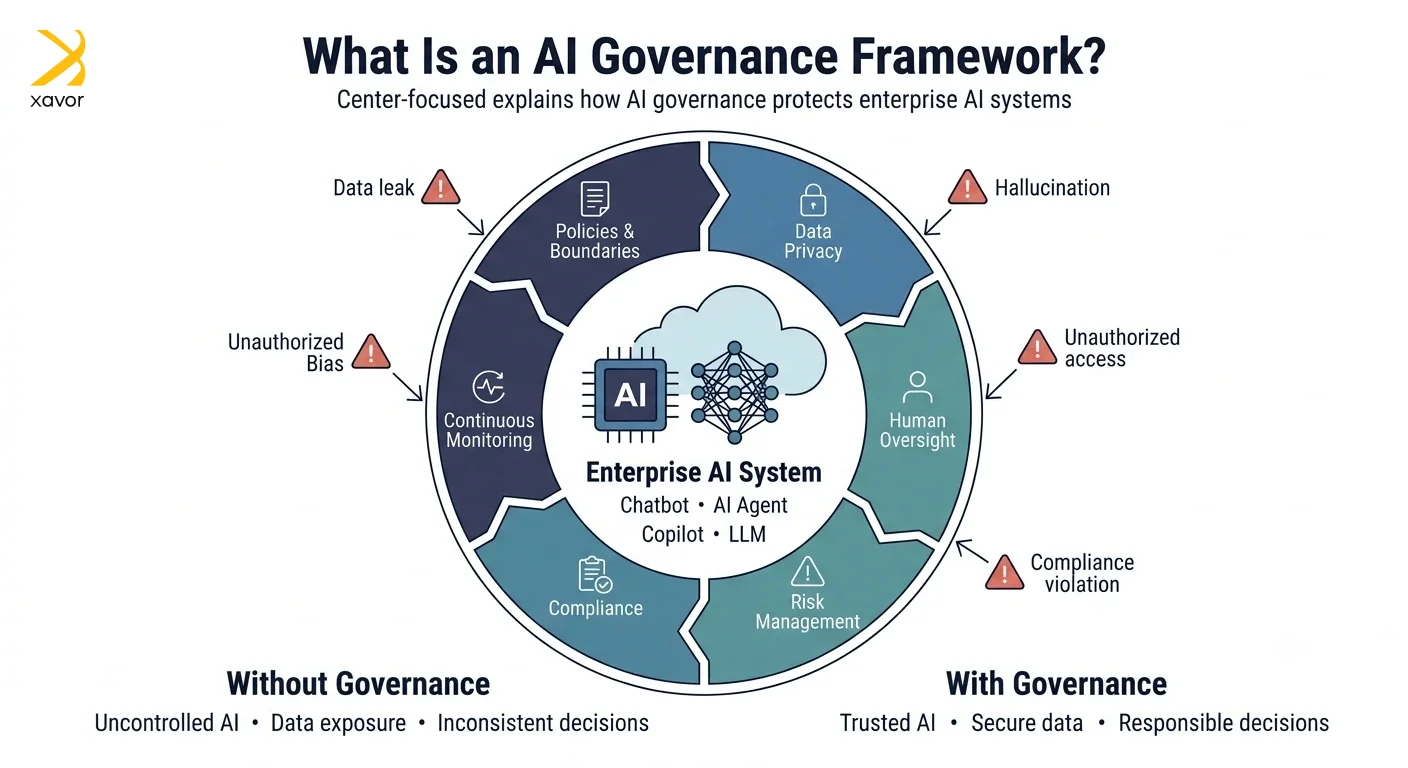
There have been many stories where an enterprise chatbot or an AI agent did something comical or leaked confidential company data. Things like this happen due to poor AI governance. You can use the finest LLMs to build your AI system. But it can easily make a costly mistake if you don’t have an AI governance framework to monitor and regulate its activities. That’s how many companies end up with unchecked AI usage in the form of AI sprawl.
Building AI governance solutions requires you to lay down the policies and processes that set clear boundaries about what the AI system can or cannot do.
Moreover, AI governance frameworks are very deeply tied to ethical AI usage and human centric AI.
The pillars of constructing an AI governance framework
There are several core principles or pillars of building enterprise AI solutions related to governance. These pillars represent high-level values that describe how an AI system ought to work ideally.
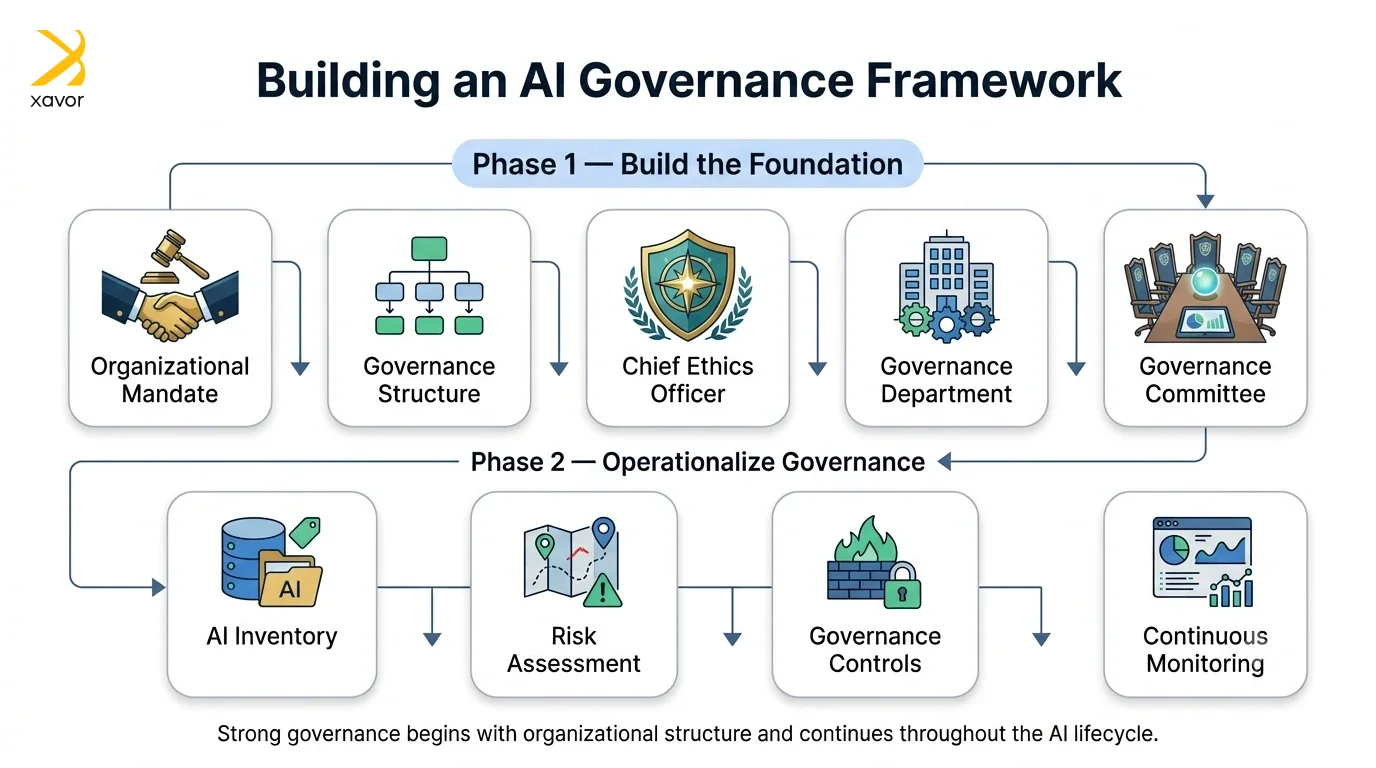
Your job is to translate those values into actual business decisions. We have divided those pillars into two separate phases of developing an AI governance framework.
- Phase 1 focuses on the foundational aspects of an AI governance framework
- Phase 2 is more about the actual practical steps of building one
So, let’s start digging in.
Phase 1: Laying the foundations of an AI governance framework
AI governance and ethics are joined at the hip. Like we said earlier, AI governance is very important for developing human centric AI products which are:
- Fair
- Transparent
- Accountable
And these are all ethical principles. In this phase, the crux of the steps below is about turning these ethical ideas into actual processes and policies.
1. Obtain organizational mandate
AI governance on a philosophical level is pretty much like the governance of a polity. Every state or even a small self-governing community has a foundational political structure that gives its governors the mandate to enforce rules and regulations on their subjects.
Throughout history, societies developed different doctrines to justify this authority. Like ancient China had the Mandate of Heaven. Other parts of the world had similar ideas. The Divine Right of Kings in England, and the Muslim world recognized the Caliphate as a legitimate governing authority.
Today, governments generally derive their mandate through democratic institutions and the rule of law.
AI governance also requires a legitimate mandate. And it derives that authority from the organization itself. The AI governance function must be formally empowered by senior leadership, such as CEOs and board-level executives. Plus, you also need to ensure the following to establish and enforce AI governance policies:
- Dedicated funding
- Dedicated staff
Developing an AI governance framework without this organizational mandate leaves governance as a mere advisory function. And if you can’t enforce an AI governance framework, the ethical principles behind it won’t translate into consistent business practices.
2. Create a governance structure
Once you have the mandate, your AI governance framework needs a fundamental structure which becomes the rulebook that outlines how your AI system is built and governed. Moreover, it decides the control and accountability of an AI solution along with its privileges.
Now, there are different ways you can build a governance structure. You can follow a decentralized model where a central authority decides all the rules, and local teams are responsible for applying those rules on a daily basis. Or you can give one major entity the power to both define and enforce your AI governance rules with absolute authority.
Personally, we prefer the decentralized model in designing an AI governance framework because it gives the space to apply standards according to specific situations.
3. Appoint a Chief Ethics Officer (EO)
A Chief Ethics Officer is the senior executive responsible for leading an organization’s AI ethics and governance initiatives. You need an EO as captain of the ship who establishes ethical policies and defines governance standards. And they are answerable for AI systems that are developed and deployed responsibly.
Having an EO on your AI governance framework team expedites the policy creation process with consistent ethical standards. However, because one person cannot oversee every AI project, they require the support of a dedicated Ethics Office to implement governance at scale.
4. Establish an AI governance department
An AI governance office is a dedicated team responsible for translating AI ethics policies into everyday business practices. It acts as the operational arm of developing an AI governance framework by helping employees and product teams apply ethical principles throughout the AI lifecycle.
Typical responsibilities of an AI governance department include:
- Reviewing AI projects for ethical risks
- Providing guidance to development teams
- Delivering ethics training and awareness programs
- Supporting risk assessments and governance reviews
- Monitoring compliance with AI governance policies
It’s up to you whether that department operates independently or as part of some broader legal or compliance body. We recommend the latter approach because it embeds AI governance naturally within existing business responsibilities.
5. Create an AI governance committee
Next, you need to form an AI governance committee that acts as an advisory body to reviews high-risk or sensitive AI use cases from multiple perspectives. The AI governance department manages only the day-to-day governance. But this committee focuses on strategic oversight and independent ethical review.
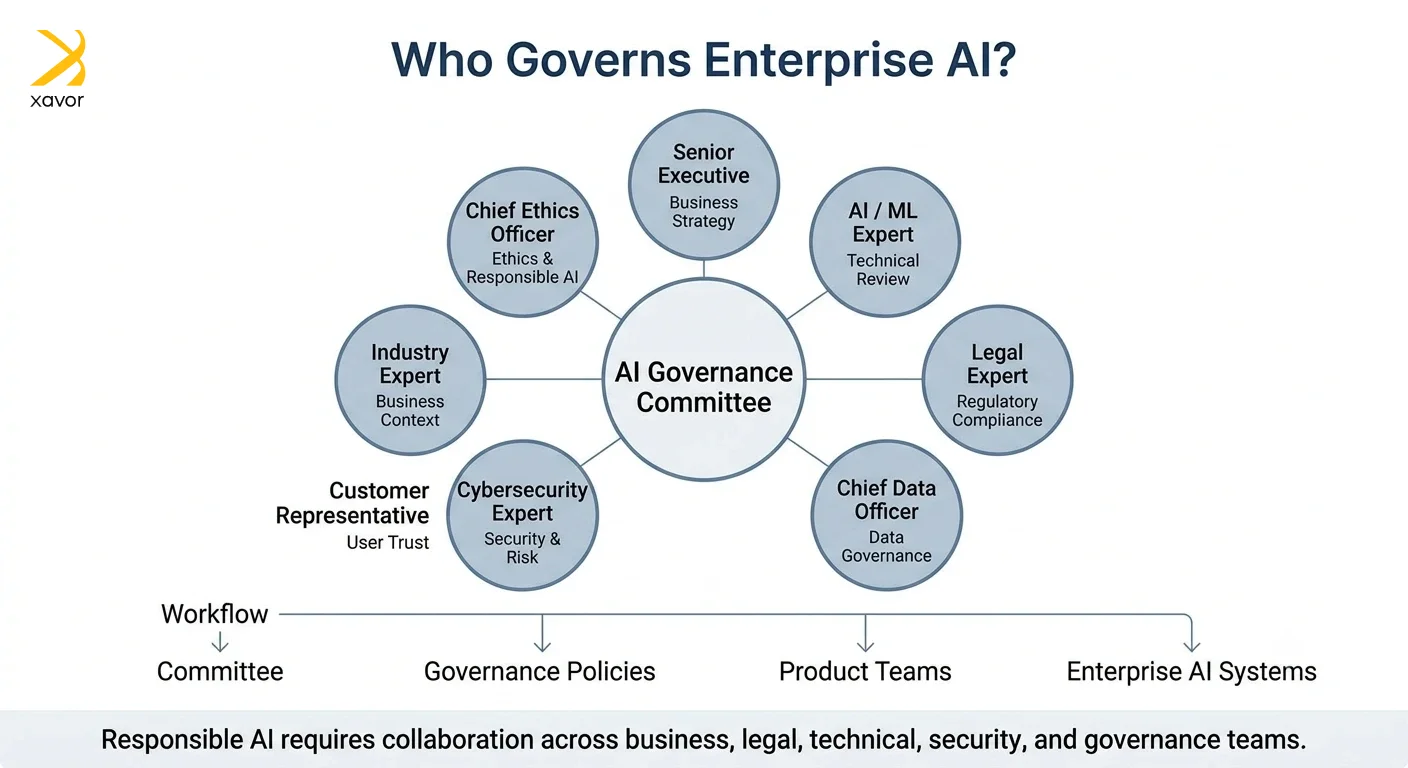
To create such a committee in an AI governance framework, you need to bring together senior professionals with diverse expertise to ensure AI decisions check all the required boxes. To coordinate these diverse experts efficiently, organizations often adopt unified AI automation tools. As an all-in-one digital platform, Lark merges everyday collaboration and automation seamlessly by embedding AI-powered workflows directly into messaging, policy documents, and databases.
Here are some designations that need to be in an AI governance committee:
| Professional | Role in the Committee |
| Senior Executive | Aligns AI decisions with organizational strategy and business objectives |
| AI/ML Expert | Evaluates the technical design and controls of AI systems |
| Chief Ethics Officer | Assesses ethical implications and fairness through responsible AI usage |
| Legal Expert | Ensures compliance with applicable laws and internal/external regulations |
| Chief Data Officer | Reviews data governance to reduce privacy risks |
| Cybersecurity Expert | Evaluates security vulnerabilities and safeguards against AI-related threats |
| Customer Representative | Provides the perspective of individuals affected by AI decisions and promotes user trust |
| Industry Expert | Contributes industry-specific knowledge to assess contextual risks |
You can decide the tenure of committee members, and how frequently the committee is convoked. Xavor’s own AI governance committee members usually serve part-time and are convened when significant ethical issues arise.
Phase 2: Implementation steps to build an AI governance framework
Now that you have the governance structure in place, the next phase is the implementation phase of an AI governance framework.
1. Have complete visibility of AI usage
The whole point of creating an AI governance framework is to have every nook and cranny of your AI environment under your watch. And you can’t do that unless you know the exact number of AI applications that are either currently operational within your enterprise or they are in the pipeline.
So, create an AI inventory that lists down all the AI systems your company uses or is planning to use. Now, how do you actually create one depends on your organization. For example, if your IT team is already keeping a record of AI usage, it becomes a lot easier to get an inventory down.
However, most companies don’t do that proactively, which makes the whole process a lot more complex. These days enterprise software systems come with their own little AI solutions, like Salesforce has Agentforce and Microsoft’s Copilot. You need to note down every one of them. AI forward board portals belong on that list too, and solutions like Onboard should be included in that inventory.
We recommend using ServiceNow AI Control Tower to gain full visibility into your AI usage. It automatically scans all the different AI assets your enterprise uses and creates an inventory where you can easily search what you’re using and where it works.
2. Create a risk assessment framework
Once you know all the AI technologies in use, you need to scope them out based on their risk assessment. High-risk AI solutions that are critical to your business’ success need to be governed on top priority basis.
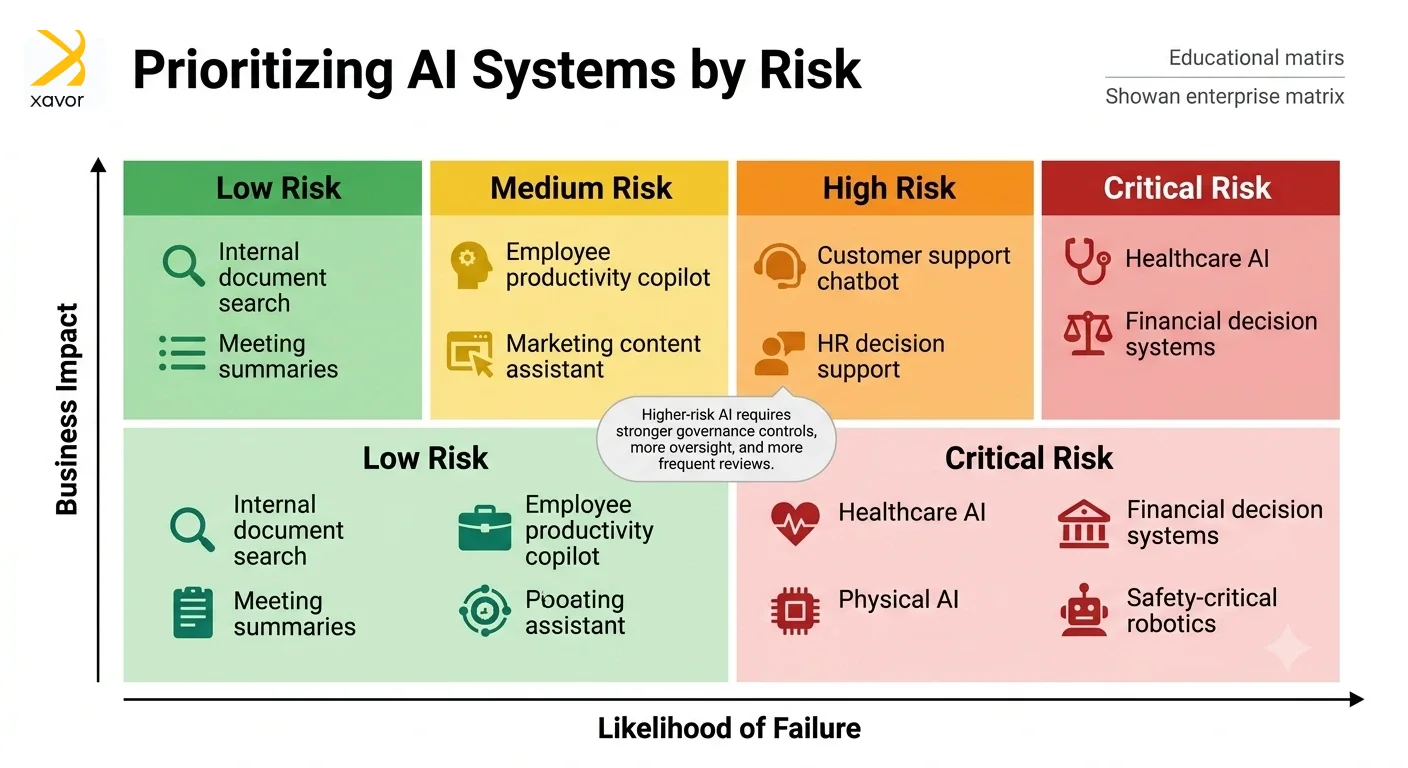
AI systems related to customer facing tasks or company finances are usually super important. Therefore, create tiers where such high-risk use cases are tackled first. And then you can move on to medium or low risk AI solutions.
Tiers also help you define how stringent the governance rules need to be for different kinds of AI systems. Like Navi, our physical AI social care companion has the strictest governance requirements and review processes.
Now, how can you assess AI systems for risk? The simplest way is to run internal surveys and questionaries. Gather as much information from different teams about an AI application to gauge what it affects and to what extent.
Xavor uses ServiceNow ITSM for internal risk surveys. It has an excellent ticketing system, which makes gathering and compiling information very efficient.
Here are some of the important information you need to know about an AI system to gauge the risks associated with it:
| Basic Information | What is the AI system called? Which department owns it? Who is the business owner? |
| Purpose | What problem does the AI solve? What business process does it support? |
| Users & Stakeholders | Who uses the AI? Who is affected by its decisions |
| Decision Impact | Does the AI make decisions or only provide recommendations? Can humans override its decisions? |
| Risk Level | What happens if the AI makes a mistake? Could it affect safety, finances, employment, healthcare, or legal rights? |
| Data Used | What data is used? Does it include personal, sensitive, or confidential information? |
| Model Details | Is the AI developed internally or purchased from a vendor? Is it a generative AI model? |
| Compliance | Are there legal or regulatory requirements |
| Monitoring | Who monitors the AI after deployment? How are incidents reported? |
3. Implement governance controls
Once AI risks have been identified, your next job is to implement appropriate AI governance controls to reduce those risks to an acceptable level. Governance controls are policies and technical safeguards that ensure AI systems operate responsibly, securely, and in compliance with legal and ethical requirements.
Common controls in an AI governance framework include:
- Humans in the loop
- Bias and fairness testing
- Model validation
- Security measures
- Access controls
- Comprehensive documentation
One rule of thumb. The level of governance should be proportionate to the AI system’s risk level. That means high-risk applications must go through more rigorous reviews and greater executive oversight than lower-risk systems.
4. Monitor continuously for improvement
Finally, you must continuously evaluate AI systems after deployment to ensure they remain on track. Model drift and other variables can jeopardize their safety and effectiveness throughout their lifecycle.
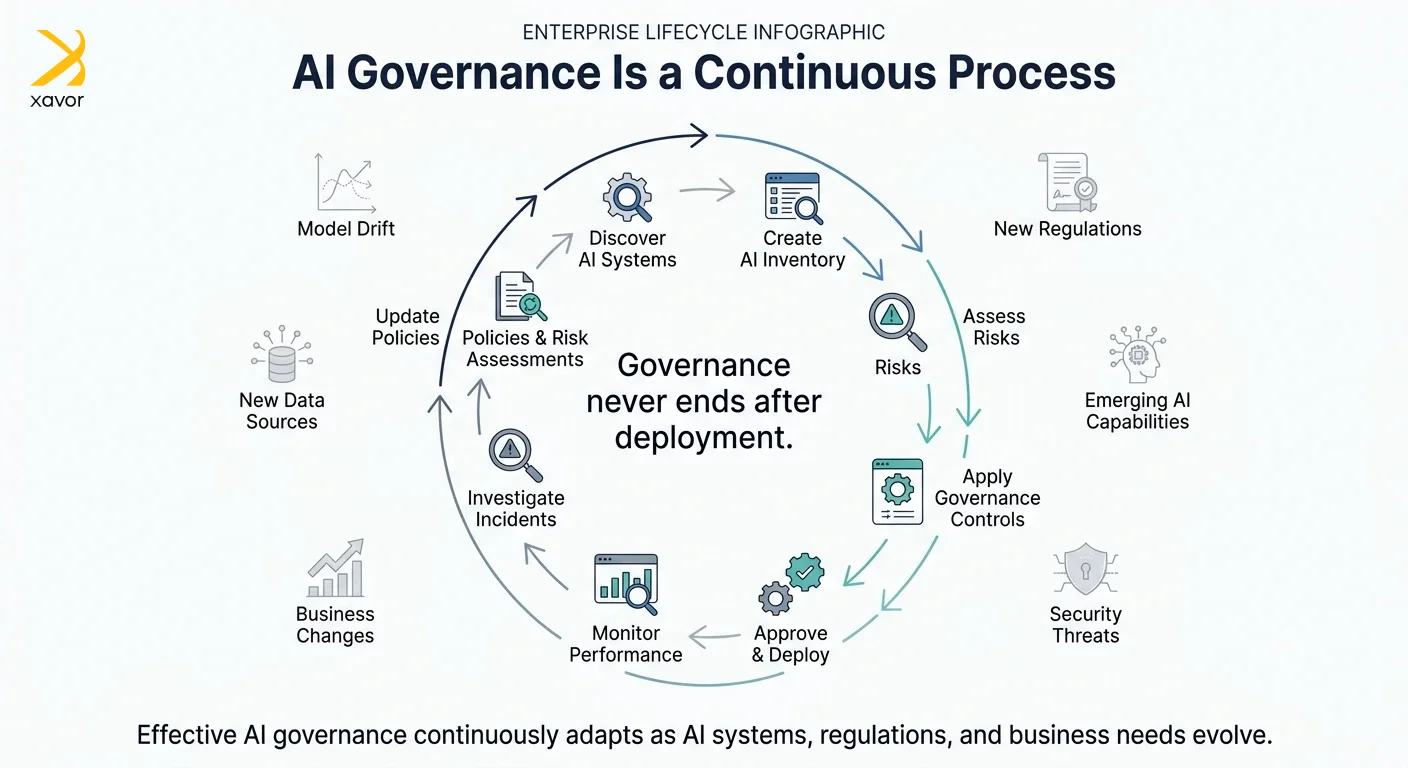
The best way to regularly monitor AI performance is to investigate incidents and reassess risks. Only then can you verify that governance controls continue to operate as intended.
Furthermore, AI technologies change in the blink of an eye. That concomitantly affects business objectives and regulatory requirements. Therefore, you governance policies and risk assessments must keep up with those changes.
Conclusion
An AI governance framework on first look seems just another layer of corporate bureaucracy. And to be honest, it does introduce a little bit of red tape. But it’s for the good of an organization and actually helps in AI innovation in the long run.
The purpose of building an AI governance framework isn’t to prevent organizations from experimenting with AI. Rather, it’s to ensure they can continue innovating without compromising business essentials. In many ways, governance is what transforms AI from an interesting technology into a dependable business capability.
As Peter Drucker, called as the father of modern management, famously observed, “Management is doing things right; leadership is doing the right things.” An AI governance framework does both. It ensures organizations not only build intelligent systems correctly but also deploy them in ways that align with their values and long-term objectives.
Partner with Xavor if you want to design an AI governance framework that meets both targets explained by Drucker. Our AI experts design a governance strategy and risk assessment framework for responsible AI implementation that you and your customers can trust.
Contact us at [email protected] to start building your AI governance framework with confidence.

FAQs
An AI governance framework should include clear policies with defined roles and responsibilities decided upon risk assessments. Human oversight, data governance, and security controls are equally important. Compliance requirements and continuous monitoring are the final pieces in the puzzle. Together, these ensure AI systems remain responsible and aligned with business objectives.
The five core pillars of an AI governance framework are fairness, transparency, accountability, privacy and security, and continuous monitoring. These principles help organizations build AI systems that are ethical, trustworthy, and compliant throughout their lifecycle.
A RACI matrix defines who is Responsible, Accountable, Consulted, and Informed for AI governance activities. It clarifies ownership across executives, AI teams, legal, security, data, and compliance functions, ensuring governance decisions are made consistently and efficiently.