
An AI readiness assessment is a structured evaluation of an organization’s data, infrastructure, skills, strategy, and governance against the requirements of one specific AI workload. We run this assessment at Xavor Corporation as the front end of our AI and ML solutions for enterprise deployment, not as a standalone advisory exercise.
The assessment scores five dimensions: data quality, infrastructure, talent and skills, strategy and leadership, and governance and risk. Data readiness is scored against the workload you intend to ship first, not against a general standard of data quality. A working checklist inspects artifacts and interviews the people who operate the systems, rather than collecting self-reported maturity scores. Outside AI readiness consulting earns its place when the evaluation must cross systems no single internal team owns end to end.
A readiness score is only as honest as the integration surface the assessment inspected.
Why most AI rollouts stall before production
Most enterprise AI programs stall not because the models underperform, but because the systems and data around them were never assessed for production conditions.
The pattern repeats across the CTOs we work with. A pilot clears its accuracy target in a controlled environment, then meets an enterprise estate where the source tables have three owners, two definitions of “customer,” and no refresh guarantee. The model did not fail. The assessment that should have surfaced those conditions never ran.
Gartner reported in February 2025 that through 2026, organizations will abandon 60% of AI projects that are not supported by AI-ready data.
The same research, drawn from a third-quarter 2024 survey of 248 data-management leaders, found that 63% of organizations either lack AI-ready data practices or are unsure of them.
That second figure measures the real gap. Most enterprises are unaware of their current standing, which is a diagnostic issue before it becomes a data problem. We have written separately on why agentic AI projects stall after the pilot, and the root cause is consistently the same: production conditions were assumed rather than measured.
What does an AI readiness assessment cover?
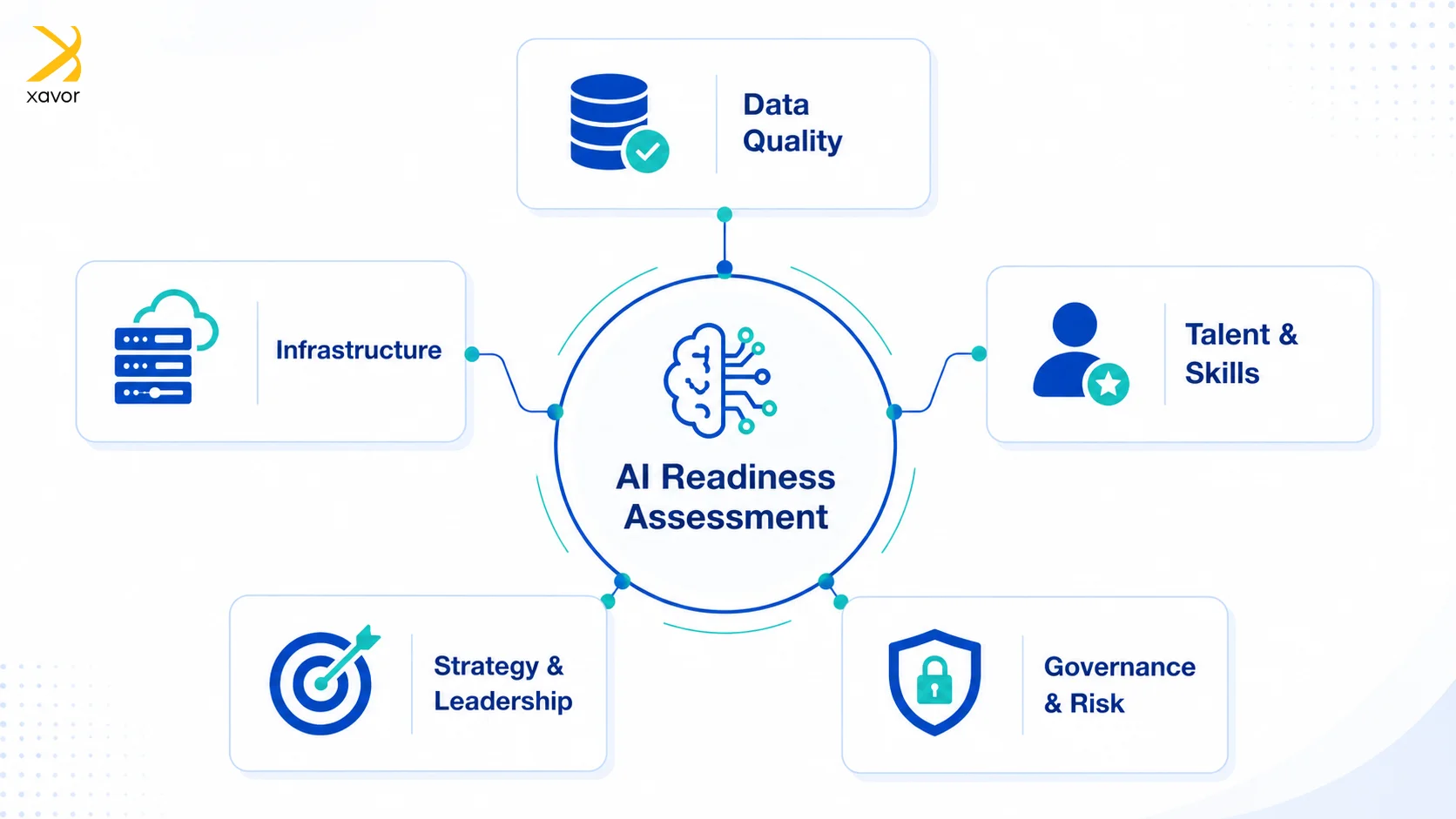
An AI readiness assessment scores five dimensions of an organization’s ability to move an AI workload into production. Each dimension receives an evidence-backed score, not a self-reported rating, and the combined result becomes a gap analysis and a sequenced remediation plan.
- Data quality: Measures cleanliness, structure, ownership, and refresh cadence against what the target workload consumes.
- Infrastructure: Measures cloud capacity, compute, model hosting, and the integration surface connecting existing enterprise systems.
- Talent and skills: Measures which capabilities exist internally and which must be hired, trained, or embedded.
- Strategy and leadership: Measures clarity of the business problem and executive ownership of the outcome.
- Governance and risk: Measures compliance posture, security controls, audit trails, and policy enforcement.
Dimension counts vary across published models. The Microsoft AI Readiness Assessment scores seven pillars. The Cisco AI Readiness Index scores six. Most consulting-led AI readiness frameworks score four or five. The count matters less than the evidence standard, because a five-pillar assessment built on interviews and artifacts surfaces more than a seven-pillar questionnaire built on opinion.
The AI readiness checklist: What we inspect at each stage
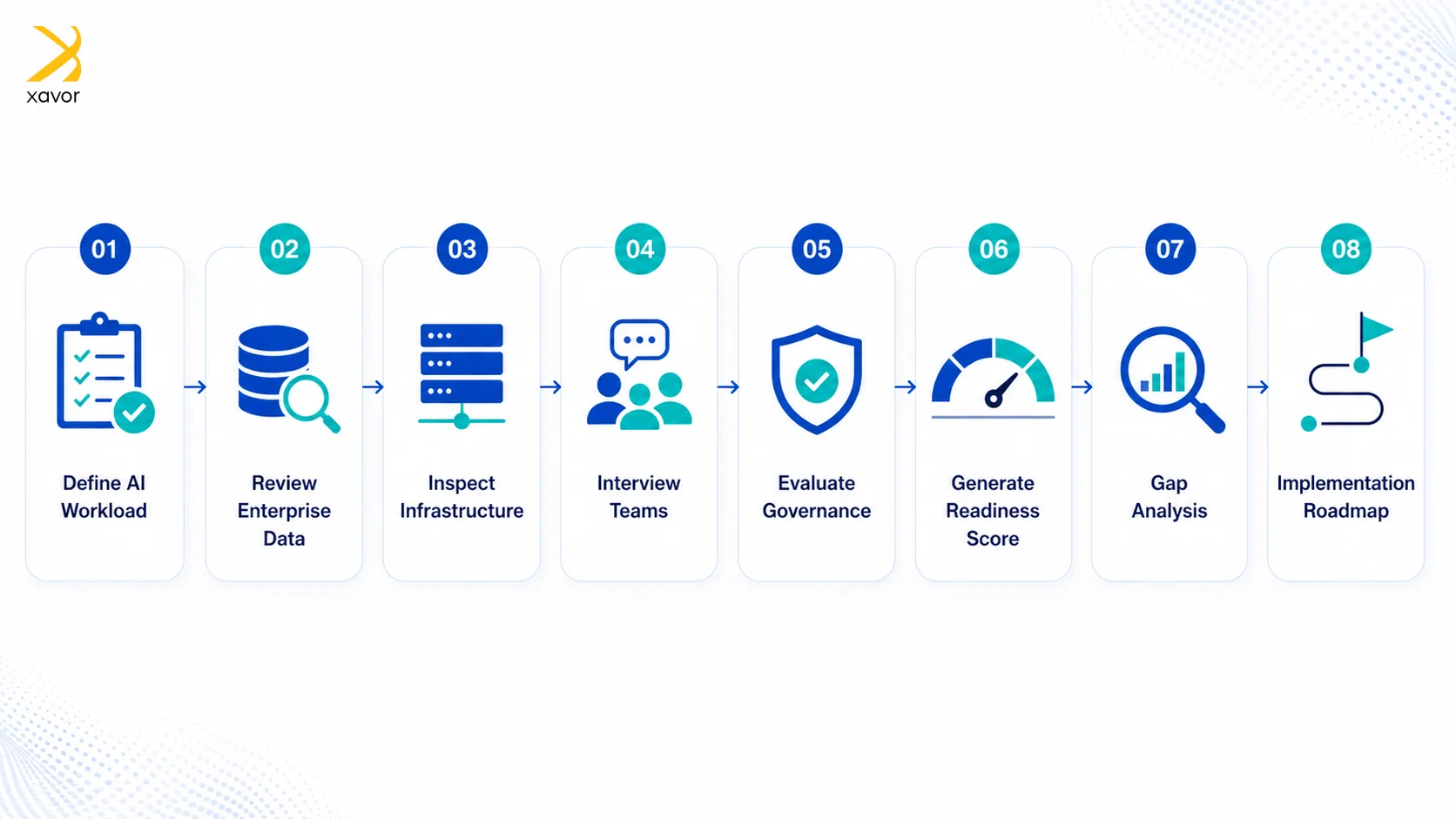
A working AI readiness checklist inspects artifacts and interviews the people who operate the systems, rather than collecting self-reported maturity scores.
We ask to see the schema, the access logs, the last three incidents, and the integration contracts. We interview the data engineer who knows which tables lie, and the operator whose workflow the AI is supposed to change. Those two conversations move a score more than any executive survey.
The distinction that matters to a CTO is what the assessment is wired to.
| Audit-style assessment | Delivery-led assessment | |
| What it inspects | Self-reported survey responses | Artifacts, logs, integration contracts |
| Who is interviewed | Executive sponsors | Engineers and system operators |
| Output artifact | Maturity scorecard | Scored gap map plus build sequence |
| Next 90 days | Undefined | First workload scoped and started |
| How failure surfaces | At rollout | During the assessment |
An assessment that ends in a maturity slide has told you where you stand without telling you what to build first.
Xavor has spent 30 years integrating enterprise systems, and we run readiness the way we run delivery. Our 90-day MVP model and embedded engineering pods set the standard the assessment scores against.
Navi, the elderly-care robot we built with Case Western Reserve University, NVIDIA, and Judson, moved from concept to a deployed physical environment because the integration conditions were measured before the build started.
How the assessment scores data readiness for AI
Data readiness is scored against the specific workload the enterprise intends to ship first, not against a general standard of data quality.
This narrows the evaluation to something measurable. Instead of scoring an entire estate, we score the tables, systems, and handoffs that one named workload touches, then extend outward once that path clears.
Five conditions carry the score: quality fit for the task, semantic consistency across systems, timeliness aligned to decision risk, policy enforcement at the data layer, and lineage sufficient to defend an output. We have documented the five conditions that make enterprise data ready for agentic AI in detail, and the assessment scores each one against evidence rather than intent.
A dataset can clear every quality check and still fail in production if the systems it must read from and write back to were never inspected.
How do you measure integration readiness across ERP, CRM, and PLM?
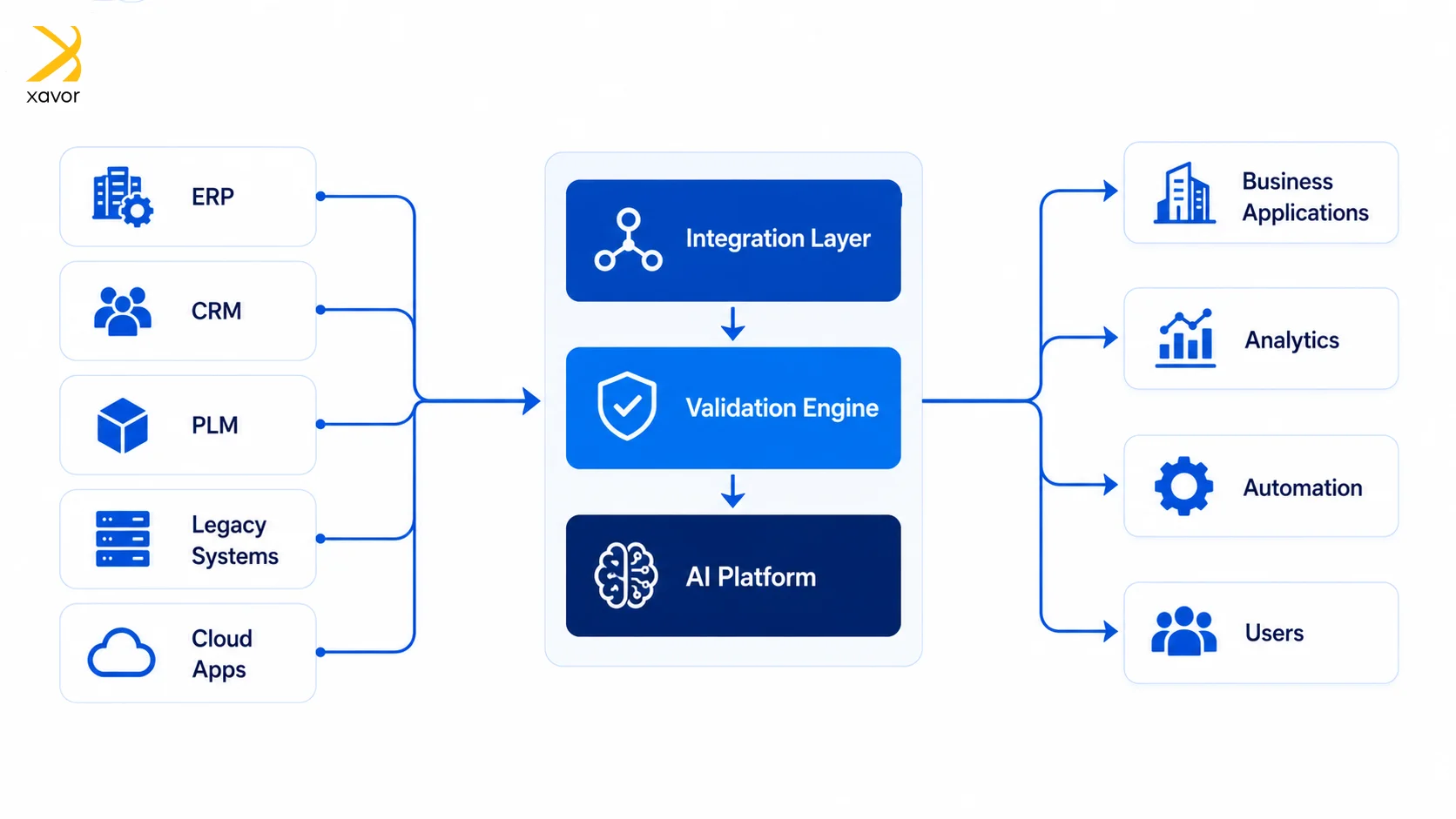
Integration readiness is measured by tracing the path one workload’s data must travel through existing enterprise systems, then scoring each handoff for latency, ownership, and failure visibility. A handoff with no named owner scores as a blocker regardless of how clean the underlying data looks.
Three conditions surface repeatedly in enterprise estates. Legacy incompatibility appears where decades-old systems expose no modern API. Integration debt accumulates where patches and point fixes have created undocumented dependencies. The pilot-to-production gap opens where a proof of concept was built against a copy rather than against the live ERP, CRM, or PLM system.
Most readiness models score data quality and treat integration as an infrastructure line item. That sequencing inflates scores. Our assessment scores the integration surface as a first-order dimension, drawing on the enterprise data integration patterns across ERP, CRM, and PLM we implement in delivery work.
When should you bring in AI readiness consulting?
Outside AI readiness consulting earns its place when the evaluation must cross systems no single internal team owns end-to-end. Internal teams score the systems they run accurately and score the seams between them poorly, because nobody is accountable for a seam. An external assessment crosses those boundaries without organizational cost.
A readiness engagement should return four artifacts:
- Scored dimension map: Each of the five dimensions rated against named evidence.
- Gap sequence: Which gaps block the first workload, ordered by dependency.
- Named first workload: One use case scoped, with its data path traced.
- Architecture outline: What gets built, on what, in what order.
Xavor delivers a detailed assessment plan with architecture in two to four weeks.
A readiness engagement should end with a named first workload and an architecture outline, not with a scorecard.
When an AI readiness assessment is not worth running
An AI readiness assessment is not worth running when no candidate workload has been named, because there is nothing concrete to score readiness against.
Two situations call for a different first move.
When AI tools have already spread through business units without oversight, the priority is containment, and we have covered the governance cost of unmanaged AI sprawl separately. When leadership has not agreed on a business problem, the assessment will score a target that changes before remediation finishes.
Free vendor instruments serve a narrower purpose. The Microsoft AI Readiness Assessment, the Cisco AI Readiness Index, and the ServiceNow Now Assist Readiness Evaluation each return a directional score in under an hour.
A free AI readiness assessment tool answers whether to look closer; it does not answer what to build first.
Start with one workload, not with a score
The value of an AI readiness assessment is decided by what it leaves you able to build.
Score one workload, trace its data path through the systems it touches, and sequence the gaps that block it. That produces a build decision inside a month. Selecting the first AI automation use case to prove value is where most readiness programs should start.
Write to us at [email protected] to put your first workload through an AI readiness assessment with Xavor.

FAQs
An AI readiness assessment is a structured evaluation of an organization's data, infrastructure, skills, strategy, and governance against the requirements of a specific AI workload. It returns a scored gap analysis and a sequenced plan for closing the gaps that block production.
Published models score between four and seven pillars. The four that appear in every model are data, infrastructure, talent, and governance. Larger models separate strategy and culture into their own dimensions. The pillar count matters less than the evidence behind each score.
AI readiness is measured by naming one target workload, tracing the data and systems that workload depends on, then scoring each dimension against inspected artifacts. Interviews with engineers and system operators carry more diagnostic weight than executive self-assessment surveys.