

AI sprawl is the unfettered spread of AI tools within a company. With more organizations seeking AI services, it’s becoming an increasingly common issue in the business world. The concept of sprawl has long roots in the IT industry. When a new technology becomes easier to buy and deploy, sometimes its adoption can move faster than it can be managed.
We saw this with the cloud sprawl in the 2010s and the server sprawl before that. And now AI sprawl is the latest iteration of this phenomenon. But its implications are far more serious than previous waves.
AI sprawl and its variants, like AI agent sprawl, are exponentially more lethal because AI is a more powerful technology. Plus, they are harder to detect and often pernicious in their effect.
In this blog, we’ll explain why that is the case and how you can contain AI sprawl before it gets out of hand.
AI sprawl and its root causes
There has been an uptick in organizations adopting AI tools in the last couple of years. Here at Xavor, our different departments all use AI agents that they personally created to help in their work.
But that’s where the problem also comes from. Every new AI tool or agent comes with its data and a myriad of other strands that help in executing tasks and making decisions. When dozens of AI tools are used in a company with no central management or governance, you get AI sprawl.
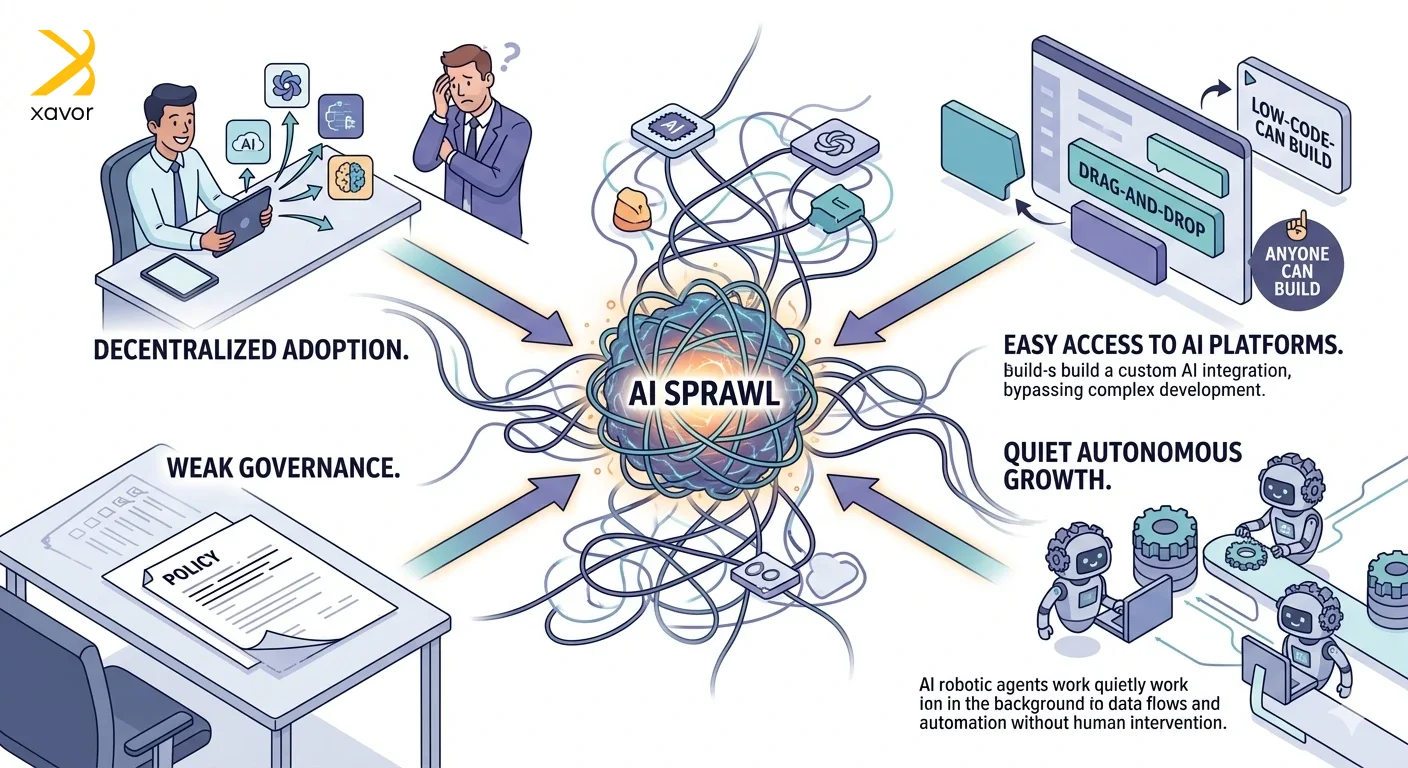
That means you won’t have an idea how many AI tools are currently running within your enterprise. What exactly do they do? What business data can they access? How autonomous they are and who has ownership of them.
It basically creates an infrastructure that is hidden right beneath your nose. And nothing is more frustrating for business leaders than being left in the dark.
AI sprawl doesn’t happen randomly. It is the result of several cultural and technical factors that allow it to grow.
1. Bottom-up AI adoption
Many companies encourage a decentralized AI policy. They give individuals the freedom to test and deploy AI tools independently. Whatever they find works for them.
Now, before going forward, Xavor also uses the same policy. Because it is great for building AI skills and brings out creativity from across the enterprise. But it has its downsides as well.
Decentralization creates space for confusion and complexity. Everyone doing their own thing with AI, with no unifying enterprise strategy, is the perfect ground for AI sprawl to spread.
Decentralization creates space for confusion and complexity. Everyone doing their own thing with AI, with no unifying enterprise strategy, is the perfect ground for AI sprawl to spread.
2. Ease of access
AI is now in the hands of everyone. And we aren’t just talking about ChatGPT, which most people use for basic purposes. We’re talking about platforms like n8n and frameworks like LangGraph. These solutions have democratized, creating advanced agentic AI solutions.
Factor in vibe coding, and the entry barrier for using AI tools is low enough to let anyone in. Again, that is great and good for businesses in the long run.
However, ease of access has led to a deluge of AI tools and models that add little value, aka workslop. On the other hand, they create more problems, and then they solve.
Which is antithetical to the very idea of AI. AI is supposed to reduce the drudgery of meaningless work and improve productivity.
3. Quiet and elusive
AI sprawl is much harder to detect than other IT sprawls. It builds up slowly and remains benign for a time, which is why many companies don’t really notice it.
That is because cloud or SaaS is not autonomous like AI. They ultimately require a human to do the final work. So, it is possible to spot your overextended public cloud resources before they cause issues.
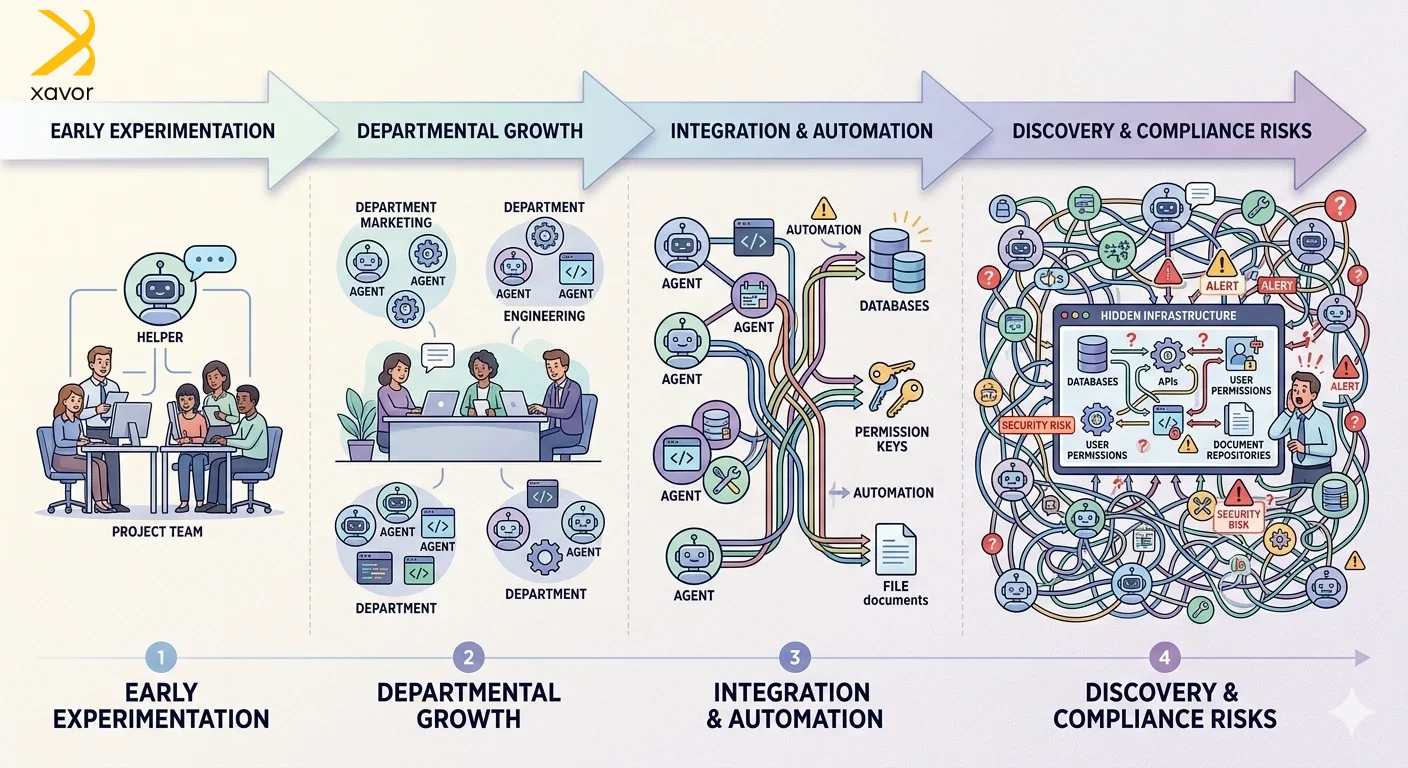
But AI, particularly agents, act on their own. As more and more agents are deployed in a company, they start working on their own and keep improving themselves to require little human intervention.
Next thing you know, you may have agents access your confidential business data without you even getting a sniff of it. It really happened with a California-based company when their agent deleted their entire database within nine seconds on its own.
4. Neglecting governance
Unfortunately, a lot of companies simply don’t give due importance to governance in their AI transformation plans. Probably because they see AI governance as the most boring part of the process.
And to be honest, it kind of is, but governance is supposed to be. The seemingly banal rules and policies that you set around your AI setup are what ensure it works properly and doesn’t silos into unmanageable parts.
Not to mention neglecting governance puts you in hot water with regulators and legal bodies.
Damages AI sprawl causes by seeping into your business
AI agent sprawl weakens your business structure like termites. A whole “colony” of agents builds in a spontaneous way. And by the time you find out, the damage is usually done.
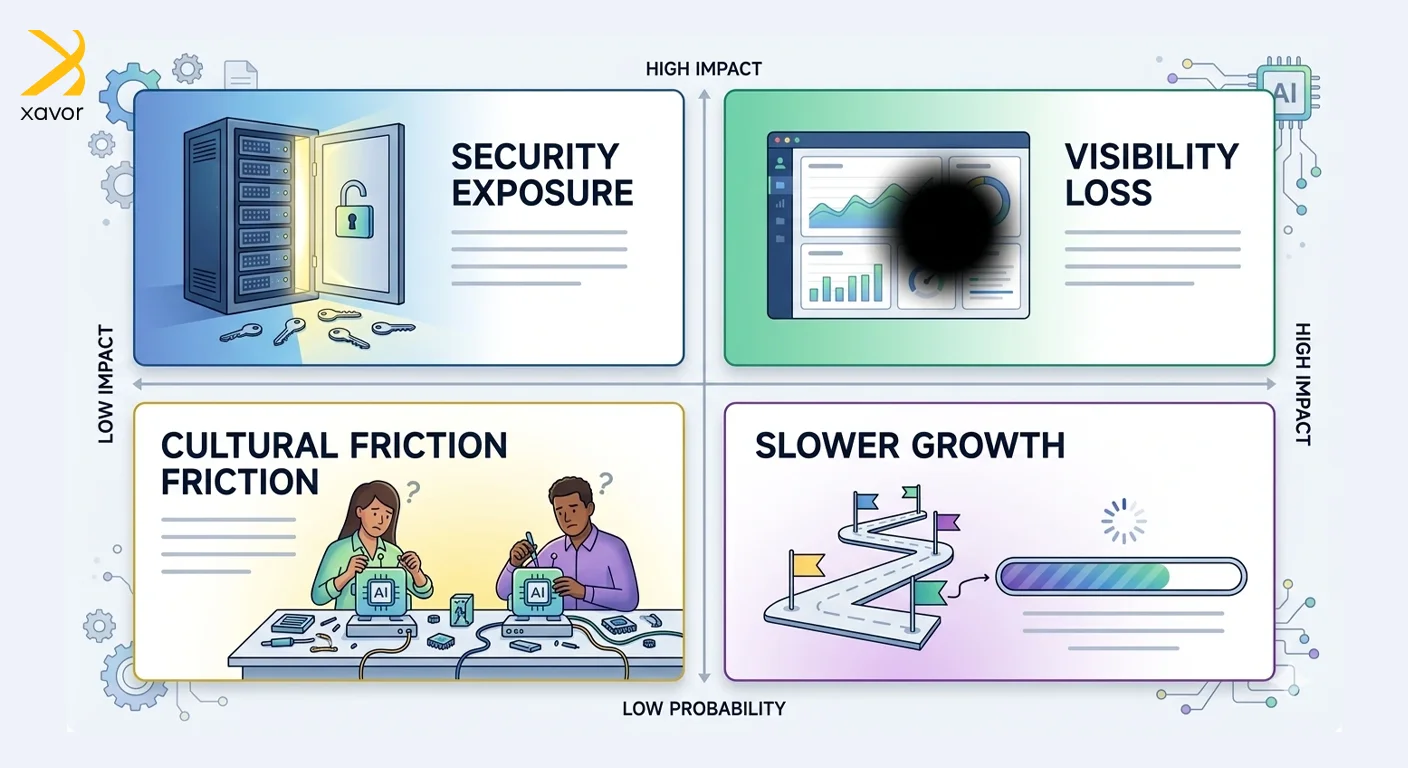
1. You can’t manage what you can’t see
Oversight quickly breaks down when AI tools scatter across departments. Things like Audit trails, fragmentation, and explainability standards become inconsistent team by team if AI sprawl is not addressed soon.
And like we said, it will put you on the regulatory bodies’ radar. Regulatory frameworks like the EU AI Act or ISO 42001 require clear documentation and data lineage. Sprawl makes that nearly impossible, which turns every undocumented model into a compliance liability.
2. Security becomes your weakest link
AI sprawl’s lack of centralized visibility makes security laps go undetected until they cause real damage.
Every untracked AI asset expands your attack surface. Scattered agents with inconsistent authentication and unencrypted data mean attackers only need to find one poorly secured component to compromise the whole ecosystem.
3. Growth slows down as a sloth
Disconnected systems can’t build on each other, so every new initiative starts from zero. Meanwhile, teams unknowingly duplicate tools and pay for the same capabilities twice. One carrier found 60% of its AI engineering capacity was consumed just maintaining existing tools, leaving little room to actually move forward.
4. Organizational culture is disturbed
Top talent wants to solve hard problems. But they need a stable, cooperative environment to do that.
AI sprawl messes up your company’s work environment. When employees are stuck maintaining fragmented infrastructure and rebuilding work that was never documented, they can disengage or lose interest. And when they do, their undocumented work becomes expensive technical debt that’s either painful to maintain or costly to rebuild.
Xavor keeps AI sprawl in check with these proven methods
We have first-hand experience of dealing with AI sprawl. Just within our one office, our developers, sales reps, AI teams, and management were all using AI agents without any central oversight.
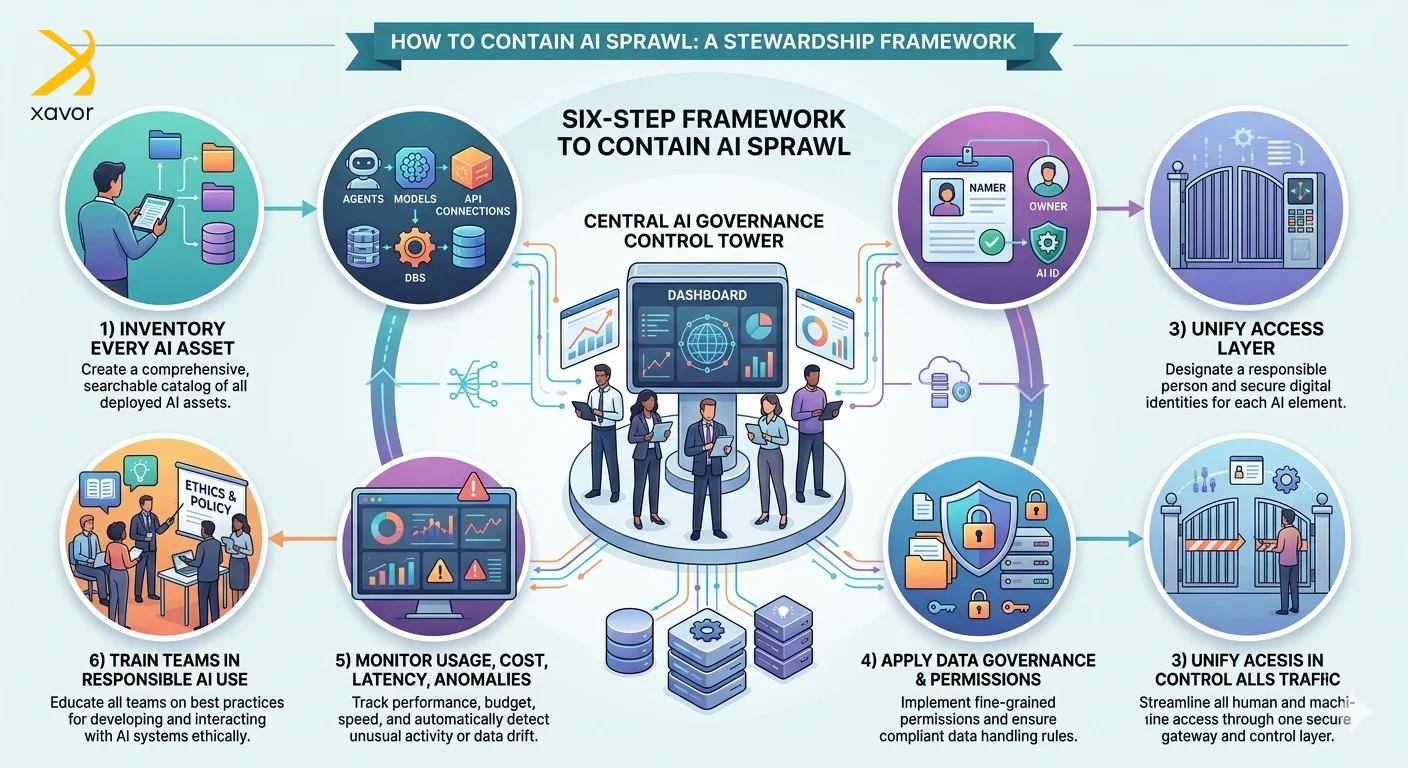
It took us a bit of effort and some planning to stop in its tracks before it could do serious damage. So, here’s how we prevented AI sprawl in Xavor, and we could do the same for you.
1. Make AI every AI asset visible
We started by building a centralized inventory of every agent and model that was in use across teams, including shadow AI that had crept in without formal approval.
A single-pane-of-glass view gives the whole picture about what you have, who owns it, and whether it still serves a purpose?
2. Set agent identity and parameters
Xavor gave every agent an identity and a leash. Each AI agent was assigned a clear owner and a defined permission set. That created a lifecycle that made it clear when an agent gets reviewed or retired.
It is a perfect way to prevent redundant agents from quietly multiplying and ensure no tool holds more access than it actually needs.
3. Unify access for everyone
Initially, we let each team manage its own model connections. However, that was part of the reason behind our AI sprawl. So, Xavor routed all AI interactions through a single access layer.
One control point for authentication and compliance guardrails instills consistency. Regardless of whether a team used OpenAI, Bedrock, or an internal model, the rules stay predictable.
4. Take data governance very seriously
Once we realized we had a sprawl problem, Xavor defined exactly what information each tool could access. So, we enforced least-privilege permissions and built processes to keep data current and retire it when obsolete.
Every AI tool operates on data. Data governance directly addresses the compliance exposure that comes when AI tools silently process sensitive enterprise data without oversight.
5. Monitor everything all the time
Governance isn’t a one-time audit. Xavor implemented ongoing observability across all AI systems to:
- Tracking usage
- Cost
- Latency
- Behavioral anomalies
But many companies do the opposite of that, which is just inviting AI sprawl in your workflows. 24/7 monitoring lets you catch an agent early if it drifts outside its intended scope.
6. Encourage responsible AI use
The best governance fails if teams route around it. Therefore, we invested in internal documentation and training so that building AI responsibly was easier than taking the riskier paths.
A cross-functional AI committee keeps strategy aligned across business units. That is essential to ensure every new initiative is connected to shared infrastructure rather than adding another silo.
Conclusion
Enterprise AI is moving at such speed that it seems it has lost some structure along the way. But it’s high time businesses bring back order and structure to their AI solutions.
AI sprawl is not the first IT sprawl, nor is it the last. The basic formula to stop the uncontrolled spread of any business technology is more or less the same. You need to build a control tower that gives you a bird’s-eye view of your tech setup.
But building that tower is different for AI than it is for cloud, which is different from servers. So, you need specific AI expertise to build a system to take AI sprawl head-on and prevent it in the future.
Partner with Xavor if you want such expertise now. Our AI experts find and fix your agents and other AI tools from being all over the place. We focus on governance tied to orchestration and operational visibility.
Contact us at [email protected] to book a free consultation session.

FAQs
AI sprawl refers to the uncontrolled proliferation of AI tools, models, and systems across an organization or industry often adopted without proper oversight or strategy. It leads to redundant tools, security gaps, and ballooning costs that no one planned for.
When teams independently adopt AI tools without coordination, it creates data silos, inconsistent outputs, compliance risks, and wasted budgets. Organizations end up with dozens of overlapping subscriptions that nobody fully manages or monitors.
The most effective approach is centralizing AI governance and having a clear policy on which tools are approved, who can adopt new ones, and how data is handled across them. Regular audits and a designated AI owner or committee help keep things from spiraling.