
Choosing an enterprise content management system is a decision you’ll live with for years. It shapes your security posture, your developers’ velocity, your marketing team’s independence, and a large chunk of your total cost of ownership. For organizations evaluating platforms as part of broader enterprise CMS development services, the CMS choice also affects how easily the website can scale, integrate with existing systems, and adapt over time.
Two names come up constantly in that conversation: Umbraco and WordPress. Both are mature, widely deployed, and capable of running serious websites. But they come from different worlds, and the right choice depends far more on your team, stack, and governance requirements than on any headline feature list.
This guide breaks down how Umbraco and WordPress compare for enterprise use in 2026 — across architecture, security, scalability, cost, and the day-to-day realities of running each at scale.
TL; DR The short answer
WordPress and Umbraco are built for different types of users. WordPress is designed to be accessible to bloggers, marketers, and businesses, with developer support needed only for more advanced tasks.
Umbraco is more developer-focused and usually requires technical expertise for setup, customization, and ongoing changes. If your organization is built on the Microsoft / .NET stack, values strict content governance, and needs a CMS that behaves predictably under enterprise security and compliance requirements, Umbraco is usually the stronger fit.
But if you need to launch fast on a limited budget, lean on a massive plugin and talent ecosystem, and give marketing teams maximum self-service, WordPress remains hard to beat.
The rest of this article explains why — and where the nuances hide.
Umbraco and WordPress at a glance
| Factor | Umbraco | WordPress |
| Underlying technology | ASP.NET Core / C# (.NET) | PHP / MySQL |
| Licensing | Open source (MIT) | Open source (GPL) |
| Market position | ~1% of CMS market, strong in .NET enterprises | ~40%+ of all websites |
| Content modeling | Structured, developer-defined by design | Flexible, plugin-assisted |
| Ecosystem | Curated, smaller | Enormous plugin/theme marketplace |
| Ideal team | .NET / C# developers | PHP developers, generalists |
| Hosting | Umbraco Cloud or Azure/self-hosted | Almost any host |
Market share figures move over time — verify the latest numbers before publishing, since these are illustrative.
1. Architecture and technology stack
Umbraco is built on ASP.NET Core and C#. That’s the deciding factor for many enterprises: if your teams already work in .NET, Umbraco slots into your existing skills, CI/CD pipelines, Azure infrastructure, and security tooling with minimal friction. Its content modeling is structured by default — developers define document types and templates, which enforces consistency and makes large content architectures easier to maintain.
WordPress runs on PHP and MySQL, the most widely deployed web stack in the world. That ubiquity is its superpower: hosting is cheap and universal, talent is everywhere, and there’s a plugin for almost anything. The trade-off is that WordPress’s flexibility is often plugin-assisted rather than structural — powerful, but easier to let sprawl over time without disciplined governance.
Enterprise takeaway: Match the CMS to your engineering org. A .NET shop pays a real tax adopting WordPress; a PHP or agency-driven team will move faster on WordPress.
2. Security and compliance
Security is where enterprise conversations get serious.
WordPress’s popularity makes it the most-targeted CMS on the internet. Core WordPress is reasonably secure, but the majority of real-world vulnerabilities come from third-party plugins and themes. At enterprise scale, that means active plugin governance, patch management, and vetting are non-negotiable operational responsibilities. For larger WordPress environments, this can also extend into identity and access design, including approaches such as zero trust architecture for WordPress.
Umbraco’s smaller, more curated ecosystem and structured architecture generally present a smaller attack surface. Because it’s a .NET application, it inherits the security tooling, authentication patterns (including straightforward Azure AD / Entra ID integration), and update discipline that enterprise .NET teams already use.
Enterprise takeaway: Neither is “insecure.” But WordPress security is largely a plugin-governance problem you must actively manage, while Umbraco’s risk profile is more contained out of the box.
3. Scalability and performance
Both platforms run high-traffic sites — the differentiator is how you get there. On Umbraco specifically, issues such as caching, database calls, hosting configuration, and media handling can have a significant effect on performance, which we cover in our guide to optimizing Umbraco website performance.
WordPress scales well with the right stack: managed enterprise hosting, aggressive caching, a CDN, and database optimization. Enterprise WordPress hosts have made this largely a solved problem, though heavy plugin loads can undermine performance if left unchecked.
Umbraco scales cleanly on Azure, benefits from .NET’s performance characteristics, and pairs naturally with cloud-native patterns. Its structured content model also tends to keep large sites more maintainable as they grow.
Enterprise takeaway: Both scale. Budget for proper hosting, caching, and a CDN regardless of which you choose — the CMS alone doesn’t guarantee performance.
4. Headless and composable architecture
In 2026, many enterprises want the option to go headless — decoupling the content back end from front ends built in React, Next.js, or mobile apps.
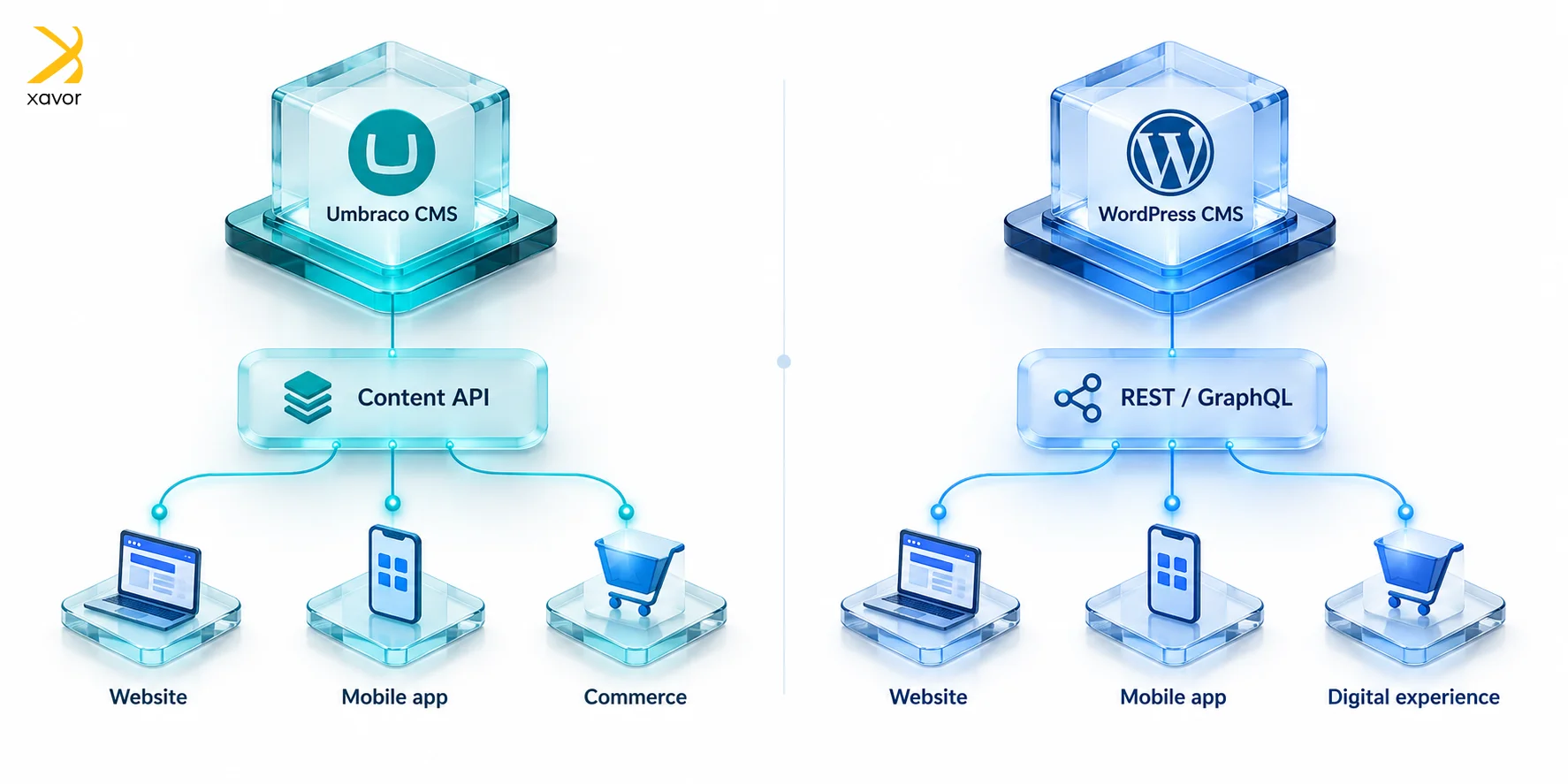
Umbraco offers a first-class headless product (Umbraco Heartcore) plus a native Content Delivery API, making it a strong fit for composable and omnichannel strategies.
WordPress supports headless through its REST API and GraphQL (via WPGraphQL), and there’s a large community doing exactly this — though headless WordPress is more of an assembled pattern than a packaged product. Teams considering this architecture can also see our practical guide to using WordPress as a headless CMS.
Enterprise takeaway: Both can go headless. Umbraco’s approach is more turnkey; WordPress’s is more DIY but well-trodden.
5. Total cost of ownership (TCO)
Both platforms are open source with no license fee for the core, so the real cost lives elsewhere:
- Talent: PHP/WordPress developers are more plentiful and often less expensive; senior .NET developers command higher rates but bring enterprise engineering discipline.
- Hosting: WordPress hosting is cheaper and more universal; Umbraco typically runs on Azure or Umbraco Cloud (a paid managed platform).
- Maintenance: WordPress’s ongoing plugin patching and governance is a real recurring cost; Umbraco’s tighter ecosystem can mean lower maintenance overhead but higher per-developer cost.
- Build speed: WordPress often wins on time-to-launch, which lowers initial cost.
Enterprise takeaway: WordPress usually wins on upfront cost. Umbraco can win on long-term cost of ownership in a governed, .NET-aligned enterprise. Model the full 3–5 year picture, not just the build.
6. Content team experience and governance
WordPress’s editing experience (Gutenberg block editor) is familiar and marketer-friendly, which lowers training overhead and gives content teams a lot of independence.
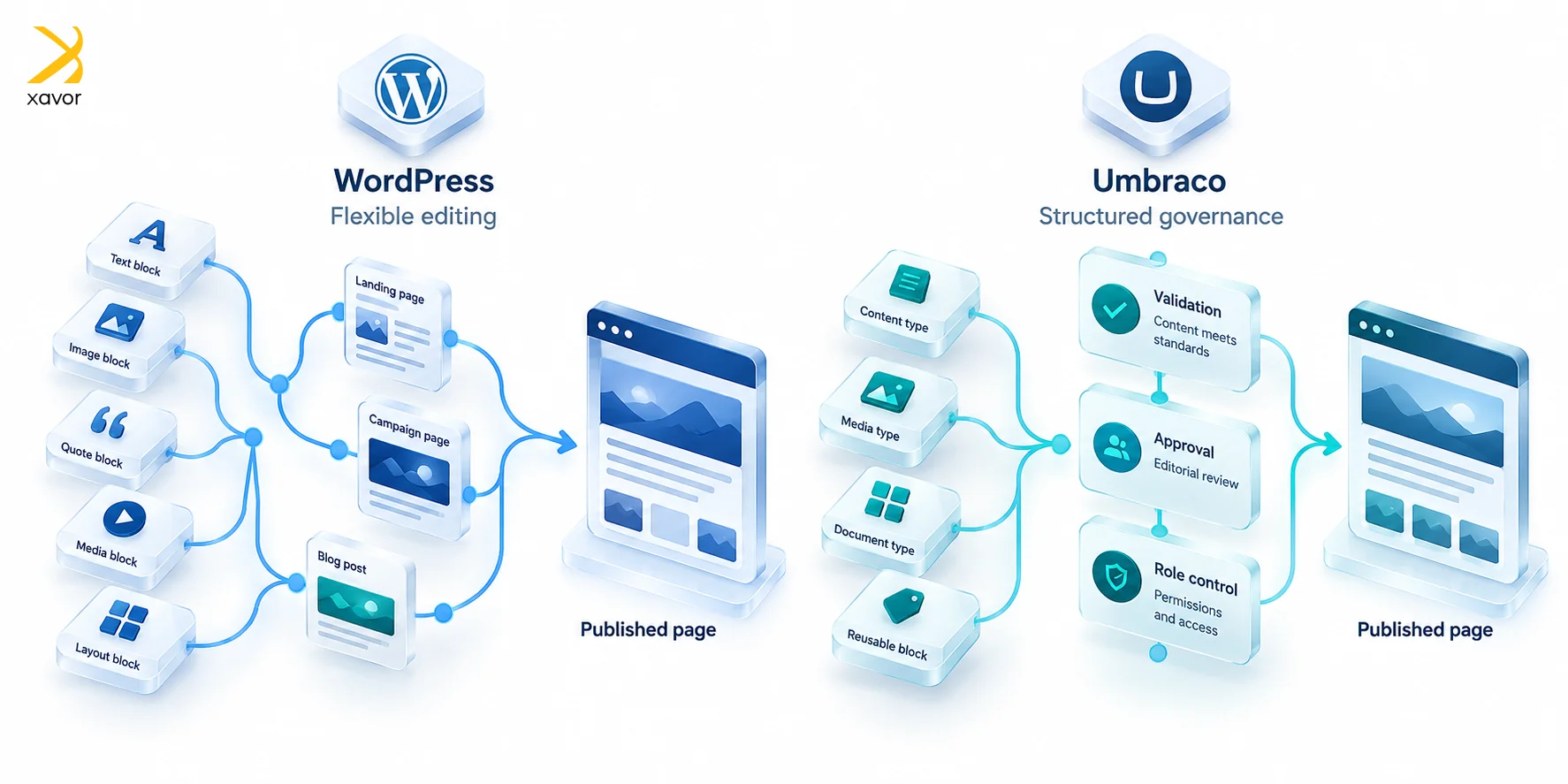
Umbraco’s editor is clean and well-regarded, and its structured content model gives governance-conscious organizations tighter control over what editors can and can’t do — valuable when brand consistency and compliance matter more than editorial free rein.
Enterprise takeaway: WordPress leans toward editor freedom; Umbraco leans toward editorial control. Pick based on how much governance your brand and compliance teams require.
7. SEO features and capabilities
WordPress is generally easier for SEO, especially for non-technical teams. It offers strong built-in fundamentals and a large plugin ecosystem that simplifies common SEO tasks.
Umbraco can also perform well in search, but it usually needs more developer setup. Its advantage is greater technical control, which can suit teams that want a more customized SEO structure.
Enterprise takeaway: WordPress offers strong SEO basics, which are faster and more accessible to execute. Umbraco provides deeper SEO developer control but requires more effort.
8. Community and support
Umbraco also has an active, committed community and offers commercial enterprise support, but its ecosystem and developer pool are smaller and more concentrated in Europe.
WordPress, on the other hand, has a much larger global community, with extensive tutorials, forums, events, agencies, and developers available worldwide. This makes support and hiring relatively easy.
Enterprise takeaway: WordPress offers a broader global support ecosystem and talent pool.
9. Extensions and integrations
WordPress has a much larger plugin ecosystem, with tools available for SEO, security, eCommerce, marketing, memberships, and many other needs. This often reduces custom development and speeds up implementation.
Umbraco offers a smaller extension marketplace, so more specialized features may require custom .NET development. Its strength is tighter alignment with Microsoft technologies such as Azure, Dynamics 365, and Active Directory.
Enterprise takeaway: WordPress offers greater extensibility and faster deployment, while Umbraco suits enterprises that prioritize custom development.
10. Multilingual, multisite content management
Large enterprises often need to manage multiple websites, brands, regions, and languages from the same CMS.
WordPress supports multisite through WordPress Multisite and multilingual publishing through plugins and enterprise setups. It offers considerable flexibility, but managing permissions, translations, plugins, and content across a large network can become complex without strong governance.
Umbraco is well suited to structured multisite and multilingual implementations, allowing enterprises to define shared content models while controlling variations across markets, languages, and brands. It can require more development upfront, but this structure can make large global ecosystems easier to govern.
Enterprise takeaway: Umbraco provides stronger structural control for complex, multilingual enterprise environments.
How to decide: a quick framework
Choose Umbraco if you:
- Run on the Microsoft / .NET / Azure stack
- Need strong content governance and a smaller, more controlled attack surface
- Want a turnkey headless and composable path
- Are optimizing for long-term maintainability over fastest launch
Choose WordPress if you:
- Need to launch quickly and cost-effectively
- Want the largest possible ecosystem of plugins, themes, and talent
- Prioritize marketing self-service and a familiar editing experience
- Have (or will build) disciplined plugin governance
CMS decisions become more complex when enterprises are managing multiple sites, publishing teams, migrations, and long-term scalability requirements. See how Xavor addressed similar challenges through enterprise CMS modernization, improving publishing speed, website launches, and scalability across a large digital ecosystem.
Conclusion
There’s no universal winner in Umbraco vs. WordPress. Only the right fit for your enterprise. The best decision comes from honestly assessing your existing tech stack, your team’s skills, your security and compliance obligations, and your true long-term budget.
If you’re weighing the two for a specific project or considering a migration between them, a short discovery conversation with Xavor can save months of rework.
Contact us at [email protected] to talk to our team about your enterprise CMS strategy.

FAQs
WordPress is often better for faster deployment, marketer autonomy, and plugin-driven flexibility. Umbraco is a stronger fit for .NET-led enterprises that prioritize structured content, governance, and Microsoft ecosystem integration.
Either migration is possible, but complexity depends on content volume, custom functionality, integrations, URLs, and SEO requirements. A proper migration plan should preserve content structure, redirects, metadata, and critical user journeys.
WordPress usually has a lower upfront cost because of its larger talent pool, hosting options, and plugin ecosystem. Umbraco can be more cost-effective long term for enterprises already invested in .NET and Azure.