
Governance, risk, and compliance (GRC) is the integrated practice of setting policy, identifying and treating risk, and demonstrating adherence to regulations. In ServiceNow, it is delivered through Integrated Risk Management, the current name for the GRC application suite. We run these rollouts at Xavor Corporation in Irvine, California through our ServiceNow implementation and managed services, and the pattern repeats. Entity scoping maps controls and risks to Configuration Items drawn from the CMDB, which means the CMDB has to already hold the records those controls attach to.
The implementation runs five phases, and each one is gated by a decision made outside the platform. No vendor-published benchmark exists for duration, so any timeline you are quoted is built from four variables you can check yourself.
Entity scoping attaches controls and risks to Configuration Items that already exist in your CMDB, which makes CMDB completeness a prerequisite rather than a parallel workstream.
What GRC means, and why ServiceNow now calls it IRM
GRC stands for governance, risk, and compliance, three disciplines that the Open Compliance and Ethics Group brought under one term in 2002, and ServiceNow now delivers them through its Integrated Risk Management suite. A GRC framework is the structure that connects the three, and GRC compliance is the demonstrable half of it.
- Governance: the policies, decision rights, and oversight structures that direct how an organization operates.
- Risk management: identifying, assessing, and treating threats that could stop the organization from meeting its objectives.
- Compliance: evidencing adherence to external regulation and internal policy.
Any GRC system or GRC solution you evaluate is built to hold those three in one place. ServiceNow does it through four applications: Policy and Compliance Management, Risk Management, Audit Management, and Vendor Risk Management.
ServiceNow’s own materials still carry both names, including a training course titled GRC: Integrated Risk Management (IRM) Implementation, so proposals and documentation you receive will use them interchangeably.
If you are comparing ServiceNow IRM vs GRC in a vendor deck, they are the same suite. We cover the ten ServiceNow modules and what each one covers separately. This piece assumes the module map and looks at what it takes to implement one.
What your CMDB has to support for entity scoping to work
Entity scoping in ServiceNow IRM maps controls and risks to business units, processes, and Configuration Items drawn from the CMDB, which means the CMDB has to already hold the records those controls will attach to. In ServiceNow GRC, an entity is the anchor record. Without it, a control exists as text.
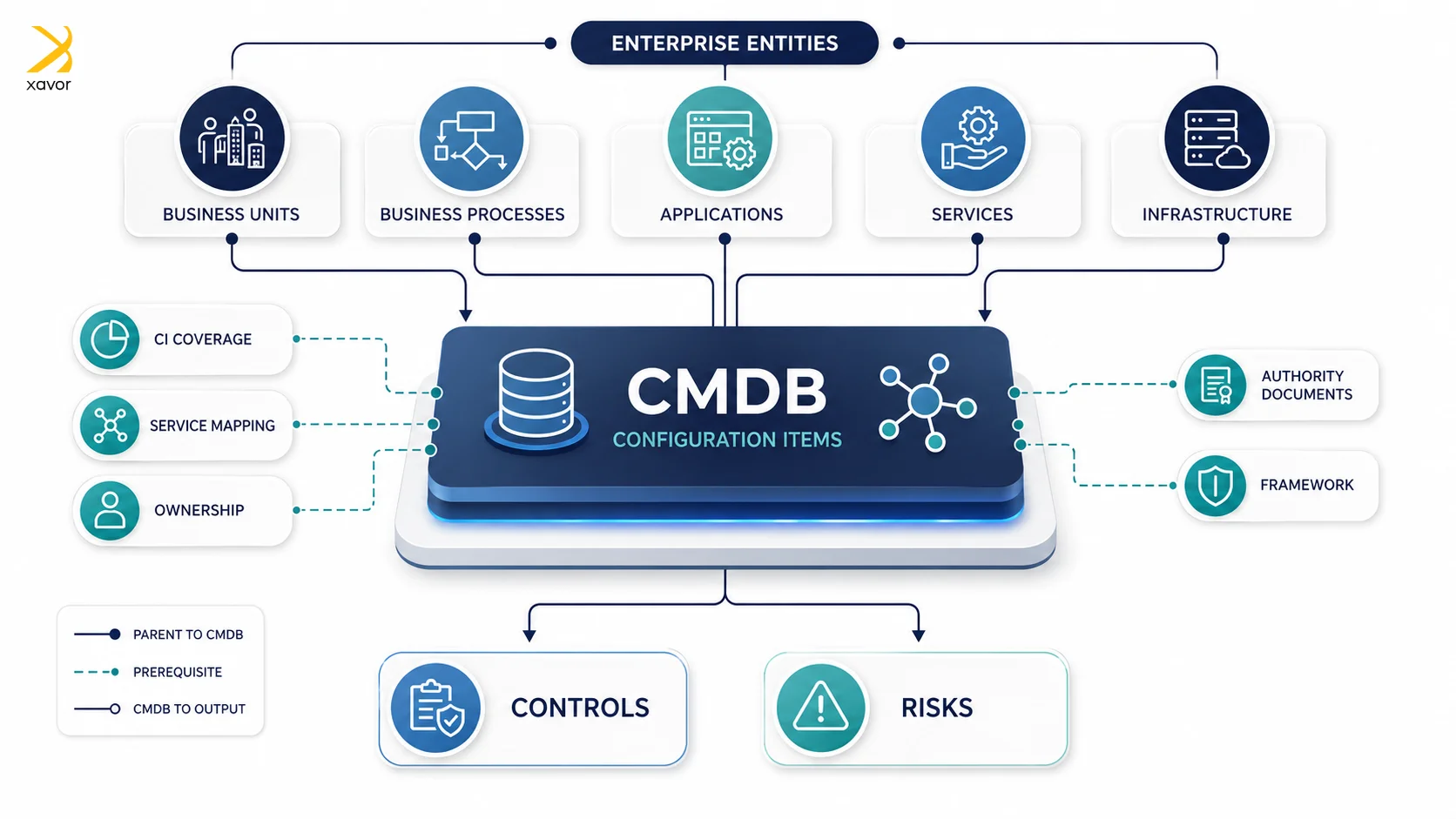
Five conditions determine whether scoping proceeds or stalls:
- CMDB population and class coverage: the in-scope applications, services, and infrastructure are represented as Configuration Items.
- Service mapping: dependencies between those items are recorded, not assumed.
- A named owner per Configuration Item: someone accountable when a control fails.
- A maintained authority document set: the regulations and standards you are evidencing against, with an owner.
- Framework agreement: which frameworks the control library serves, decided before the library is built.
Teams that scope IRM against an org chart rather than the CMDB discover mid-build that half their controls have no record to attach.
The CMDB dependency is not new to IRM. It is the same shared data layer that connects service management to operations, and we cover in detail how the CMDB functions as the shared data layer between ITSM and ITOM. Xavor has integrated enterprise systems for 30 years, and this is where we focus first: a ServiceNow GRC implementation.
How an IRM implementation sequences, and what gates each phase
A ServiceNow IRM implementation runs through five phases: foundation setup, entity scoping, data onboarding, workflow automation, and testing and rollout, each gated by a decision made outside the platform. The configuration work is well documented. The gating decisions are where programs stop.
| Phase | What it configures | What gates it |
| Foundation setup | Authority documents, citations, control objectives | Which frameworks are in scope |
| Entity scoping | Controls and risks mapped to CIs | CMDB completeness |
| Data onboarding | Legacy registers, control catalogs | Whether legacy data merits migration |
| Workflow automation | Tasks, attestations, indicators | Which controls evidence automatically |
| Testing and rollout | UAT, update sets, dashboards | Whether control owners were trained |
Foundation setup fails quietly when two teams hold different framework lists. Data onboarding fails loudly when a legacy register is migrated intact, reproducing its own inconsistencies within the platform.
Workflow automation is where governance, risk, and compliance stop being just documentation. An indicator pulls evidence from a live source. An attestation asks a person. The ratio between them determines how much of the program runs on its own.
A GRC implementation is sequenced by what can be evidenced automatically, not by which module was bought first.
Flow Designer generates the tasks and routes the attestations once that ratio is set.
How long a ServiceNow GRC implementation takes
No vendor-published benchmark exists for ServiceNow IRM implementation duration, so any timeline you are quoted is an estimate built from four variables you can check yourself. Ask which of the four the estimate assumed, and the number becomes testable.
- Module count in phase one: each additional application adds its own configuration and its own owners.
- CMDB readiness: the gate from the previous section, and the variable that moves timelines most.
- Framework count: a control library serving one standard is a different build from one serving four.
- Automation ratio: controls evidenced by live data are configured once, whereas attested controls require owners, cadences, and training.
[CONFIRM — if a published duration range is sourced before publication, state it here with the source. Otherwise this section ships as variables only.]
Timelines set by the license start date rather than by CMDB state are the most common reason a phase-one scope gets cut halfway through.
Partner selection matters here, and the criteria mostly hold across ServiceNow projects. We set them out in how to evaluate a ServiceNow implementation partner. What changes for IRM is the CMDB question, which a partner should raise before quoting a date.
Governing third-party access: what a delivered control looks like
A global asset management firm granted temporary vendor access via email and spreadsheets while already using ServiceNow for ITSM, leaving approvals unrecorded and access never expiring. Xavor was engaged to build the control inside the platform the firm already owned.
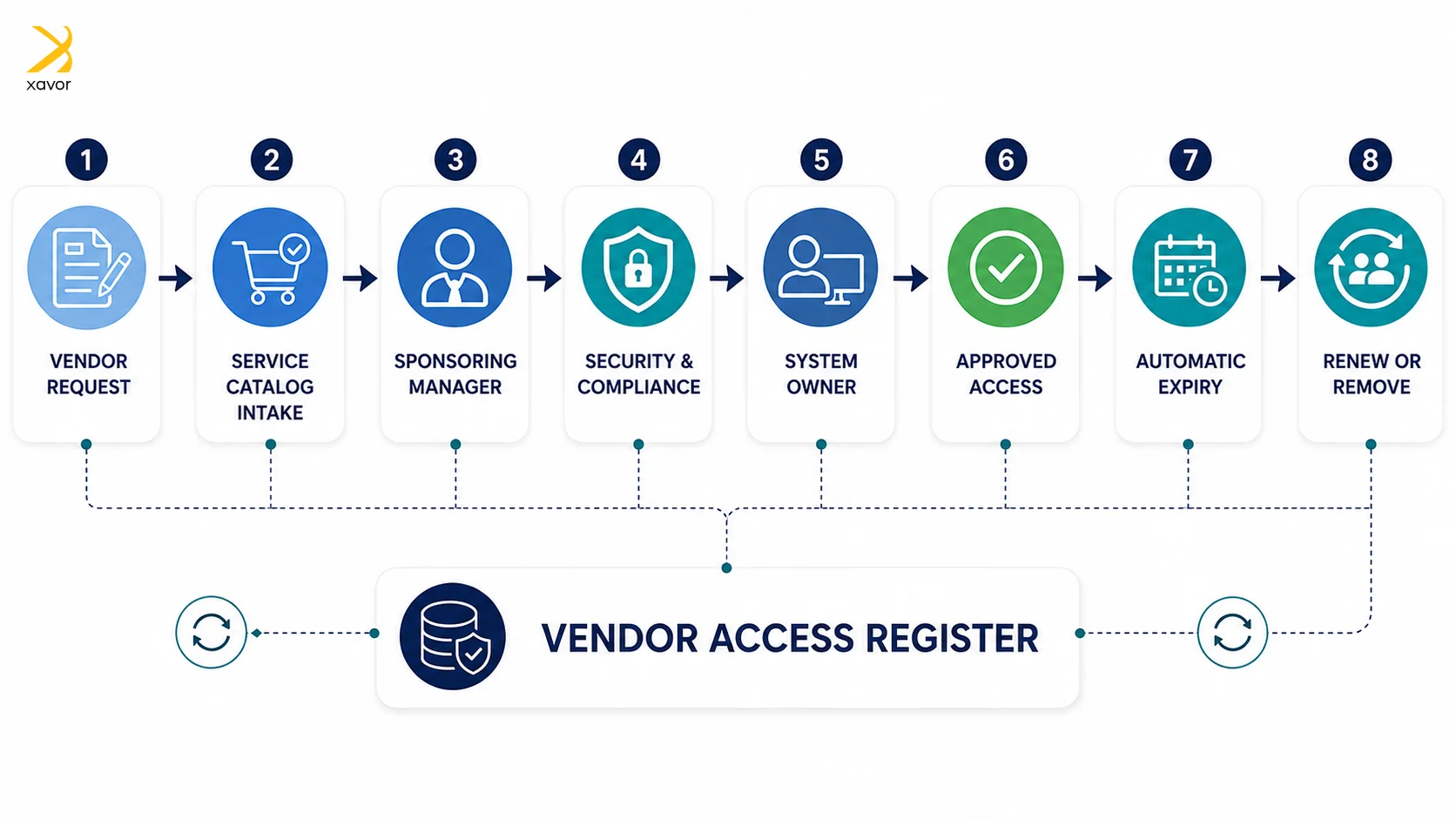
Five failures defined the pre-state. No standard request process, so approvers could not tell which systems were being requested. Approvals sat in inboxes with no trail. Security reviews were skipped when requesters went straight to IT.
End dates were recorded and never acted on, leaving former consultants with access to financial systems. And no one could see all active vendor access in one place during an audit.
We built an enforced Service Catalog intake that rejects incomplete submissions, a three-stage approval chain through the sponsoring manager, security and compliance, then the system owner, and automated expiry that prompts renewal at two weeks and creates a removal task at one week. Extensions require renewed approval. A Vendor Access Register table became the authoritative record rather than the original ticket.
The client already owned the platform; what was missing was the process built into it.
The outcomes were measurable at go-live: a 95% reduction in incomplete requests, 100% auditability of approvals, an 80% reduction in overdue vendor access, and 50% less administrative effort for IT. The full build is documented in automating vendor access management on ServiceNow for an asset management firm.
Where ServiceNow IRM fits against other GRC platforms
The GRC platform market is split by company size and by what the platform is expected to connect to, and ServiceNow IRM sits at the enterprise end, where risk data comes from operational systems already on the platform. That is the honest framing, and it cuts both ways.
Compliance automation tools such as Vanta and Drata are built to reach a first certification quickly. Enterprise risk platforms such as Archer, Optro, and MetricStream compete on configurability and audit depth across large regulated estates.
ServiceNow IRM is oversized for an organization whose main requirement is a first SOC 2 or ISO 27001 certification and whose systems are not on the Now Platform.
Where it earns its cost is where the CMDB, ITSM, and security operations already run on ServiceNow, because the controls attach to records that update themselves.
Continuous monitoring, and why it is not AI governance
An indicator that pulls evidence from live data replaces an attestation that asks a control owner whether everything is fine, and that substitution is what separates continuous monitoring from a quarterly review cycle. It also sets the ceiling on how much of a control library can run without human input.
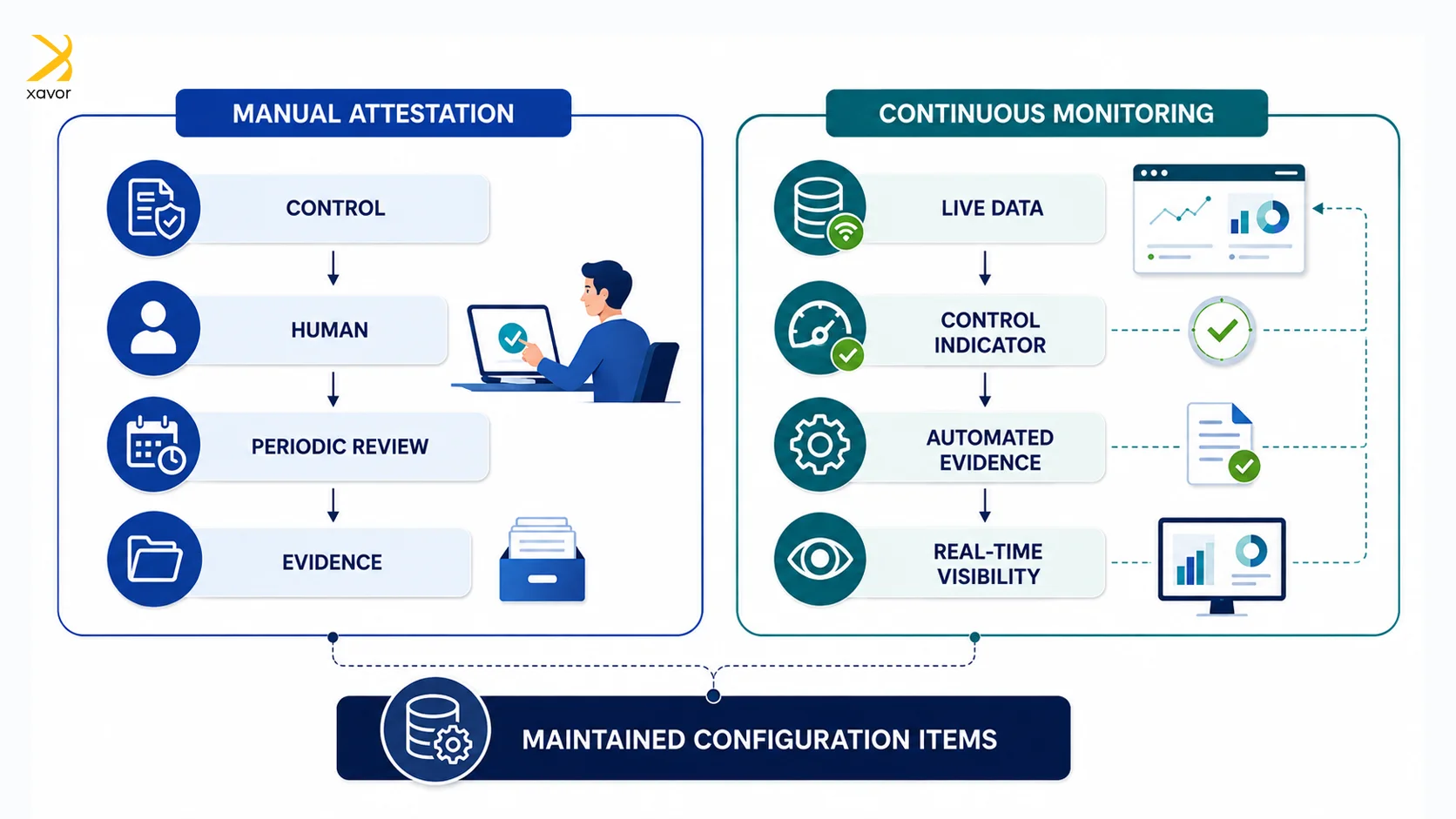
Monitoring depends on the same records that entity scoping depends on. A control monitoring a Configuration Item that nobody maintains produces a green dashboard and no assurance.
AI governance and traditional GRC operate at different layers, and treating one as a relabelled version of the other produces a control library that covers neither properly.
That distinction is worth holding as AI systems enter the estate. We cover separately what ServiceNow AI Control Tower governs and why it is a different layer.
Scope the estate, then scope the modules
The decision to set an IRM timeline is made before any module is configured, and it concerns records rather than risk methodology.
Check whether the systems your controls will attach to exist as Configuration Items, whether anyone owns them, and how many of your controls could pull evidence without asking a person. Those three answers move a schedule more than the module list does.
The first question we ask on an IRM scoping call is what your CMDB can already support. If you want that answered against your own estate rather than a generic checklist, [email protected] reaches our ServiceNow team.

FAQs
Yes. Integrated Risk Management is the current name of the application suite formerly known as Governance, Risk, and Compliance. ServiceNow materials, including its implementation training, still use both names, so vendor documentation will carry each.
Controls and risks attach to entities, which represent business units, processes, or Configuration Items from the CMDB. Authority documents hold the regulations you evidence against, and citations link specific requirements to control objectives.
Vendor Risk Management, also described as third-party risk, is one of the four applications ServiceNow names in the IRM suite. It automates risk assessments for suppliers and vendors. [CONFIRM — verify current packaging and licensing against ServiceNow documentation.]