

As businesses become more dependent on technology, managing IT systems and maintaining platform stability become increasingly challenging. Platforms like ServiceNow help organizations automate workflows, manage IT operations, and improve service delivery. With ServiceNow managed services, businesses can also maintain platform performance and support ongoing operations.
ServiceNow offers solutions for IT service management, asset tracking, HR, customer support, and more. In this article, we’ll cover the top 10 ServiceNow modules in 2026, along with their key features, benefits, and use cases.
What is ServiceNow?
ServiceNow is a cloud-based enterprise platform that helps organizations manage business processes and automate routine work.
Founded in 2003, ServiceNow originally focused on IT service management. Over time, it expanded into IT operations, asset management, HR, customer support, and other business functions. Its applications run on the ServiceNow AI Platform, allowing departments to share information and coordinate work through connected processes.
What are modules in ServiceNow?
In ServiceNow, a module is technically a navigation component within an application. It provides access to specific functions, records, or pages. For example, a ServiceNow application may contain separate modules for managing incidents, viewing reports, or accessing records. However, people commonly use the term “ServiceNow modules” to describe broader ServiceNow products such as ITSM, ITOM, and HRSD.
Top 10 ServiceNow modules in 2026
ServiceNow stock has grown considerably over the years. Forbes, Gartner, and other business research firms rate it as one of the most innovative companies with promising prospects.
This growth is driven by key ServiceNow modules that have made the platform the first-choice business process automation software of many enterprises.
Here is a ServiceNow modules list of most popular among users in 2026.
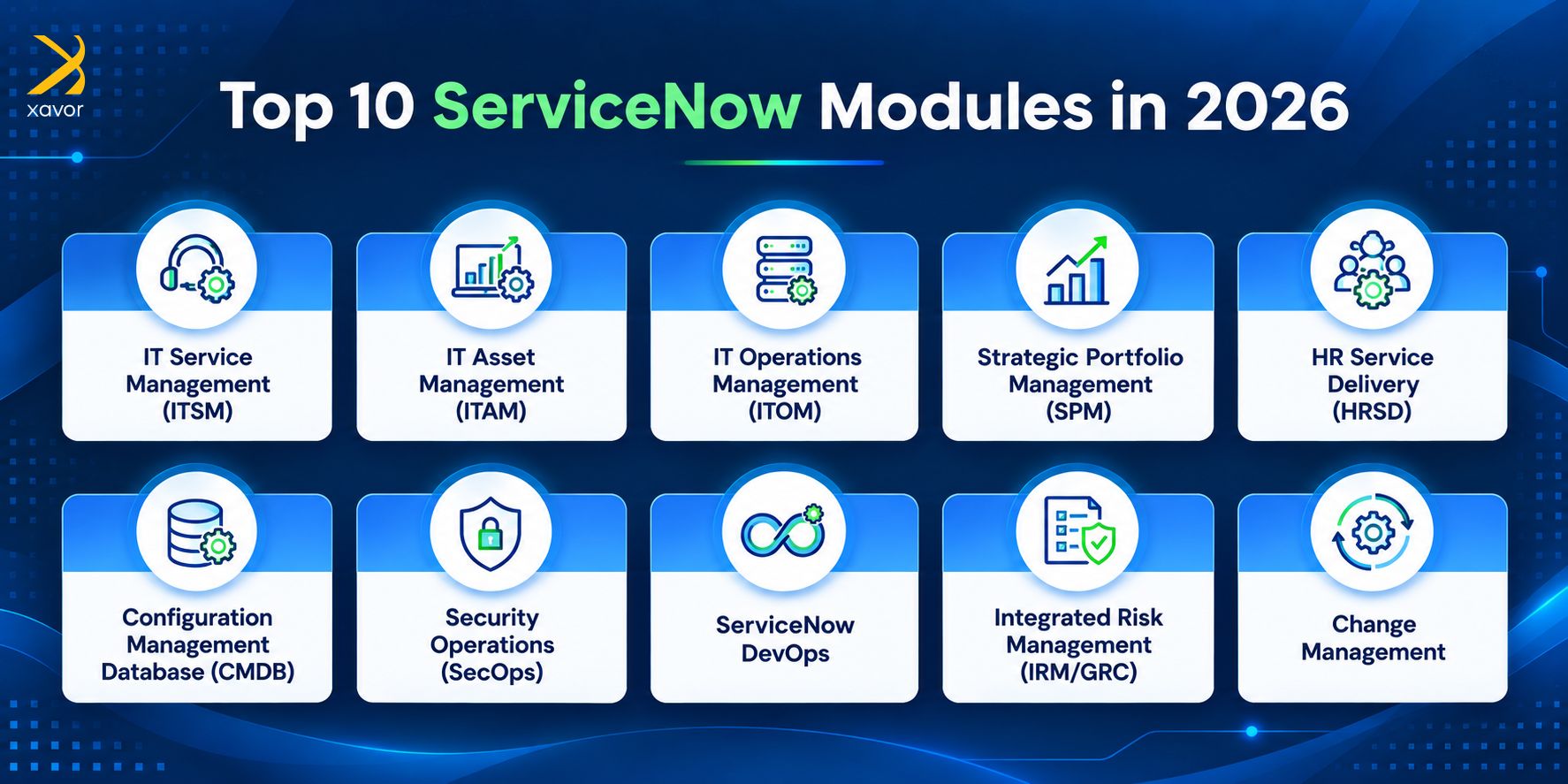
1. IT Service Management (ITSM)
ServiceNow ITSM manages the processes organizations use to deliver and support IT services. It provides a central environment for handling incidents, service requests, problems, and changes.
For example, when an employee cannot access an application, they can submit a ticket through the service portal. ServiceNow routes the request to the appropriate support group, tracks progress, and maintains a record of the resolution.
Some of the key ServiceNow ITSM modules are:
- Incident Management
- Change Management
- Problem Management
- Configuration Management
- Service Catalog
- Service Level Management
- Configuration Management Database (CMDB)
- Self-Service Portal
- Knowledge Management
- Event Management
ITSM also connects with other ServiceNow products, allowing support personnel to investigate technical issues using infrastructure and configuration information.
For organizations managing large service desks, this shared context can improve coordination and reduce repetitive administrative work.
2. IT Asset Management (ITAM)
Modern businesses maintain extensive inventories of laptops, servers, software subscriptions, and other technology assets.
ServiceNow ITAM helps organizations track these assets throughout their lifecycle, including procurement, assignment, maintenance, and retirement.
Its major capabilities include:
- Hardware Asset Management
- Software Asset Management
- Asset Lifecycle Management
- Cloud Asset Management
- License compliance and reconciliation
- Contract and warranty tracking
- Asset inventory reporting
- Asset retirement
Consider an organization paying for software licenses assigned to former employees. ITAM can help identify these unused licenses so administrators can review reassignment or renewal options.
This visibility supports better purchasing decisions and reduces the risk of maintaining inaccurate asset records.
3. IT Operations Management (ITOM)
ServiceNow ITOM handles the IT operations that power IT services. It provides a set of tools to manage and monitor the IT system within an organization to keep the system healthy, reduce downtime, and keep a record of all related IT operations.
ServiceNow ITOM provides a map of servers, applications, and their dependencies, helping you understand where everything is located and how the components are connected. This is very useful in managing digital infrastructure, which is becoming increasingly complex in modern times.
These are the key ServiceNow ITOM capabilities:
- IT Infrastructure Monitoring
- Event Management
- Service Mapping
- Discovery
- Root Cause Analysis
- ITOM Dashboards
- Operational Intelligence
- Predictive AIOps
- Capacity Planning
- Orchestration
4. Strategic Portfolio Management (SPM)
ServiceNow Strategic Portfolio Management helps organizations plan investments, prioritize projects, and manage resources.
Previously known as IT Business Management (ITBM), SPM provides a structured approach to managing work across project portfolios.
An organization may have several technology initiatives competing for the same budget and engineering resources. SPM gives decision-makers information about project priorities, resource availability, and delivery progress.
Its major capabilities include:
- Demand Management
- Project Portfolio Management
- Resource Management
- IT Financial Management
- Strategic Planning
- Scenario Planning
- Portfolio reporting
- Agile planning capabilities
For example, a company preparing its annual technology budget can compare proposed projects and assess whether sufficient resources are available.
5. HR Service Delivery (HRSD)
HR departments regularly handle requests involving employee documents, onboarding, benefits, and workplace policies.
ServiceNow HRSD provides a centralized system for managing these requests and coordinating related activities across departments.
Employees can access information through self-service experiences, while HR professionals can manage cases and track outstanding work.
Important HRSD capabilities include:
- HR Case Management
- Employee Center
- Employee Journey Management
- HR Knowledge Management
- Employee Document Management
- Onboarding workflows
- Employee service reporting
Consider the onboarding of a new employee. HR may need to collect documents, arrange equipment, and coordinate account access with IT. HRSD can connect these activities through defined workflows, reducing the number of separate emails and manual follow-ups. It can also work alongside existing human capital management platforms that maintain employee records.
6. Configuration Management Database (CMDB)
Despite the critical role of IT in modern enterprises, many businesses struggle to understand how their IT assets are connected. ServiceNow CMDB provides a single source of truth for IT infrastructure, helping teams track assets, map dependencies, and assess the impact of changes. Businesses comparing solutions can also explore software for IT management to understand how different platforms manage IT environments.
With CMDB, teams can identify how changes to one component affect other systems. For example, they can trace which services contribute to rising cloud costs. CMDB also includes tables such as cmdb_ci that support configuration item records and custom classes of assets.
These are the ServiceNow CMDB features that let you see things clearly:
- Service Graph Connectors
- Configuration Item Lifecycle Management
- Impact Analysis
- Automated Discovery
- Service Mapping
- Data Quality Management
- Change Management Integration
- Configuration Item Lifecycle Management
- Visual Dependency Mapping
- Data Acquisition Management
7. Security Operations (SecOps)
The next product in our list of top ServiceNow modules integrates artificial intelligence in cybersecurity as a business functionality directly in your enterprise. ServiceNow SecOps manages and automates the security operations of a business.
It provides you with security tools and features in a single module that you can use to detect, track, and respond to security threats proactively. ServiceNow SecOps improves the overall security posture of your business and integrates with wider compliance standards in your industry.
Key SecOps features include:
- Security Incident Response
- Vulnerability Response
- Threat Intelligence integration
- Security investigation workflows
- Vulnerability prioritization
- Remediation task management
- Security reporting
For example, when a vulnerability scanner identifies affected servers, ServiceNow can help security personnel assign remediation tasks to the responsible infrastructure owners.
Businesses evaluating artificial intelligence in cybersecurity should also understand the difference between security detection tools and the workflows used to investigate their findings.
ServiceNow SecOps supports the latter through structured response and remediation processes.
8. ServiceNow DevOps
ServiceNow DevOps connects development and IT operations teams by integrating their existing tools with change management workflows. It provides visibility across the software development lifecycle (SDLC), including planning, coding, testing, and deployment.
One of its main capabilities in 2026 is DevOps Change Velocity, which automatically creates change requests from CI/CD pipelines and processes approvals based on configured policies. This reduces manual approval work while maintaining control over software releases.
ServiceNow also provides DevOps Insights, allowing engineering managers and ServiceNow developers to track deployment performance, change failure rates, and delivery timelines across connected tools.
Here are the core ServiceNow DevOps capabilities in 2026:
- DevOps Change Velocity
- DevOps Insights and Performance Dashboards
- DevOps Toolchain Integration
- Agile Team Planning
- Automated Change Requests and Approvals
- Change and Release Traceability
- Test and Quality Evidence Collection
- CI/CD Pipeline Integration
- Change Approval Policies and Workflows
- Pipeline Monitoring and Visualization
9. Integrated Risk Management (IRM/GRC)
Organizations in regulated industries need consistent processes for managing risk, documenting controls, and preparing for audits.
ServiceNow Integrated Risk Management provides applications for organizing these activities.
Governance, Risk, and Compliance (GRC) remains a commonly used term, although ServiceNow uses Integrated Risk Management for its broader product offering.
Major capabilities include:
- Policy and Compliance Management
- Risk Management
- Audit Management
- Issue Management
- Control management
- Third-Party Risk Management
- Regulatory Change Management
For example, a financial services company can use ServiceNow to organize evidence requests, risk assessments, and corrective actions associated with internal controls.
The platform can support compliance management, but organizations remain responsible for meeting applicable regulatory requirements.
10. Change Management
Changes to IT systems can introduce service disruptions, particularly when organizations manage several connected applications and infrastructure components. ServiceNow Change Management helps businesses plan, assess, approve, and track changes through structured workflows.
Part of ServiceNow ITSM, Change Management supports standard, normal, and emergency changes. It uses risk assessments, approval policies, and configuration data to help IT teams understand the possible impact of a change before implementation. Routine, preapproved changes can follow a simpler process, while higher-risk changes receive additional review.
ServiceNow also supports automated approvals and change models for different operational requirements. Its AI-assisted capabilities can help assess scheduling conflicts and identify affected services, depending on the organization’s configuration and available features. Organizations can also use ServiceNow Testing solutions to validate platform changes and reduce the risk of problems after deployment.
Here are the core ServiceNow Change Management capabilities in 2026:
- Standard Change Templates
- Change Calendar
- Change Request Creation and Tracking
- Normal and Emergency Change Management
- Automated and Policy-Based Approvals
- Change Risk Assessment and Impact Analysis
- Change Models and Workflow Automation
- Change Advisory Board (CAB) Workbench
- Change Management Dashboards and Reporting
- AI-Assisted Change Conflict Assessment
What is new in ServiceNow in 2026?
ServiceNow continues to add AI capabilities across its products, particularly in IT service management, customer service, and enterprise workflow automation. One notable development is AI Control Tower, which ServiceNow expanded in May 2026. It supports the discovery, monitoring, governance, security, and measurement of AI systems across enterprise environments.

ServiceNow has also expanded its use of AI agents for selected business processes. These capabilities can assist with tasks such as handling service requests and coordinating operational work.
Availability depends on product packages, entitlements, and release versions. For organizations considering AI-enabled ServiceNow features, reliable underlying data and clearly defined workflow permissions remain important implementation considerations.
How do you choose the right ServiceNow module?
Choosing the right module starts with identifying the business process that needs improvement. An organization with slow IT incident resolution may benefit from ITSM. A business struggling to track software licenses may need ITAM, while one managing complex infrastructure could prioritize ITOM.
Before selecting additional products, assess existing processes, data quality, integration requirements, and licensing costs.
Also consider relationships between modules. ITSM, ITOM, and CMDB, for example, can share configuration and service information. Organizations generally get better results when implementation plans account for these dependencies early.
What is ServiceNow pricing for different modules?
ServiceNow does not publish a universal fixed price list for all enterprise modules. Pricing generally depends on the products selected and the organization’s licensing agreement.
Common pricing factors include:
- Number and type of licensed users
- Product packages and additional capabilities
- Contract terms
- Business requirements
- Implementation and support costs
You can get more information about the ServiceNow pricing for each module on the company’s official page.
Conclusion
ServiceNow offers applications for managing IT services, infrastructure, assets, employee support, customer operations, and enterprise risk.
The ten modules discussed here address common business requirements, although ServiceNow’s product portfolio extends further.
Successful implementation depends on choosing products that match existing processes and ensuring the underlying data and integrations are maintained properly.
Xavor provides ServiceNow consulting, implementation, customization, integration, and managed support. Our team works with organizations to configure ServiceNow workflows and maintain their environments as requirements change.
Contact us at [email protected] to discuss your ServiceNow requirements.

FAQs
ITSM remains a major ServiceNow product for enterprise IT service delivery. ITOM, ITAM, CSM, and HRSD also address common operational requirements. There is no verified public ranking establishing one product as the most in-demand across every industry.
People, process, technology, and culture are commonly discussed as four pillars of successful IT service management. They are general implementation principles rather than four official ServiceNow product modules.
P1 through P4 are commonly used incident priority levels, ranging from critical to lower-priority issues. ServiceNow can calculate priority using impact and urgency. Exact definitions depend on organizational configuration.