
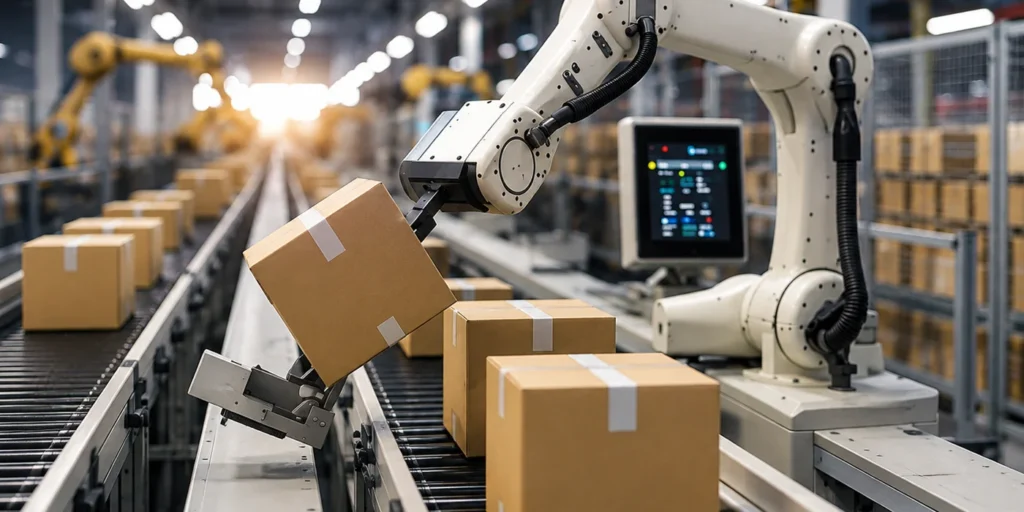
Using autonomous mobile robots (AMRs) in your warehouse is a very smart decision. AMRs expedite and improve common supply chain and logistical warehouse operations by a mile.
Implementing and managing mobile robots is not that different from training and supervising the human workforce. Though an AMR robot may not demand high wages, it still needs careful management and operational oversight.
If you’re a COO considering automating your warehouse with AMRs or have already made up your mind, consider what we have shared in this blog before you approve serious investments.
What are autonomous mobile robots?
AMRs are intelligent robotics solutions that can navigate the world around them independently. They fall within the ambit of physical AI.
The common perception of an AMR robot is of a small robot that carries boxes in a factory or warehouse. And it’s not wrong, but AMRs come in many different shapes and sizes.
AMRs can have wheels or legs to move around. Arms or no arms. It doesn’t matter. Technically, even a humanoid robot can be an AMR. Their primary job is to carry out a given task as instructed by the user.
AMR vs AGV
Autonomous guided vehicles (AGVs) are another type of robot that are used in warehouses for material transportation. AGVs are less sophisticated than AMRS. They are essentially self-driving cars that follow fixed routes that are designed for them using magnetic wires or tapes.
If there is an obstacle in the way of an AGV, it will stop moving unless you remove that obstacle. Moreover, AGVs have less onboard capabilities and are programmed using simple instructions.
AGVs are mainly used for fixed, repetitive tasks in warehouses, such as delivery tasks between production lines.
| AMR | AGV |
| Plans its own route dynamically | Usually follows a predefined route |
| Uses sensors such as LiDAR and cameras plus mapping software | Often relies on magnetic tape and wire. QR markers are also a modern option. |
| Can often detect the obstacle and find another route | If its route is blocked, it often stops and waits |
| Routes can usually be changed through software | Changing routes may require infrastructure or configuration changes |
How do autonomous mobile robots work?
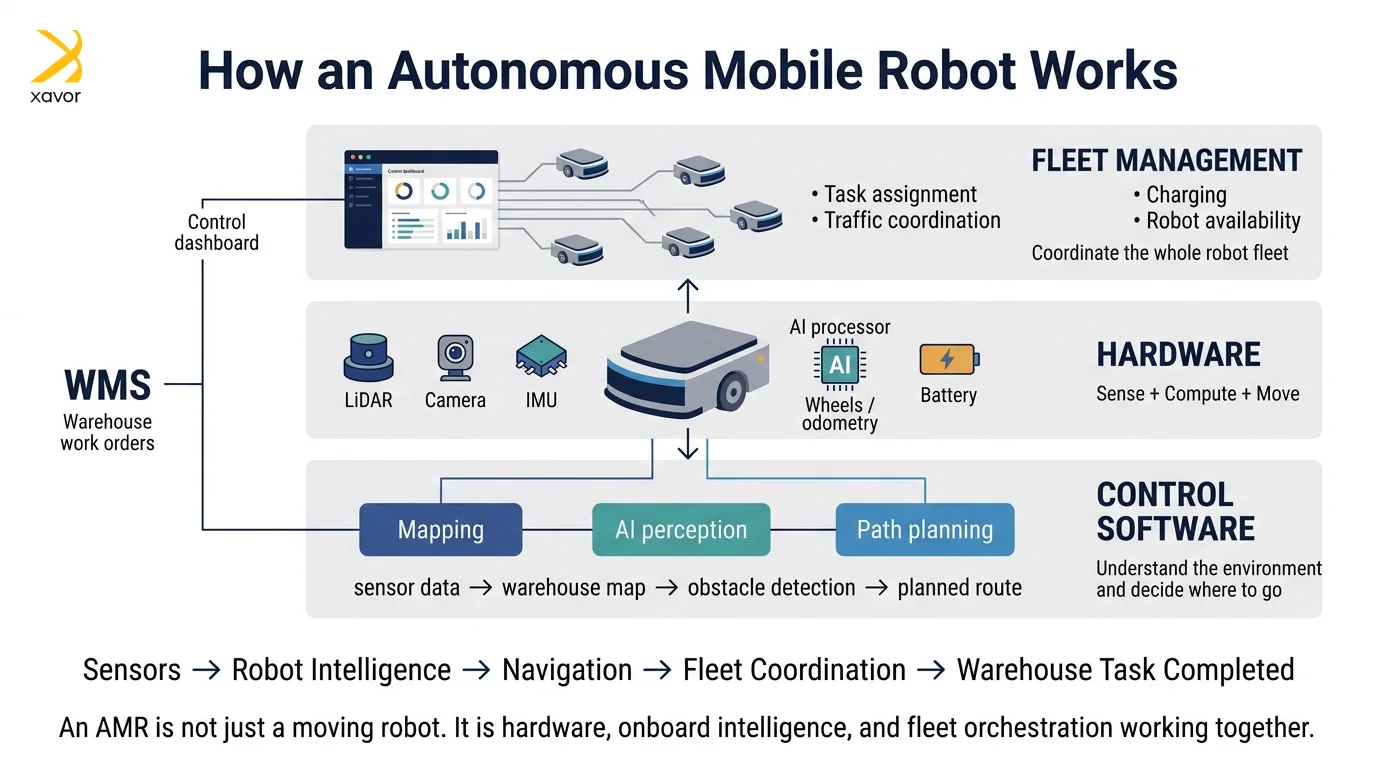
AMRs work by using three different components of their structure:
- Hardware
- Control software
- Fleet management software
1. Hardware
Sensors
Autonomous mobile robots use a variety of sensors to see the world around them. 2D and 3D cameras act as sensors. Gyroscope sensors are used for filtering out high-frequency bumps from rough flooring.
LiDAR, however, is the main sensor used in AMRs like other mobile robots. It provides precise, real-time 3D or 2D structural maps of the environment by firing millions of laser beams per second.
Inertial Measurement Unit (IMU) is an electronic device mounted on AMRs to monitor the robot’s acceleration and rotation.
Processors
Each AMR requires processors to, well, process the data taken in from the sensors. However, AMR processors aren’t just regular Intel desktop processors. The computational requirement for AMRs in warehouses is much more than running a video game at 100% settings.
Therefore, autonomous mobile robots these days use AI-specific processors and units. NVIDIA Jetson series is very popular in AMR development because it provides reasonable AI computing capabilities for mobile robotics.
Batteries
Most AMRs use lithium-ion batteries. So, they aren’t that much different in that regard to other electronics. However, AMR batteries do have one peculiarity. They are designed to be charged quickly without conventional charging connectors to keep up with the pace of 24/7 warehouse operations.
2. Control software
AMR mapping
The data from the sensors is used for AMR mapping. It is the process of creating a digital map of the physical space around the robot. AMR mapping is what enables a robot to find its way.
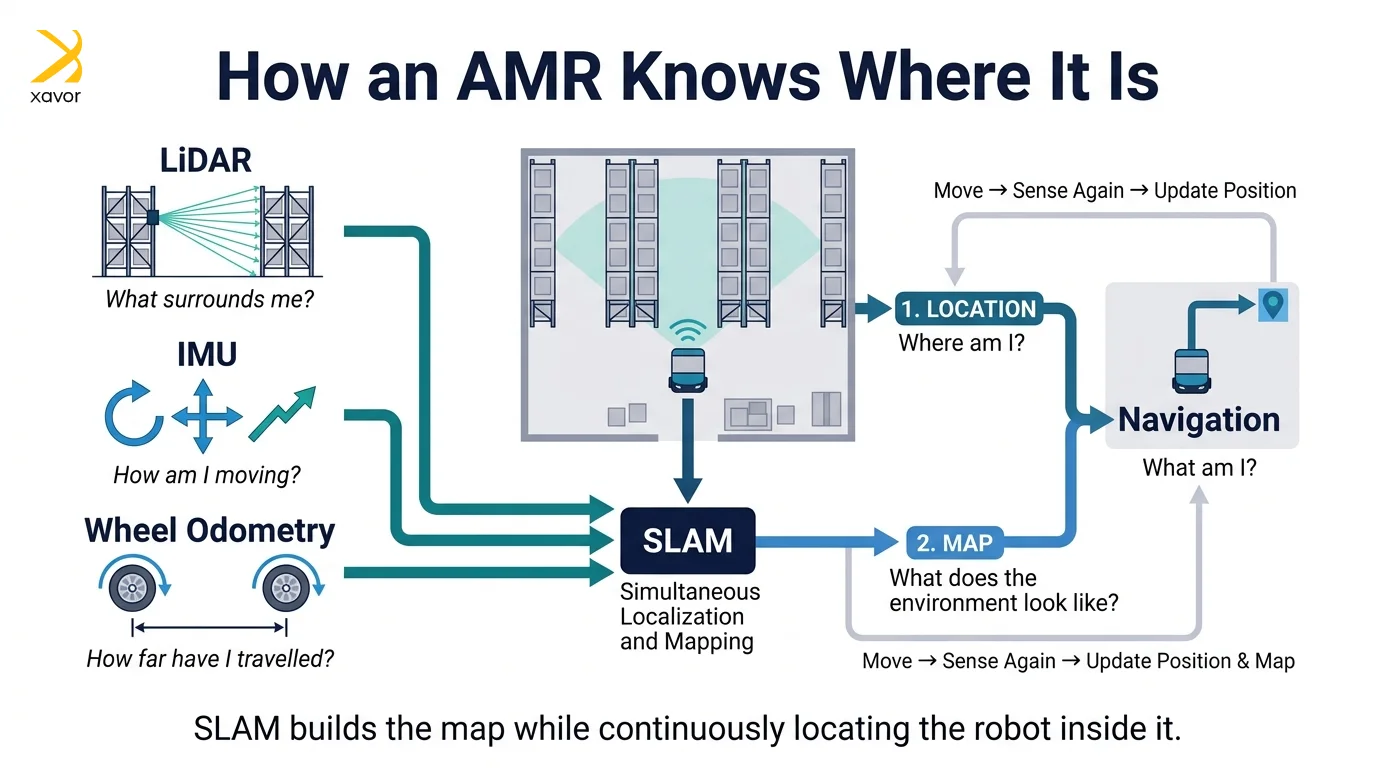
Methods of creating an AMR map are different. But SLAM (Simultaneous Localization and Mapping) is a common technique that builds a map while concurrently tracking where the robot is on the map right now.
Core data needed to create an AMR map:
- LiDAR data
- IMU data
- Wheel odometry data
Artificial intelligence
AI-based software solutions are embedded within AMRs to make them able to operate in the random, dynamic real world. Particularly in warehouses, where there is always a sense of rush and something can come in your way suddenly.
So, the robot must know how to avoid an obstacle. And it also needs to differentiate between different types of obstacles and how to react to each one. Artificial intelligence and machine learning helps give them this knowledge.
Autonomous mobile robots are a significant research field in AI circles since at least the 1970s.
Path planning algorithms
AMRs need path planning algorithms to move from their current place to the target position. There are a few main motion planning approaches used for AMRs, considering their obstacle-ridden working environment.
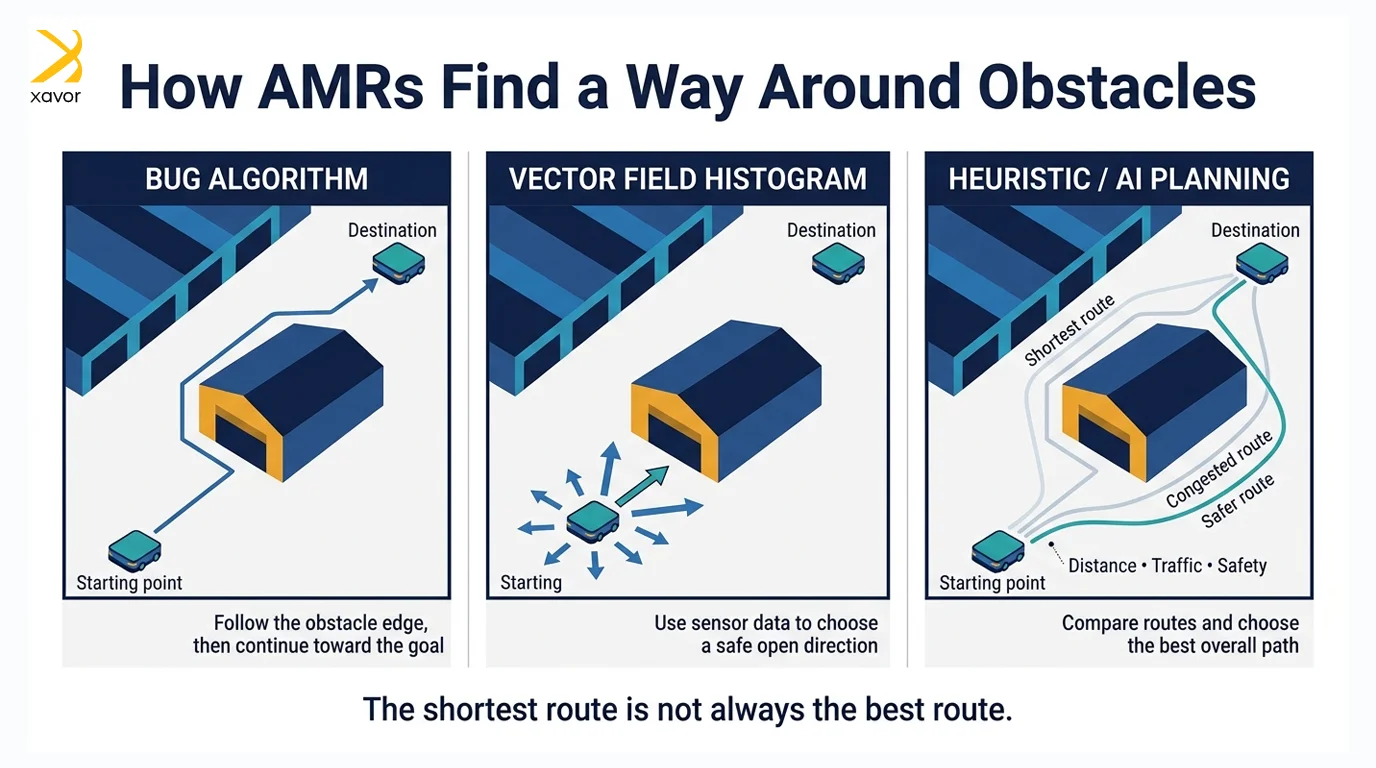
- Bug algorithms let the robot move around the edges of a detected obstacle and then return toward the destination once the path is clear.
- Vector field histograms (VFH) use sensor data to identify open spaces around an obstacle and choose a safe direction, while accounting for the robot’s own size.
- Heuristic and AI-based methods compare many possible routes and can consider more than distance, such as intersections and safety.
3. Fleet management software
Resource management
Warehouses use a whole fleet of AMRs. The fleets can have 100s of robots working day in and day out. So, a special set of management platforms or software is needed to give warehouse managers complete control over the fleet of mobile robots.
These platforms are often integrated with warehouse management systems (WMS). Managers or operations leads use management systems to ensure robots charge during quieter periods rather than simply going to charge whenever their battery gets low. Otherwise, it is possible that too many robots can become unavailable at the same time.
But more importantly, resource management systems determine the right number of AMRs in a warehouse. Too few robots can delay orders, while too many can create traffic and bottlenecks. Fleet size is calculated using warehouse systems.
Scheduling
Fleet management software also helps delegate work to different robots.
The WMS first decides what warehouse work needs to happen, such as which orders should be fulfilled. The fleet management system then handles the lower-level decisions, like assigning those tasks to specific robots and coordinating their movement.
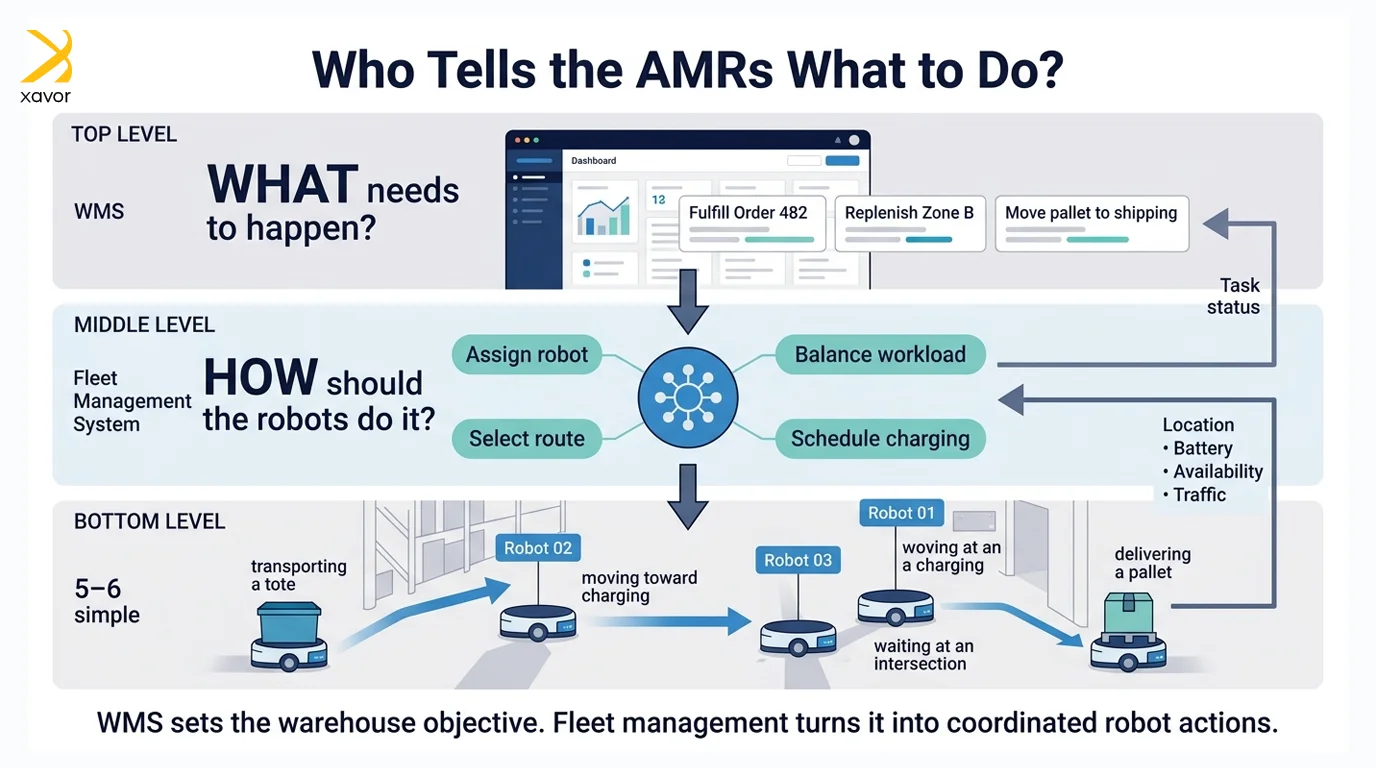
The challenge is that a warehouse is constantly changing. Because of this, simple first-come-first-served scheduling is often not enough. More advanced systems use optimization or AI-based methods to balance workloads and coordinate human-robot interactions.
Use cases that justify the ROI on warehouse AMRs
Deploying autonomous mobile robots just to keep up with the time is a case of doing the right thing for the wrong reasons.
You might be surprised that only a fraction of warehouses used robots in the UK in 2025. So, if you’re considering autonomous mobile robots for your warehouse to stay “competitive”, warehouses are still run by humans.
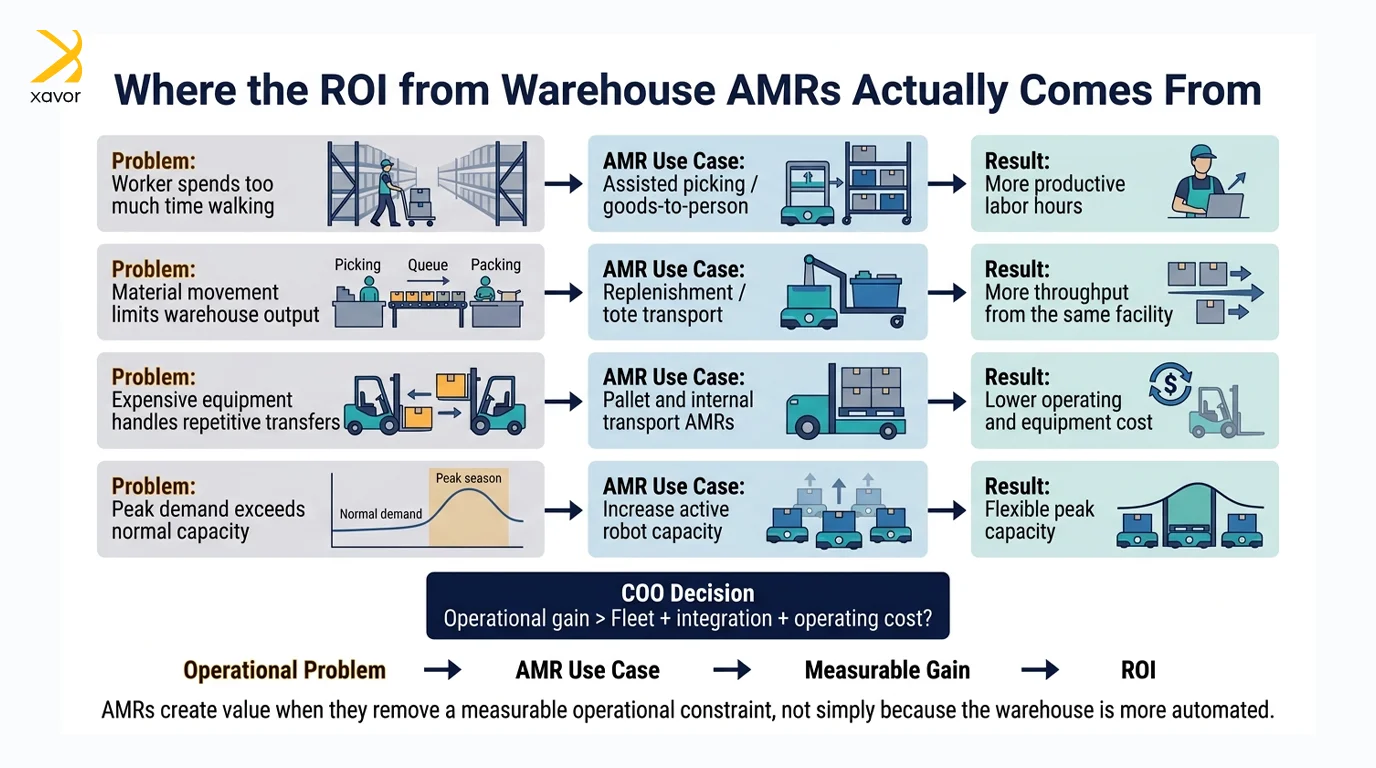
The true value of autonomous mobile robots in the warehouse is in tangible results that justify the economics and operating conditions.
There are four major ROI pools in warehouses that COOs can be interested in:
- Labor productivity
- More throughput from the same warehouse
- Avoided equipment and operating costs
- Peak capacity and flexibility
1. Labor productivity
The clearest ROI autonomous mobile robots can give often comes from reducing the amount of paid time employees spend on menial, banal work instead of actual productive work that generates value.
Assisted picking: The AMR travels between pick locations or carries the order while the picker focuses on picking. The employee spends less time walking long distances or pushing a heavy cart.
Goods-to-person picking: AMRs bring inventory, racks, or totes directly to a picking station. Instead of the worker traveling to the product, the product comes to the worker.
Tote and carton transport: Once an order or tote is complete, an AMR can take it to consolidation, packing, or sortation rather than having the picker leave their zone to deliver it.
Replenishment: AMRs can move replenishment stock from reserve storage toward picking locations, reducing the amount of time employees spend on internal transport.
2. More throughput from the same warehouse
Sometimes the biggest autonomous mobile robots return is in capacity.
A warehouse may be approaching its maximum output, but the constraint is not necessarily shelf space. It may be how quickly goods can move between receiving, storage, picking, packing, and shipping.
Goods-to-person: Inventory continuously arrives at workstations, allowing pickers to process more orders without spending time travelling through the warehouse.
Assisted picking: Pickers remain focused in productive zones while robots move completed orders and bring the next work.
Replenishment: AMRs can keep forward-pick locations supplied, reducing situations where pickers stop because the item they need has not been replenished.
Tote/carton transport: AMRs move completed work quickly between picking, consolidation, packing, and sortation.
Staging and shipping: Finished orders or loads can be transported to outbound staging without waiting for an employee or forklift to become available.
3. Avoided equipment and operating costs
Warehouses use relatively expensive equipment and human operators for very simple movements. A forklift might spend large portions of its day carrying the same pallet between two predictable locations.
That may work, but it is not necessarily the most economical use of either the forklift or its operator. Autonomous mobile robots can save these costs.
Pallet transport: Pallet-moving AMRs can handle repetitive transfers between receiving, storage, production, replenishment, staging, and shipping.
Tote/carton transport: Smaller AMRs can replace some repetitive cart, tugger, or manual transport movements.
Returns and internal logistics: Robots can move returns, empty containers, packaging, waste, components, or other materials between departments.
4. Peak capacity and flexibility
This is one of the most strategically important autonomous mobile robot benefits because warehouses rarely operate at one constant level of demand.
A facility might handle normal demand comfortably for ten months and then struggle badly during peak season. Traditionally, the response is to hire temporary workers, add overtime, rent equipment, or add another shift.
Autonomous mobile robots give you another lever.
Assisted picking: Additional AMRs can support more pick activity without requiring the same increase in walking and cart handling.
Tote/carton transport: More robots can be put into service when significantly more orders must move between picking and packing.
Replenishment: Additional transport capacity helps keep forward-pick locations supplied when inventory is moving much faster.
Staging and shipping: AMRs can absorb higher outbound movement during periods when shipping areas experience intense demand.
Types of autonomous mobile robots to deploy in wearhouses
Different autonomous mobile robots are built for different warehouse jobs. Roughly, there are around 6-8 AMR robots used in warehouses mainly for material handling tasks.
| Type | Typical work | Avg. payload capacity |
| Platform AMRs | Transport loaded boxes or SKUs | ~60–600 kg |
| Tugger AMRs | Pulling multiple carts for stock replenishment | ~1,000–7,000 kg |
| Pallet Jack AMRs | Picking pallets from the floor and moving them to the target | ~1,200–2,000 kg |
| Forklift AMRs | Moving and lifting pallets from ground level to higher storage | ~1,200–2,000 kg |
| Sortation AMRs | Parcel sorting, e-commerce fulfillment, and returns handling | ~8–100 kg |
| Conveyor AMRs | Transferring cases or materials between conveyors and production lines | ~50–200 kg |
| Goods-to-Person AMRs | Zone picking and moving racks/carts to workers | ~200–1,200 kg |
Conclusion
Autonomous mobile robots deliver the most value when they solve a clear operational problem. It could be reducing unnecessary worker travel or increasing throughput. Automating repetitive material movement or adding capacity during peak demand.
The right robot and fleet size should therefore be driven by your warehouse economics. Xavor helps you find that perfect combination to turn your business case into practical warehouse automation.
Contact us at [email protected] to explore warehouse automation with Xavor.