

Modern manufacturing industries generate enormous amounts of data. And a huge chunk of that pile of information is related to domains outside of the factory floor, like customer service and supply chain management. Salesforce Agentforce provides AI solutions for centralizing these customer-facing and manufacturing operations.
Usually, several teams in a standard manufacturing unit are all working on the same piece of data. But they do so in complete isolation, which hinders accurate decision-making for a product. Salesforce provides the latest IT solutions for the manufacturing industry to remove those silos with the introduction of Agentforce Manufacturing.
In this blog, we’ll dissect how Salesforce Agentforce does that to improve your manufacturing processes.
Salesforce for manufacturing: The different products
Okay, you need to bear with us because Salesforce’s branding can get confusing. They occasionally rebrand products, so you can lose track of what’s actually new and what’s just renamed.
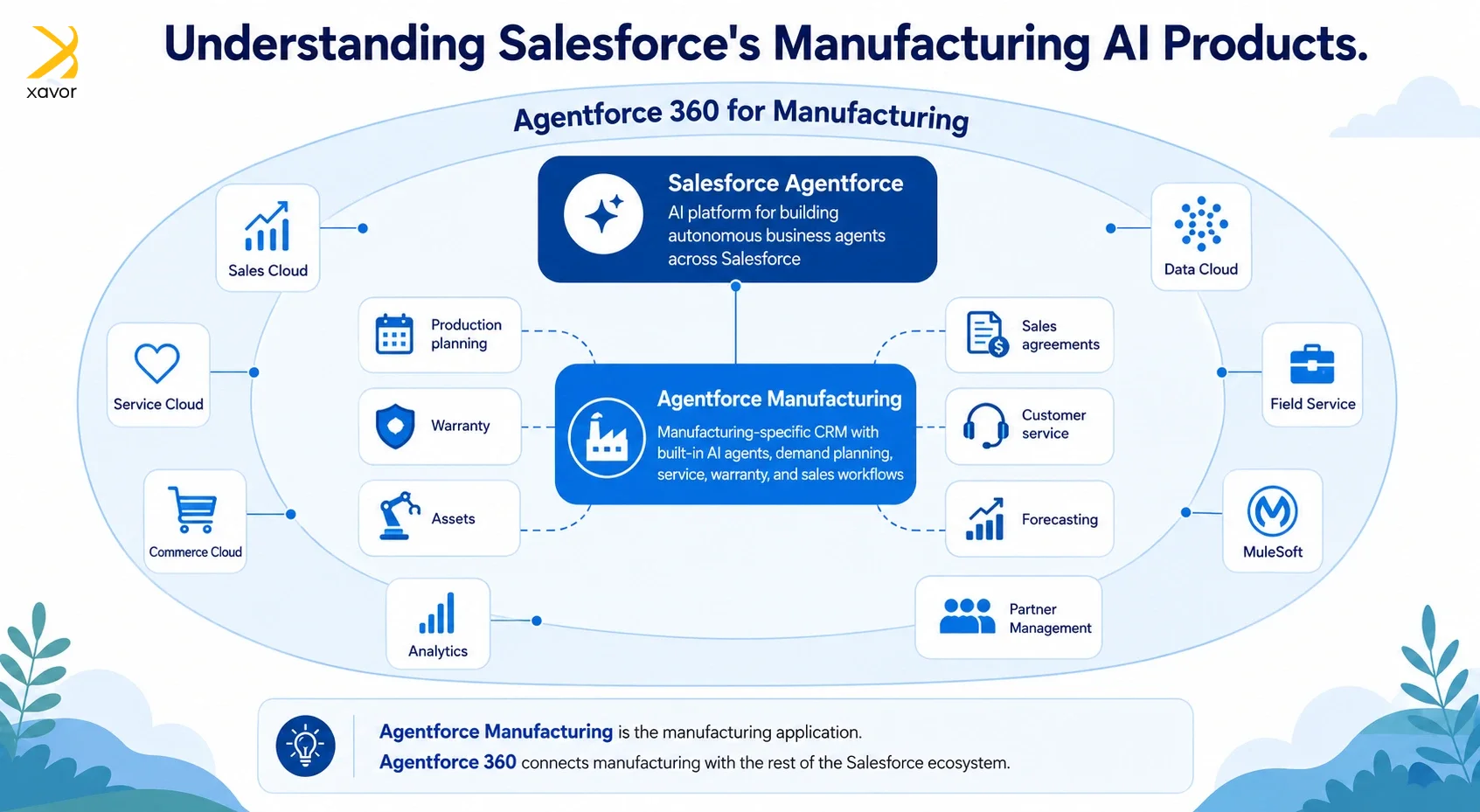
Therefore, we will be discussing these different but similar-sounding platforms ahead.
- Salesforce Agentforce
- Agentforce Manufacturing
- Agentforce 360 for Manufacturing
What is Agentforce Manufacturing?
Salesforce Agentforce is a relatively new platform that lets you create AI agents to automate routine tasks within the Salesforce CRM. You can use Agentforce to deploy agents in any of the Salesforce Clouds, including the Manufacturing Cloud.
But it’s no longer called the Manufacturing Cloud. Salesforce Manufacturing Cloud has been rebranded to Agentforce Manufacturing since September 2024. It’s basically the old Manufacturing Cloud integrated with Salesforce Agentforce. So, you get pre-built agents and agentic workflows already designed for manufacturing concepts.
If you’re already using Manufacturing Cloud, you get access to Agentforce agents without migrating to a separate system.
Things you can do with Salesforce Agentforce Manufacturing
Agentic AI in manufacturing is one of the latest trends moving the industry forward. So, it was expected that a name like Salesforce would not take long to extend its agentic platform to manufacturers.
And they have done an excellent job since you can do all of this using Agentforce Manufacturing:
1. Deploy manufacturing-specific AI agents
Instead of building AI agents from scratch, Salesforce provides prebuilt, role-based agent templates for common manufacturing functions.
So, you can build one agent for inventory management and another one for service operations with little effort. And their modular design also means that you can customize them for your own specific processes.
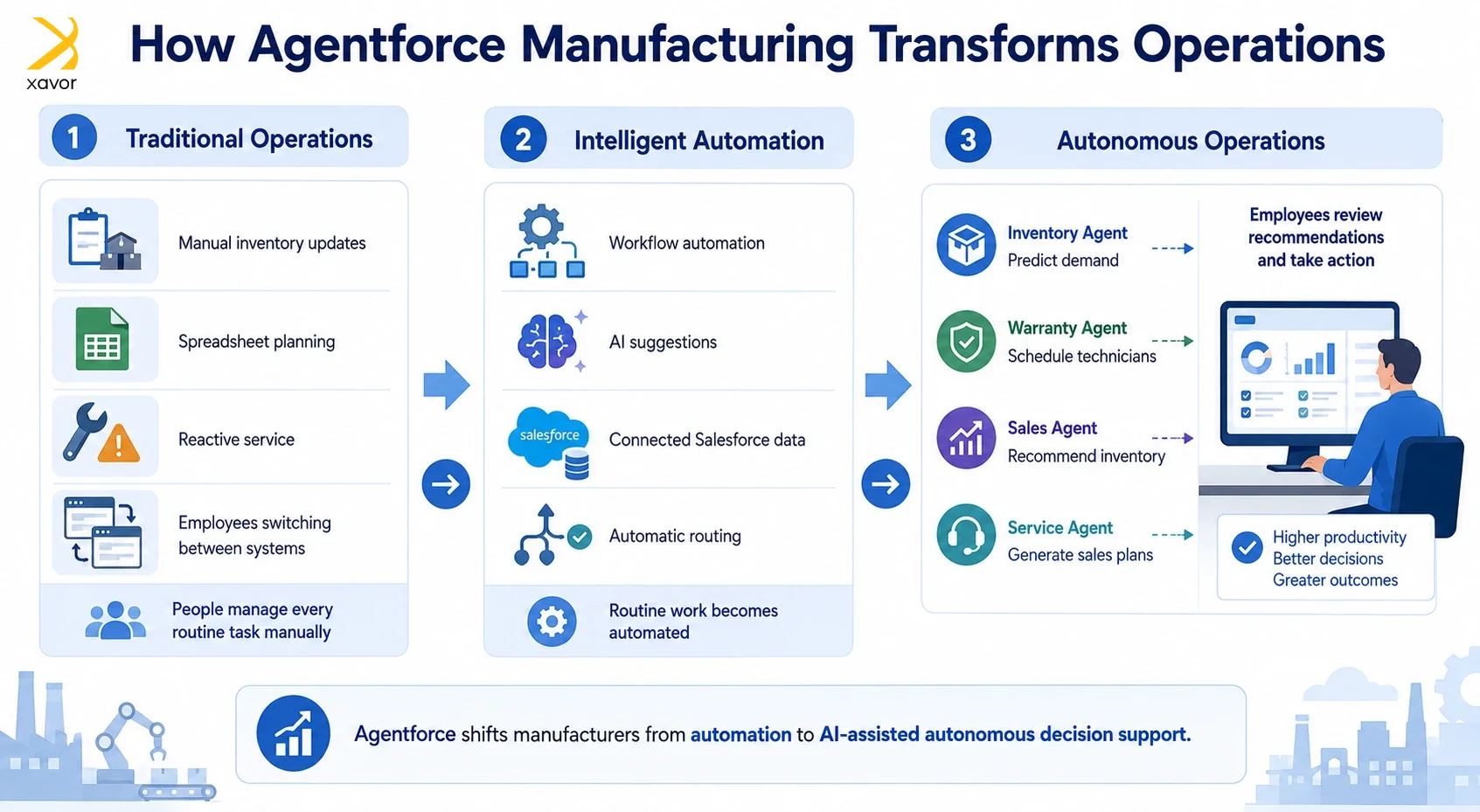
2. Upgrade to autonomous intelligence
Agentforce Manufacturing takes you from traditional automation to intelligent automation. For example, traditional manufacturing software solutions for automation like RPA (Robotic Process Automation) can get stuck if they encounter any new challenge that they aren’t programmed for.
But agents created using the Agentforce platform can actively support day-to-day operations with independent, autonomous thinking. Their goal is to automate routine work so employees can focus on higher-value decisions.
3. Service proactively instead of reactive
Normally, field service in manufacturing units is a reactive process. Only when a machine breaks, someone reports it, and a technician gets assigned to order replacement parts further down the line. So, by the time anyone’s actually fixing anything, the equipment’s already been out of service for a while.
Agentforce Manufacturing gets ahead of that. IoT sensors watch the equipment around the clock, and the AI agents catch warning signs before the machine actually fails.
Once they spot something, the right technician is assigned, with the required parts sorted out mostly on their own. Therefore, you get less downtime due to equipment failures.
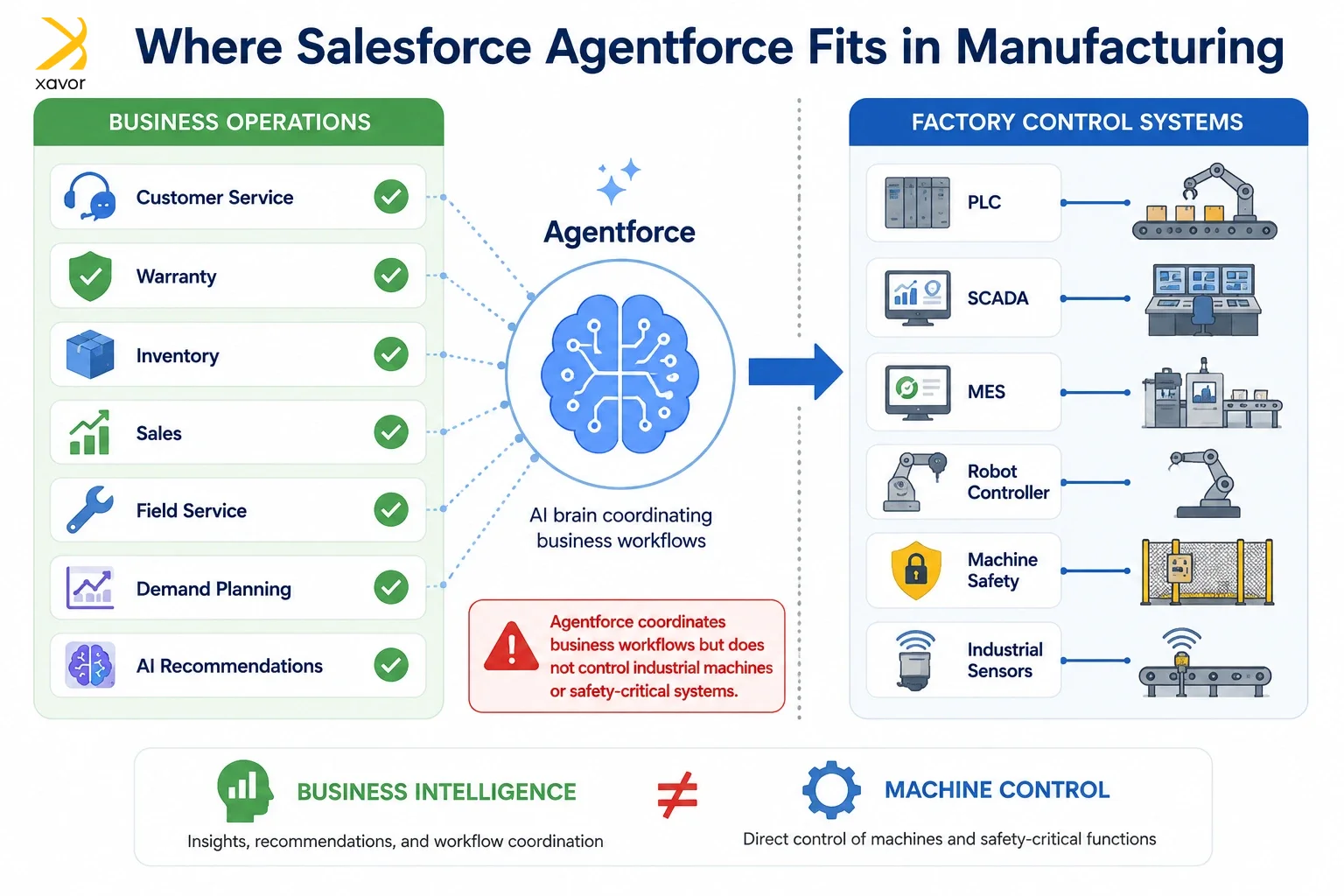
Disclaimer: Don’t use Salesforce Agentforce for this thing
Agentforce is not factory-floor control software. It works with manufacturing data and business workflows. Salesforce positions it around commercial and operational business processes. Salesforce Agentforce can interpret information and perform actions for these tasks.
But factory control belongs to a different class of technologies that interact directly with the physical process and carry strict requirements, such as:
- PLCs
- Robot controllers
- SCADA
- MES
- Machine-safety systems
- Real-time industrial control
You can use Salesforce Agentforce to help coordinate business workflows around them, but safety-critical and real-time machine control normally remains within specialized industrial systems.
Integrating Salesforce Agentforce with other Salesforce Clouds
Manufacturers can connect Salesforce Agentforce with additional Salesforce Clouds to improve several other operations as well.
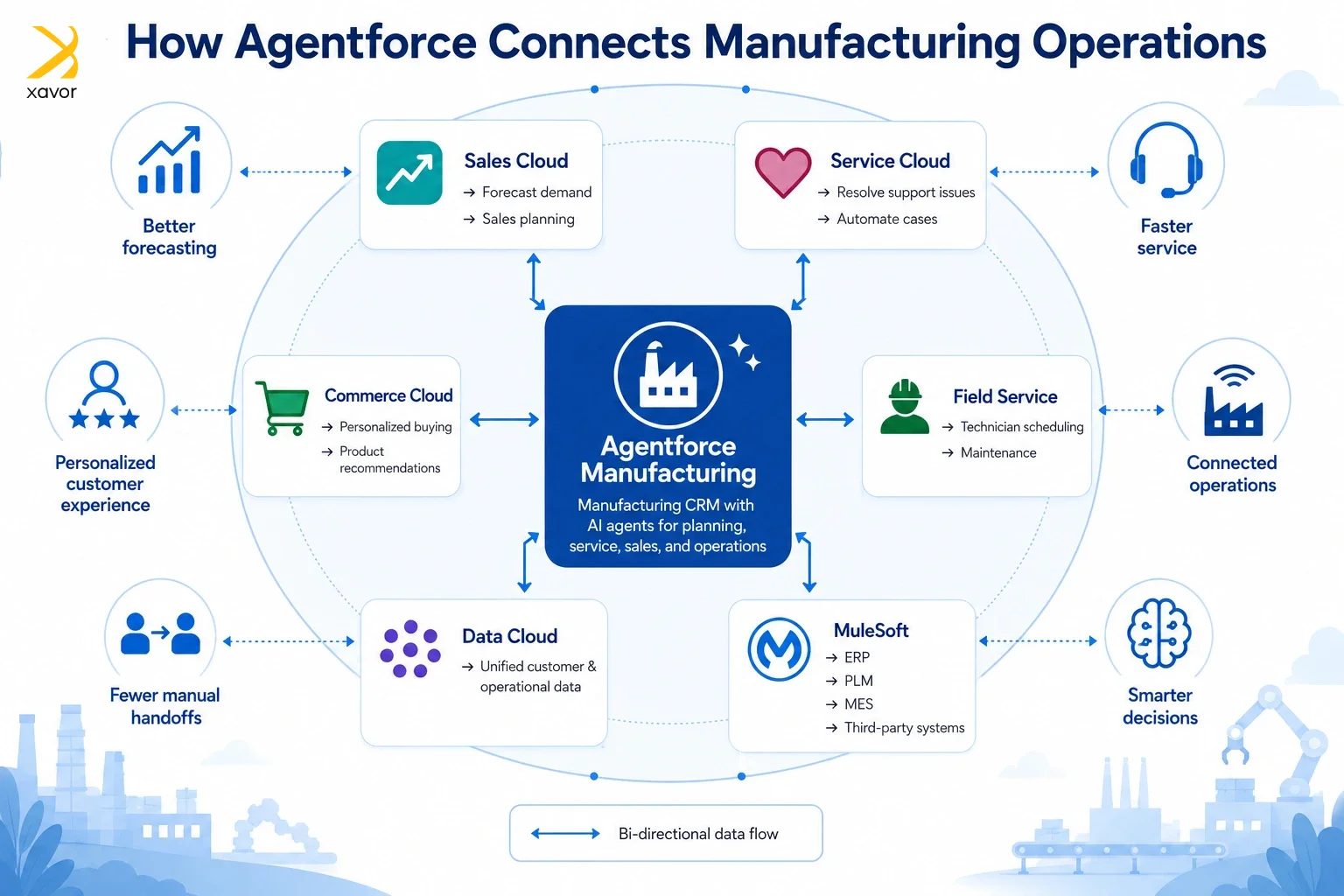
1. Sales Cloud
Sales Cloud stores customer and sales data. When integrated with Agentforce, AI analyzes this data to predict future demand more accurately. Manufacturers can use these insights to adjust production schedules, allocate resources, and prepare inventory before demand changes.
Agentforce also helps sales teams by creating personalized action plans for important deals.
2. Commerce Cloud
Commerce Cloud powers manufacturers’ online stores. When combined with Agentforce, AI analyzes customer behavior to deliver personalized product recommendations and targeted shopping experiences.
This helps manufacturers increase customer engagement and drive repeat purchases across both B2B and B2C channels.
3. Service Cloud
Service Cloud manages customer cases and support requests. Agentforce helps support teams resolve issues faster by suggesting solutions, summarizing case histories, and automating repetitive tasks.
Agentforce Manufacturing vs. Agentforce 360 for Manufacturing: What’s the difference?
So, here it gets more confusing. We’ll cut right to the chase to spare you from unnecessary complexity. As mentioned earlier, Agentforce Manufacturing is the new name for Manufacturing Cloud. Agentforce 360 for Manufacturing, on the other hand, covers the full Salesforce product set for manufacturers.
The difference is scope. Agentforce Manufacturing fits companies that need manufacturing-specific CRM processes inside Salesforce. Agentforce 360 for Manufacturing fits companies that want those processes connected with service operations, partner channels, analytics, and other enterprise systems.
| Area | Agentforce Manufacturing | Agentfore 360 for Manufacturing |
| Scope | The manufacturing industry application formerly called Manufacturing Cloud | The full set of Salesforce products for manufacturing |
| Core Components | Manufacturing data model, applications, business logic, user interfaces, and AI agents | Agentforce Manufacturing plus products for field service, partner management, analytics, collaboration, and integration |
| Main Use | Manage manufacturing sales and service processes, including demand forecasts, sales agreements, warranty claims, assets, and customer support | Coordinate work and data across several departments, Salesforce products, and connected business systems |
| Agent Coverage | Agents work within manufacturing-specific workflows | Agents can work across manufacturing, service, customer engagement, and other enterprise workflows |
| Best Fit | Industrial units that need industry-specific CRM processes and agents | Manufacturers that need agents to use information and trigger actions across a wider set of business functions |
Salesforce Agentforce must gel with the wider manufacturing tech stack
Manufacturing data isn’t confined to just one platform. PLM software, for example, controls everything related to product requirements and engineering changes. Furthermore, modern factories use industrial IoT devices to collect machine and asset data.
Therefore, Agentforce Manufacturing becomes useful when it can read the right records across those systems and take an approved action. Salesforce says its manufacturing agents can use structured and unstructured industry data from multiple sources, including third-party manufacturing and asset data.
How Xavor helped an automobile manufacturer implement Salesforce Agentforce
One of our clients built and serviced automobiles, and their reps were dealing with 250-300+ documents per vehicle. Both needed to identify the right part or fix it fast, but the information they needed was all over the place.
A parts database was mixed with engineering docs and ISO references. And much of this equipment came from third-party suppliers, so resolving an issue meant hunting through documentation the company didn’t originally produce.
Xavor was engaged to load their vehicle documents into Agentforce, so it could:
- Help the parts engineer find the right spare part by searching structured data first, then falling back to unstructured documents, and surfacing the exact reference page.
- Make life easy for the warranty engineer by triaging customer-reported issues by walking through fault modes grounded in ISO documentation, then pulling vessel-specific solutions.
The project’s success hinged on both clean, text-based documents and scanned/image-heavy ones. We handled all of the work of document normalization, OCR pipelines, and structuring unstructured content before it ever hits the agent sprint.
Moreover, our experts narrowed the scope by unit/customer or document source upfront to improve search performance dramatically.
The change showed quickly with faster, more accurate retrieval across mixed structured/unstructured data.
Conclusion
Manufacturing never runs out of data. And that data must constantly feed into timely decisions across the manufacturing lifecycle. Agentforce manufacturing represents Salesforce’s attempt to solve that problem by embedding AI agents into the workflows where those decisions are made.
However, the technology is only one piece of the puzzle. An AI agent can only be as effective as the data and processes behind it. That’s why proper Salesforce Agentforce implementation becomes just as important as the platform itself.
Xavor helps manufacturers implement Salesforce Agentforce properly to build AI experiences grounded in trusted business data.
Talk to our Salesforce specialists by dropping us a line at [email protected] to design an Agentforce implementation that fits your manufacturing environment and integrates with your existing systems.

FAQs
No, Agentforce Manufacturing is the evolution of Salesforce Manufacturing Cloud, with AI agents built into the platform. Existing Manufacturing Cloud customers can adopt Agentforce capabilities without migrating to a separate application.
Yes, Agentforce is designed to work alongside enterprise systems such as ERP, PLM, MES, and IoT platforms. Integrating these systems gives AI agents access to the data they need to automate workflows and provide more accurate recommendations.
Implementation timelines vary based on your existing Salesforce environment, data quality, integrations, and business processes. A phased rollout typically delivers faster value while reducing implementation risk.