

We get asked one question a lot while developing physical AI initiatives. And we’re sure CTOs reading this can resonate with us because this question comes up a lot in boardroom meetings one way or another.
When you want to adopt physical AI robotics, should you build knowledge internally, buy expertise/technology externally, or partner with physical AI development services? It is colloquially coined as the “build, buy, or partner” conundrum. Every head of any AI project has to know the answer to this quandary.
In this piece, we’ll give our two cents on this topic for physical AI initiatives specifically. Let’s walk through all three paths to know which one is the right call for you.
The three paths: Make, buy, or ally
Your early AI choices are bets that either pay off or lock you into catching up later. So, you need to choose wisely between these three paths for your physical AI project early on.
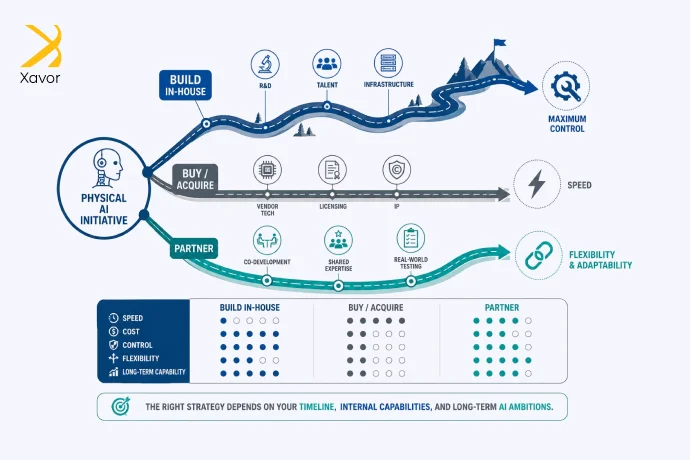
- Build in-house
- Acquire tech or talent
- Find a deployment partner
Remember that there is no time to do experiments. You need a clear decision framework to pick the right strategy from the get-go.
1. Build in-house
Building in-house means creating your own physical AI capabilities, totally relying on your internal teams. You will develop the capacity required to understand, integrate, and operate physical AI systems all on your own, such as:
- Internal R&D
- Employee training
- Software and hardware
- Digital infrastructure
- Technical expertise
- Organizational routines
The biggest upside of building in-house is control. You get something tailored exactly to your workflows and requirements. But it’s the slowest of the three approaches and demands internal talent that everyone may not have.
Not to mention, sometimes the market moves faster than you can build. What takes you a year to build in-house might just show up as a feature in someone else’s platform next quarter.
2. Acquire tech or talent
Buying means using physical AI platforms or technologies of third-party vendors instead of building your own. And sometimes it may also involve hiring consultants to gain access to knowledge that might be too expensive or difficult to develop internally.
If you “buy” externally for your physical AI project, you typically get:
- External R&D
- Licensed technology
- Intellectual property
- Specialist consulting
- Vendor expertise
- Ready-made technical solutions
Acquiring external tech or talent is significantly faster for developing physical AI systems because the burden is off your shoulders now. However, off-the-shelf solutions don’t always fit your business exactly. And you have to share your proprietary data with the external vendor, which creates dependency and security concerns.
3. Find a deployment partner
The third option is to find an ally. There are many physical AI development firms that collaborate with you to jointly design and implement the physical AI product. Note that this is different from acquiring tech or talent, where you make one-time purchases instead of working jointly.
Now, you don’t have to work with just one ally. If you can find one deployment partner that does everything, that’s great. But usually, companies work with several partners for each aspect of the physical AI development lifecycle.
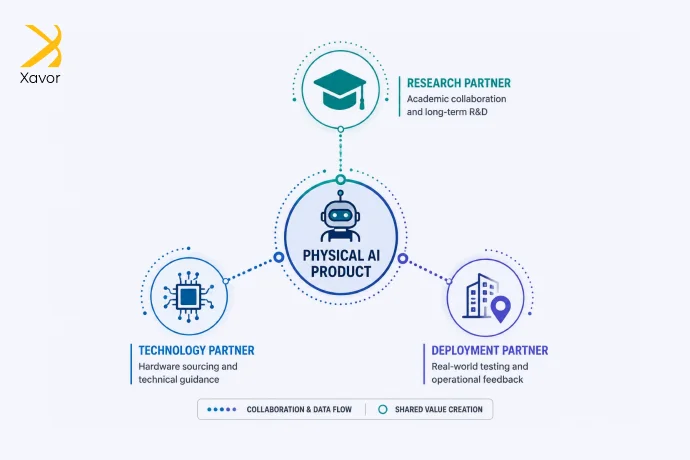
For example, to build our embodied AI social care companion, Navi, we partnered with the following:
- Universities like Case Western Reserve for research collaboration
- NVIDIA Inception Program for technical guidance and hardware sourcing
- Judson Senior Living for real-world testing
These are active collaborations that helped us develop and deploy Navi.
What AI leaders should do: Xavor’s perspective
If you just want a straight answer between the three options, we’d say partnering is usually the best choice because it has the advantages of the other two options as well.
It beats building alone by bringing in ready-made multidisciplinary teams, so you move fast without skipping the hard enterprise-readiness work. Partnering also tops buying because a partner doesn’t squeeze your business into a vendor’s constraints.
Having said that, the choice doesn’t necessarily have to be an either-or situation. A hybrid approach where you go with each option during a certain phase of the physical AI development lifecycle is often the best decision.
The hybrid physical AI staffing model
Think outside of the usual framing of the build, buy, or partner question altogether. The three options play different roles, and the strongest operating model combines all three.
1. Make to absorb
Building internally does not mean you have to build every model or sensor for the robot yourself from scratch. Start with developing the internal capability to make good decisions about your physical AI project.
That means identifying:
- The business problem the robot should solve
- The process that will change
- The data and systems involved
- Who will own the initiative?
- How success will be measured
- What safety and governance requirements apply
Your internal team should map the current process and improve data readiness. Furthermore, assign them to define the integration architecture and decide how employees will be trained.
In this way, internal R&D mainly functions as a readiness and integration capability rather than the sole engine of adoption.
Here’s a table showing what you should own internally:
| Business ownership | A business unit that is responsible for the outcome |
| Domain knowledge | Internal employees who understand the products and operational constraints that external vendors may not know |
| Data readiness | The provenance of operational data along with its reliability and access controls |
| Integration architecture | Internal teams with a clear plan for connecting the robot with other enterprise systems |
| Governance and safety requirements | You must define the guardrails and governance policies of the physical AI system |
| Testing and acceptance criteria | Have internal clarity about what the system must demonstrate before it is considered production-ready |
2. Buy what’s risky to do yourself
Only buy external physical AI tools or platforms if building them internally is either too slow, expensive, risky, or a combination of these factors.
Buying external tools for physical AI is one of the most consistent accelerators of AI robotics adoption once you understand your internal requirements. External providers help companies gain access to capabilities that would otherwise require significant hiring and infrastructure investment.
Some common ready-made solutions that you can purchase for your physical AI project include:
- Robot hardware
- Sensors and cameras
- Safety technologies
- Control software
However, buying should not mean that you let the vendor handle everything. You need to ensure technical fit, interoperability, and lock-in risk before you choose a third-party vendor to buy from.
3. Choose an ally carefully
Active collaboration with a deployment partner is generally associated with higher AI robotics adoption. But not all partnerships work equally well.
Physical AI systems operate in highly specific environments. A warehouse robot and a healthcare robot may share technologies, but their workflows and performance requirements are completely different.
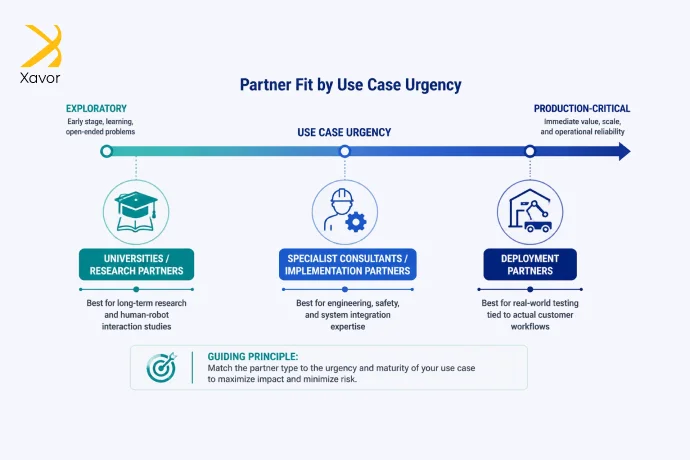
That is why you should choose your deployment partner based on real use cases. Moreover, customer collaboration is the clearest relationship with adoption. Customer collaboration prevents the R&D team from building a technically impressive robot that does not fit the customer’s workflow.
Another important ally to have is a specialist partner. Specialist consultants and implementation partners can contribute to:
- Robotics engineering
- AI model adaptation
- Embedded development
- Simulation
- Functional safety
- OT/IT integration
Their role should not be to create permanent dependence. A strong partnership should leave the internal team more capable than it was before.
Finally, collaborate with universities where appropriate. Universities and research institutions are valuable for human–robot interaction and long-term research. However, they are generally more suitable for exploratory work than urgent production deployments.
Closing remarks
Ultimately, CTOs have to take ownership of a physical AI project whether a company goes for the build, buy, or partner approach. And it’s not a one-time decision. As the robot encounters new products and operating conditions, organizations will have to repeat the cycle.
Therefore, the strongest physical AI strategy is not necessarily choosing one of the three. It is deciding what your company must own internally, what it should acquire, and where collaboration will shorten the path to production.
It takes a great bit of prudence to know when and where each option is the best choice. And it’s a bit unfair that there is very little time to make this decision.
Xavor helps you make those crunch decisions in physical AI development. Our physical AI engineering pods directly embed with your project to opt for the best route possible to ensure your physical AI pilots reach production successfully.
Take AI out of the screens and into the real world now. Get in touch.

FAQs
A hybrid approach is often the most practical: buy mature hardware or foundational platforms, build the capabilities that differentiate your business, and use partners for integration and deployment. The right balance depends on strategic value, time to market, internal skills, compliance, and long-term maintenance.
Robotics-as-a-Service can be better when you want to avoid high upfront capital costs and shift maintenance, upgrades, and technical support to the provider. Purchasing may make more sense when utilization is predictable, customization is substantial, and long-term ownership offers better economics.
Organizations should normally retain ownership of the business case, operational knowledge, data governance, safety requirements, integration architecture, and acceptance criteria. External providers can supply technology and specialist expertise, but accountability for outcomes and risk should remain internal.