
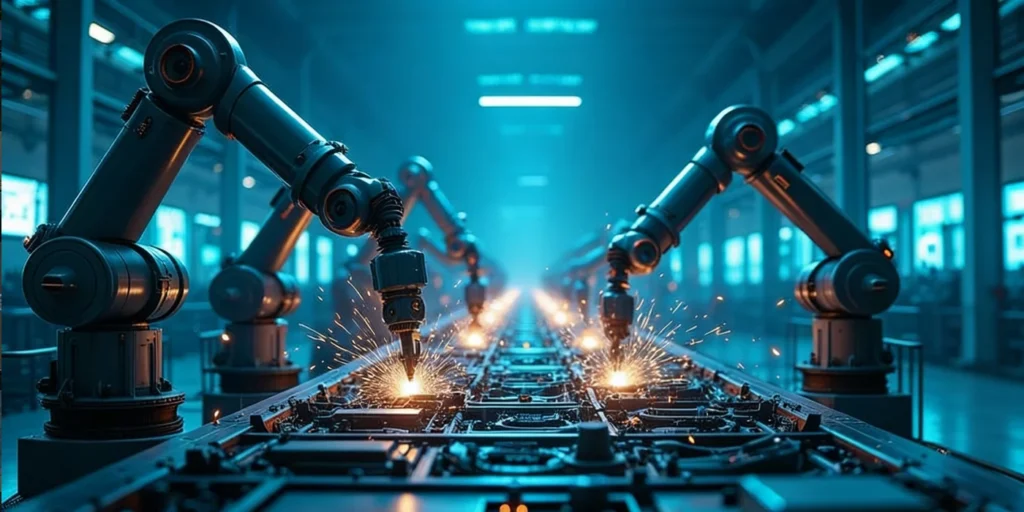
Industrial manufacturing is one of the toughest things to do in the world. It requires extremely high levels of precision and efficiency. That is why very few countries today have a proper industrial base.
And the few who do have historically focused on automation to have this capability. Henry Ford and his lean manufacturing approach are good examples of how automation makes manufacturing more viable.
But now, agentic AI in manufacturing is taking precedence over simple automation in manufacturing. Industries now want smart manufacturing solutions that don’t just follow fixed rules.
They are building on the traditional capabilities of AI to infuse a degree of autonomy in manufacturing systems to mass-produce goods.
In this blog, we’ll unpack this ongoing agentic shift in manufacturing. We’ll track this transition from automation to autonomy and explore some agentic AI use cases in manufacturing.
Historical phases of industrial manufacturing
We won’t be talking about the four industrial revolutions in this section. They are larger economic and technological periods that are beyond the ambit of this blog. Instead, we’ll be looking into the micro view of how manufacturing specifically changed during these periods.
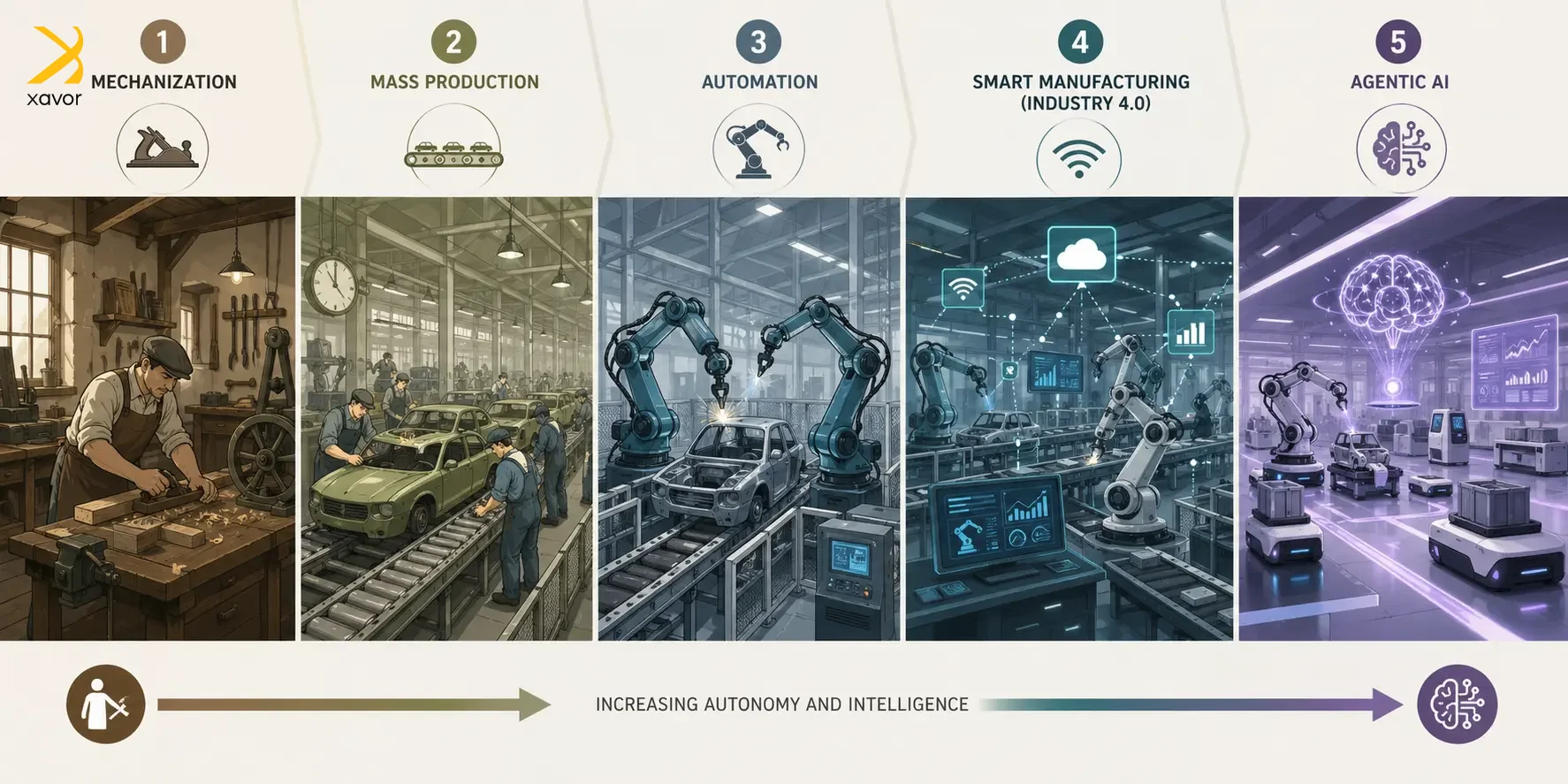
This historical context will help you understand that agentic AI in manufacturing didn’t just come out of nowhere. It is a natural juncture in the continuous evolution of manufacturing processes.
1. Mechanization
This is the first phase of industrial manufacturing that started with the Industrial Revolution in the late 18th century. It was the time when production was moving away from individual craftsmen to factories and workshops.
2. Mass production
Then came the 20th century, and now countries wanted to produce the same thing faster and cheaper. That is why manufacturing became more systematized and predictable to increase efficiency and reduce cost.
Ford’s lean manufacturing through assembly lines in 1913 is the highlight of this era.
3. Automation
The mid-20th century was the moment when automation truly became the linchpin of manufacturing. It was one of the impetuses in the previous periods as well, but it was a means to an end.
This period saw the introduction of industrial robots, widespread use of control systems, and processes that required minimal human intervention.
4. Digitization and smart manufacturing
This phase of manufacturing is given the term Industry 4.0. It started with things like IoT, digital twins, and cloud computing entering factory floors. The shift this time was that manufacturing systems could monitor and analyze themselves.
5. AI-driven manufacturing
Now, we are in the era of autonomous manufacturing through things like agentic AI in manufacturing. An autonomous factory goes beyond rule-based automation. Instead, it can adapt and make decisions to handle unexpected situations with minimal or no human intervention.
How agentic AI in manufacturing works?
Agentic AI applications in manufacturing proactively assist workers with reasoning and decision-making capabilities. They have contextual awareness of the workflows they are designed to handle.
That is unlike regular automation in manufacturing, like robotic process automation (RPA) that follows rules-based options. And it breaks the moment something unusual comes up that it isn’t programmed to handle.
Here’s how agentic AI solutions actually do that in real-time.
1. Sensing operational conditions
Agentic AI systems continuously perceive and interpret signals from operational areas using sensors and industrial IoT devices. These signals could be from machines on the factory floor or data from inventories. The purpose here is to create a goal-aware understanding.
2. Evaluating the course of action
In the next step, smart manufacturing solutions decide what to do next based on all the gathered signals. They infer the relevant conditions from that information and make trade-offs considering all the constraints.
3. Acting across workflows
Agentic AI in manufacturing doesn’t work in isolation. Once the preferred action is selected, it is executed with full coordination with all affected operational workflows and systems.
4. Learning from feedback
Such smart solutions learn from outcomes. They monitor every result and compare it to expected outcomes. So, they could make better decisions in the future and adjust their workflows to the realities on the ground.
AI agents vs agentic AI in manufacturing
Here, a distinction needs to be made between AI agents and agentic AI in manufacturing. Agentic AI is the overall domain where AI is applied to manufacturing processes. It doesn’t denote a single tool or technology.
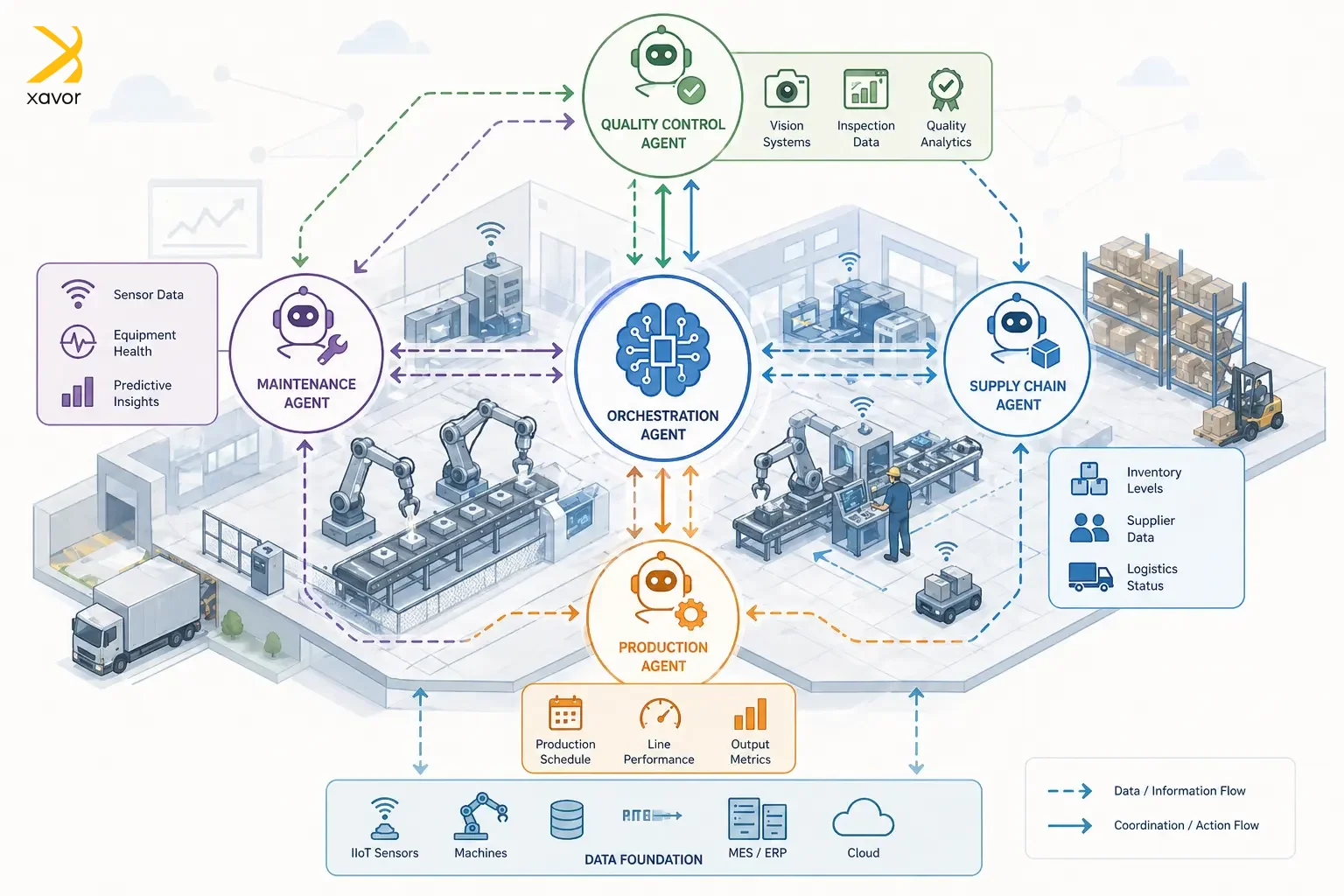
On the other hand, AI agents are the individual tools that actually make agentic AI manufacturing possible. They do all of the above sensing operational conditions and the rest. Each agent is made to handle a specific task, and there are multiple agents that work in tandem.
Colloquially, AI agents and agentic AI are used interchangeably. So, it doesn’t really matter in day-to-day settings. But it’s good that you know this difference for better understanding.
Agentic AI use cases in manufacturing
Agentic AI in manufacturing is still in its initial stages. Therefore, the full list of use cases may not even be evident to us. But agentic AI applications in manufacturing are already making their mark in some ways.
1. Smart factories
A smart factory uses AI-based sensors to collect and share data at all times. This helps maintain their daily operations. Things like monitoring equipment and preventing downtime by anticipating failures.
Siemens’ electronics plant in Amber, Germany, is one of the most famous smart factories globally. It is a completely smart factory that uses AI to digitize and automate its manufacturing processes.
2. Quality assurance
Manufacturers have to deliver flawless products. One tiny fault in a product can upend whole enterprises. That is why quality control through defect detection is of utmost importance.
AI-based computer vision systems can perform defect detection on the go. They can detect faulty products on the production line. So, humans can intervene immediately before these issues go further in the pipeline.
3. Machinery optimization
Industrial machinery can be as fragile as glass. They perform highly intricate tasks with precision, but that also takes a toll on them physically. That is why they need regular upkeep and maintenance.
Agentic AI in manufacturing can be used for predictive maintenance of these assets. Factories can use agentic systems to initiate maintenance responses and plan machinery maintenance according to their production schedules.
This is a great boon in large-scale productions. Knowing when critical machines need maintenance beforehand can prevent costly disruptions.
4. Sustainability and resource optimization
Manufacturing units are always under the watch of governments over their waste disposal and consumption standards. But even if they miss something, there is a great internal emphasis on sustainable production methods in manufacturing these days.
Using AI for energy optimization is one of such smart manufacturing solutions. Energy-intensive industries like steel manufacturing facilities use AI to adjust energy consumption to reduce their carbon footprint.
Furthermore, machine learning models optimize assembly processes to use the exact amount of raw material needed, which is a concept known as zero-waste manufacturing.
5. Supply chain optimization
Supply chains are the veins of manufacturing. They keep procurement in sync with production demands. But that balance is often disturbed due to operational roadblocks.
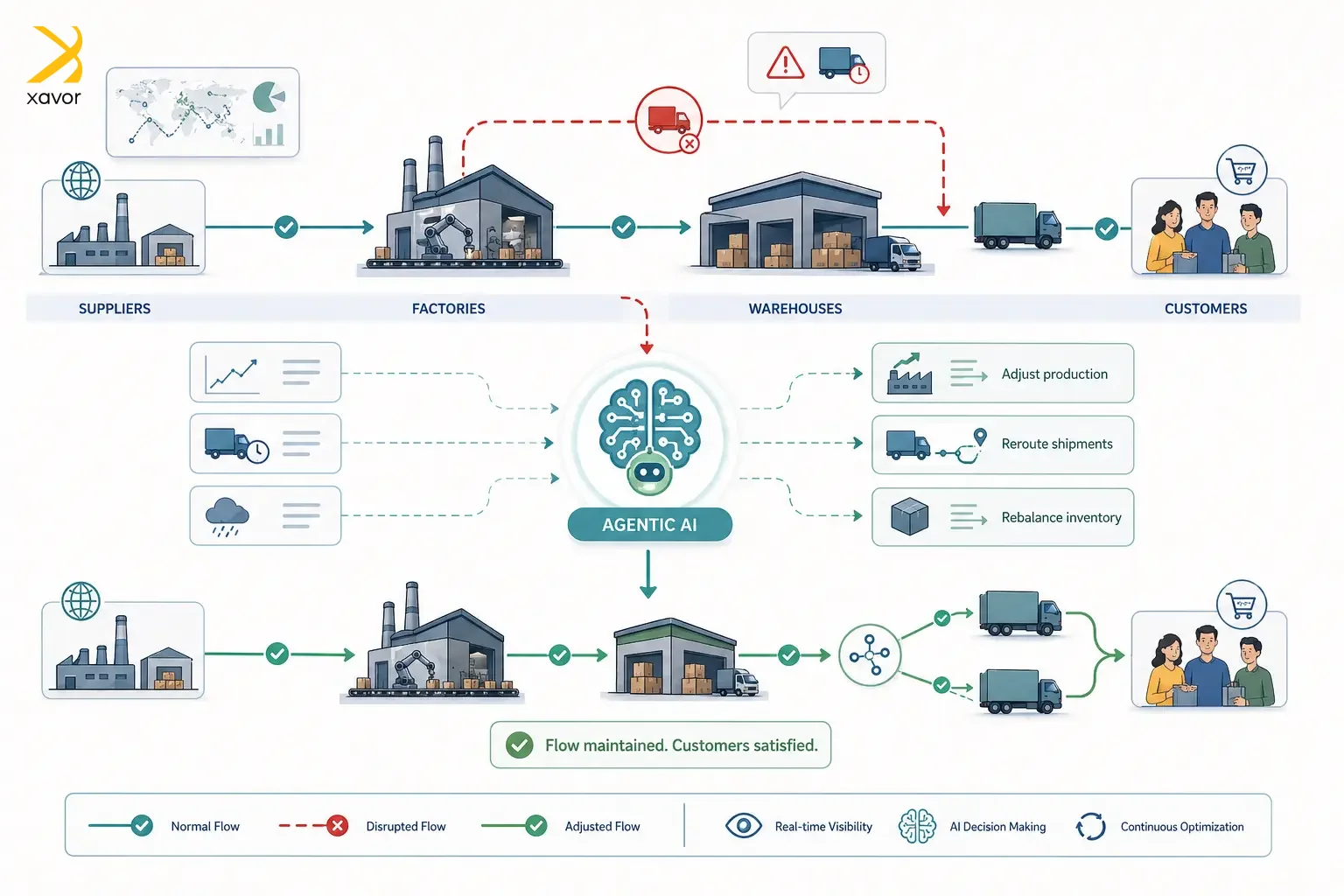
Agentic AI in manufacturing ensures this imbalance doesn’t happen through demand forecasting and inventory optimization. AI in logistics enables faster responses to disruptions.
If there is a delay by the supplier, AI can automatically adjust orders and find alternative production plans based on available materials.
How Xavor designs smart manufacturing solutions
Agentic AI is a very powerful technology. And it requires equal diligence to implement it in a field like manufacturing. That is why Xavor’s AI teams develop agentic AI applications in manufacturing with complete governance and integration with the organizational setup.
1. Data integration
Agentic AI requires huge swathes of high-quality data to give worthwhile results. Particularly, in manufacturing, that data needs to be real-time. But manufacturers often use legacy systems with data all over the place.
Read our case study: Enterprise data engineering in semiconductor manufacturing
Therefore, we first develop modern data architectures using technologies like data warehouses and IoT to build a strong data foundation. This necessarily requires using APIs and middleware to integrate everything and to set a consistent standard.
2. Human-AI collaboration
Just because agentic AI can act autonomously doesn’t mean it should do everything on its own. Agentic AI in manufacturing still requires human oversight and governance for accountability and control.
Xavor sets clear boundaries about when humans should intervene and when machines should act. Our humans-in-the-loop protocols clearly define ownership in overlapping areas.
Remember that you need this to align the autonomy of agentic systems with regulatory compliance and ethical implications.
3. Scalability
Manufacturing happens at scale. So, agentic AI in manufacturing is pretty useless if it doesn’t deliver beyond isolated use cases. That is why we develop comprehensive agentic ecosystems that scale across the industrial unit.
The best way to do this is by developing modular agentic AI systems. But we ensure that such interoperable agents are deployed with complete governance.
4. Cultural alignment
Our AI experts don’t just stay until deployment. They also make sure that workers are comfortable with their new “digital” co-workers. Agentic AI in manufacturing shifts quite a lot of roles from human operators to agents.
Naturally, that change can be a little off for workers who have to give up some autonomy. Xavor provides teams with proper training and change management so that they adopt agentic systems with confidence.
5. Security
Manufacturing is one of the most vulnerable fields to cybersecurity threats. The irony is that AI is simultaneously the problem and the solution. It has expanded the attack surface while also being the most effective tool for real-time threat detection and response.
That is why implement strong access controls and encryption to safely connect agentic AI in manufacturing to multiple platforms and data sources.
Conclusion
Manufacturing has changed the course of humanity. It turned our largely agrarian societies to the modern, complex industrial civilizations we inhabit today. And it will continue to shape our world with new advancements like agentic AI in manufacturing.
The agentic shift is the milestone when we move from automation in manufacturing to autonomous systems. These systems will be able to mass-produce goods at an unprecedented pace that is not humanly possible.
We aren’t exactly there yet, but it’s closer than you might think. That is why manufacturers should start preparing for this change.
Xavor helps such forward-looking business leaders. We provide agentic AI development solutions for manufacturing that are designed for the future.
Contact us at [email protected] to see how.

FAQs
Predictive maintenance, quality inspection via computer vision, and energy optimization are the three use cases consistently delivering real returns. Mature adopters report 30–50% reductions in unplanned downtime and up to 25% savings on energy costs.
The dominant direction in 2026 is augmentation. Particularly under the industry 5.0 philosophy of human-machine collaboration. AI is increasingly handling the dull, dirty, and dangerous tasks, freeing workers for creative problem-solving and high-value decisions.
Extremely, manufacturing has been the single most targeted industry for cyberattacks four years running, with ransomware exploiting legacy systems being the primary threat vector. The key is balancing automation with human judgment, as over-reliance on AI can create blind spots that sophisticated attackers learn to exploit.