

Picture this: a massive Category 5 hurricane disrupts your primary manufacturing hub. But instead of your logistics team frantically scrambling through messy spreadsheets, an autonomous AI agent instantly intercepts the data.
The system simulates multiple alternative trade routes, checks real-time inventory buffers across five regional distribution networks, dynamically requests quotes from pre-vetted backup suppliers, executes a digital procurement workflow, and books alternative ocean freight, all in under four minutes, without a single manual click.
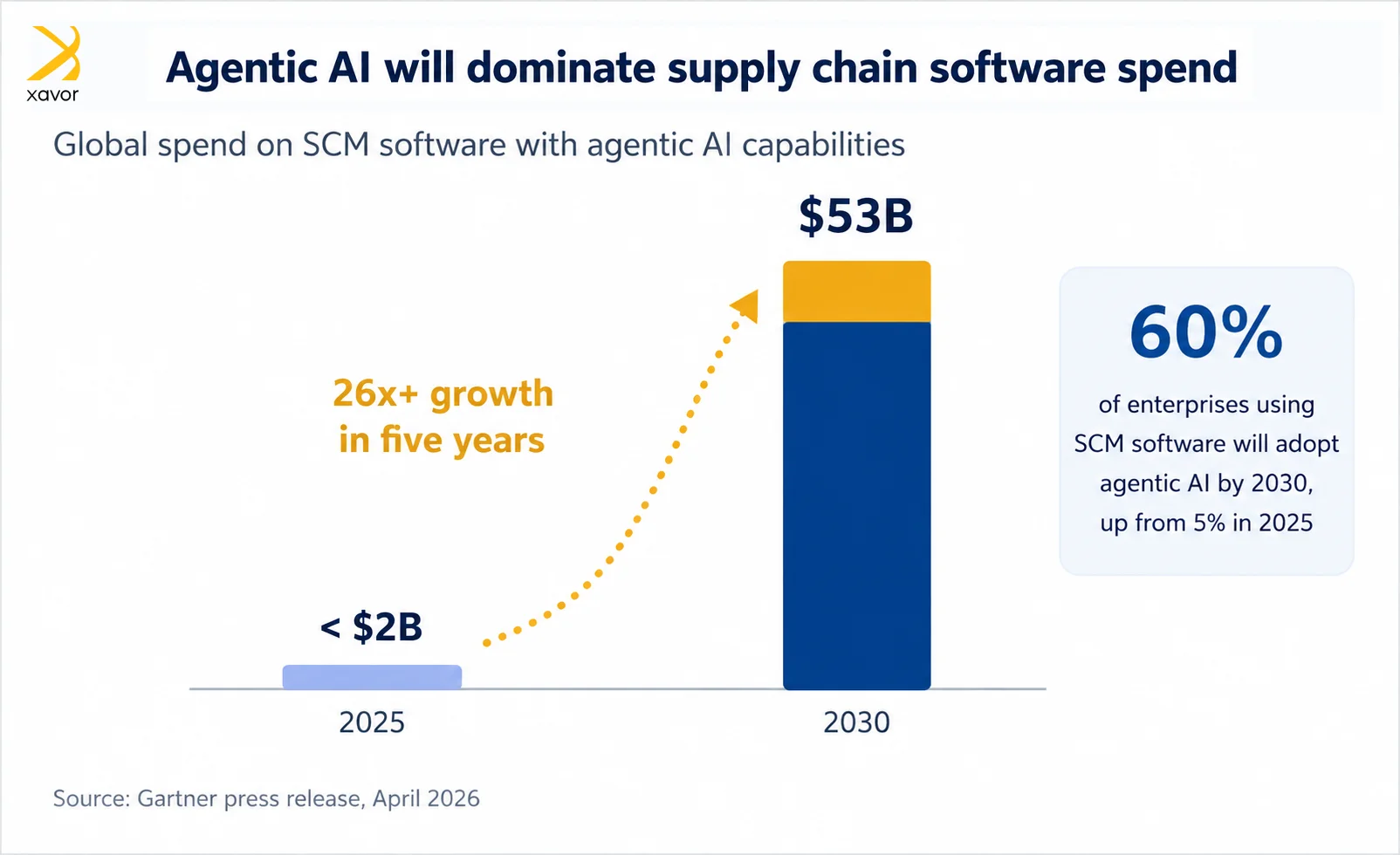
This is no longer a futuristic sci-fi vision. Agentic AI has emerged as the defining technology reshaping enterprise supply chain infrastructure. Gartner forecasts that spending on supply chain management software with agentic AI capabilities will skyrocket from under $2 billion in 2025 to a staggering $53 billion by 2030.
However, utilizing agentic AI services in supply chain operations requires more than just launching an API. If your internal data architecture is fractured, your agents will execute flawed operational decisions at machine speed.
Agentic AI in Supply Chain: A 5-Step Checklist
Agentic AI in supply chain refers to autonomous systems that go beyond analyzing data: they plan, decide, and execute actions such as rerouting freight or issuing purchase orders within pre-set guardrails. Before deployment, Chief Supply Chain Officers must verify five things: unified data and APIs, operational guardrails, graceful failure handling, continuous state management, and intelligent simulation.
This checklist walks through each requirement so you can assess your readiness honestly.
Step 1: Unified Data & Bidirectional API Accessibility
Traditional AI tools merely look up information or summarize documents. In contrast, production-ready AI agents are built to take real-world actions. To do this effectively, they require an open, interconnected, and hyper-reliable digital ecosystem.
The Machine-Paced Connectivity Mandate
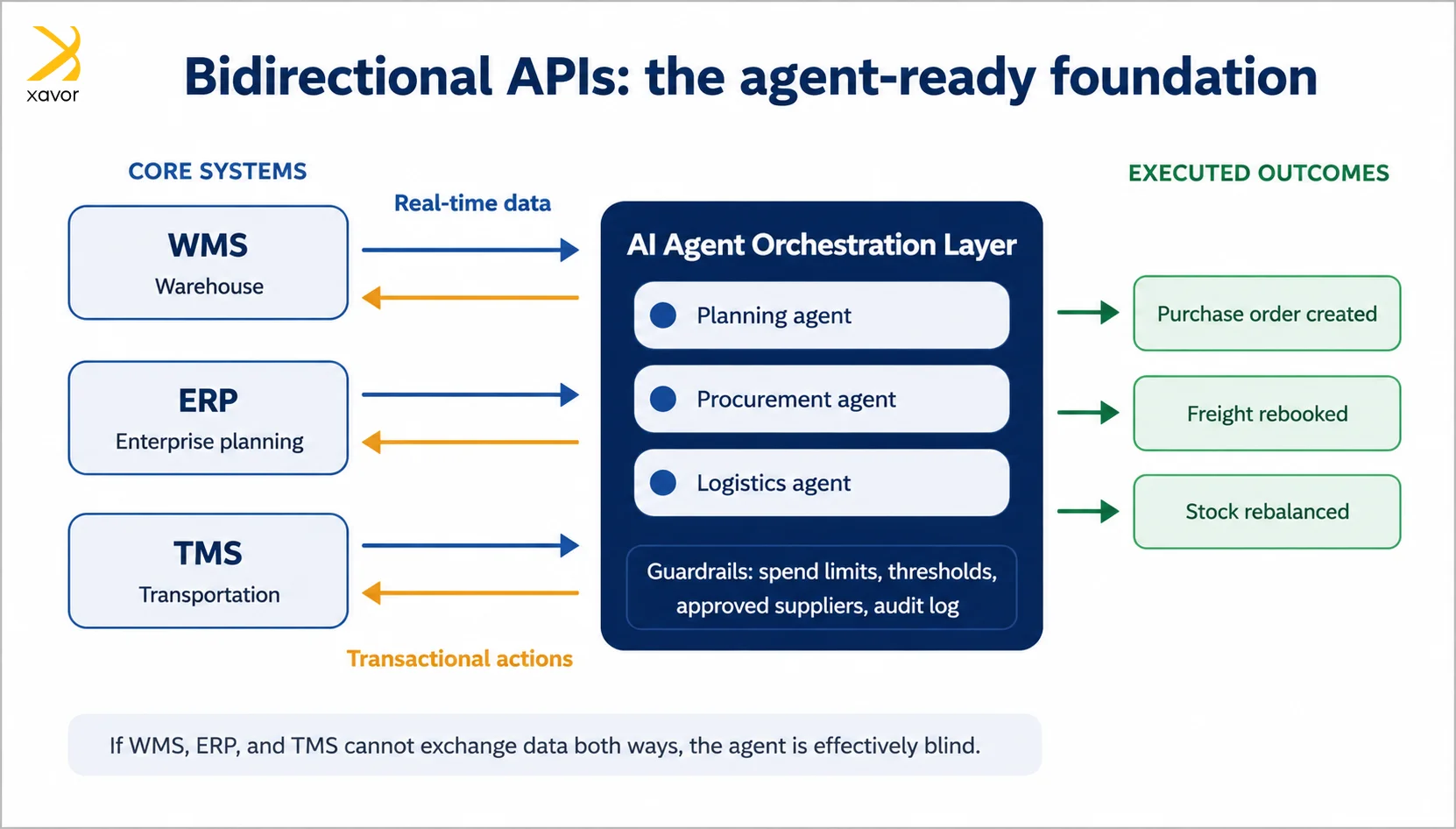
An AI agent cannot operate inside a data silo. If your warehouse management system (WMS), enterprise resource planning (ERP) platform, and transportation management system (TMS) do not communicate natively, your AI agents in supply chain operations are effectively blind. Your infrastructure must feature robust, bidirectional APIs. The agent must be able to instantly extract real-time data, such as live freight rates or active stock counts, and push transactional actions back into your core software (e.g., automatically generating a purchase order).
The Data Quality Reality Check
Messy master data is the absolute leading cause of failed AI deployments. If your data taxonomy is fragmented across different regional business units, an AI agent will experience severe context drift, make critical calculation errors, or hallucinate inventory balances. Before deploying a multi-agent framework, you must aggressively standardize your data architecture, eliminate “ghost stock,” and feed your system clean, high-velocity data pipelines.
Step 2: Operational Guardrails & Blast Radius Controls
Transitioning toward supply chain autonomy does not mean handing your corporate bank accounts over to an unmonitored algorithm. Without strict operational boundaries, an agent experiencing an error could easily over-order millions of dollars in excess safety stock.
Establishing Bounded Autonomy
Enterprises must hardcode non-negotiable compliance rules directly into the agent’s orchestration layer. These programmatic guardrails include maximum spend limits per individual transaction, strict volume thresholds for automated purchase orders, and pre-approved supplier lists. The system must operate under a framework of progressive, bounded autonomy, meaning the agent must explicitly earn operational trust before it is granted broader execution freedom.
Implementing the Human-in-the-Loop (HITL) Gateway
While confidence in enterprise AI continues to grow, the RELEX State of Supply Chain 2026 report, based on a survey of 514 retail, manufacturing, wholesale, and supply chain leaders, found that only 10% would trust AI agents in supply chain management to make fully independent decisions without human review. High-risk exceptions, such as changing long-term vendor allocations or executing capital-intensive procurement contracts, must always route through a Human-in-the-Loop (HITL) consent gateway. The agent handles the data collection and trade-off analysis, presenting clear options to a human executive who retains final decision authority.
Step 3: Graceful Failure & Multi-Agent Anomaly Handling
In a highly complex digital environment, system dependencies break. An API endpoint might drop, a cloud vendor could experience an outage, or a supplier’s portal might return malformed data.
Eliminating Silent Failures
A legacy automation script often fails silently, leaving a broken workflow undetected until an emergency occurs weeks later. Enterprise AI agents must be programmed to fail loudly and transparently. If an agent hits an empty search result, encounters an unknown variable, or experiences an API timeout, it must instantly trigger a structured error state, freeze its operations, and alert human operators.
Preventing Infinite Optimization Loops
When an agent encounters a system error or an unresponsive vendor portal, its natural programming may cause it to continuously retry the action. Left unchecked, this can result in an infinite loop that spams suppliers or runs up massive, unexpected cloud-computing token bills. Your architecture must include clear maximum retry thresholds and graceful degradation protocols. This ensures that if a digital tool fails to respond, the workflow is safely halted and flagged for technical review.
Step 4: Continuous Context Window & State Management
Supply chain execution is rarely a single, quick transaction. Resolving a complex international shipping delay or rebalancing warehouse networks often requires multi-day, multi-step actions across various operational teams.
Mitigating Token and Instruction Drift
As an agent interacts over time with multiple vendors, brokers, and internal managers, the sheer volume of data within its active context window expands rapidly. If the underlying system architecture is poorly optimized, the agent can suffer from memory degradation or lose track of its original core constraints. Leaders must build systems that reliably preserve core operational goals throughout complex, long-running processes.
Immutable Decision Logging and Traceability
For comprehensive regulatory compliance and internal trust, every step of an agent’s reasoning chain must be recorded. You need an immutable, auditable log that saves the exact context window, the specific tools used, and the precise variables evaluated at every step. If a vendor disputes an automated order or an allocation decision is questioned, your teams must be able to look back and completely trace the agent’s exact decision-making process.
Step 5: Automated Exception Management & Intelligent Simulation
A truly agentic supply chain does not just run static plans on a pre-programmed loop. It must actively adapt to real-world volatility, freight delays, and sudden shifts in global market demand.
Transitioning to Real-Time Demand Sensing
Static weekly planning cycles can no longer keep pace with today’s market velocity. Your agentic platform must connect directly to real-time demand sensing signals, including point-of-sale data, shifting order backlogs, macro-economic indicators, and live port congestion metrics. This is especially critical for AI in retail supply chain operations, where demand can swing overnight on promotions, seasonality, and social trends. Connected demand signals enable specialized planning agents to continually optimize inventory safety-stock levels on the fly. Changes in demand can also affect local delivery requirements. For businesses serving multiple commercial locations, shifts in order volume may change the number of routes, stops, or drivers needed from one day to the next, making flexible delivery planning an important part of responding to demand in real time.
Leveraging Advanced Digital Twins
The ultimate test of an agent’s readiness is its integration with intelligent simulation tools. When an anomaly occurs, the agent should interact seamlessly with a digital twin of your supply network. This allows it to safely simulate alternative rerouting paths, calculate total landed costs, model potential trade-offs, and recommend or execute the highest-value option. Early adopters leveraging these autonomous execution models report significant operational improvements, including up to a 35% reduction in total inventory levels and a 15% drop in logistical costs.
How Xavor Accelerates Your Autonomous Supply Chain Transformation
Navigating the architecture requirements of agentic AI is not something your IT team should tackle blindly. This is where Xavor steps in as your elite digital engineering partner. We specialize in bridge-building between legacy enterprise systems and cutting-edge autonomous AI frameworks, ensuring your organization moves from theory to execution flawlessly.
- Advanced ERP & Systems Integration: Xavor bridges the gap between fragmented legacy infrastructure and modern LLM orchestration layers. We build the high-speed, bidirectional APIs required to connect your SAP, Oracle, or Microsoft Dynamics systems to autonomous agent fleets.
- Data Standardization & Governance: We eliminate the primary bottleneck to AI success: messy data. Xavor cleanses, standardizes, and unifies your supply chain master data, preventing critical agent hallucinations and ensuring absolute operational accuracy.
- Custom Guardrails & HITL Architecture: Our engineering teams design and implement robust behavioral guardrails, custom anomaly detection models, and seamless Human-in-the-Loop (HITL) consent gateways tailored exactly to your risk tolerance and corporate spend limits.
- End-to-End Multi-Agent Orchestration: From automated exception management to real-time demand sensing, Xavor builds resilient, self-healing digital ecosystems that allow task-specific agents to communicate, simulate scenarios, and safely optimize margins at scale.
The Verdict: Is Your Organization Ready?
The competitive landscape is bifurcating rapidly. Companies clinging to legacy processes risk being outpaced by competitors operating at machine speed. Moving to an agentic supply chain requires a deliberate, step-by-step strategy. Leaders should focus first on high-value, highly specific use cases, such as automated inventory replenishment or exception-based freight rerouting, before attempting to scale autonomy across their entire network.
Ready to find out where your infrastructure stands on all five steps? Request a agent-readiness assessment of your supply chain from Xavor’s AI engineering team. Drop us a line at [email protected], and our experts will get back to you within 24–48 hours for a thorough evaluation of your data, guardrails, and integration gaps.

FAQs
The highest-value agentic AI use cases in supply chain right now are automated inventory replenishment, exception-based freight rerouting, autonomous supplier quote collection, and real-time demand sensing. These are bounded, measurable workflows and ideal starting points before scaling autonomy across the wider network.
AI can enhance sustainability in supply chain operations in three main ways. Route-optimization agents reduce fuel consumption and transport emissions. Demand-sensing agents cut overproduction and excess inventory, which lowers waste and warehousing energy use. And simulation tools let planners weigh carbon impact alongside cost when choosing suppliers and freight lanes.
Traditional automation follows fixed, pre-programmed rules and breaks when conditions change. An agentic system plans multi-step actions, adapts to real-time signals, uses tools across your WMS, ERP, and TMS, and executes decisions within guardrails, which makes it resilient to the volatility that breaks static scripts.