
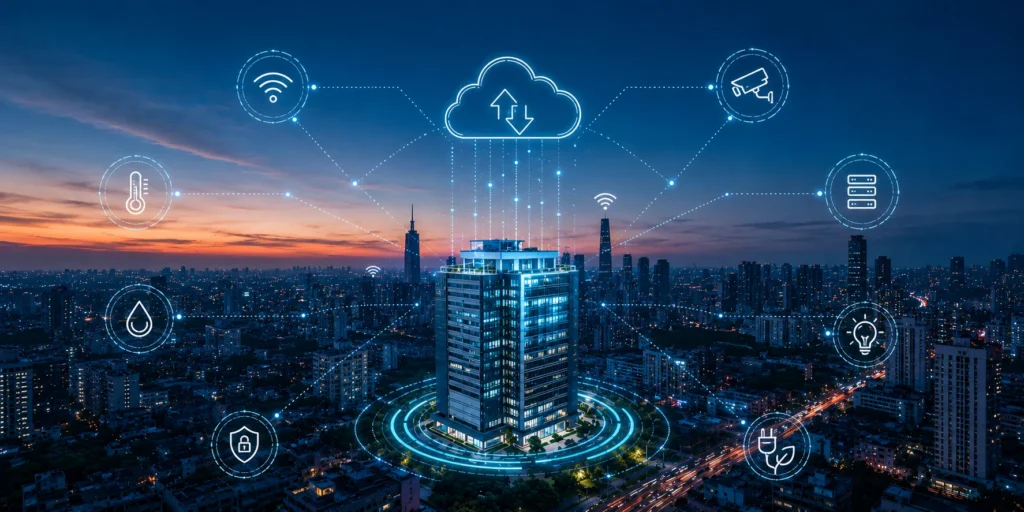
Internet of Things (IoT) is the working principle behind the smart TV in your home or the smart watch that you may wear. Anything smart in its name uses an IoT architecture to create a web of interconnected devices.
But it is a very carefully engineered architecture that enables data to flow seamlessly from physical sensors to cloud platforms and back. Building a reliable IoT system is far more than connecting a sensor to the internet. It demands a structured, layered approach that balances scalability, security, and real-time performance.
This article breaks down each layer of a modern IoT architecture and explains how they work together to create robust, production-grade systems, helping organizations make informed decisions about IoT development services.
What is an IoT architecture?
An IoT architecture structurally defines how physical IoT devices and related cloud applications interact to collect, transmit, and process data.
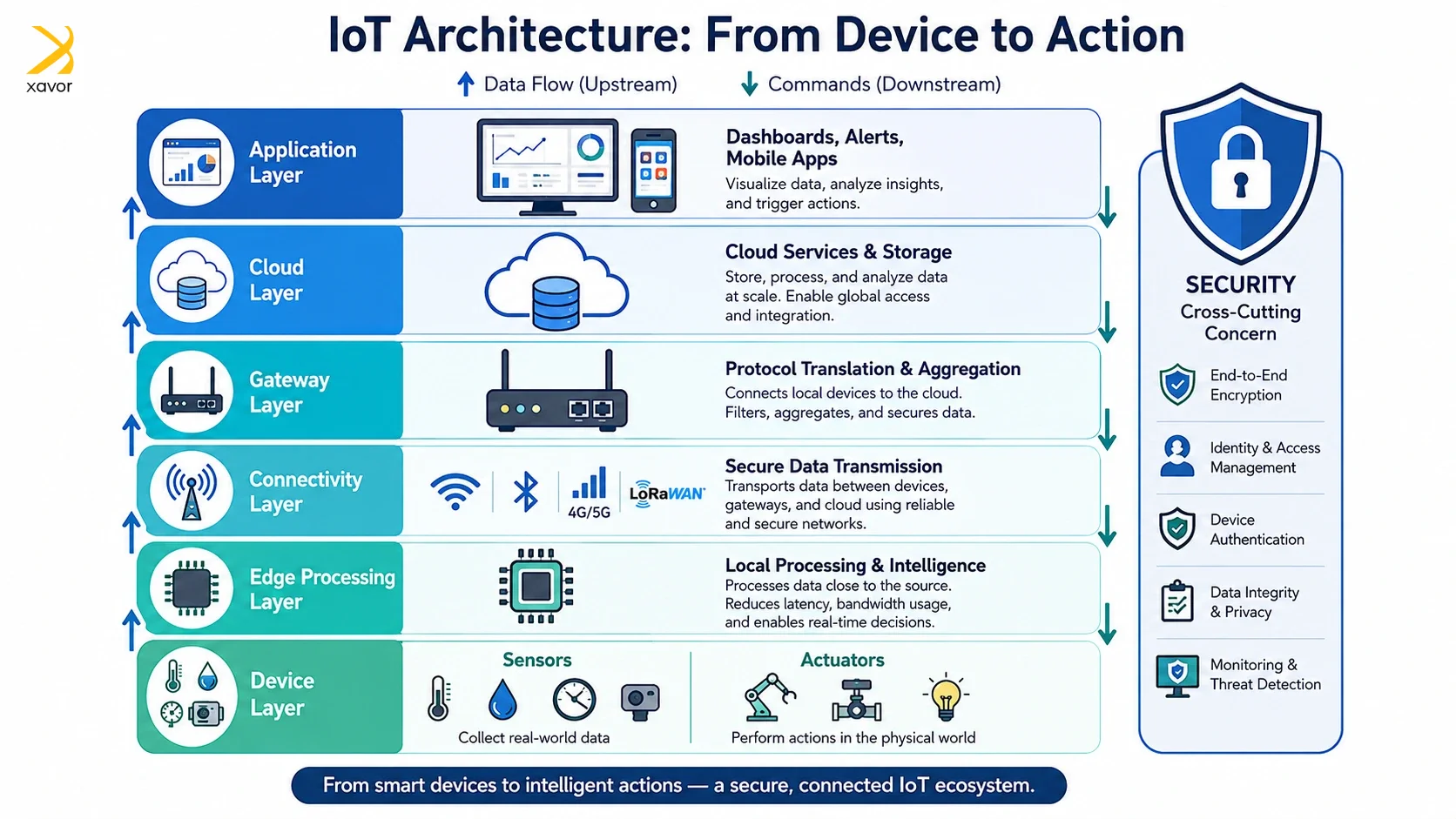
While there is no single universally accepted model, IoT architecture is most commonly broken down into some fundamental layers.
1. Device layer consisting of sensors and actuators
Every IoT system begins at the physical world. The device layer consists of sensors that capture real-world data, like temperature, pressure, motion, or voltage. And actuators respond to commands by triggering physical actions such as adjusting valves or driving motors.
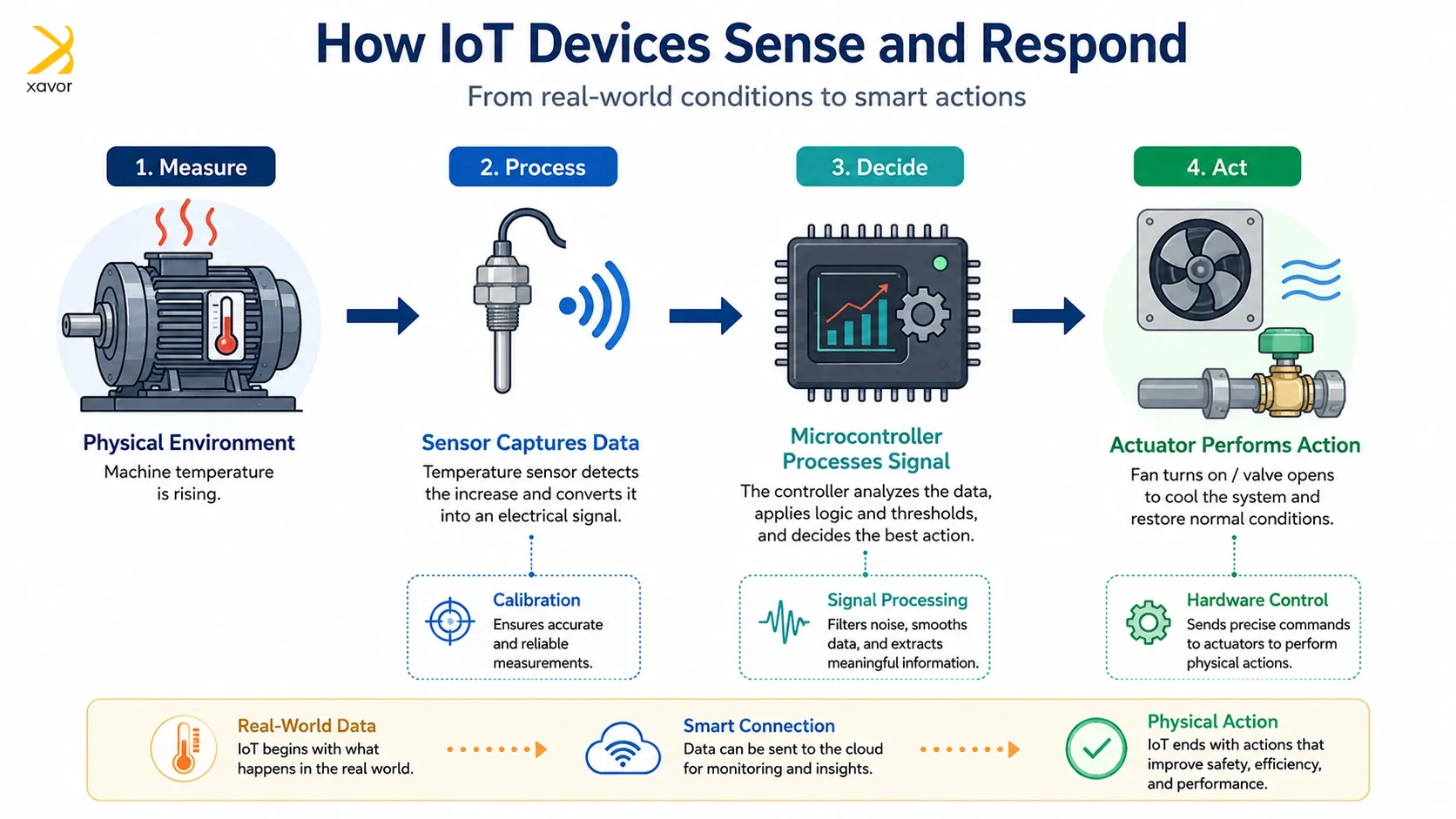
These components interface with microcontrollers and embedded processors responsible for:
- Data acquisition from hardware peripherals
- Basic signal processing and conditioning
- Hardware abstraction for higher-level communication
The accuracy and reliability of the entire system depend on sensor quality and proper calibration of these components.
2. Edge processing layer embedded intelligence
Raw sensor data is often noisy. There are redundant entries or it is generated at frequencies too high to transmit efficiently to the cloud. Edge processing addresses this by embedding intelligence directly into local devices.
At this layer, embedded systems handle:
- Data filtering and calibration to clean raw inputs
- Event detection through threshold-based or pattern-based triggers
- Local decision-making that enables autonomous operation without cloud dependency
More advanced deployments use edge AI platforms to run machine learning models locally, enabling real-time anomaly detection and predictive responses. Reducing latency and conserving bandwidth using edge processing ensures the system remains operational even when network connectivity is intermittent or unavailable.
A well-designed edge layer is one of the most impactful investments in IoT reliability, particularly in environments with unstable power or connectivity.
3. Connectivity layer based on communication technologies
Once data has been processed at the edge, it must be transmitted reliably to downstream systems. The connectivity layer defines how devices communicate, and the right choice depends heavily on the application context.
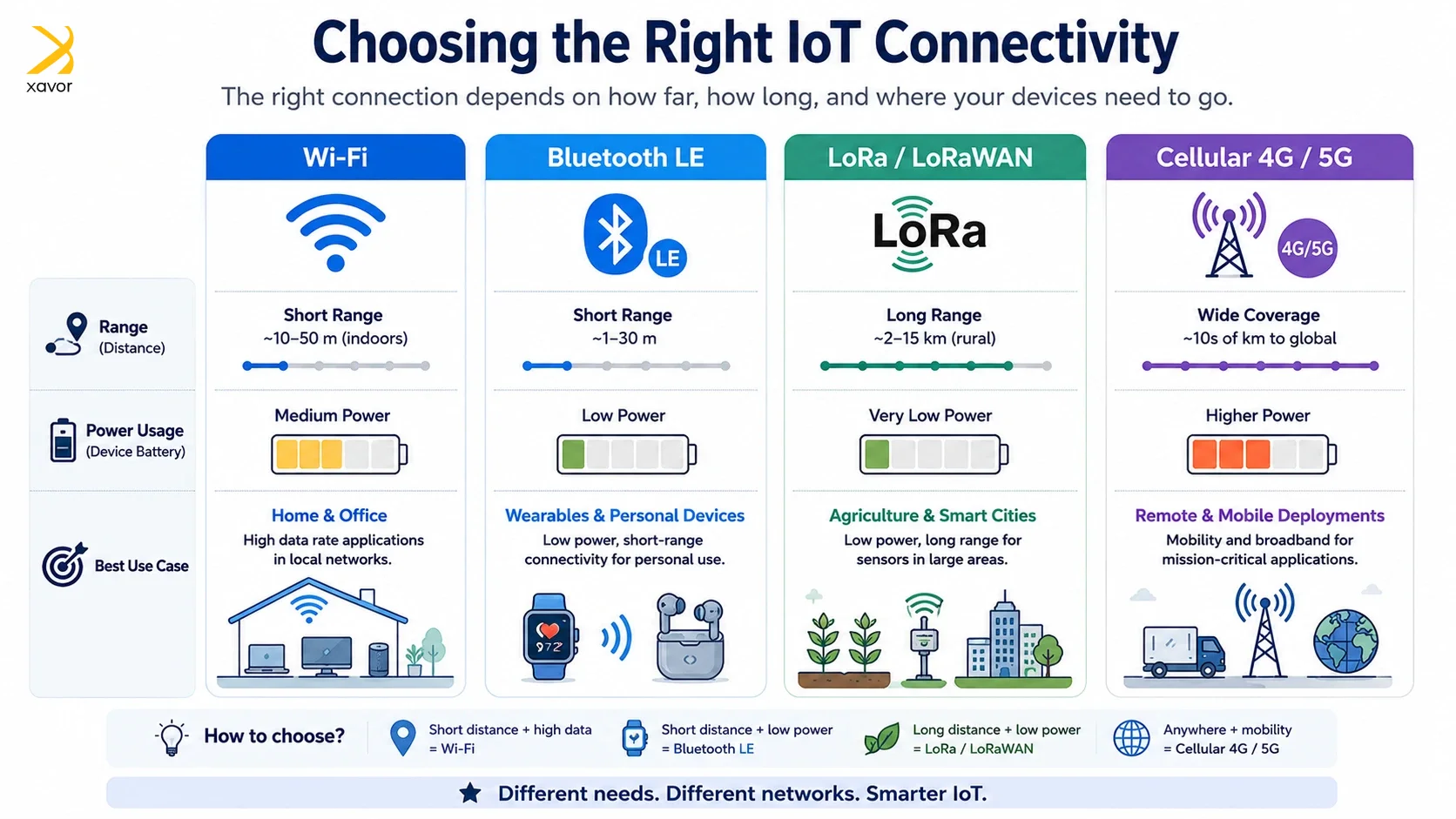
Common communication options include:
| Technology | Range | Power | Best Use Case |
| Wi-Fi | Short | Medium | Home/Office Environment |
| Bluetooth/LE | Short | Low | Wearables, Proximity Devices |
| LoRa/LoRaWAN | Long | Very Low | Agriculture, Smart Cities |
| Cellular (4G/5G) | Wide | Higher | Mobile or Remote Deployments |
Widely adopted IoT protocols include:
- MQTT — Lightweight publish/subscribe messaging, ideal for constrained devices
- HTTP / REST — Familiar and widely supported, suited for less frequent communication
- CoAP — Optimized for low-power, lossy networks
However, protocol and technology selection should be driven by application requirements. The wrong choice can introduce latency on top of scaling issues.
4. Gateway layer is the bridge between edge and cloud
In many architectures involving industrial and enterprise deployments, a gateway device acts as an intelligent intermediary between field devices and the cloud.
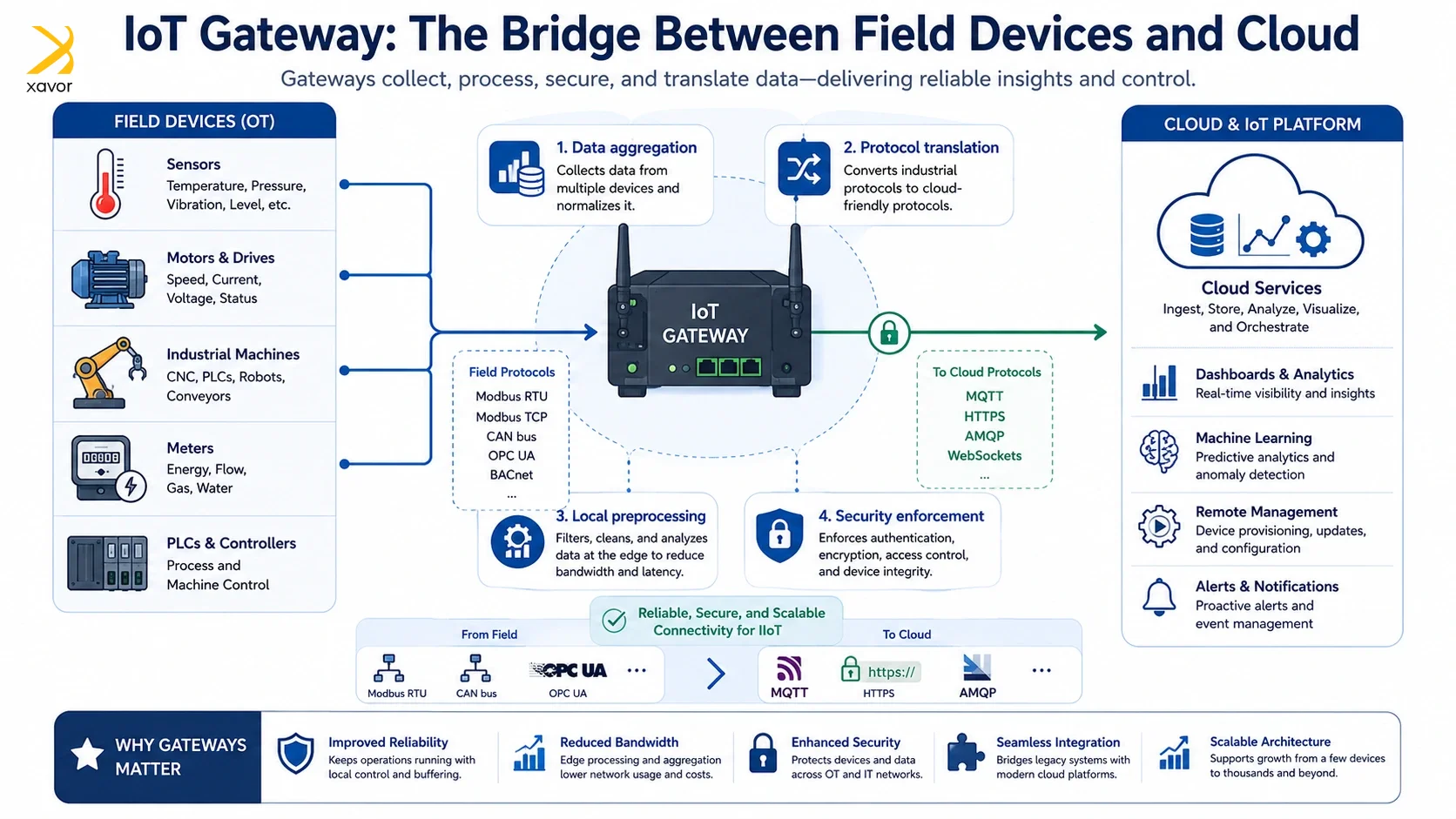
Gateways serve several critical functions:
- Data aggregation from multiple downstream nodes
- Protocol translation (e.g., Modbus or CAN bus to MQTT or HTTPS)
- Local preprocessing to reduce upstream bandwidth
- Security enforcement by isolating field devices from direct cloud exposure
Gateways are especially valuable when devices use non-IP protocols, when bandwidth optimization is essential, or when centralized local control is required. Moreover, in large-scale deployments, gateways significantly reduce cloud ingestion costs and improve overall system resilience.
5. Cloud Layer for data storage and analytics
The cloud is where data is stored at scale, processed into insights, and made available to applications and business systems.
Key responsibilities of the cloud layer include:
- Data storage: Time-series databases, object storage, and data lakes
- Stream and batch processing: Real-time analytics and historical analysis
- Device management: Remote provisioning, monitoring, and configuration
- Rule engines and automation: Triggering workflows or alerts based on data conditions
Modern IoT cloud platforms provide managed infrastructure that abstracts much of this complexity, allowing teams to focus on business logic rather than infrastructure management.
Cloud architecture decisions made early in the project are difficult and expensive to reverse. Design for scalability from the start.
6. Application layer for user interfaces and control
The application layer is the human-facing surface of the IoT system. It translates processed data into actionable insights and provides mechanisms for monitoring and control.
Common application forms include:
- Web dashboards with real-time graphs, alerts, and historical reporting
- Mobile applications for remote monitoring and device control
- Enterprise integrations connecting IoT data to ERP, SCADA, or analytics platforms
In livestock operations, feedlot management software can bring RFID, weighing, feeding, and ERP data into a single operational view. Well-designed applications surface only what users need and present data clearly to make interactions intuitive, regardless of the underlying system complexity. Even the most sophisticated backend architecture will fail to deliver value without a clear, purposeful user interface.
7. Security layer is a cross-cutting concern
Security is not a single layer. Rather, it is a discipline that must be embedded across every tier of the IoT architecture.
Critical security practices include:
- Device authentication and secure provisioning at onboarding
- Encrypted communication using TLS/SSL across all data paths
- Secure over-the-air (OTA) firmware updates with signature verification
- Access control and identity management at the application and cloud layers
- Network segmentation to limit the blast radius of a compromised device
A vulnerability at any single layer can expose the entire system. Security retrofitted after deployment is both costly and fundamentally less effective. Therefore, treat security as a first-class architectural requirement.
How these layers interact through end-to-end data flow
The real value of IoT comes from how information moves through the system. The process begins from the moment something happens in the physical world and ends when an action is taken. Industry term for this process is the data lifecycle or end-to-end data flow.
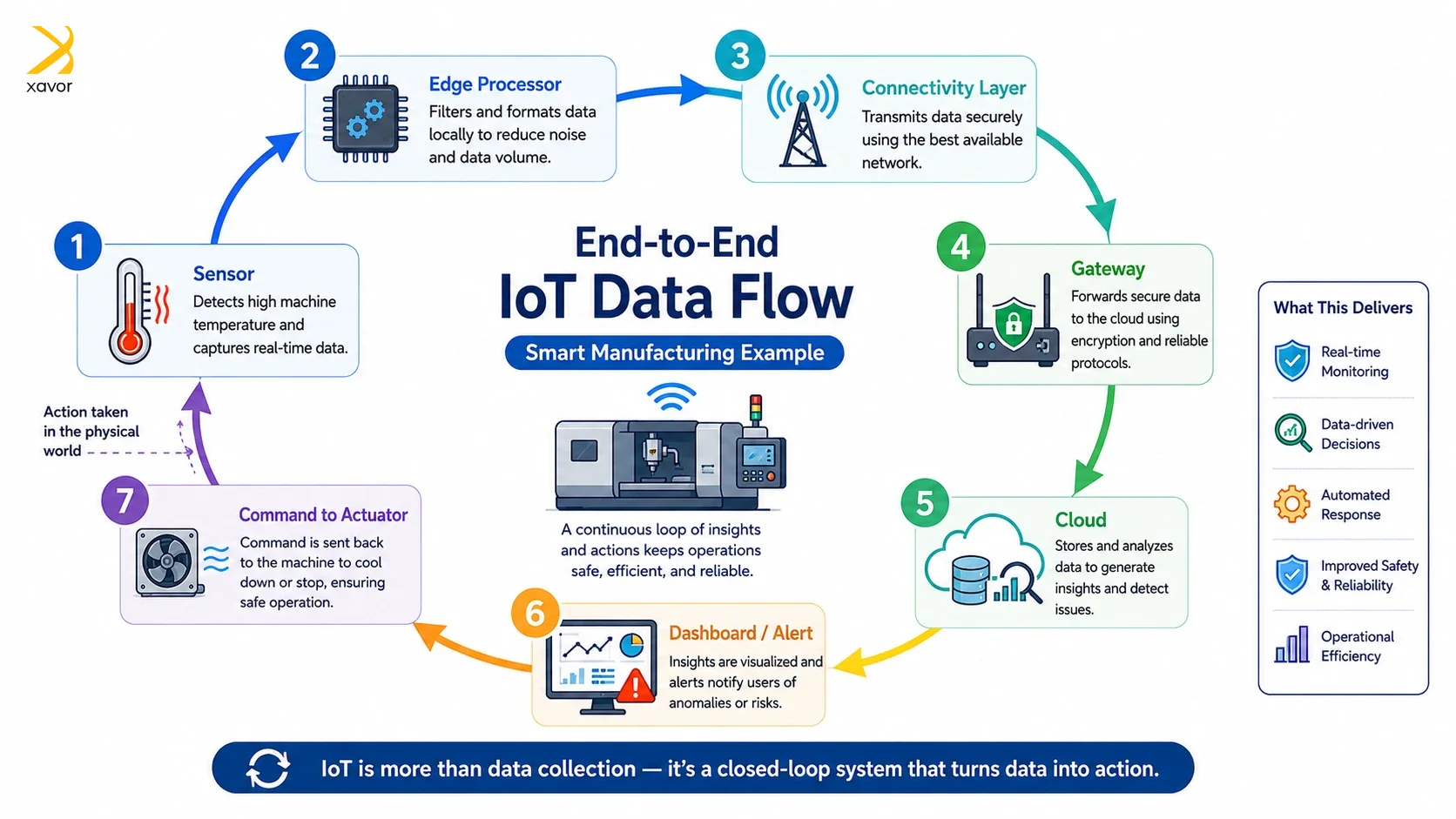
Consider a smart manufacturing environment where a machine begins operating at a higher-than-normal temperature.
- A sensor detects a change in the physical environment
- The microcontroller processes, filters, and formats the data
- Data is transmitted via the connectivity layer using an appropriate protocol
- A gateway (where present) aggregates and forwards the data to the cloud
- The cloud platform stores the data and applies analytics or rules
- The application layer surfaces insights and alerts to users
- Control commands are sent back to devices, closing the loop
This closed-loop architecture enables real-time monitoring, automated responses, and intelligent decision-making at scale.
Conclusion
A well-designed IoT architecture is the foundation of any reliable smart systems. Each layer plays a distinct and critical role. Shortcuts at any level introduce risk that tends to compound as the system grows.
Connecting devices is just one part of the goal. The full picture involves building a system that is secure by design and adaptable as requirements evolve.
At Xavor Corporation, we specialize in designing end-to-end IoT architectures using embedded hardware and firmware integrated with cloud integration and intelligent applications. Our IoT experts are proficient at prototyping a new connected product or scaling an existing deployment.
Drop us a line at [email protected] to invest in an IoT architecture that ensures long-term success.

FAQs
IoT architecture is the structured framework that allows connected devices to collect, transmit, process, and act on data. It typically includes devices and sensors, edge processing, connectivity, gateways, cloud services, applications, and security controls working together to enable real-time monitoring, automation, and intelligent decision-making.
The four main types of IoT platforms are device management platforms, connectivity management platforms, application enablement platforms, and analytics platforms. Together, they help organizations manage devices, control network connections, build IoT applications, and turn device data into actionable insights.
AI helps IoT devices analyze data, recognize patterns, and make decisions without constant human input. Common applications include predictive maintenance, anomaly detection, smart automation, voice assistants, energy optimization, and real-time monitoring in connected devices and systems.