

Most companies are making the mistake of treating physical AI like a traditional software project. But physical AI is that moment when artificial intelligence leaves the screen and begins to operate in the real world. It is a multidisciplinary field that cannot be built by AI teams alone.
Physical AI systems can perceive, reason, move, interact, and support decisions in physical environments. And creating such systems that truly partner with humans requires expertise in many domains.
In this piece, we’ll explain that by breaking down the eight multidisciplinary domains that complete the physical AI development lifecycle.
Physical AI is where software meets physical reality
“What computers can and cannot compute is determined by the laws of physics, not by pure mathematics.” These words by David Deutsch, the father of quantum computing, seem like they were said for developing physical AI because it is fundamentally different from the AI waves we’ve experienced so far.
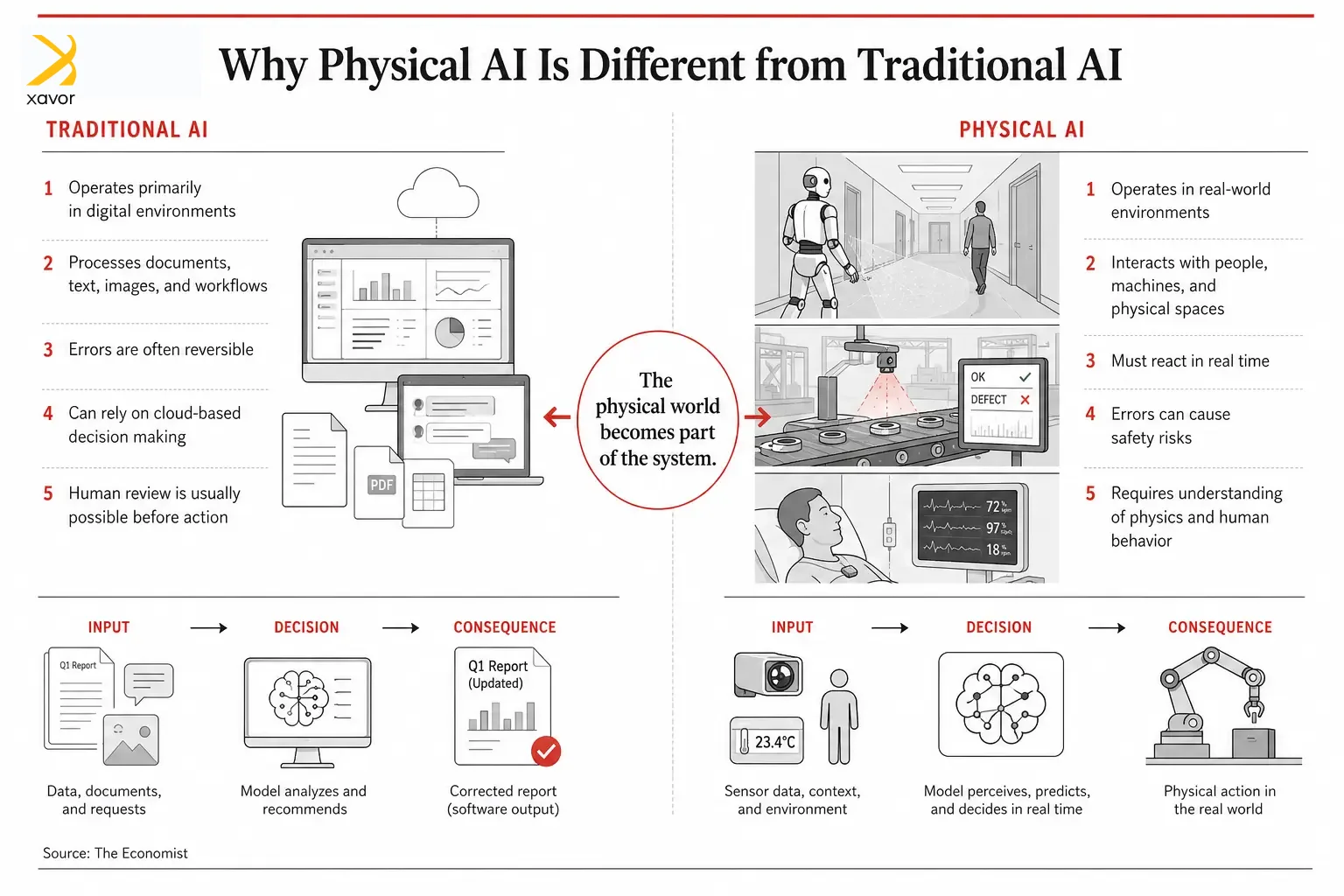
Physical AI products work in the real world. And reality is defined by the laws of physics. Think of action and reaction, inertia, entropy, viscosity, and gravity. Now, our spatial senses have evolved over eons to allow us to perceive and navigate the physical world.
But for physical AI to do the same, it’s like computing the uncomputable. And that is very consequential as well.
In traditional enterprise software, failure is usually recoverable and not deadly. A wrong dashboard will give you incorrect numbers, but it can be corrected. Similarly, a workflow bug can be patched.
And to be pedantic, yes, there are worst-case scenarios where traditional AI can be deadly too. Someone can ask ChatGPT for wrong medical advice, for example. But that’s why AI recommendations should always be reviewed by a human, which in this case is a doctor.
However, the margin of error is almost zero in physical AI, and mistakes have serious repercussions because the real world becomes part of the system.
A general-purpose robot moving through a crowded hallway can trip someone if it doesn’t see them coming. A customer can receive a faulty product because the quality check camera failed to identify a safety risk on the production line. Similarly, a sensor may miss some change in a geriatric patient’s mobility, which can be a matter of life and death.
So, you see, physical AI must handle changing environments at the blink of an eye while simultaneously dealing with sensor noise. On top of that, it needs to understand human behavior because it will be working with humans all the time.
The technical constraints are no less daunting. Processing sensory data in real-time requires super-fast networks and hardware capabilities, such as IoT and edge computing.
And then comes the ethical side, where privacy, physical safety, integration, and adoption are of paramount importance.
That is why physical AI is not simply “AI + hardware.” It is a multidisciplinary operating model that overlaps with engineering, AI, spatial science, ethics, and even a little bit of human psychology.
The eight disciplines physical AI requires
You must have a grip over each of these eight disciplines if you want to create stellar physical AI products. Take out one of these, and the whole system would fall. Comprise one, and the product becomes unreliable.
1. AI and foundation models
The first discipline is AI and foundation models. Physical AI depends on AI models that can understand images, video, audio, language, spatial context, movement, and physical common sense. When combined with AI data analytics, these models can process vast amounts of information, identify patterns, and make more informed decisions in dynamic real-world environments.
However, creating such models is really hard. The real world is unpredictable. Just consider driving on a busy road during rush hour. You have to be vigilant of other vehicles and pedestrians. And then there is always some crazy driver on the road who has little regard for their own and others’ safety.
We can quickly adapt to these many possible outcomes, but traditional LLMs would need gargantuan amounts of data to calculate every possible outcome and decide a course of action.
And it’s a persistent challenge for robotics and AI. They need to react in real time, whether the situation is simple or highly complex. But as complexity increases, making real-time decisions in the physical world becomes much harder.
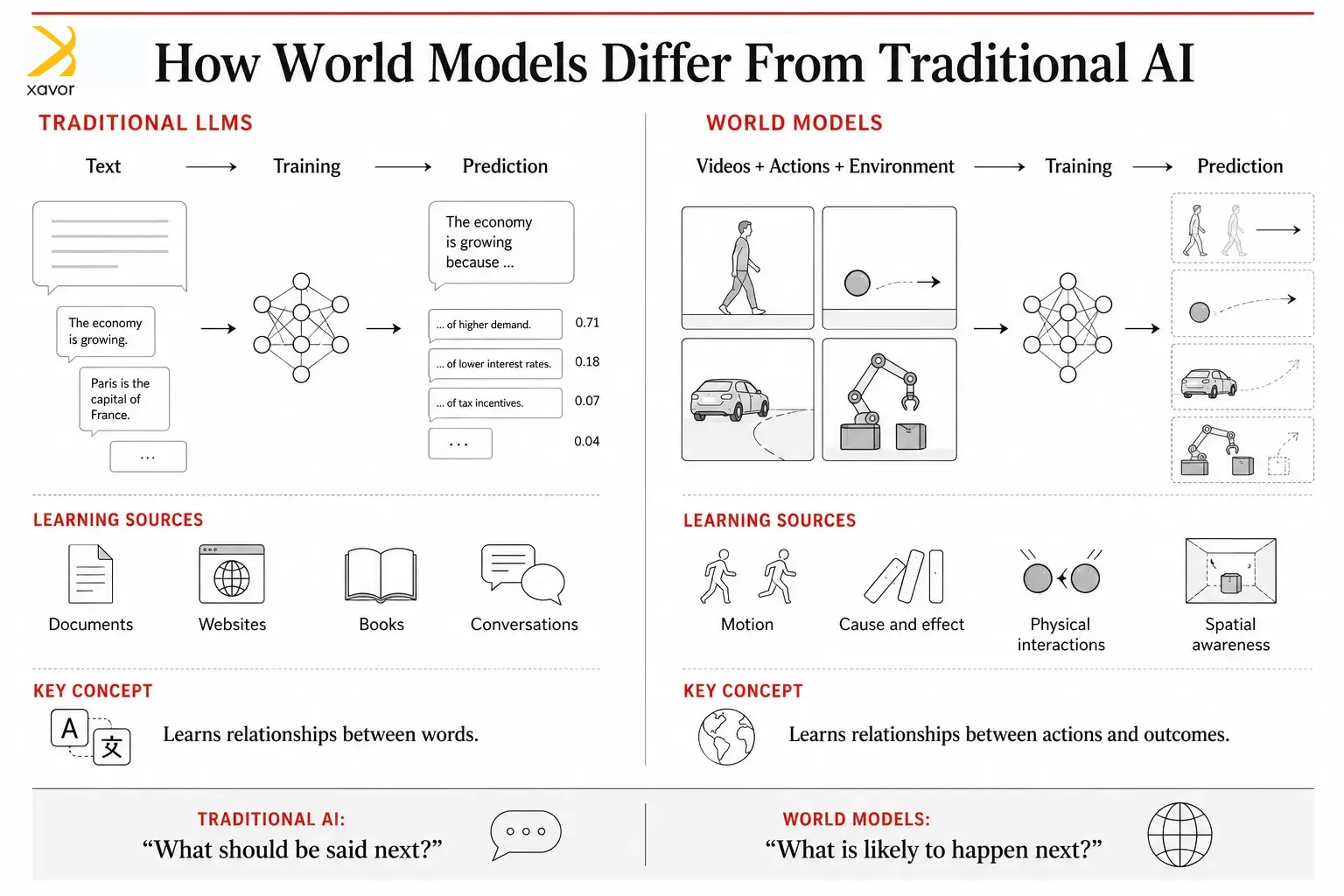
The solution to this predicament is a new class of foundation models called World Models. Instead of learning mainly from text like traditional LLMs, they learn from observing the world through videos and actions to understand how things move and how actions change outcomes.
So, you need to create models that don’t calculate every object and interaction one by one. Rather, develop them to infer patterns behind the physical world during training. Such models, when they need to predict what happens next, can process the whole scene in one neural network pass.
The ultimate aim of physical AI is to mimic human intelligence. And human intelligence is not built from language alone. We learn through seeing, moving, trying things, and understanding cause and effect in the real world.
Many leading AI researchers and companies are currently investing heavily in world models.
2. Robotics and physical systems
The second thing in our checklist is robotics and physical systems. But let’s make one thing clear before diving into this core discipline. Physical AI doesn’t necessarily mean that a system must have a movable, physical body to be called such.
What makes physical AI physical is its ability to reason with the outside world to recommend a course of action. It may not involve touching something or altering things around the system. A sensor for flood prediction that monitors water levels to alert the relevant authorities is a physical AI system. The sensor has no legs or arms and can’t move, but it’s a physical AI system.
What people commonly think of as physical AI, such as humanoid robots or robotic arms, falls within embodied AI. It is a subdomain of physical AI that includes systems that have a physical, tangible presence and can alter the environment around them.
However, even when a solution is not a humanoid robot, it usually involves cameras, sensors, embedded devices, mobile platforms, or machine interfaces. That’s why you need a team of hardware engineers who can develop and maintain these devices that power physical AI products.
3. Enterprise software engineering
Physical AI eventually has to connect with other enterprise systems that companies usually employ, such as:
- ERP, MES, and PLM
- QMS, EHR, WMS, and CRM
There are also analytics, security, identity, and operational systems that need constantly exchange data with physical AI systems to create real business value.
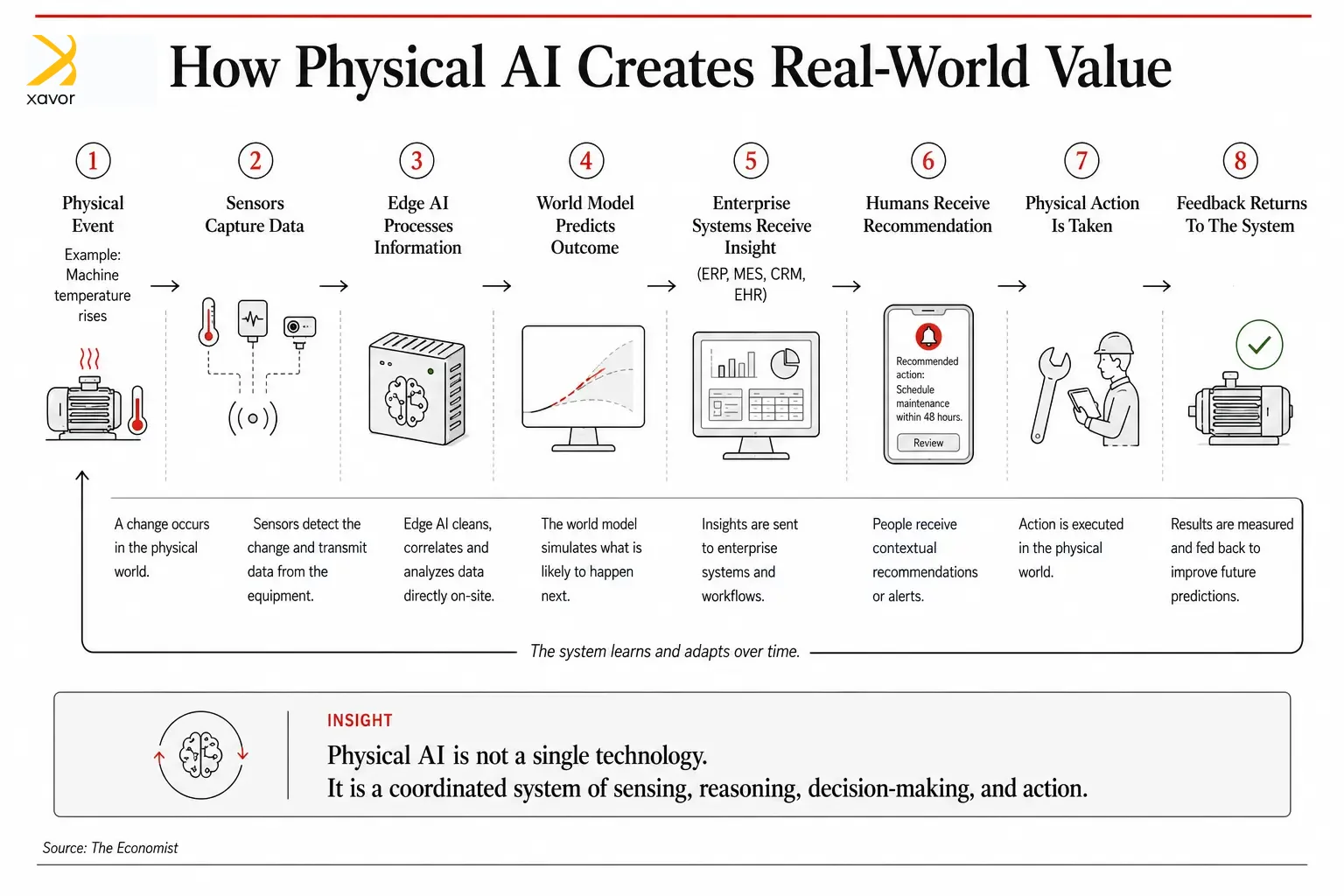
For example, a robot may be able to identify a defective product on a production line. But it needs to push that insight automatically into the PLM software to update quality records and alert the right teams. Only then can a corrective workflow be triggered at the right time, and that data can be fed back into planning and reporting systems.
The challenge, however, is that most enterprise systems don’t connect with each other by default, let alone with your physical AI product. Therefore, you need enterprise software engineers who can integrate physical AI with different enterprise platforms using solutions like middleware or custom-built integrations.
4. Edge and cloud architecture
The fourth discipline is edge and cloud architecture. There is no room for latency if physical AI systems are to make decisions on the go.
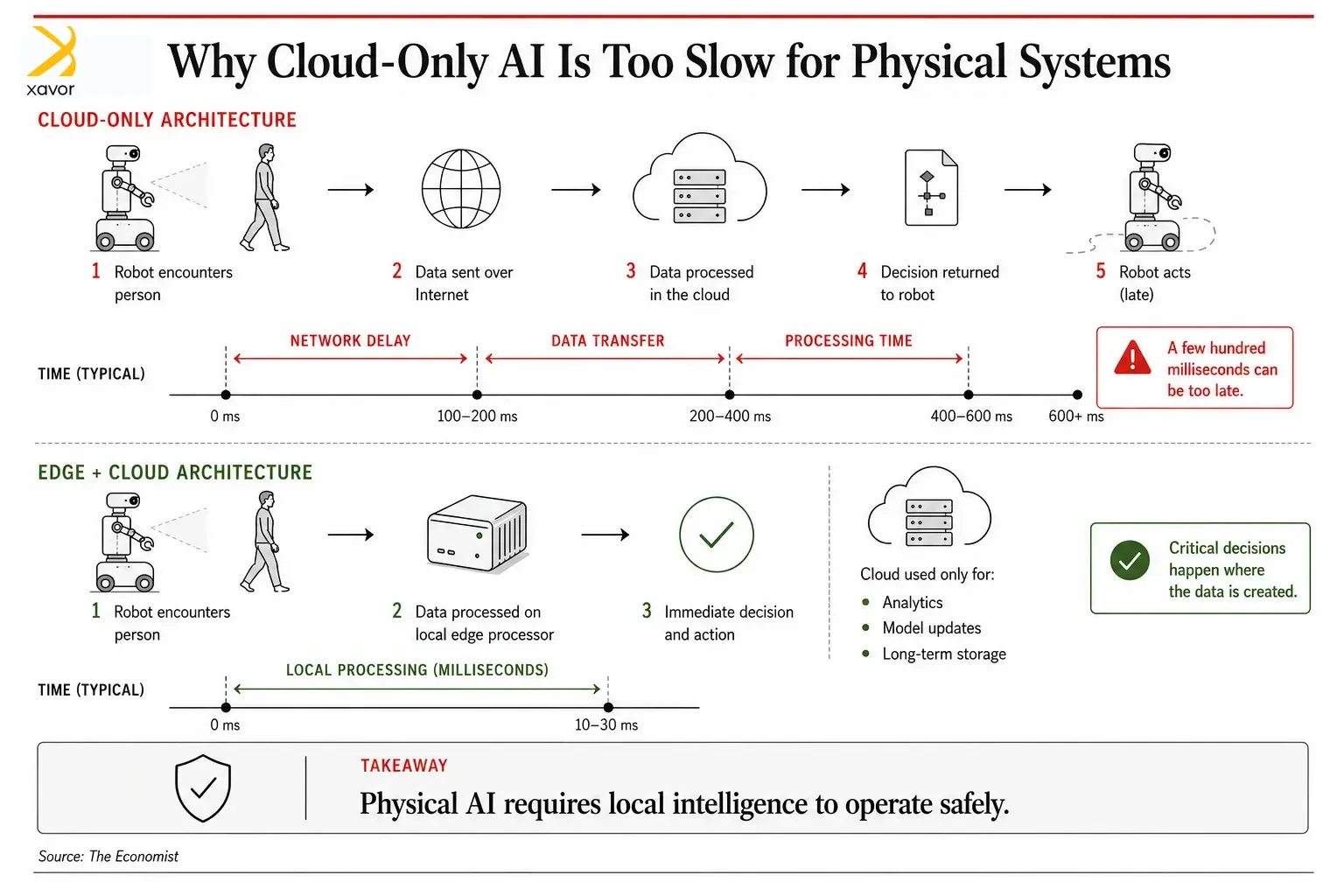
The traditional model of first sending data to the cloud, where it’s processed and then sent back to the device, is too slow for physical AI. While a robot waits for the cloud to send back the data, it would bump into a person or some object. Even milliseconds of delay are not tolerable.
And the only way to eliminate latency is by processing data near physical AI devices. IoT and edge computing allow physical AI devices to process their data locally to make snap decisions that must happen locally in real time. While other, less urgent decisions can be processed centrally using cloud architecture.
5. Simulation and digital twins
Creating context-aware world models to train physical AI using 100% real-world data is simply not possible. You can’t feed everything under the sun to a model because it would exceed zettabytes of data. The real world is too expensive, risky, and slow as the only training and testing environment.
That is why you need expertise in the fifth discipline, which is simulation and digital twins. Enterprises need synthetic data to train their physical AI products. Synthetic data is important because it realistically captures the world in a faster and cost-effective manner.
Therefore, you need to create a digital twin of a real environment, like a street or a warehouse, to develop synthetic data. Digital twins like these create training simulations in a controlled virtual world quickly and at scale.
Those simulations imitate real operations. And as the simulations run, the physical AI learns what happens in the real world. However, synthetic data needs to be impeccable; otherwise, physical AI will drive wrong conclusions that can prove to be costly.
6. Human factors and ethics
The sixth discipline is human factors. The best way of explaining that is through the connection humans have with pets. People trust their pets, and they feel comfortable around them.
Physical AI must achieve that level of trust with humans if it is to become ubiquitous. Workers, nurses, caregivers, technicians, managers, and customers must trust and understand these systems. A technically impressive system can fail if people do not know how to work with it.
And that is where that little bit of psychology comes into play in this field, along with some other key domains. You need experts who know how humans build trust, perceive risk, and react to autonomous systems.
Furthermore, physical AI needs a smooth user experience that makes it easy for people to interact with it. This is the job of UI/UX and interaction designers who know how human-machine relations work.
Lastly, humans are emotional beings. We are driven by emotions first, and rationality comes later. That is why many people have reservations about putting AI everywhere. And physical AI needs to assuage those concerns by focusing on security, privacy, and ethical questions that are concomitant with incorporating machines into everyday life.
7. Domain-specific expertise
Physical AI in healthcare is different from physical AI in manufacturing, logistics, retail, or transportation. Each domain has its own workflows, language, economics, and adoption barriers.
So, a robot may be able to navigate a factory perfectly, but if it interrupts clinical workflows in a hospital or creates additional work for nurses, it will struggle to gain adoption.
The current in-vogue way of acquiring domain-specific expertise is through an AI Forward-Deployed Engineer (FDE). FDEs are part engineers, part consultants who can make general-purpose AI products work for industry-specific outcomes. That is why having an FDE in your delivery team is very important.
8. Change management
Last but not least, change management is the eighth discipline to make any physical AI stand the test of time. Building a working prototype is only the beginning. A physical AI system may perform perfectly in a controlled environment.
But success ultimately depends on turning that prototype into something that people use every day and that delivers measurable business value. And it is a continuous process because teams need training, new processes, and support when new problems arise.
Organizations also need ways to monitor the performance of their physical AI system. It helps them continuously improve the system after deployment. What works during a pilot often needs to be refined once it encounters the realities of day-to-day operations.
Without change management, physical AI projects struggle to scale. The technology may work, but the organization is not prepared to adopt it. And change management bridges that gap.
How Xavor and NaviGait see things differently
At Xavor and NaviGait, we see physical AI through two lenses:
Xavor brings decades of enterprise software delivery experience: systems integration, cloud, data, AI, PLM, enterprise applications, QA, DevOps, and delivery discipline for complex organizations.
NaviGait brings embodied AI experience: robotics, sensing, human-centered design, healthcare AI, aging care research, gait and mobility intelligence, and field learning from real deployments.
Together, these perspectives create a practical understanding of what physical AI really requires, which is:
- Vision, but also engineering
- Models, but also workflows
- Sensors embedded in an enterprise architecture
Our multi-disciplinary team behind physical AI
Working with Fortune 500 companies for 30+ years and counting, Xavor has had hands-on experience dealing with different technology waves. We were there during the cloud boom, the rise of enterprise SaaS, and now AI is one of our core areas of interest.
That has given Xavor+NaviGait vast organizational knowledge. We have dedicated AI engineers, software architects, robotics engineers, product managers, healthcare collaborators, cloud experts, and field support personnel who are the best in their domains.
Conclusion
Physical AI raises the bar on what artificial intelligence can do. But reaching its potential demands intelligent systems that can reason and act in environments where every decision is constrained by a number of factors. Physics is the most prominent, followed by safety, human behavior, and business outcomes.
And all of these factors are separate fields. That is why physical AI will not be built by AI teams alone. You will need to bring together expertise across all of those fields to develop a new operating model for how intelligence interacts with the physical world.
Xavor and NaviGait bring together the multidisciplinary expertise required to turn physical AI from an ambitious concept into a measurable business capability. Partner with our AI services to start building the intelligent systems that will define the next generation of enterprise operations now.
Drop us a line at [email protected]

FAQs
A self-driving car is one of the most common examples of physical AI. It uses cameras, sensors, AI models, and real-time decision-making to perceive its surroundings, predict what might happen next, and safely navigate the physical world without constant human control.
Agentic AI focuses on making decisions and completing tasks autonomously in digital environments, such as managing workflows, conducting research, or interacting with software systems. Physical AI goes a step further by perceiving, reasoning, and acting in the real world through sensors, devices, robots, or other connected systems.
Physical AI learns by combining data from sensors, cameras, and real-world interactions with AI models trained on both real and simulated environments. Many systems use world models, simulations, and digital twins to understand how actions affect outcomes, allowing them to improve decision-making and adapt to changing physical conditions over time.