

People usually dread calling customer service hotlines. And they can’t really be blamed because of the long hold times and constantly getting run around. You don’t need to be an expert to realize that making someone wait for 20–30 minutes just to cancel their subscription or fix a technical glitch is bad customer experience (CX).
Customers today want instant answers to their problems. But customer service departments usually don’t have the required bandwidth to meet that demand. AI chatbot development services can make this predicament go away for customers and businesses.
Self-service chatbots can take care of most routine queries through human-like conversational interfaces. It’s AI picking up a call and conversing with a customer, or responding with text to resolve their problem.
This blog will elaborate on the role of enterprise chatbot solutions to improve customer experience. We’ll delve into their benefits and how you should implement a self-service chatbot.
What are self-service chatbots?
A self-service chatbot is a smart, automated assistant that can have a real conversation with you to solve your problem without needing a human. Such AI self-service platforms are trained to understand customer queries from a knowledge database.
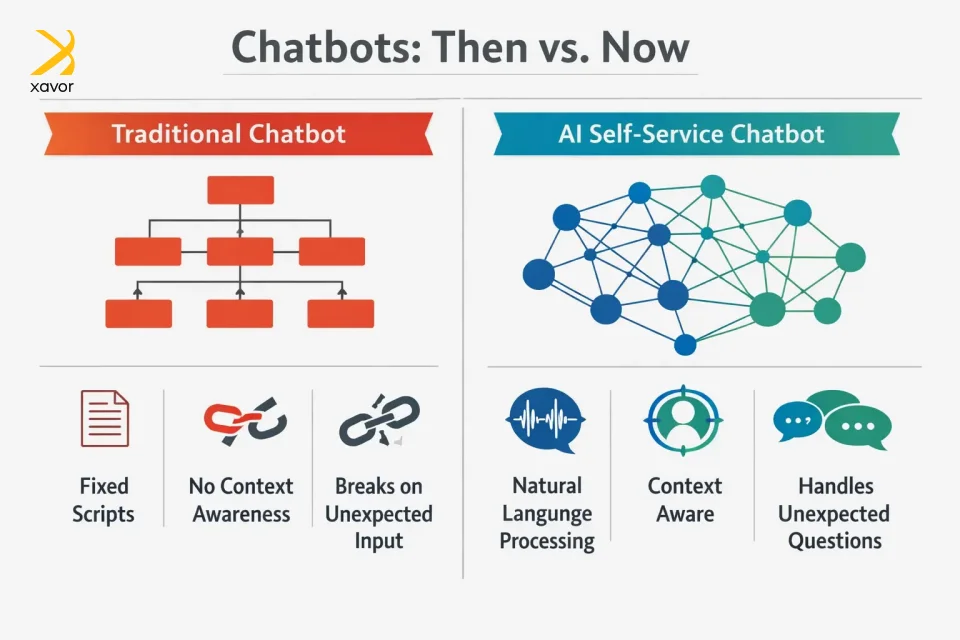
It is important that you know the difference between traditional and self-service AI chatbots. The former are basically just glorified menus or FAQs sections. Traditional chatbots can only ask very specific things, and they break easily if you ask something beyond their scope.
But AI chatbot development services now have much more potent natural language processing (NLP) capabilities at their disposal. Modern self-service chatbots use AI to actually understand what you’re saying, even if you phrase it in an unusual way. That is because they have context awareness and the ability to handle unexpected questions.
How enterprise chatbot solutions improve CX
Answering questions is the starting line of customer service. The ultimate aim of good customer service is to get things done. That is why AI chatbot development services focus on making chatbots capable enough to solve problems like or better than a human rep.
1. 24/7 availability and support
Humans are bound by time zones. Businesses, however, work on the follow-the-sun model. They need to provide round-the-clock customer service to people across the world.
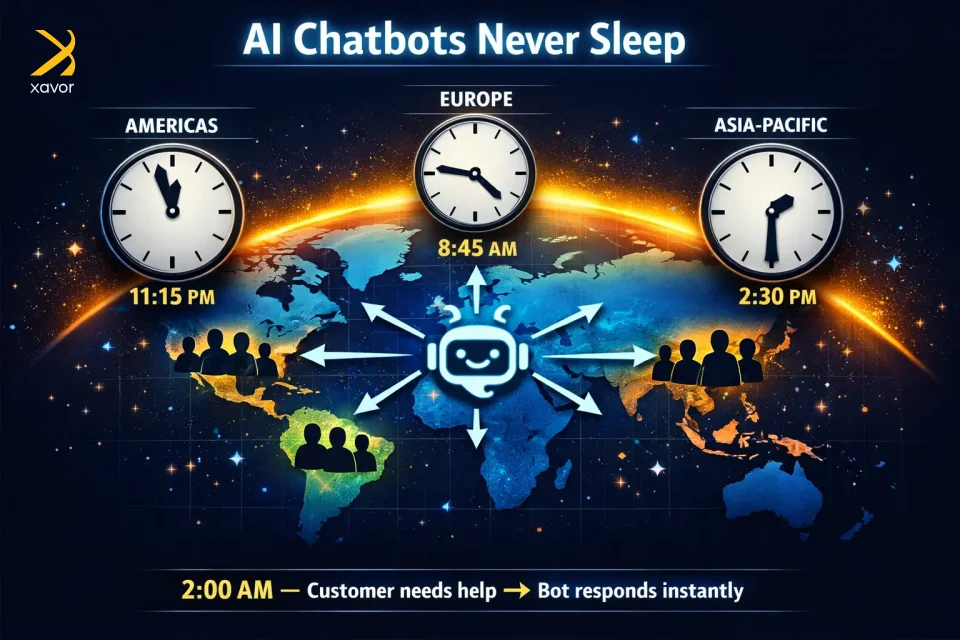
It doesn’t matter whether the sun has set or is rising. A customer can have a problem that they need to solve ASAP. Now, having a human rep answer queries at midnight is not always possible or feasible. But with AI chatbot development services, you don’t need to.
Self-service AI chatbots assist customers instantly, anytime, anywhere.
2. Faster resolution time
Customers these days expect instant solutions. Instead of being placed on hold or stuck in a queue, customers connect instantly with an AI chatbot that responds within seconds.
For common questions like order status, password resets, or business hours, the chatbot provides immediate answers and resolves straightforward inquiries on the spot, often in under a minute. When the chatbot detects a complex problem it can’t handle, it automatically transfers the conversation to a human agent along with all the context the customer has already provided.
Because the bot has gathered details about the problem, the human agent can jump straight into solving the issue without asking customers to repeat themselves.
3. Cost savings
Self-service chatbots dramatically reduce operational costs while maintaining quality support. They eliminate the need to staff large support teams for 24/7 coverage for routine inquiries.
A single chatbot can manage thousands of simultaneous conversations at a fraction of the cost of human agents. For repetitive questions that make up 60-80% of support volume, the cost per interaction drops from several dollars with human agents to just pennies with AI.
In this way, human agents become a strategic resource rather than a scaling bottleneck. Instead of burning out answering the same password reset question hundreds of times, they focus exclusively on complex, high-value interactions that genuinely require human expertise.
4. Data-based insights
AI chatbots act as continuous data collection systems, automatically tracking every customer interaction and generating insights that would be impossible to gather manually.
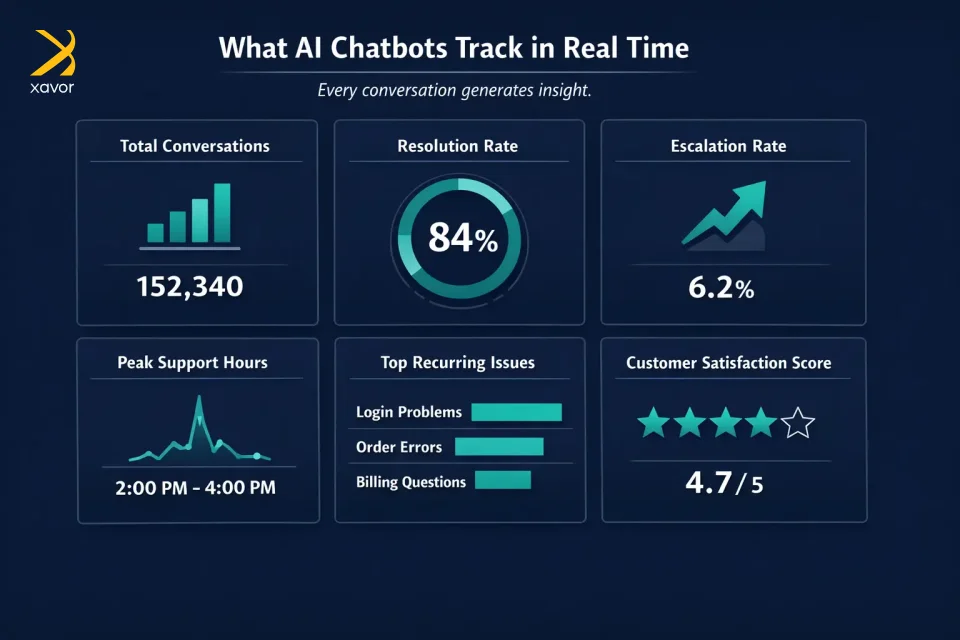
They record important metrics, such as:
- The number of conversations
- Track response patterns
- Measure resolution rates
- Identify escalation by humans
This gives you a complete picture of what customers need and where your support process succeeds or struggles.
More importantly, chatbots reveal patterns in customer behavior using data analytics about which questions come up repeatedly. If hundreds of customers ask the same question about a specific feature, that signals a gap in your product documentation, UI design, or onboarding process that needs fixing.
These insights flow back into continuous improvement loops. Frequently asked questions get added to the chatbot’s knowledge base, so future customers get instant answers.
5. Personalization
AI chatbots don’t treat every customer the same. They can remember who you are and adapt their responses based on your history, preferences, and current context. When a returning customer asks a question, the bot instantly accesses their information to provide answers that are specifically relevant to them.
This personalization goes beyond just knowing your name. If you previously bought a specific product, the chatbot recommends accessories or upgrades compatible with what you own. If you contacted support about shipping delays last month, it proactively checks your current order status before you even ask.
The result feels less like talking to a robot and more like working with an assistant who actually knows you. Instead of explaining your situation from scratch every time, the chatbot picks up where you left off. This level of personalization at scale would be impossible with human agents alone.
How Xavor’s AI chatbot development services approach self-service efficiency
Building an effective AI self-service strategy means more than just deploying a chatbot. It requires thoughtful planning to ensure the system actually helps customers rather than frustrating them.
Your approach should match your business size and complexity, while keeping the customer the top priority.
Here’s how Xavor AI chatbot development services build custom self-service systems to meet these objectives. Follow in the footsteps of this approach to meet your sector’s unique regulations, customer expectations, and operational workflows.
1. Always ensure easy access to human support
The biggest mistake businesses make is trapping customers in endless AI loops with no clear way out. While chatbots excel at handling routine questions, they can’t solve everything. And trust us, nothing frustrates customers more than being stuck in automated menus when they desperately need human help.
So, our AI chatbot development services design your system with escalation as a core feature. Every chatbot interaction includes a visible, easy-to-find option like “Talk to a person” or “Connect with an agent”. It isn’t tucked away in some hidden menus or forcing customers through ten questions first. The escalation button is as prominent as the automated options.
Also, we make navigation intuitive for everyone, including non-tech-savvy users. We place your most common questions front and center where customers see them immediately, not buried three layers deep in a conversation tree. Our AI chatbot development services use clear, plain language in menu options rather than internal jargon.
We also prefer providing multiple escalation pathways: some customers prefer voice calls, others want video chat, and some just want to switch to text-based chat with a human agent without changing channels.
This seamless continuation of the support journey ensures customers feel heard rather than bounced between systems that don’t talk to each other.
2. Keep entry points simple and direct
We try as much as possible to make initial contact effortless. When customers land on your support page, we give them clear, immediate options: start chatting with the bot, browse FAQs, or connect with an agent. Our developers don’t hide contact methods or make customers prove they “deserve” human support by exhausting automated options first.
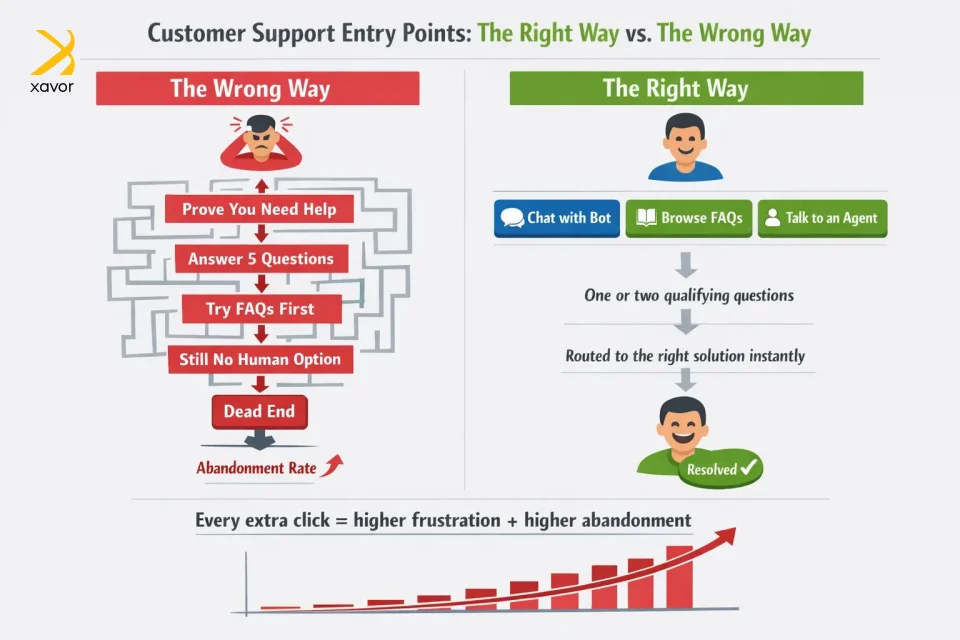
Xavor’s AI chatbot development services balance automation with accessibility. We design enterprise chatbot solutions to route requests efficiently. However, we make sure to force customers into interrogations before they can explain their problem. Simple account verification gets customers to the right place quickly without friction. The goal is intelligent triage by letting the bot ask one or two qualifying questions to route the issue appropriately, then connect the customer to the solution.
Remember that confused or frustrated customers need help fast, not a maze to navigate. Our AI chatbot development services make every extra click, menu, or decision point increase abandonment rates and irritation.
3. Be upfront about expectations
One of the most frustrating customer experiences is investing time explaining a problem to a chatbot, only to discover 20 minutes later that it can’t actually help with that issue. This wastes everyone’s time and erodes trust in your self-service system.
Therefore, we prevent this by telling customers immediately what the chatbot can and cannot handle. Before they start typing, a brief message is displayed like: “I can help with order tracking, password resets, and billing questions. For account upgrades or technical support, I’ll connect you with a specialist.”
This simple transparency lets customers decide whether self-service is the right path or if they should go directly to human support.
Moreover, our AI chatbot development services provide channel guidance across your support ecosystem. On your help center homepage, it is clearly indicated which problems work best through chat, which require phone calls, and which can be fully self-solved through your knowledge base. A good way we employ to make this instantly scannable is by using visual cues like icons or color coding.
Clear expectations from the first interaction save customers time, reduce frustration, and ensure they use the right channel for their specific needs.
4. Build continuous learning systems
It’s okay if chatbots make mistakes, but it’s not okay if they don’t improve from it. When a customer struggles with a specific issue today, and another customer hits the exact same wall next month, that’s a bad look at your business. Static chatbots repeat their mistakes indefinitely because nobody’s monitoring what’s breaking or why.
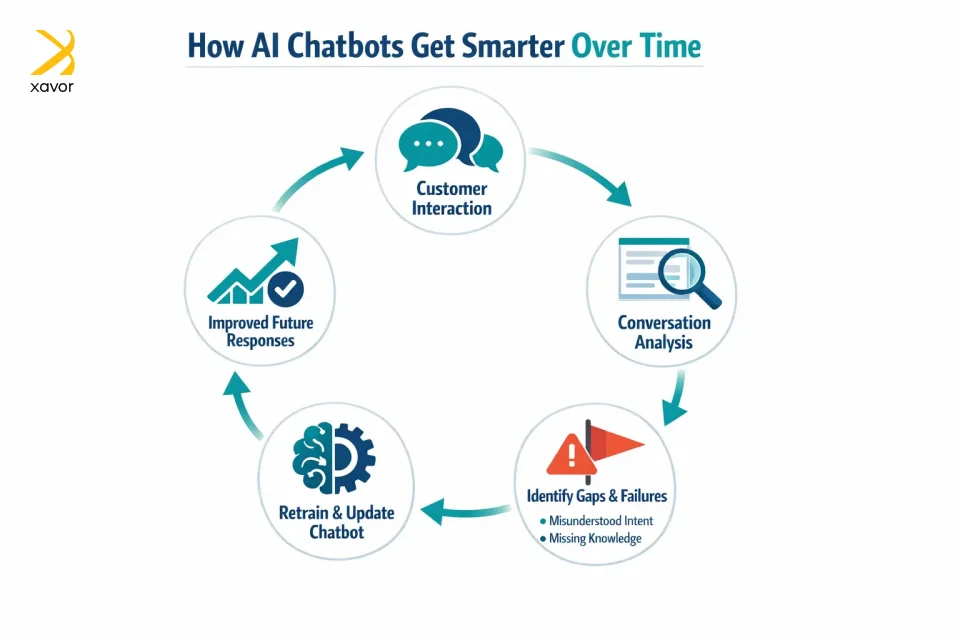
So, our AI chatbot development services implement systematic conversation analysis to identify patterns in customer struggles. We review chat transcripts regularly using analytics to flag conversations that took unusually long or received negative feedback. These problem interactions reveal where the chatbot fell short due to:
- Lack of knowledge
- Misunderstanding intent
- Providing unhelpful responses
If ten customers this week asked about exchange policies and all got escalated to humans, that’s a clear signal the bot needs better training on that topic.
Finally, we create a feedback loop between insights and improvements. When analysis reveals recurring issues, the chatbot is updated immediately. This adds the missing knowledge, refines the conversation flow, trains the AI on new language patterns, or adjusts decision trees to handle edge cases better. And this should be an ongoing process.
Use real usage data to optimize continuously. Our AI chatbot development services track which self-service paths customers abandon, which questions generate the most follow-ups, and which automated solutions actually resolve issues versus just frustrate users into calling support.
Conclusion
The shift from traditional support to AI-powered self-service is a fundamental rethinking of what customer service is supposed to do. The goal was never to have customers wait in queues or repeat themselves to three different agents. The goal was always resolution. AI chatbots, done right, finally make that possible at scale.
But technology itself is only half the equation. A chatbot that traps customers in loops, hides the escalation button, or never learns from its mistakes isn’t self-service. Instead, it’s just a more sophisticated run around. The businesses that get this right are the ones that treat AI as a tool for genuine helpfulness.
And that distinction matters more now than ever. As AI becomes embedded in every customer touchpoint, the companies that will stand out are the ones whose automation actually earns trust. If your customers dread contacting your support team, what does that tell you about the experience you’ve built for them?
Build AI-powered self-service that customers actually want to use, partner with Xavor’s AI chatbot development services, and transform your customer experience from the ground up.
Contact us at [email protected] to book a call and talk to our AI experts.

FAQs
Self-service AI lets customers resolve issues on their own through intelligent, conversational tools without needing to contact a human agent. It understands natural language, takes real action on your account, and is available 24/7, making support faster and more convenient for everyone involved.
There are four main types of chatbots. 1) Rule-based chatbots follow fixed scripts and predefined menus, only responding to specific commands. 2) AI-powered chatbots use natural language processing to understand intent and hold more human-like conversations. 3) Hybrid chatbots combine both approaches, using AI where possible but falling back on rules when needed. 4) Voice-enabled chatbots do the same but through spoken conversation rather than text.
The cost varies widely depending on complexity and business needs. A basic rule-based chatbot can cost anywhere from a few hundred to a few thousand dollars, while an advanced AI-powered chatbot integrated with your existing systems can range from tens of thousands and upward. Ongoing costs like maintenance, updates, and platform fees also apply.