

There is practically no limit on what devices you can interconnect with the Internet of Things (IoT). Just Google unique IoT-enabled devices and you’ll find interesting (and sometimes slightly weird) ideas. Like a smart cat litter tray that automatically notifies you through an app whenever your cat does its business.
So, if you’re a startup or business with an idea for an IoT device, don’t think it’s impractical unless you try it.
But you need an IoT development company to get it off the ground. IoT solutions development is a complex process that requires expertise in highly specialized fields.
In this article, we’ll look at the top 10 IoT companies in the United States that can help you build talking shoes, a smart umbrella, or any niche smart device idea you have in mind.
What are the types of IoT development companies?
The IoT technology stack is a vast ecosystem. Therefore, one IoT development firm can be different from other IoT services companies based on where it operates in the IoT tech stack.
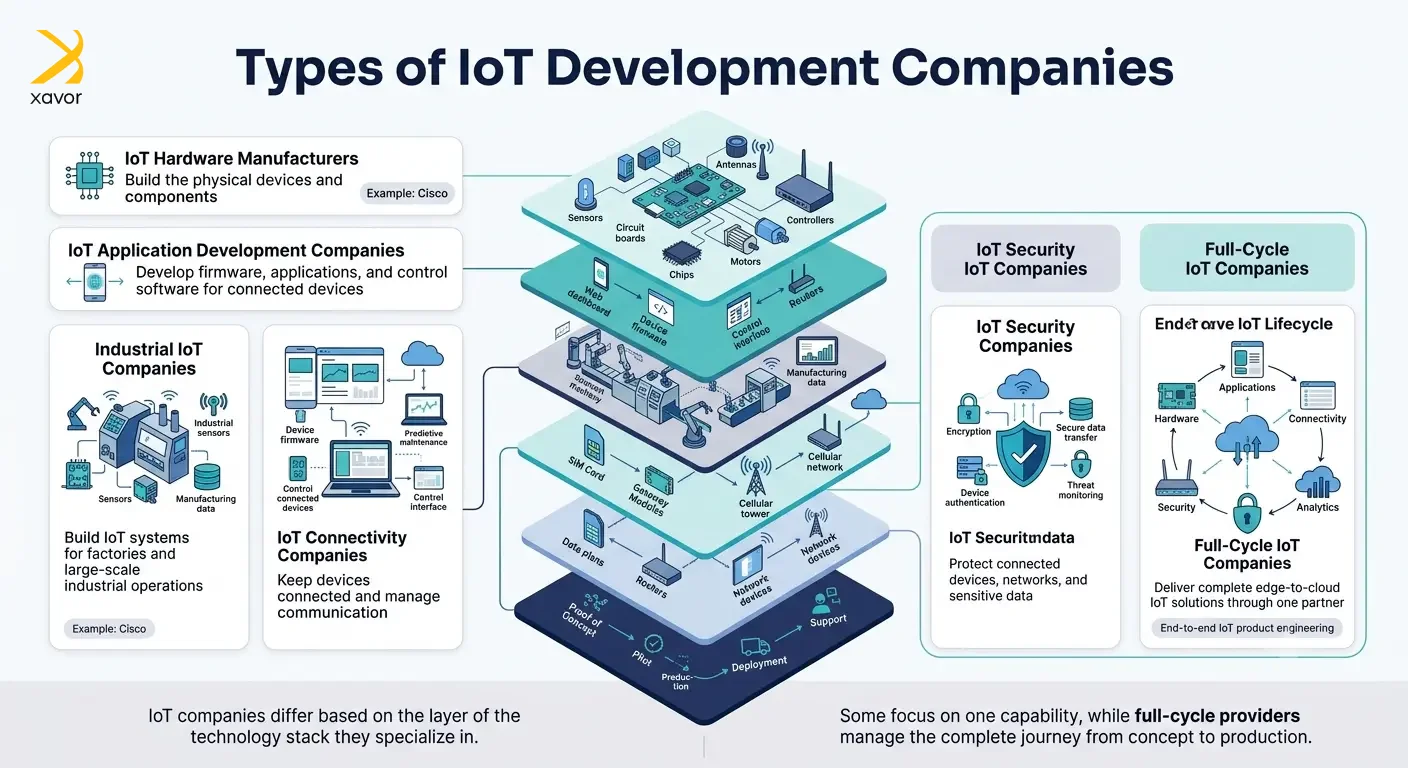
Here is a rough industry classification of IoT technology companies:
1. IoT hardware manufacturers
IoT hardware design and manufacturing companies produce the physical devices and components of IoT products, such as:
- IoT sensors
- Controllers and circuit boards
- Chips and motors
- Antennas and switches
- Routers
Cisco is a household example of an IoT development company that deals with hardware.
2. IoT application development companies
Every IoT device needs firmware or software that powers the system and is usually used to control the connected devices. So, IoT application development companies specialize in developing the software with existing hardware and cloud services rather than engineering the device itself.
3. Industrial IoT companies
Industrial IoT (IIoT) is a niche within IoT devices that are designed for large-scale industrial operations. IIoT devices are employed in factories and often integrate with other industrial equipment to support industry operations.
4. IoT connectivity companies
The IoT connectivity market has its own class of companies. Such IoT development companies provide either services or products for the connectivity-management layer that keeps devices online, such as:
- SIMs cards
- Gateways modules
- Data plans
- Network devices
5. IoT security companies
IoT devices are prone to cyberattacks because they are almost always connected to the internet and exchange sensitive data. For example, people use smartwatches and other wearables to monitor their health.
So, some IoT companies only focus on the security domain of the IoT lifecycle.
6. Full-cycle IoT companies
It’s possible for one IoT development company to cover the entire spectrum of IoT technologies. They are typically hired by businesses that want one partner to take an IoT product through proof of concept, the pilot, and production. AWS describes this broader model as specialized edge-to-cloud IoT delivery.
10 leading IoT development companies in the US of A
Top 10 lists can become cliched if they aren’t picked based on some sound methodology or decision criteria. So, for objectively comparing the top IoT companies in the US, we created a framework that can be consistently applied across vendors.
An IoT development company must be evaluated against these 10 dimensions:
- IoT technical expertise
- End-to-end development capability
- Security and compliance
- Cloud architecture and scalability
- Technology stack and R&D
- Industry experience
- Engineering quality and delivery process
- Post-deployment support
- Project governance and communication
- Market credibility and performance
Every IoT company in this list is evaluated using publicly verifiable evidence rather than marketing claims.
1. Xavor Corporation
Headquarters: Irvine, California
Type: Full-cycle IoT development company
Xavor was founded in 1995 by an American technology practitioner-scholar. Our company is based in the city of Irvine with an overseas presence in China as well.
We have dedicated IoT and embedded engineering services that have developed some successful IoT projects. Among them, Navi is our flagship project that has received much traction in the United States. It is a physical AI, social care companion for elderly healthcare.
Navi is built using NVIDIA Jetson and STM32 for low-level controls. Its robot sensors have 360-degree LiDAR scanning with an RGBD camera for AI models.
Our IoT hardware engineers designed Navi to work in both home settings and medical facilities. It has a cliff sensor to prevent falling and bumper sensors for fail-safe scenarios.
But more importantly, Navi is an emotionally intelligent care companion that provides older adults with companionship and therapeutic conversation. It has a long-term memory for intelligent conversation that feels human-like.
Plus, it performs routine healthcare tasks, such as diligent patient monitoring to timely alert a patient’s caregivers.
Here is our complete list of IoT development expertise that we provide to clients:
- Embedded hardware design
- Firmware development
- IoT connectivity and dashboards
- Industrial automation and control systems
- Battery-optimized design
- Prototyping and product development
- Embedded UI/UX and HMI development
To work with us for your IoT project, contact us through any of the following channels:
Location: 2211 Michelson Drive, Suite 900, Irvine, CA 92612
Website: https://www.xavor.com/
Email: [email protected]
LinkedIn: https://www.linkedin.com/company/xavor
2. Very Technology
Headquarters: New York City, New York
Type: Full-cycle IoT development company
Very Technology ironically has a very simple name for a very complex field they work in. But it’s a top-notch IoT development company that connects hardware with software and AI.
The IoT solutions provider has developed IoT products for international brands. Particularly in the manufacturing industry, they have some prominent work regarding safety and compliance.
Services they provide:
- Roadmap development
- Product strategy
- Design sprints
- Proof of concept build
- EVT/DVT/PVT prototypes
- Manufacturing support
- Product launch
3. Geisel Software
Headquarters: Worcester, Massachusetts
Type: IoT application development company
There are some high-consequence IoT system software, in healthcare and fintech to name a few, that cannot simply be restarted when something goes wrong. Geisel Software works on such embedded software that don’t get a second chance.
Services they provide:
- IoT architecture consulting
- Embedded firmware development
- Device-to-cloud connectivity
- Edge AI and machine learning
- Computer vision and sensor fusion
- Forward-deployed engineering
The IoT development company’s portfolio includes NASA’s lunar robotics and Mars Sample Return programs.
4. SumatoSoft
Headquarters: Boston, Massachusetts
Type: IoT application development company
SumatoSoft is another IoT software development firm that gained some limelight for building the firmware for a robotic kitchen arm created by a Boston-based robotics company.
Moreover, they position themselves as an AIoT company as well that combines connected devices with machine learning and AI-based processes.
Services they provide:
- Data acquisition and device integration
- Real-time ETL and edge computing
- Predictive ML and agentic automation
- IoT dashboards, control apps, and operator interfaces
- Security audit and device trust architecture
- OTA updates and fleet operations
5. Blues
Headquarters: Boston, Massachusetts
Type: IoT connectivity company
Blues is a product-based IoT connectivity company that builds and sells its own proprietary hardware and software to eliminate connectivity issues in IoT, which are one of the most pestering problems in IoT development.
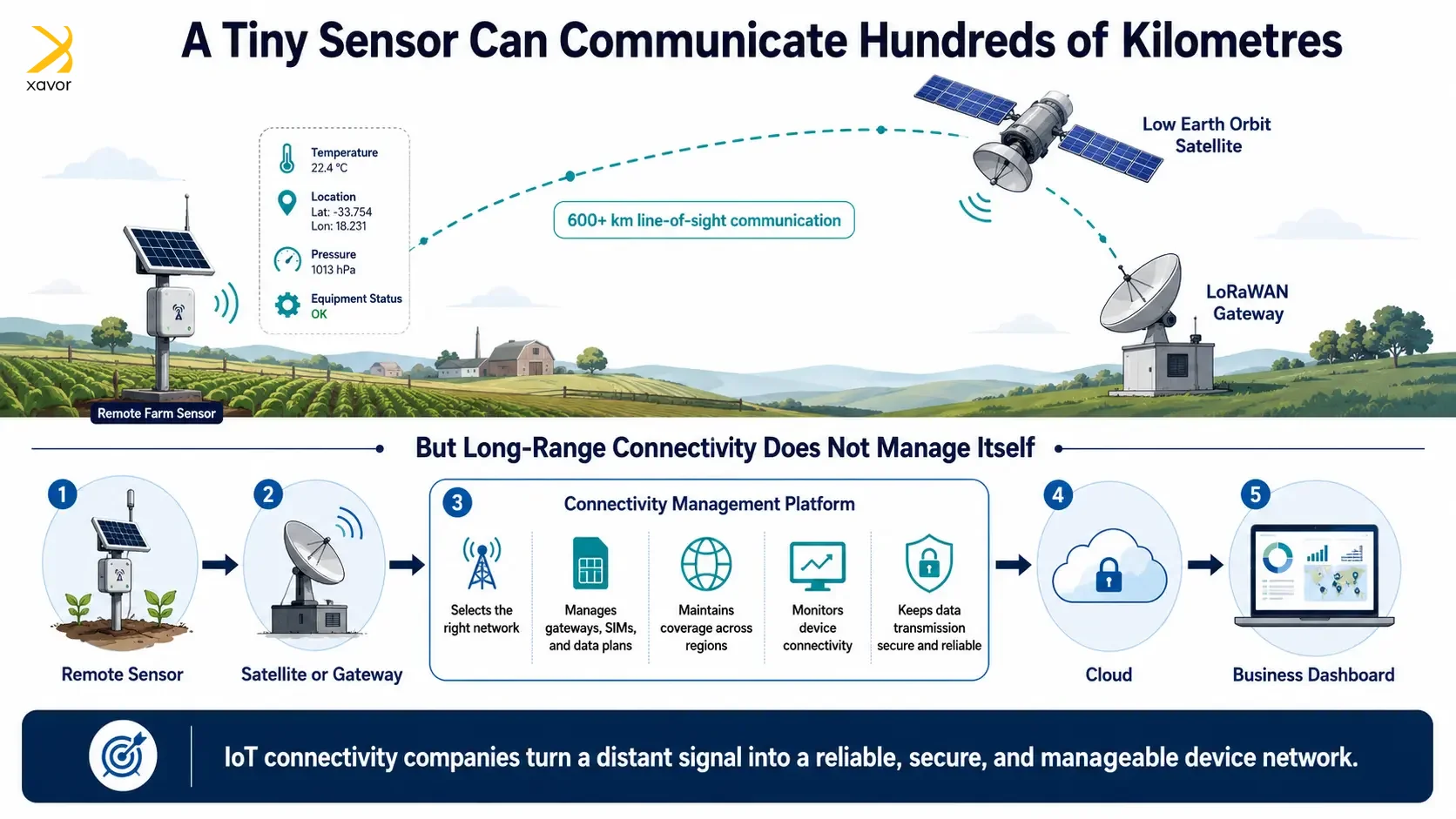
The company was formed by a former Microsoft chief software architect. Its flagship Notecard handles cellular, Wi-Fi, LoRa, or satellite connectivity between devices and cloud applications.
Some other IoT products that they offer:
- Starnotes
- Notecarriers
- Wireless for OPTA
- Feather MCUs
- Airnote
- Notehub
So, if you’re looking for an IoT development company for connectivity components specifically, Blues is the best of the lot.
6. Bastille Networks
Headquarters: San Francisco, California
Type: IoT security company
Bastille Networks provides OT and IoT security by watching the radio waves moving through the physical space around a company.
It is a very interesting and vital proposition because modern IoT-OT networks are connected to distributed networks, which increases the attack surface. And mitigating these threats requires monitoring the entire radio spectrum.
Services they provide:
- Wireless airspace cybersecurity
- Zero trust, CAASM and XDR integration
- Executive protection
- IoT device monitoring
7. Kickr Design
Headquarters: Atlanta, Georgia
Type: IoT hardware manufacturer
Kickr Design is a product development and engineering consulting firm. Their electronics and IoT wing creates the latest connected IoT electronic devices.
The IoT development company operates a hardware incubator with an 8,000-square-foot prototyping workshop. Its equipment includes 3D printing, laser cutting, machining, welding, fabric development, and even on-site injection molding.
Services they provide:
- Custom electronics design
- IoT product engineering
- Sensor integration
- Prototyping and manufacturing support
You can walk in at Kickr Design with an idea and leave with a physical prototype.
8. Density
Headquarters: San Francisco, California
Type: IoT hardware manufacturer
Density started as a weekend project, and now it’s one of the top IoT development companies in the United States. The firm designs privacy-conscious IoT sensors that measure how people use offices and buildings without functioning like conventional surveillance cameras.
They have purposely made their sensors physically incapable of recording people. That means no photos or facial recognition that erodes trust. Instead, they use depth sensing and radar to perform the same actions.
Their hardware lineup includes:
- Waffle, a compact, self-installable sensor
- Open Area is a radar-based IoT sensor
- Entry is a sensor that is mounted above doors
Atlas is also their software that combines sensor data into insights.
9. Yeti
Headquarters: San Francisco, California
Type: IoT application development company
Not many IoT application development companies have such an unusual portfolio as Yeti. The IoT services company has developed firmware for an automated dart-scoring system and an app for connected skincare products.
Yeti was founded in 2010, and UI/UX is their USP. Traditionally, IoT apps are not as intuitive to use as, say, regular mobile applications. But Yeti pays great attention to the user experience of their IoT firmware and software.
Services they provide:
- IoT app and firmware development
- Connected product prototyping
- Wearables and Bluetooth app development
- IoT cloud integration and dashboards
10. KCF Technologies
Headquarters: State College, Pennsylvania
Type: IIoT development company
KCF was founded in 2000 by researchers associated with Penn State University. The company grew out of work involving machinery safety and failure analysis. They have developed IoT products that reduce workplace accidents using AI predictive maintenance.
The IoT development company’s most prominent products are:
- SMARTdiagnostics
- SMARTsensing Suite
- SENTRYsolutions
Conclusion
Even the most unconventional IoT idea can become commercially viable when it is backed by the right engineering expertise. But it is a long list of expertise. That’s why evaluating an IoT development company on technical depth and execution matters far more than choosing the biggest name.
The companies in this list represent different pieces of the IoT ecosystem. Some specialize in embedded engineering while others specialize in industrial automation. Connectivity, security, or purpose-built hardware firms are in a category of their own.
We know choosing between them is not easy. Contact us at [email protected] if you need further help. Our IoT and embedded engineering services will guide you on what kind of partner is the perfect fit for you.

FAQs
IoT can reduce manual monitoring, detect equipment issues earlier, track assets, automate field operations, and give managers current operating data. The right use case depends on where connected devices can reduce cost, delay, risk, or waste.
It depends on range, power use, bandwidth, coverage, and operating environment. Wi-Fi suits fixed devices with local network access, cellular suits mobile or remote devices, LoRaWAN suits low-power sensors over long distances, Bluetooth suits short-range device connections, and satellite suits areas without reliable terrestrial coverage.
Yes, we can assess your hardware, firmware, communication protocols, interfaces, and processing limits before developing the required device software, mobile application, cloud services, or control dashboard.