

Our imagination of AI is so far of something we see on our screens. Like text-based ChatGPT, image generator Sora, or Claude Code. These are all fantastic tools, but they don’t do anything in the actual, physical wortld. They all live in the digital world, and their intelligence falls apart when you ask them to reason with their physical environment.
But that soon will also be within grasp with physical AI. The next wave of AI will be about physical intelligence solutions that can understand and interact with their surroundings. Physical AI systems can sense and interact with the real-world pretty much as humans do with their five senses.
Although the idea is pretty old, physical AI is a new, loosely defined term. There is a fair bit of vagueness around it, and people are jumping on the bandwagon without really understanding it.
In this blog, we will attempt to clear the fog around this buzzing technology. What is it really? How does it work? And will it live up to the hype? Keep on reading if questions like these are on your mind as well.
Physical AI 101: What it is and isn’t
NVIDIA’s CEO, Jensen Huang, coined and popularized the term physical AI in his keynote addresses over the last two years. “The next wave requires us to understand things like the laws of physics, friction, inertia, cause and effect,” said Huang about his vision for physical AI.

Based on this description, physical AI systems can think and act in the real world. Machines with physical intelligence not only compute but also interact with their physical environment. They have awareness of things like space, motion, and interaction.
Key features of physical AI
These are some of the essential elements of any physical AI system.

1. Autonomy
Physical AI systems can run on their own instead of waiting for humans to approve every step. They don’t just follow fixed scripts. Instead, they can handle routine decisions and keep operating even when conditions change.
2. Real-time perception
It can constantly sense what’s happening right now and process that information fast enough to be useful in motion. This happens continuously, sometimes in milliseconds, because physical environments are unpredictable.
3. Adaptability
A physical AI doesn’t stay frozen at version 1. It can get better over time by learning from past outcomes. That learning may happen through updates, retraining, or tuning based on well-engineered data pipelines, so the system gradually becomes more reliable across different situations.
4. Sensory integration
Humans have five senses, and we combine them to make sense of our world. Physical AI works similarly by fusing multiple streams of data using cameras, microphones, and radars to build a more accurate picture of what’s going on.
5. Closed-loop operation
This is one of the biggest differences from other types of AIs. A physical AI system does something, then checks what happened using a closed-feedback loop. This feedback loop is how it stays stable and improves in changing conditions.
We’ll discuss this feedback loop in detail below when we talk about how physical AI actually works.
6. Built-in governance
Physical AI operates in places where mistakes can cause damage or major losses. So serious systems include governance from the beginning.
In practice, governance makes the system trustworthy enough to deploy beyond impressive demos.
Trust rarely stops at the system itself, though. A report or compliance summary about that system faces its own scrutiny, and Getsolved AI tool covers this layer with fact-checks, grammar fixes, and an originality scan before a document goes out.
Examples of physical AI in daily life
Common applications of physical AI are mainly in robotics and automation, such as:
- Smart robots
- Autonomous robotic systems
- Vision-based inspection cameras
- Predictive maintenance model
Logistics
Logistics has been one of the quickest industries to adopt Physical AI. Companies such as Amazon, Walmart, and Alibaba use large fleets of warehouse smart robots to move inventory, sort items, and keep orders flowing efficiently.
Amazon’s early approach focused on robots that mainly handled straightforward transport; you know, moving shelves or goods from one place to another. That kind of automation reduced manual walking and sped up fulfillment.
However, newer autonomous robot systems go further. Robots like Amazon’s Proteus and others in the same category are designed to:
- Sense the environment using tools like LiDAR scanners and cameras
- Understand what’s around them
- Plan routes independently in a changing warehouse
- Coordinate with workflows instead of just following fixed paths
The important shift is that these physical AI platforms are AI-driven mobile workers that can navigate safely, adjust to real-time conditions, and operate continuously to keep warehouses productive.
Healthcare
In healthcare, physical AI shows up in two main ways: precision procedures and assistance to staff.
Surgical robots in healthcare support minimally invasive operations by improving steadiness, precision, and consistency. This helps clinicians perform delicate tasks with better control and potentially smoother recovery outcomes.
On the other hand, care and support for physical AI systems assist hospitals and caregivers in day-to-day administrative and patient care procedures. Rui, our physical AI care companion, does exactly that by monitoring elderly patients and providing them with empathetic care with human-like rapport building.
Manufacturing
Manufacturing is one of the fastest-growing areas for physical AI because factories are full of repetitive tasks, safety risks, and opportunities to improve speed and quality.
For example, Tesla’s Optimus is positioned as a humanoid robot meant for factory tasks such as:
- Moving parts and materials
- Supporting assembly work
- Inspecting product quality
Beyond Tesla, robots like Figure AI’s Figure 02 represent a new wave of humanoids being piloted for real work settings. The future of physical AI promises major steps toward robots that can be useful in everyday industrial operations.
At this point in the article, it is time to discuss another aspect of physical AI. The above examples might give you the impression that physical AI is just things like robots and stuff. That they must do tasks, such as walking, using two arms, and handling objects. However, what makes physical AI is not the physical humanoid shape by itself; rather, it’s the development approach.
Feeling confused? That’s where you need to know what physical AI isn’t.
What physical AI is not
At first, physical AI seems simple; it’s physical + AI, right? As mentioned earlier, it is an inchoate term, and that’s an oversimplified understanding of it. Physical AI doesn’t need an actual, tangible physical body to exist. Rather, it only needs to analyze data about the physical world and generate insights to propose what to do next.
This ability to reason about the physical world is what makes physical AI. For example, a prediction model for rain gets data from a sensor. It estimates flood risk at a specific location by combining real-time data with an understanding of how water moves.
Such cyber-physical systems don’t have arms to touch anything like a robot, but they use computational power to infer things related to the physical world.
Physical AI vs embodied AI
On the other hand, what people commonly think of as physical AI, as artificial intelligence with a physical body that moves around and touches, actually falls within embodied AI. Embodied AI is things like humanoid robots, self-driving cars, and smart home appliances, which have an actual physical body and physically interact to change the real world around them.
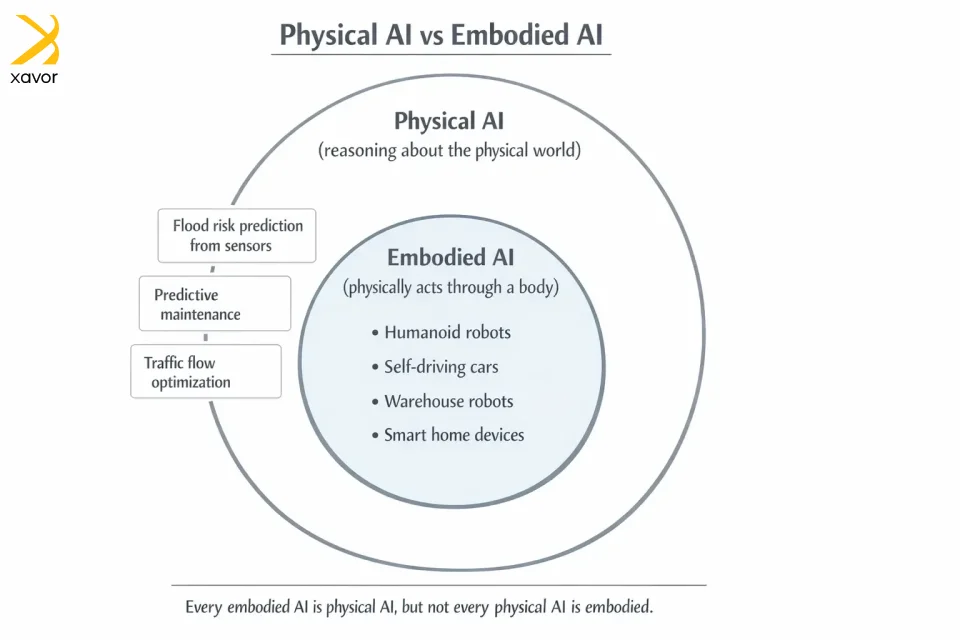
Physical AI is an umbrella term that includes embodied AI as a subset. To remember the difference, every embodied AI is a physical AI, but not every physical AI is an embodied AI.
How does physical AI work?
Generative AI models are great at producing human-like text, visuals, and concepts, but their training can’t cope with the 3D world around them. Physical AI basically uses the latest LLM models to understand things like space and physics in the real world, which is why it is also known as generative physical AI.
However, the difference is that physical AI doesn’t take input from text prompts. It takes multimodal inputs from external signals to generate insights and take action based on a continuous feedback loop.
Sense-think-act loop
The sense-think-act cycle is the fundamental model behind the working of physical AI systems. It is pretty similar to how humans operate with the world around us.
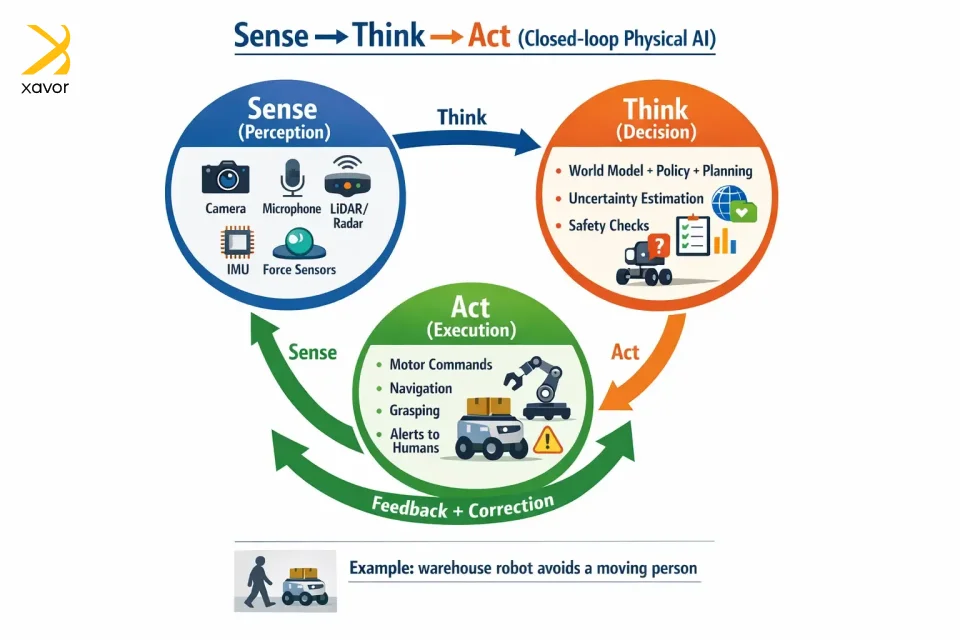
1. Sense (Perception)
As we discussed earlier, just like how we see with our eyes and hear with our ears, physical AI systems take input from the world using sensors, cameras, and microphones to sense their surroundings and notice what’s out there.
For example, self-driving cars use LiDAR technology to detect other cars and pedestrians on the road, so they don’t run over them.
2. Think (Decision-making)
We use our brains to make sense of spatial inputs from our senses. Similarly, physical AI processes what it senses and decides what to do. But the brain here is AI models, algorithms, and machine learning.
Thinking involves recognizing patterns and selecting the best possible action.
3. Act (Execution)
Finally, the system does the chosen action in the real world. This action could be altering the world around it in the case of embodied AI, like autonomous robotic systems. Or it could also mean giving insights to a human or another machine.
This cycle runs over and over, so the system can adjust quickly when things change.
The importance of synthetic data in physical AI
Synthetic data matters a lot for physical AI because these systems need huge amounts of realistic world data. We aren’t just talking about pictures or text, but data that reflects 3D space, motion, contact, and physics. Getting that data purely from real life is difficult and expensive.
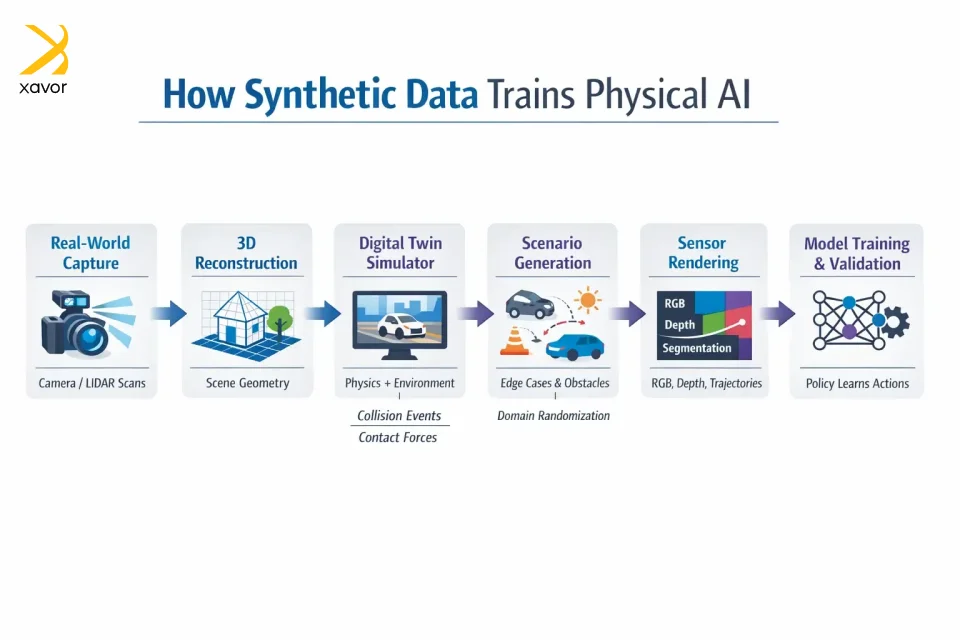
Therefore, companies develop synthetic data to generate training examples in a controlled virtual world quickly and at scale. One way of doing that is by creating a digital twin of a real environment, like a factory, warehouse, or street layout.
But to make twins closer to reality, you can reconstruct the space from real sensor captures. One common method for that is 3D Gaussian-based reconstruction, which essentially turns real capture into a usable 3D scene inside the simulator.
Then simulations are run to imitate real operations. The key is that the simulator tries to model real physical behavior, so the synthetic data is as accurate as possible. Finally, as the simulations run, the sensors record what happens, similar to the real world. That produces large datasets: images, depth maps, trajectories, collision events, and more.
Why the push towards physical AI is important
There have been some over-the-top claims about AI recently, to be honest. Salesforce’s CEO recently admitted that they were wrong about the pace of AI doing much of the work at the company. Now, we know this is gonna sound like, “This time it’s different…” but physical AI is actually a differentiator.
Physical AI isn’t just hot air. It matters because it’s taking AI into the real world, something that all other previous AI waves couldn’t do.

1. The change is already underway
In the case of physical AI, the proof is in the pudding. If it were just vibes, you wouldn’t see companies actually deploying it. And we’re talking about big players, like Amazon and Waymo. The former has deployed its 1 millionth smart robot and introduced DeepFleet, a physical AI model to coordinate robot movement for faster delivery and lower costs.
The International Federation of Robotics also reports that the global demand for autonomous robotic systems has more than doubled in the last 10 years. These are sound indicators that a real economic engine already exists for physical AI.
2. Demographic pressures demand physical AI
Many countries around the world are facing fertility drops and population decline. Therefore, there are fewer young people available to do physically demanding or repetitive work. This is a structural problem straining critical industries that software alone cannot solve.
That’s why physical AI is gaining urgency. It’s not primarily about replacing human judgment or doing everything with robots, but about offloading the kinds of tasks that wear people down. So, operations don’t stall when staffing is tight or turnover is high.
3. We finally have better models
For a long time, physical AI systems were built like a patchwork. One system handled seeing, another handled deciding a plan, and another handled control. On paper, that sounds clean, but in practice, the fragile part was always the glue between them. Small changes in the real world would break the handoffs, and the system would fail in ways that were hard to predict.
What’s changing now is the rise of vision-language-action (VLA) and other foundation-style models that can take many inputs at once, and produce outputs that are directly useful for acting, like what skill to use, where to move next, or how to grasp something. .
In simple terms, physical AI is becoming more capable because modern AI solutions are moving from just recognizing the world to choosing actions in it.
The challenges ahead for physical AI
Overall, the future outlook of physical AI is optimistic, with much to look for. However, there are still some big hurdles before it becomes truly widespread.
1. Cost is still a major worry
The current financial picture of physical AI hints that it might go down the AR/VR path. A futuristic tech that aims to reduce class divide but instead fuels it. Right now, running and maintaining smart robots or autonomous systems is expensive. They require specialized hardware, software integration, and ongoing maintenance.
Big companies can afford these upfront costs and long rollout timelines. But small and medium businesses (SMEs) can’t unless they really cut corners. Moreover, this will also increase the gap between the privileged and less privileged countries of the world. The world already has many inequalities, and the lack of affordable physical AI will aggravate these divisions.
2. Accountability is a grey area
This age-old problem has been hanging around for decades. Just how far can we trust machines to make decisions, and who will be responsible for their errors? When physical AI moves into the real world, these errors won’t be just wrong answers, as they can cause real damage or bodily injury. When automated systems fail and cause collisions on the road, consulting an experienced car accident lawyer is essential to navigate liability disputes and secure proper compensation
Resolving this challenge will require a collective effort from everyone: tech leaders, governments, and society at large. In some parts of the world, regulations are catching up, but there are still grey areas where rules aren’t clear who is responsible for a robot’s actions.
3. The tech still has limitations
Despite the improvements, it’s extremely difficult to make physical AI understand the real world like humans. Our senses and brain have evolved over eons to make sense of the world around us. But physical AI has many tech constraints that inhibit its capabilities.
Many physical AI systems can’t run long enough without downtime. The amount of computing power they need requires regular maintenance. Unlike humans, their precision and reliability can break down in difficult conditions, like bad lighting, dust, or rain.
These are solvable problems, but they require better technology and engineering, which will take some time.
4. The society isn’t exactly ready
We all remember The Jetsons cartoons from the 60s. Self-driving cars, Rosey the maid robot, etc. The series was almost prophetic in its prediction of a world where AI is integrated in the world. However, unlike the cartoon, the real world has much anxiety and fear about such a future.
Many people aren’t fans of an idea where AI is everywhere. They have security, privacy, and ethical concerns about incorporating machines into their everyday life. Furthermore, the debates around AI replacing human workers don’t do any favors either.
It is a very nuanced topic, so one shouldn’t rush to judgment. Dismissing people’s fears will only push them away. Researchers and experts have warned that things like non-consensual AI-generated imagery not only hurt the direct victim. But also, it can change how people participate online and can push entire groups out of public spaces.
So, how can we fill this gap between what technology can do and what society can manage? We’ll leave this question for you to ponder over.
Conclusion
Physical AI is the first AI wave that deals with the world as it is: messy, uncertain, and governed by physics. That’s what makes it so exciting, and also why it’s so hard. In the digital world, a model can be “wrong,” and you lose a few seconds. In the physical world, being wrong can cause serious repercussions.
Organizations need to ask what kind of physical AI future they are building? One where only a handful of giants can afford reliability, safety, and compliance? Or one where smaller manufacturers, healthcare providers, and logistics teams can benefit too? And when machines start making decisions in shared spaces, we’ll need to decide some thought-provoking questions.
Xavor builds physical AI for real environments and real users. We undertake physical AI product engineering with all the must-haves. Are you ready to move from physical AI demos to a production-ready system? Contact us at [email protected] to book a free consultation session.

FAQs
Agentic AI is about initiative and autonomy in decision-making. It is an an AI that can plan, take steps, use tools, and pursue a goal often in software like browsing or coding. But physical AI is about operating in the real world. It senses physical environments and produces insights and sometimes actions that affect them.
We’re already in the early phase of physical AI. It’s working today in controlled environments like warehouses, factories, hospitals, and limited-area autonomous driving . What we’re still years away from is general-purpose physical AI that works reliably anywhere like a human.
A physical AI example is a warehouse robot that uses cameras/LiDAR to navigate around people and shelves, then moves items autonomously based on what it senses. Unlike chatbots, it makes real-time decisions and takes actions in the physical world.