

Downtime becomes a business problem very quickly. A single hour of IT downtime can cost up to $3 million, and 2025 research puts high-impact outages in the range of $1 million to $3 million per hour. When teams cannot respond quickly, the impact spreads across operations, revenue, and customer experience.
What makes this difficult is that many teams are working with fragmented signals, limited visibility into service impact, and slow prioritization. When information is spread across multiple tools, it takes longer to understand what is happening and where to focus first.
ServiceNow ITOM helps bring clarity to that complexity. It gives teams one view across cloud, on-premises, and hybrid environments, making it easier to understand issues, assess impact, and act faster. With built-in automation and AI, it helps organizations deliver stronger IT operations management services by helping teams cut through noise, prioritize better, and reduce the disruption caused by outages.
Let’s explore how ServiceNow ITOM helps strengthen IT operations and reduce downtime.
What is ITOM in ServiceNow
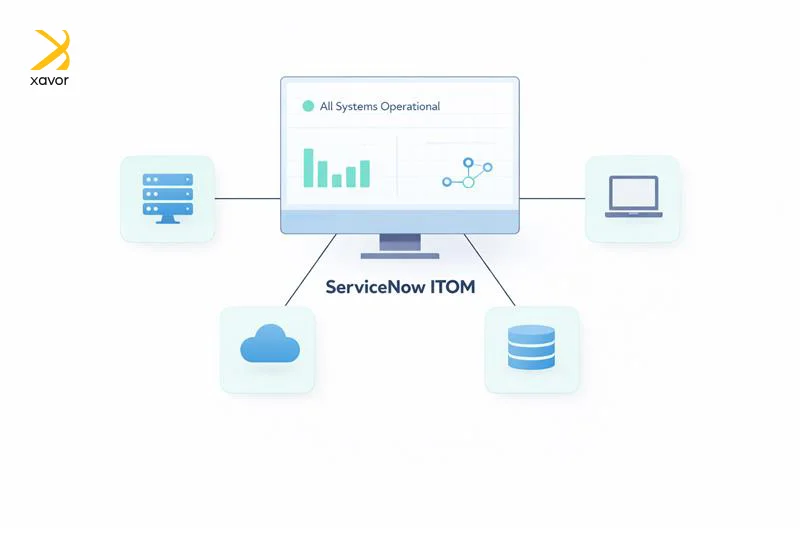
ServiceNow ITOM is a suite of applications designed to monitor, manage, and automate IT infrastructure operations across an organization. It provides end-to-end visibility into IT environments and helps organizations maintain system health, prevent downtime, and optimize resources.
The platform combines automation, monitoring, machine learning, and analytics to support modern operations management. With these capabilities, organizations can proactively detect potential issues and resolve them before they affect end users.
ServiceNow ITOM helps companies:
- Discover infrastructure automatically
- Monitor system performance
- Correlate events and alerts
- Automate incident response
- Optimize cloud resources
By integrating these capabilities into a unified platform, ServiceNow IT operations management enables organizations to shift from reactive IT management to proactive operations.
ServiceNow ITOM modules
Strong IT Operations Management depends on a few essential capabilities that help organizations maintain visibility, improve efficiency, and keep IT environments running reliably. Each component plays a distinct role in supporting day-to-day operations and reducing disruption.
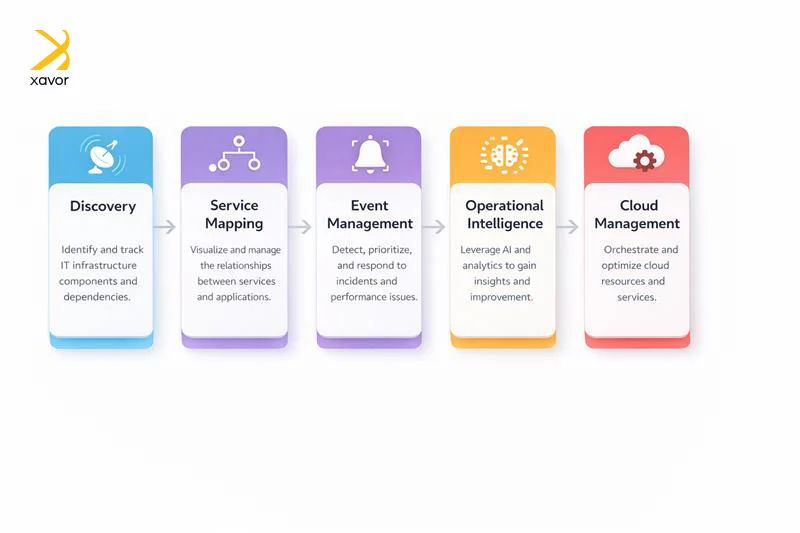
1. Discovery
Discovery helps automatically identify the devices, applications, and other assets connected to the network. It keeps the Configuration Management Database, or CMDB, accurate and up to date, so teams have a reliable record of configuration items and can manage them more effectively.
2. Service mapping
Service Mapping helps teams understand how IT services are connected by showing the relationships between applications, servers, and other infrastructure components. This makes it easier to see service dependencies, evaluate the impact of changes, and respond more effectively when incidents occur.
3. Event management
Event Management brings together alerts and events from multiple monitoring tools into a single platform. This helps IT teams identify issues faster, prioritize them more clearly, and respond more efficiently. By correlating related events, it reduces unnecessary noise and draws attention to the incidents that matter most.
4. Operational intelligence
Operational Intelligence uses machine learning solutions to analyze historical performance data and detect anomalies. It identifies unusual patterns that may indicate potential system failures. This proactive approach helps organizations prevent outages rather than simply reacting to them.
5. Cloud management
Modern enterprises operate across multiple cloud providers. The Cloud management module helps organizations manage cloud resources, automate provisioning, and control costs. With a centralized dashboard, IT teams gain visibility into cloud usage and infrastructure performance.
Best practices for ITOM implementation
A strong ITOM strategy helps organizations improve system performance, support security, and keep operations running in a more reliable way. The following practices can help improve outcomes:
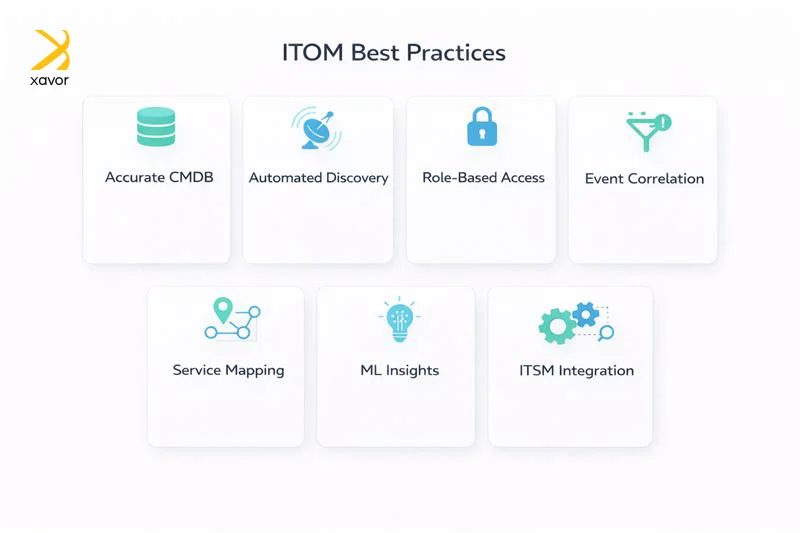
- Keep the CMDB accurate: Review and update the CMDB regularly so the data stays current, complete, and useful.
- Use automated discovery consistently: Run discovery scans on a regular schedule to capture new assets and track changes across the environment.
- Apply role-based access control: Limit access to ITOM capabilities based on user roles to strengthen security and reduce unnecessary exposure.
- Improve event correlation: Set clear correlation rules to reduce alert noise and help teams focus on the incidents that have the greatest impact.
- Refine service mapping continuously: Update discovery patterns and entry points over time to maintain accurate service dependency mapping.
- Use machine learning insights: Take advantage of predictive analytics in Operational Intelligence to identify risks early and help prevent outages.
- Connect ITOM with other ITSM processes: Integrate ITOM with Incident, Change, and Problem Management to improve coordination and increase overall value.
ServiceNow ITOM implementation strengthens IT operations
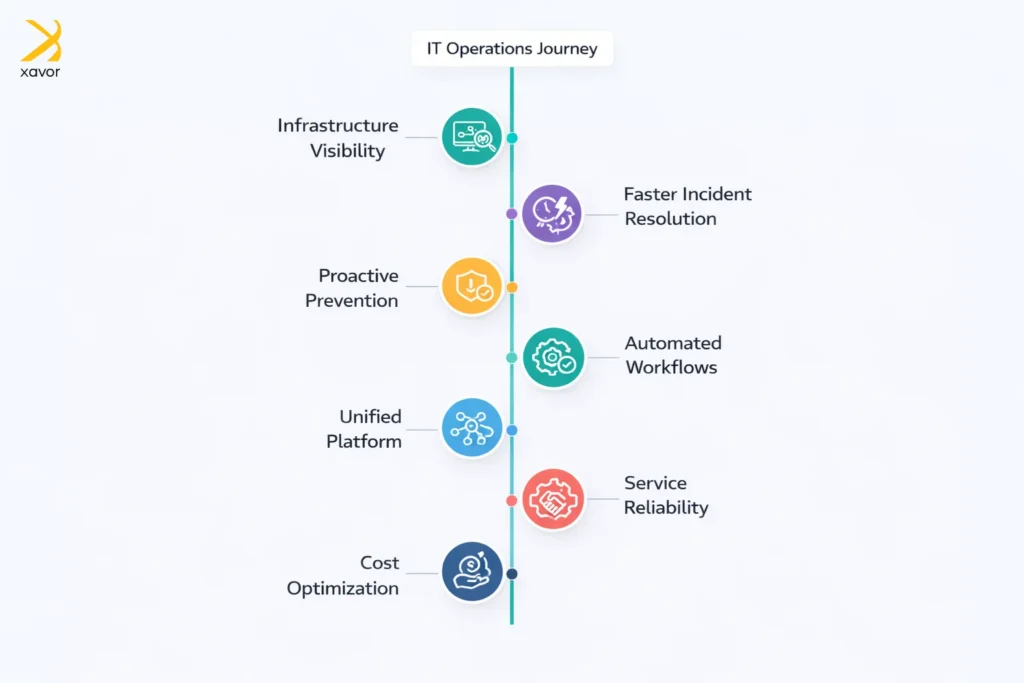
1. Complete infrastructure visibility
One of the biggest challenges in IT operations is limited visibility across complex environments. ServiceNow ITOM automatically discovers and maps infrastructure components across on-premises systems, cloud platforms, and hybrid environments. This provides organizations with a centralized view of their IT ecosystem.
Improved visibility enables IT teams to understand dependencies between systems and identify potential risks before they escalate.
2. Faster incident detection and resolution
Modern IT environments generate thousands of alerts daily. Without proper filtering, IT teams can struggle to identify real issues. ServiceNow ITOM uses intelligent event correlation to group related alerts into meaningful incidents. This reduces alert fatigue and enables teams to focus on critical problems.
As a result, organizations experience faster incident response times and improved system reliability.
3. Proactive issue prevention
Traditional IT operations management services focus on fixing problems after they occur. However, proactive monitoring can prevent issues before they impact users. ServiceNow ITOM uses machine learning and AIOps capabilities to analyze system performance data and identify anomalies early.
This predictive capability allows organizations to resolve issues before they lead to downtime.
4. Automated IT workflows
Automation is a major advantage of modern operations management platforms. ServiceNow ITOM enables organizations to automate routine operational tasks such as:
- Incident remediation
- System updates
- Infrastructure provisioning
- Performance optimization
Automation reduces manual work and allows IT teams to focus on strategic initiatives.
5. Unified IT operations platform
Many organizations use multiple monitoring tools across different departments. This fragmented approach can create data silos and communication gaps. ServiceNow ITOM integrates discovery, monitoring, automation, and analytics into one unified platform. This provides a single source of truth for IT operations.
Teams can collaborate more effectively and make informed decisions based on real-time data.
6. Improved service reliability
Business continuity depends on a reliable IT infrastructure. By monitoring system health, detecting anomalies, and automating remediation processes, ServiceNow IT operations management improves overall service reliability.
Organizations that implement ITOM solutions often experience fewer outages and improved service performance.
7. Cost optimization
Efficient IT operations management also helps organizations control infrastructure costs. ServiceNow ITOM provides insights into resource utilization and cloud consumption. With this data, businesses can eliminate unused resources and optimize infrastructure spending.
This leads to improved operational efficiency and better return on investment.
Real-world impact of ServiceNow ITOM
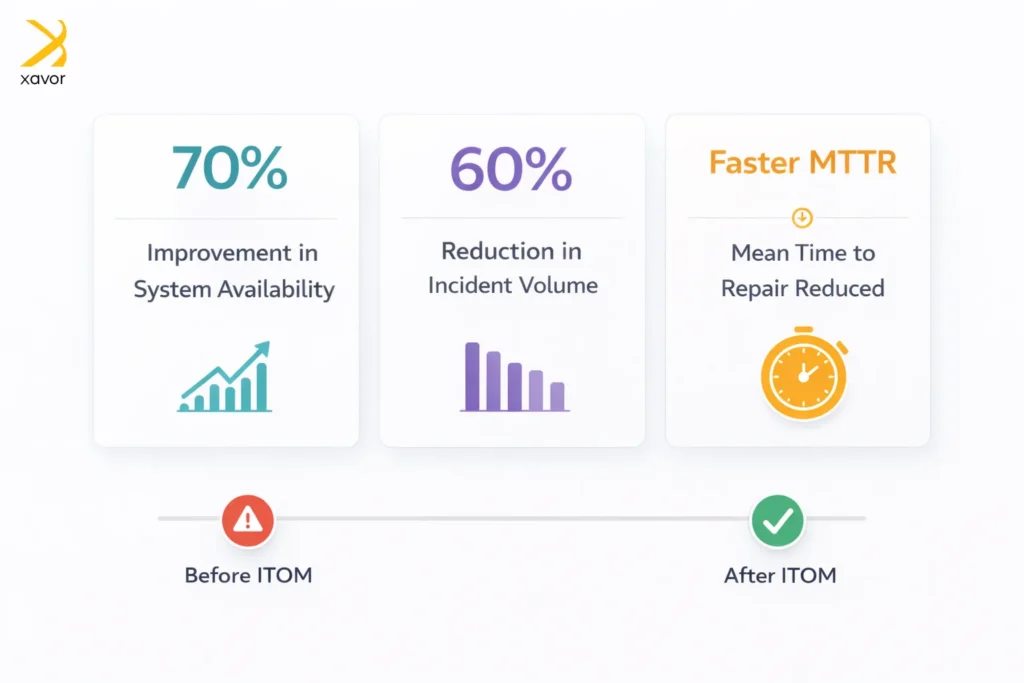
Organizations across industries are adopting ServiceNow ITOM to improve their operational efficiency.
For example, companies implementing ServiceNow Discovery, Service Mapping, and Event Management have achieved:
- Up to 70% improvement in system availability
- 60% reduction in incident volume
- Faster repair times and reduced downtime.
These results highlight the transformative impact of advanced IT operations management tools.
Conclusion
When IT operations are hard to manage, even small issues can turn into bigger business problems. That is why organizations need better visibility, faster response, and tools that help teams stay ahead instead of constantly reacting. ServiceNow ITOM helps make that possible by giving teams a clearer view of their environment and helping them handle issues in a more efficient way.
With the right implementation, ServiceNow ITOM can help businesses reduce disruption, improve day-to-day operations, and build a stronger foundation for growth. At Xavor, we help organizations make the most of ServiceNow ITOM with the right strategy, implementation, and support. Connect with Xavor at [email protected] to build IT operations that are stronger, smarter, and ready for what’s next.

FAQs
The core capabilities commonly associated with ServiceNow ITOM include Discovery, Service Mapping, Event Management, and Operational Intelligence, with broader ITOM offerings also supporting cloud visibility and optimization.
ITSM focuses on managing IT services, requests, and support workflows, while ITOM focuses on the underlying infrastructure and operations that keep those services running. In simple terms, ITSM manages the service experience, and ITOM helps keep the technology behind it healthy and available.
ServiceNow positions ITOM to modernize IT operations with visibility, insights, and intelligent remediation so teams can solve issues before they occur. In practice, that means it can help reduce outages and minimize service disruption when implemented well.