

Tiger Woods holds the record for the longest streak as world’s number one golf player in the official world golf rankings from 2005 to 2010. There are no official CRM rankings as such, but if there were, Salesforce would mirror this feat. The platform has been at the top spot in the global CRM market share for 12+ years and counting.
And software rankings are much more volatile than professional golf. Take Siebel Systems, for example. It was the top customer database software before Salesforce. But this is probably the first time you’re hearing about it? A software platform can go from industry leader to obscurity very quickly.
But Salesforce has maintained itself as the leading choice for businesses to manage their customer relationships. In this piece, we’ll get into why that is the case and how Salesforce compares to its competitors.
Four reasons why Salesforce is the top customer database software
Salesforce is to CRM what Windows is to computers. The Salesforce brand has become synonymous with CRM itself. It is used by companies around the world and is an entire ecosystem with its own platform-specific applications.

We could list several reasons why Salesforce is the top customer support database software. But that would take up a lot of your time and attention. So, we’ll try to confine everything we want to say to these four reasons.
1. Point-and-click development
There is a good reason why programmers earn in six figures. Coding is hard. But most software for client databases requires writing code for every little thing.
And one of the biggest reasons behind Salesforce’s success is that it made point-and-click development (aka declarative development) a core part of the CRM experience very early on.
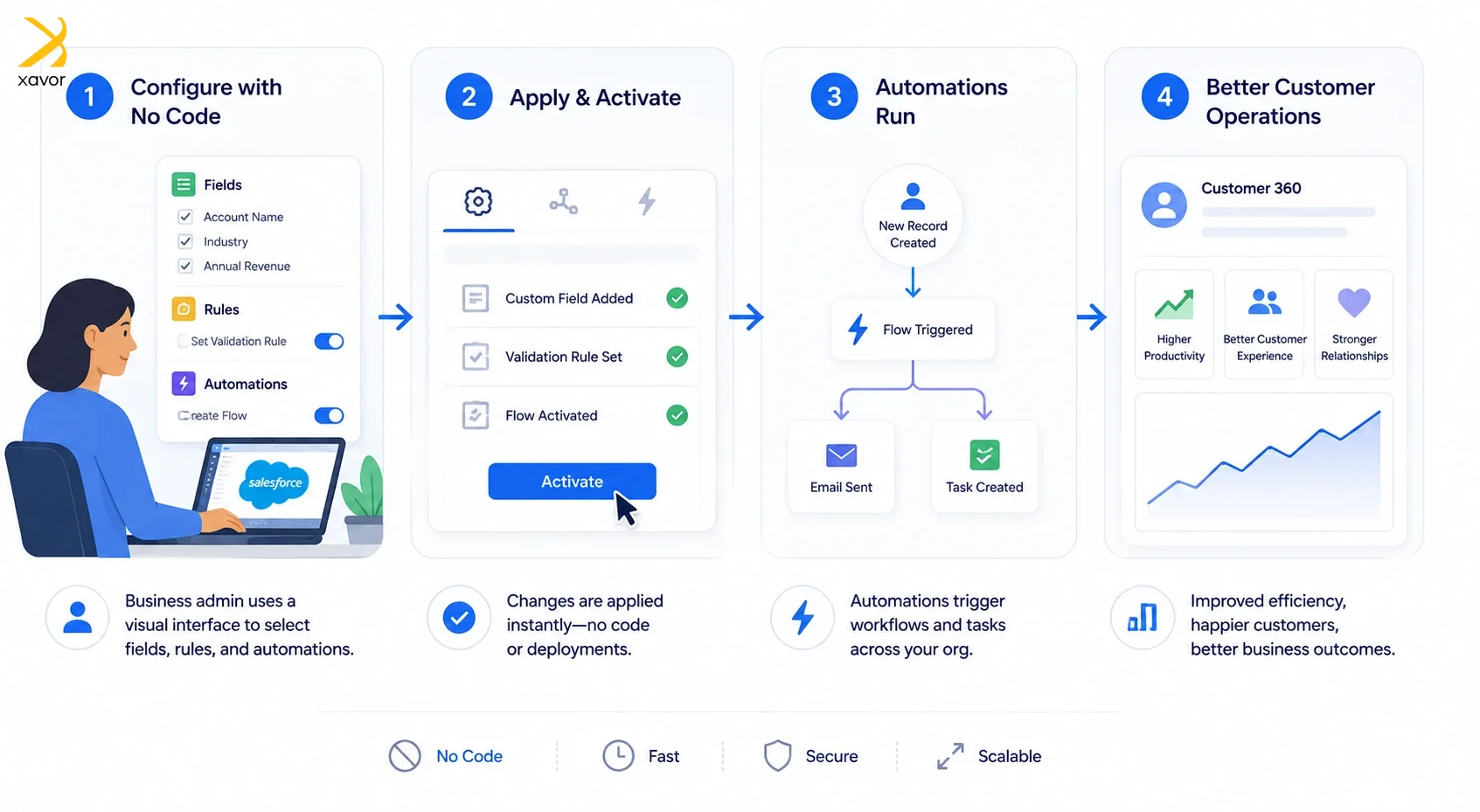
Point-and-click development in Salesforce basically means building on the platform without using any code. You just need to click around to make changes instead of coding them. Users can perform all of the essential customer software database actions through the Salesforce UI without needing to be traditional software developers, such as:
- Creating fields and workflows
- Implementing automations
- Setting business rules
Point-and-click development is not the industry norm. But Salesforce has invested in it for many years. And it has paid off as it is a major advantage because many business problems do not require fully custom code. A large part of a CRM implementation can often be built through configuration.
Non-developers, such as Salesforce admins or business analysts, can also create useful solutions quickly. They can adapt the system as the business changes without waiting for a full software development cycle.
And a Salesforce database does not stop at no-code or low-code tools. When the declarative tools are not enough, professional developers can use code to extend the platform. So, companies get a mix of both worlds where they can build the simpler 80% of the solution quickly through configuration and then use code for the more complex 20% that requires custom logic.
2. More than a CRM
Another important advantage is the Salesforce ecosystem. Salesforce is not just a customer database software. It has become a community and career path. Like you need to know Adobe Photoshop or Illustrator if you want to work as a designer. Salesforce is the same for making a career in sales, customer management, and revenue operations.
Moreover, Salesforce has multiple modules (called Clouds) that perform more than CRM functions, like:
- Marketing Cloud
- Commerce Cloud
- Service Cloud
- Salesforce Data Cloud
And each of these modules has its own training programs and certifications. So, that is why companies are hiring for Salesforce-specific job roles all the time.
Not to mention the AppExchange. It’s the official marketplace where you can create or access thousands of apps to extend the functionality of your Salesforce setup. That is why users never have to leave the Salesforce ecosystem to get anything done. There is always some app made for it, or you can create one.
That matters big time because companies are buying access to a large talent pool and a mature ecosystem when they invest in Salesforce customer database software.
3. Trusted by big names
The big fish in any industry sets the whole tone. The systems they use or the methods they adopt have a trickle-down effect. Salesforce is the primary customer database software of several huge corporations. PepsiCo, American Express, and Spotify all use some Salesforce Cloud in their global operations.

So, all these household names trusting Salesforce with their data is the biggest promotion the platform needs. It has made Salesforce the industry standard for managing customer databases.
Moreover, using Salesforce as the primary customer database software is also unavoidable at times. Many small and medium enterprises (SMEs) work as contractors of big corporations or take up their projects. So, they are required to use Salesforce as part of the project requirements.
4. AI capabilities
You might have heard of the word agentic enterprise era floating around these days. It simply means that enterprise AI solutions, such as AI agents, are now part of core business functions. That is why enterprise systems now need to provide their users with agentic workflows to get things done in the software.
And Salesforce is one of the leaders in this field as well. Agentforce is the CRM’s official platform where you can create AI agents that automate different manual processes, pulling accurate context from integrated AI knowledge bases to cut down tedious data lookup work. For example, sales teams usually have to peruse through hundreds of rows and columns in customer database software to find the information they want. But you can create agents in Agentforce to automate the whole process in Salesforce.
Salesforce Headless 360 is another latest addition that completely replaces the Salesforce UI with an API-first architecture. It allows you to use the platform without needing the normal Salesforce screens or browser interface. Your AI agents will have access to anything you need through API calls, MCP tools, and commands.
These features make Salesforce the cogent choice for businesses that want to stay current with the AI-based enterprise era.
Salesforce vs competitors in 2026
There are many Salesforce alternatives in the market. And quite a few of them have emerged as noticeable competitors to the platform’s supremacy as the top customer database software.

The biggest competitors Salesforce has in 2026 are:
- Oracle Fusion Cloud CX
- HubSpot
- Adobe Experience Cloud
- SAP Customer Experience
- ServiceNow CRM
Let’s compare Salesforce with these customer database software to see why Salesforce still clears them.
1. Salesforce vs Oracle Fusion Cloud CX
Oracle and Salesforce go a long way back. When Salesforce was founded in 1999, its slogan was “The End of Software.” It was largely a shot at companies like Oracle and Siebel selling expensive on-premise enterprise software. Salesforce, on the other hand, came up with a cloud-based delivery model, which was cheaper and ingenious for its time.
Fusion Cloud CX is Salesforce’s direct competitor in the domain of sales, service, and marketing processes. It is really strong in back-office integration and ERP alignment. Finance and supply-chain-heavy organizations usually prefer Fusion Cloud CX as their customer database software of choice.
But Salesforce is the more natural CRM-first choice, with a bigger CRM-specific talent market and ecosystem. Fusion Cloud CX is great if you want to connect tightly with Oracle’s broader business suite. Otherwise, Salesforce offers you more options.
2. Salesforce vs HubSpot
HubSpot is a dedicated CRM platform like Salesforce. It positions itself as a customer database software with marketing/sales and customer service integrated in one place. And being objective, HubSpot has a simpler UI and easier adoption than Salesforce.
That is why HubSpot is preferred by SMEs and startups to manage marketing and sales with something that is easy to use. However, that is also the reason why Salesforce beats HubSpot as a customer database software in enterprise settings.
Salesforce is much stronger when a company needs to handle complex workflows in large sales teams. Think of multi-region operations with different partner ecosystems.
3. Salesforce vs Adobe Experience Cloud
Adobe Experience Cloud is the central hub for Adobe’s online marketing and web analytics products. It is optimized to enhance brand experience through personalized web journeys and market campaign analytics.
That said, Salesforce is stronger as a full CRM operating layer for customer data and day-to-day revenue operations, which aren’t related to customer experience and marketing.
4. Salesforce vs SAP Customer Experience
SAP is primarily an ERP software. But it also offers advanced CRM functionalities through SAP Customer Experience (CX). Companies already running SAP as their operational backbone use CX to integrate their core functions with marketing and sales.
Salesforce and SAP are both powerful enterprise platforms, but they feel very different to work with. Salesforce is more cloud-first and more aligned with common web technologies. Developers can enter the Salesforce ecosystem more easily because it uses familiar concepts around JavaScript.
Salesforce also has a lower barrier to learning. Its documentation is freely available, and Trailhead gives people free structured training. This makes it easier for new consultants, admins, and developers to ramp up.
SAP is often used in very large, complex enterprise environments. The manufacturing industry is one of the biggest users of SAP.
On the other hand, Salesforce tends to be broader across company sizes and industries.
5. Salesforce vs ServiceNow CRM
ServiceNow is one of the newer challengers to Salesforce in the customer database software domain. ServiceNow CRM is offered as part of its Customer Service Management (CSM) module. It is good for workflow automation in IT-service-heavy industries like telecom.
But it’s still a fledgling CRM platform compared to Salesforce. The latter has mature, and tested pipelines for sales and marketing operations.
Conclusion
Salesforce’s dominance is about gravity. Every advantage covered in this piece compounds into something larger. Salesforce becomes a platform so embedded in how businesses operate that switching away from it carries real organizational cost.
And that’s not a vendor lock-in in the predatory sense. It’s the natural result of a platform that has been consistently useful and adopted at scale for over two decades.
Salesforce’s philosophy as a customer database software is to engage deeply with customers to create one-to-one relationships with them.
However, choosing Salesforce is the easy part. Getting it to actually work for your business is where most implementations fall short.
Xavor is a certified Salesforce implementation and consulting partner with hands-on experience deploying Salesforce across industries to make sure Salesforce delivers on what it promises.
Contact us at [email protected] to book a free consultation session.

FAQs
Salesforce is popular because it combines CRM, automation, AI, analytics, integrations, and industry-specific tools in one ecosystem. It has also ranked as the #1 CRM provider for 13 consecutive years.
No, Salesforce is widely used by enterprises, but it can also support growing businesses that need scalable customer data management, sales automation, and service workflows.
Salesforce stands out because of its customization options, AppExchange marketplace, large talent pool, and broad product ecosystem across sales, service, marketing, commerce, and data.