

Salesforce, aka SFDC, is not a plug-and-play platform. Implementing it properly requires meticulous planning to align it with your business workflows. But many companies don’t get the full value out of their Salesforce investment because they don’t align the CRM platform with their business model and processes.
As a result, CEOs or COOs feel frustrated that their strategic priorities aren’t translating into tangible results. That is why Salesforce implementation must be synced with how your enterprise works from day one. Salesforce development and implementation services do what needs to be done in advance, so your Salesforce instance becomes a revenue engine.
This article is for leaders who know that they can get more out of Salesforce. We will provide a practical framework on how to implement Salesforce for aligning your strategy, your systems, and your execution.
What is Salesforce implementation?
Salesforce CRM is a major customer relationship management (CRM) platform. It is used by companies to track and manage their sales pipeline, customer interactions, and revenue data in one place. According to the IDC, it is the leading CRM vendor with a 20% market share.
Implementing Salesforce is the whole process of setting up and configuring it to match how a business operates. Out of the box, Salesforce comes with default settings and licenses that may or may not work for you as they are. On top of that, Salesforce’s repertoire includes many different clouds and tools beyond regular CRM functions, such as:
- Marketing Cloud
- Agentforce
- Commerce Cloud
To implement Salesforce, you need to know how to configure and deploy these tools correctly. And all of that is part of Salesforce implementation. Additionally, Salesforce implementation also involves people, training, and ongoing support.
Major phases in the Salesforce implementation process
Salesforce implementation happens through a phase-wise approach. However, these phases are rarely perfectly linear. The best implementations treat these phases as a framework for thinking, rather than a rigid structure.
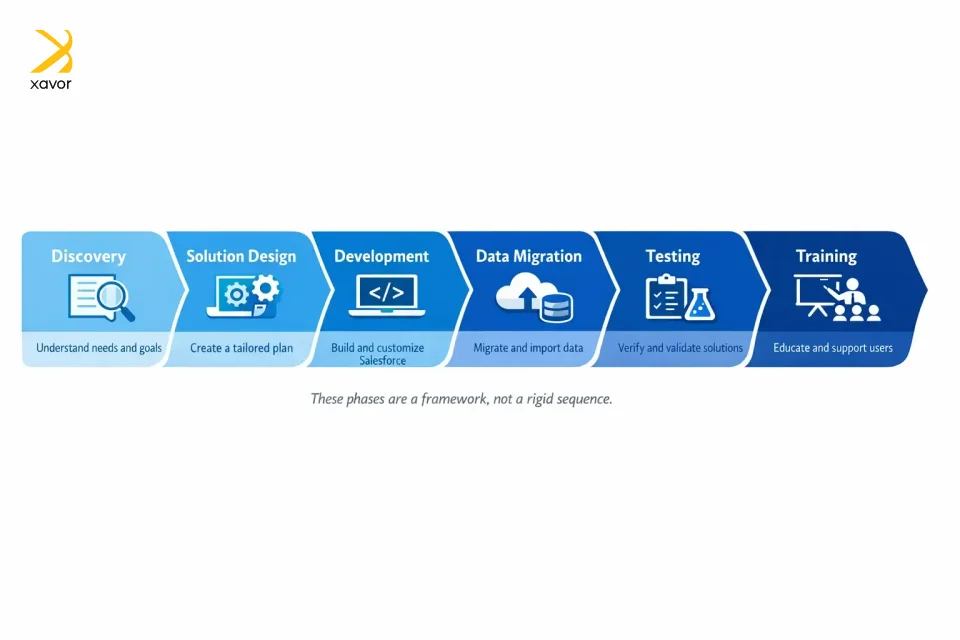
1. Discovery
This is where everything begins. We sit down with stakeholders across sales and leadership to understand how their business actually works. Current processes, pain points, goals, and what success looks like are all on the agenda. The quality of everything that follows depends entirely on how honest and thorough this phase is.
2. Solution Design
In phase two, we design how Salesforce will be configured to match the business. This includes defining the data model, pipeline stages, user roles and permissions, automation logic, and integrations with other systems. Nothing gets built yet, but this is the blueprint phase.
3. Development
This is where the actual build happens. We configure Salesforce according to the design, including:
- Custom fields
- Workflows
- Automation flows
- Dashboards,
- Integrations
Any custom Salesforce development is part of the job if needed. Think of it as constructing the building from the blueprint.
4. Data Migration
Next, existing customer data gets cleaned, mapped, and migrated into Salesforce. This phase is really underestimated. Bad data migrated into a new system is still bad data, so cleaning and validation before migration is critical.
5. Testing
Before anything goes live, the system gets rigorously tested. This includes unit testing individual components, end-to-end process testing, and user acceptance testing, where actual users validate that the system works the way the business needs it to.
6. Training
Finally, training is arguably the most underinvested phase in most implementations. The best-configured Salesforce in the world fails if people don’t use it correctly or don’t understand why it matters. We train internal teams according to role-specific, practical, and real workflows.
Importance of process alignment in SFDC implementation
Business process alignment connects your goals with your workflows. Running a modern business means managing people and systems while dealing with customers and regulations. So, you are pulling a lot of strings at the same time, and it is expected that gaps will form between them.
However, these gaps can be super expensive for an enterprise in terms of time and money. That is why when you implement Salesforce, you need to make it the linchpin of your business workflows.
After years of Salesforce consulting across industries, if there’s one thing we can tell you with absolute certainty, it is that technology is rarely the hard part.
We’ve seen companies spend half a million dollars on a Salesforce implementation and walk away with something that nobody uses. But there are also cases where small teams get transformational results from a relatively simple setup.
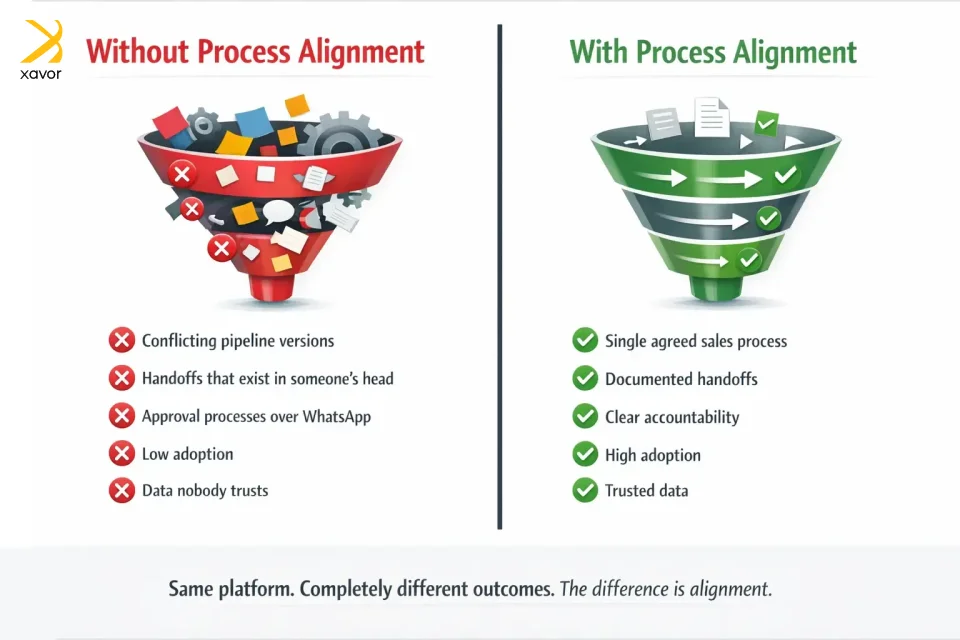
When Salesforce implementation is doomed from the start
When a new client comes to us, the first thing we do is ask them to walk us through how they actually sell. Not how their corporate deck says they “should” sell. We don’t want the ideal version, but how it actually happens.
And what we find, more often than not, is that nobody fully agrees. The VP of Sales has one version of the pipeline. The reps have another. The CEO has a third. There are handoffs between teams that exist only in someone’s head. And one time, we found out that there were approval processes happening over WhatsApp.
These are all ingredients for a recipe that fails a Salesforce implementation before it even begins. If you take that misalignment and build it into Salesforce, you make your problems worse. And you make it harder to change, because now it’s baked into a system.
Salesforce CRM implementation with process alignment
Process alignment, in practical terms, means that before you configure a single field or build a single flow, you have answered three questions clearly:
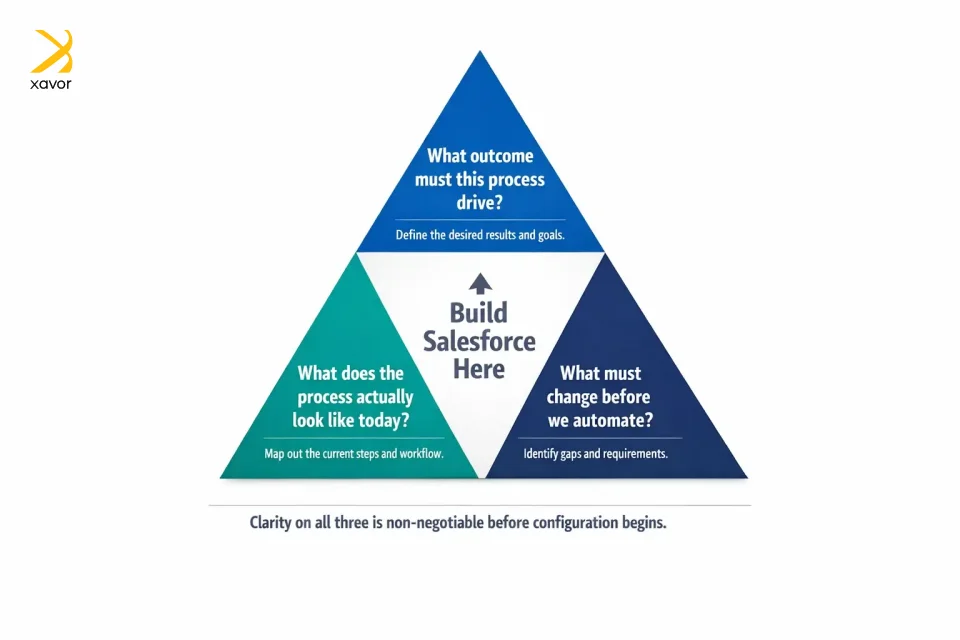
- What is the outcome this process is supposed to drive? It has to be a specific, measurable business outcome, like shortening the sales cycle or improving conversion.
- What does the process actually look like today, end to end? Who does what, when, and based on what information? Where are the handoffs? Where do things fall through the cracks?
- What needs to change about that process before we automate it? Because automating a broken process just makes it break faster and at a greater scale.
Only when you have clarity on those three things should you open Salesforce and start building.
Salesforce will faithfully execute whatever process you give it. It has no opinion on whether that process is good or bad, aligned or chaotic, strategic or accidental. That judgment is yours to make before implementation begins.
The organizations that treat process alignment as a prerequisite are the ones that look back on their Salesforce investment and say it changed how they operate. The ones that skip it are the ones still asking, two years later, why adoption is low, and the data can’t be trusted.
So, get the process right first. The technology will take care of the rest.
How to implement Salesforce with effective alignment
1. Map your real process before designing the system
Companies usually design their Salesforce around the process they wish they had, not the one they actually have.
Therefore, sit down with the people doing the actual work and map out exactly how things flow today. How does a lead come in? Who touches it first? What information is needed to qualify it? You need the answers to these questions for a successful Salesforce implementation.
Be brutally honest about what you find. Messy, inconsistent, and undocumented processes are the norm in most organizations. That’s okay, finding them before implementation is the whole point. Because if you skip this step and build Salesforce on top of unexamined processes, you just make them faster and harder to change.
Once you have a clear picture of the current state, then you redesign. Clean up the process first, agree on how it should work, get stakeholder alignment on that, and then build Salesforce to reflect the improved process.
2. Get the right people aligned early
Departmental politics is one of the most common reasons Salesforce implementations fail. Different departments have different priorities, different vocabularies, and different ideas about what the system should do. If those tensions aren’t surfaced and resolved before implementation begins, they surface during go-live, when they’re far more expensive to fix.
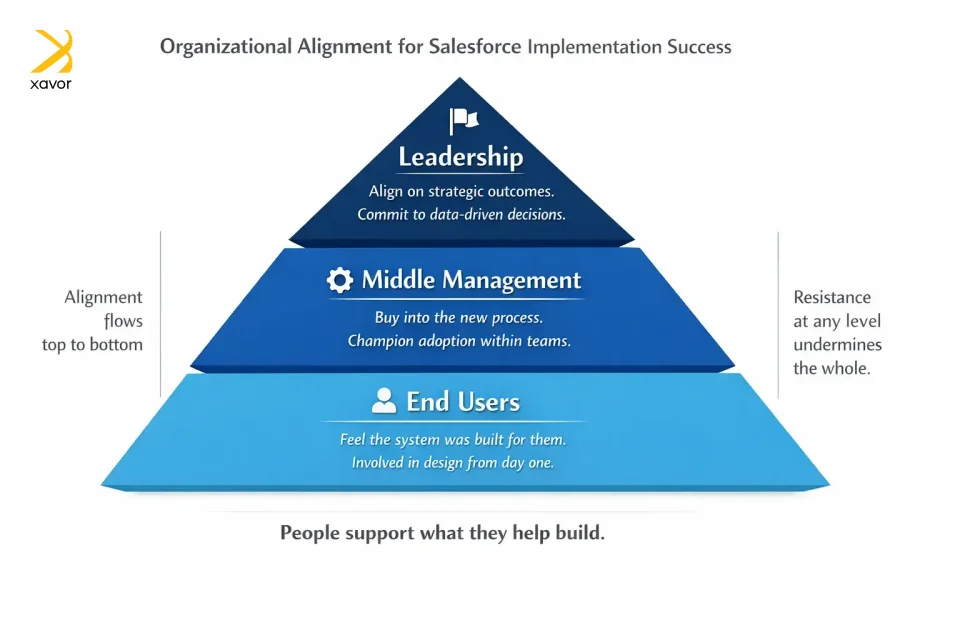
To avoid this friction, you need to get three groups aligned early:
- Leadership needs to agree on the strategic outcomes Salesforce implementation is meant to drive, and commit to making decisions based on those outcomes rather than personal preferences or departmental politics.
- Middle management needs to understand how Salesforce will change how their teams work and genuinely buy into the new process. Managers who are skeptical of the system will quietly undermine adoption, whether they mean to or not.
- End users like salespeople, the service reps, and the marketing team need to feel that the system was built for them. Involving them in the design process dramatically increases adoption. People support what they help build.
3. Design the system around outcomes
Salesforce is an enormously capable platform. It can do almost anything. That is, paradoxically, one of the biggest risks in Salesforce implementation. The temptation to build everything and automate every conceivable workflow is powerful and almost always leads to an over-engineered system that confuses users and collapses under its own complexity.
The discipline here is ruthless simplicity. Every field should exist because someone needs that information to make a decision. Every stage should represent a real, meaningful milestone in the buyer’s journey. Enterprise automation should eliminate a genuine pain point instead of just demonstrating technical sophistication.
A good rule of thumb for this is that if you can’t explain in one sentence why a field, stage, or workflow exists and what decision it enables, it probably shouldn’t be there.
4. Treat data migration as a strategic decision
Most organizations think of data migration as a technical task. Just export from the old system, import into the new one. Well, it’s not that simple. It is a strategic decision related to your entire organization.
Before migrating anything, audit your existing data honestly. You need to be dead sure how complete, accurate, and consistent it is. Migrating dirty data into a clean system only gives you a dirty system with a better interface.
Decide what to migrate, what to archive, and what to leave behind. Establish data standards before migration. Also, decide beforehand who is responsible for maintaining data quality going forward.
Getting this right means your team starts with a Salesforce instance you can trust, which is foundational to adoption.
5. Invest in training as seriously as you invest in configuration
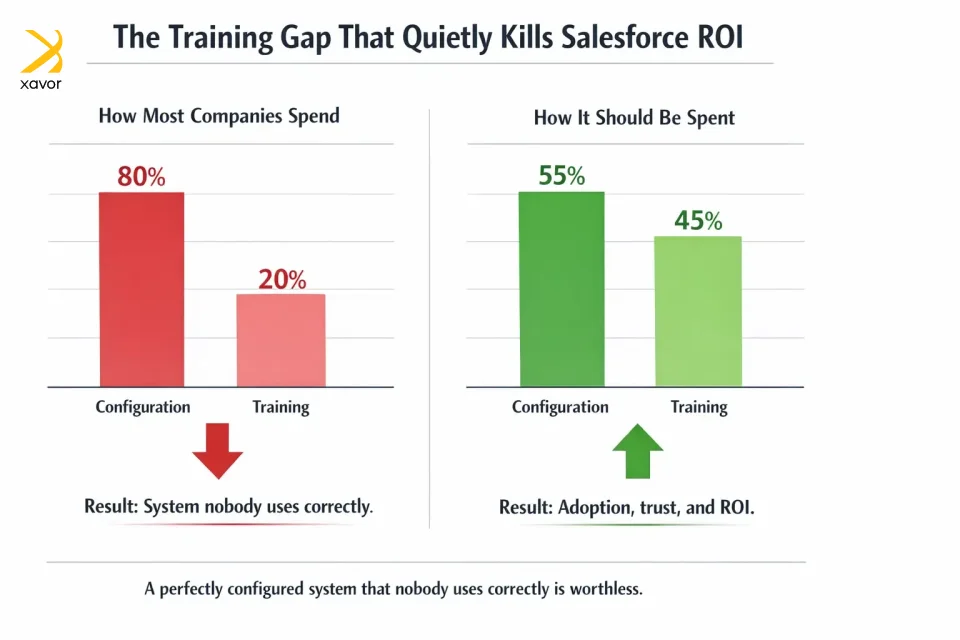
Most Salesforce implementations invest 80% of their budget in configuration and 20% in training, when the ratio should probably be closer to the reverse.
A perfectly configured system that nobody uses correctly is worthless. And people don’t use systems correctly because they weren’t trained well. And generic, one-size-fits-all training doesn’t connect the system to their actual daily work.
Good training is role-specific. A salesperson needs to understand how to manage their pipeline and log the right activity. A sales manager needs to understand how to run a pipeline review and coach from the data. A marketing manager needs to understand lead flow and campaign attribution. Each of these is a different training conversation.
Moreover, Salesforce implementation training is also an ongoing event after go-live. As the system evolves, as new features are added, so training needs to keep pace.
6. Make optimization a permanent practice
The single biggest mistake organizations make after a successful go-live is treating implementation as a completed project. Salesforce needs to evolve with every market change, team growth, and strategy shift.
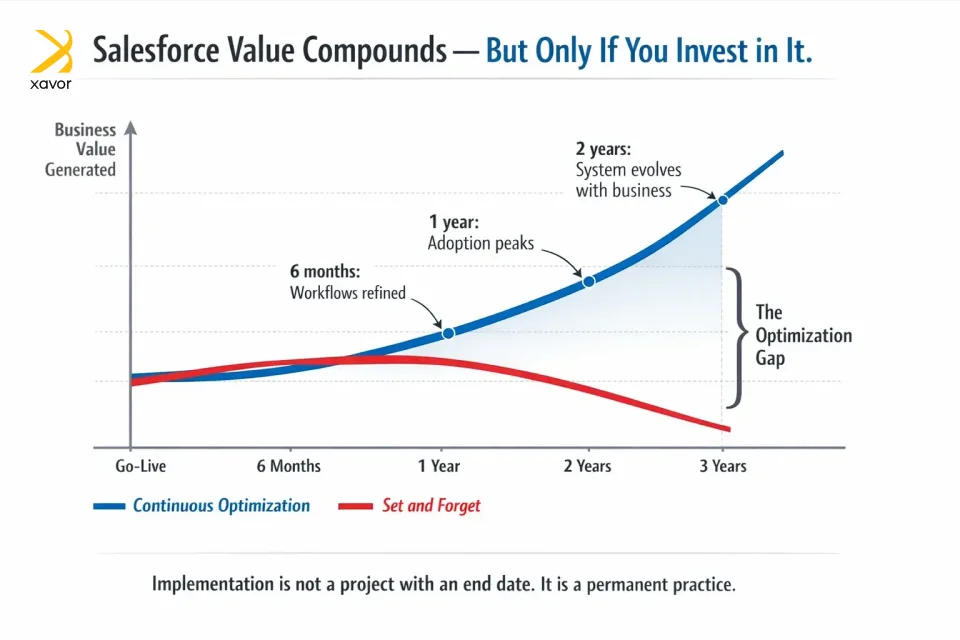
Therefore, building a rhythm of regular review is one of the key Salesforce implementation best practices. Look at adoption data, data quality metrics, and user feedback quarterly. Identify what’s working, what’s creating friction, and what’s missing. Make incremental improvements continuously rather than waiting for problems to become big enough to demand a full re-implementation.
Organizations that do this well find that their Salesforce investment compounds over time. Each improvement builds on the last, the system becoming more aligned and more valuable as the business matures.
Salesforce implementation real-life case study
Xavor has been providing Salesforce implementation services to one of the largest musical instrument retailers in the United States. Behind their retail success is a quieter, fast-growing B2B division serving recording, generating significant revenue with almost no operational infrastructure to support it.
We spent weeks in discovery before touching their Salesforce platform. Interviewing reps, managers, and service teams to understand how the business actually worked. The core finding was that the people and the relationships were strong. The system holding it together was not.
Our experts ran their Salesforce implementation in phases. First, by building a clean foundation with clear stage criteria, and a fully effective data migration that cleaned and rebuilt three years of account history. Second, automating the operational work that was consuming rep time.
And third, by connecting sales and service through Service Cloud, so that every customer interaction has full context behind it.
The results? We managed to increase forecast accuracy from 52% to 84% because the pipeline finally reflected reality. Deals closed faster, too, as the average sales cycle dropped from 47 days to 36.
Furthermore, New hires ramped 40% faster, no longer dependent on tribal knowledge to get up to speed. At the top of the customer base, retention improved by 18%. When we matched the system with the business. Everything else followed.
Conclusion
Salesforce is only as powerful as the clarity and discipline you bring to it. Process alignment, stakeholder buy-in, clean data, role-specific training, and continuous optimization are Salesforce features. They are organizational decisions. And they are the decisions that separate companies that transform how they operate from companies that spend six figures on a system nobody fully trusts. Salesforce implementation with real process alignment is the operational infrastructure that makes everything else actually executable.
Think about the last time your team missed a revenue target, lost a deal you should have won, or couldn’t answer a straightforward question about your pipeline. Was the real cause a lack of ambition? Or was it a gap between what leadership decided and what actually happened on the ground?
If any part of this blog felt uncomfortably familiar, you may have an alignment problem that needs the right partner.
Xavor has spent years implementing Salesforce for Fortune 500 enterprises. We don’t just configure software. Our Salesforce crm implementation services build the operational system your growth strategy deserves.
Contact us at [email protected] to make the most out of your Salesforce instance.

FAQs
A CRM project typically moves through five or six phases: planning, implementation, training, go-live, and optimization. Each phase builds on the last, and skipping any one of them is where most CRM projects run into trouble.
Salesforce is neither an ERP nor SAP. It is a CRM platform. SAP is a separate software company that makes its own ERP system, while an ERP (Enterprise Resource Planning) system manages back-office functions like finance, inventory, and supply chain. Salesforce, by contrast, is built around the customer-facing side of a business.
Salesforce clouds are specialized products built on top of the core Salesforce platform, each designed for a specific business function. Think of each cloud as a purpose-built module, which you can use one, several, or all of them depending on what your business needs.