
Retrieval-Augmented Generation (RAG) and fine-tuning are two of the most common ways to get the most out of large language models (LLMs). While both techniques aim to improve the performance of LLMs on domain-specific tasks, they solve fundamentally different problems. Understanding the difference is essential for organizations evaluating AI development services or building enterprise AI applications.
RAG improves an AI system’s access to knowledge by retrieving relevant information at runtime. That makes it ideal for applications that rely on frequently changing data. Fine-tuning, by contrast, changes the model itself, which allows it to learn specialized behaviors or decision-making patterns.
However, many organizations treat RAG and fine-tuning as competing approaches when they often address different requirements. The right choice depends on whether your primary goal is improving knowledge, improving behavior, or both.
This guide explains how RAG and fine-tuning work, where each approach excels, their trade-offs, and how to determine which method is best suited to your AI application.
When to use RAG vs fine-tuning in enterprise AI
TL;DR
| Category | RAG | Fine-Tuning |
| What it does | Retrieves relevant information from external sources before generating a response | Trains the model to learn domain-specific behaviors, patterns, or expertise |
| Where knowledge lives | In external documents, databases, or knowledge repositories | Inside the model’s parameters |
| Best for | Applications that rely on current, frequently changing information | Applications that require specialized expertise, behavior, or output formats |
| Knowledge freshness | Always up to date if the source data is updated | Static until the model is retrained |
| Implementation cost | Lower training cost but requires retrieval infrastructure | Higher training and maintenance costs |
| Speed | Slightly slower due to document retrieval | Faster because no retrieval step is required |
| Maintenance | Update the knowledge base | Retrain the model when knowledge changes |
| Hallucination risk | Lower because responses are grounded in retrieved content | Higher if the model lacks relevant knowledge |
| Typical use cases | Enterprise search, customer support, internal knowledge assistants, research assistants | Coding copilots, legal drafting, medical assistants, classification and summarization tasks |
| Main challenge | Retrieval quality determines response quality | Training costs, model maintenance, and knowledge becoming outdated |
What is RAG?
RAG is a technique that combines an LLM with an external knowledge source. Instead of relying solely on information stored within the model’s parameters, a RAG system retrieves relevant documents from a database and provides them as context to the model before generating a response.
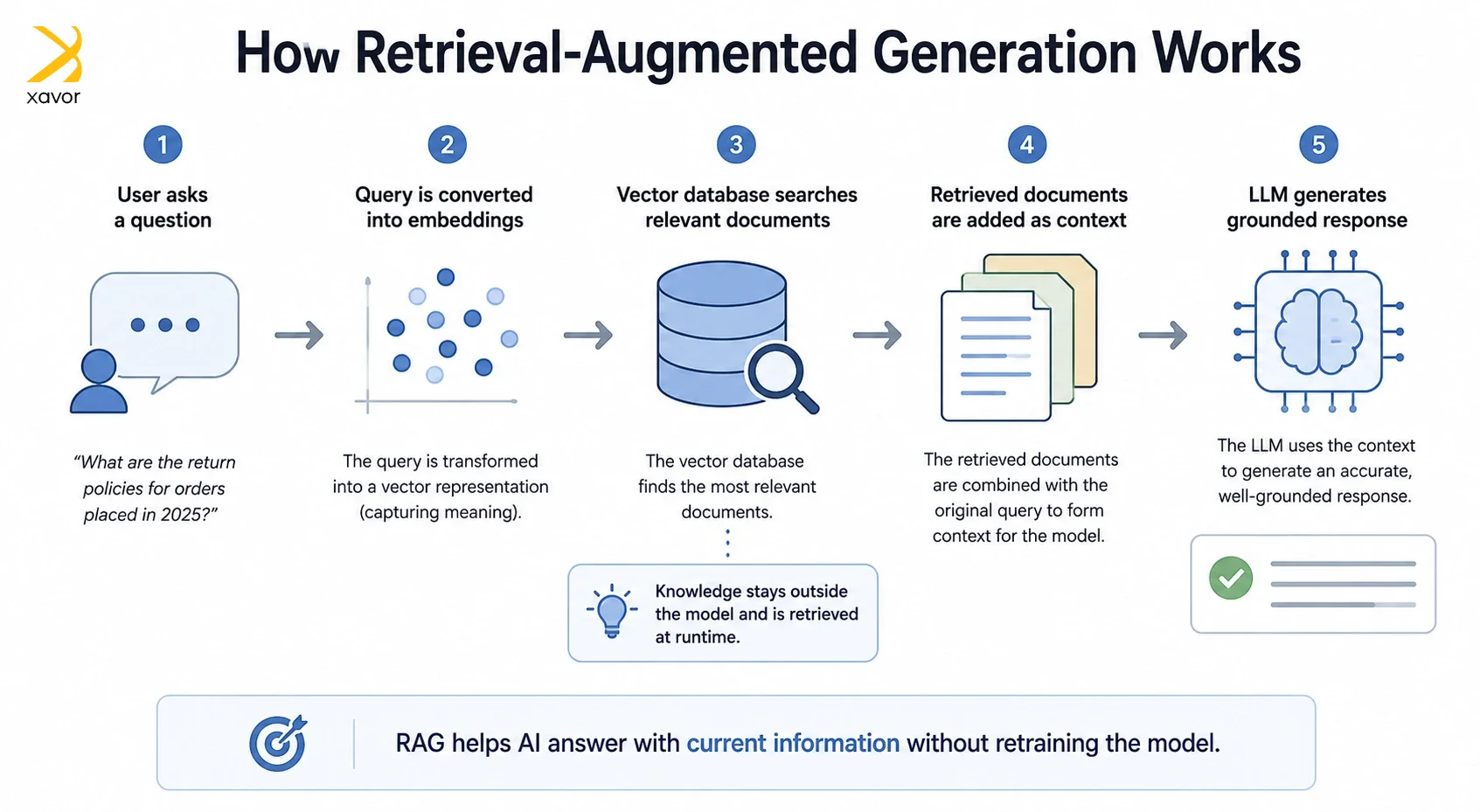
The workflow typically looks like this:
- User submits a query.
- The query is converted into vector embeddings.
- A vector database searches for relevant documents.
- Retrieved documents are added to the prompt.
- The LLM model generates a response using the retrieved information.
For example, imagine a company wants to build a customer support chatbot. The chatbot needs access to product manuals, internal documentation, and company policies. Instead of retraining the entire model whenever documentation changes, a RAG system retrieves the latest documents and feeds them into the model at runtime.
This approach enables the model to provide responses based on current and accurate information without modifying the model itself.
What is fine-tuning?
Fine-tuning involves further training a pre-trained language model on a specialized dataset. Instead of retrieving information externally, the model learns patterns directly from domain-specific examples.
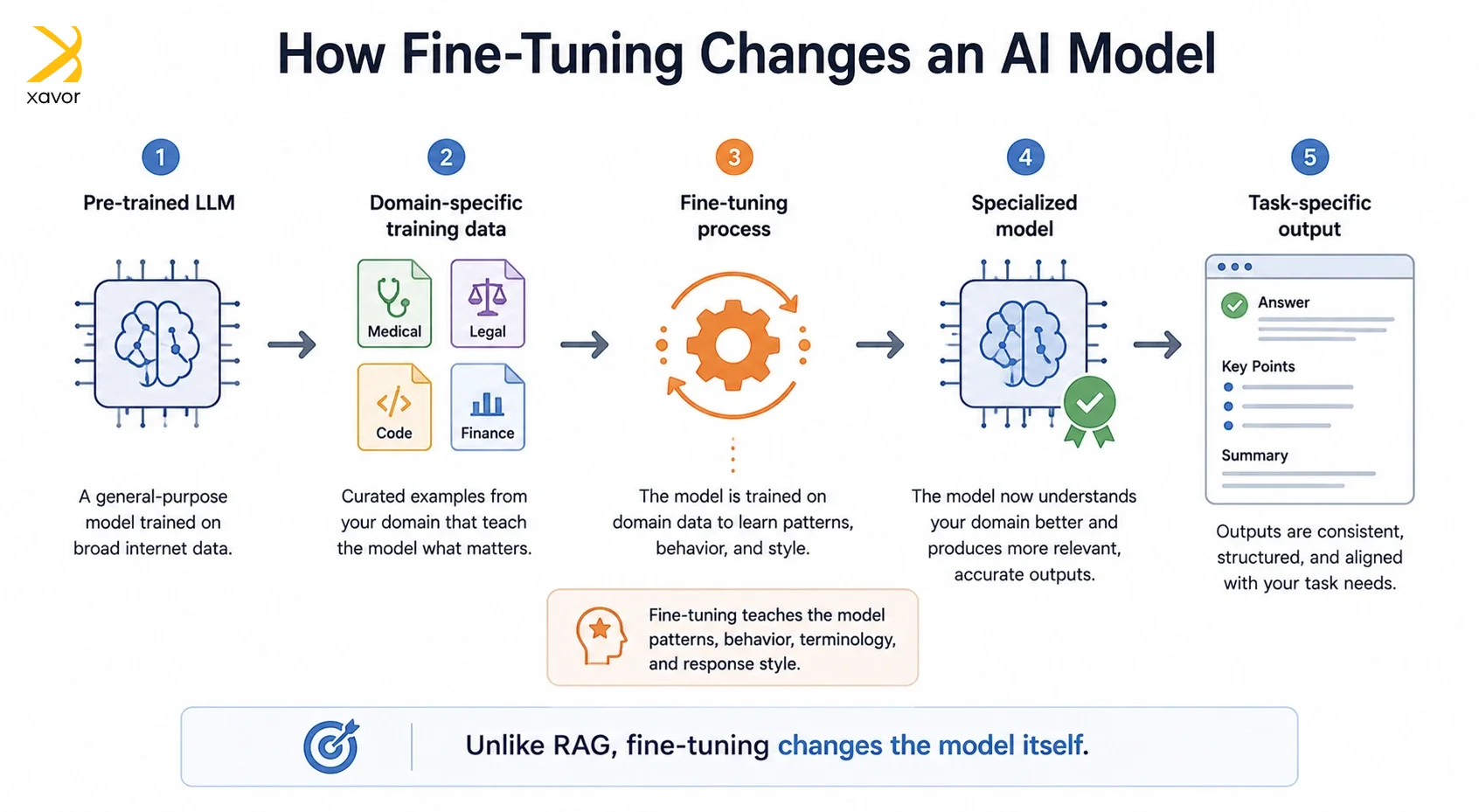
For instance, a healthcare organization may fine-tune a model using medical records, clinical terminology, and healthcare conversations. After training, the model becomes more proficient at understanding and generating medical content.
Unlike RAG, fine-tuning modifies the model’s internal parameters.
Benefits of RAG
Our AI team has used RAG in several projects, and it has always been a great experience. For example, our private ChatGPT for secure supply chain knowledge solution uses RAG to give access to constantly evolving documentation and operational knowledge.
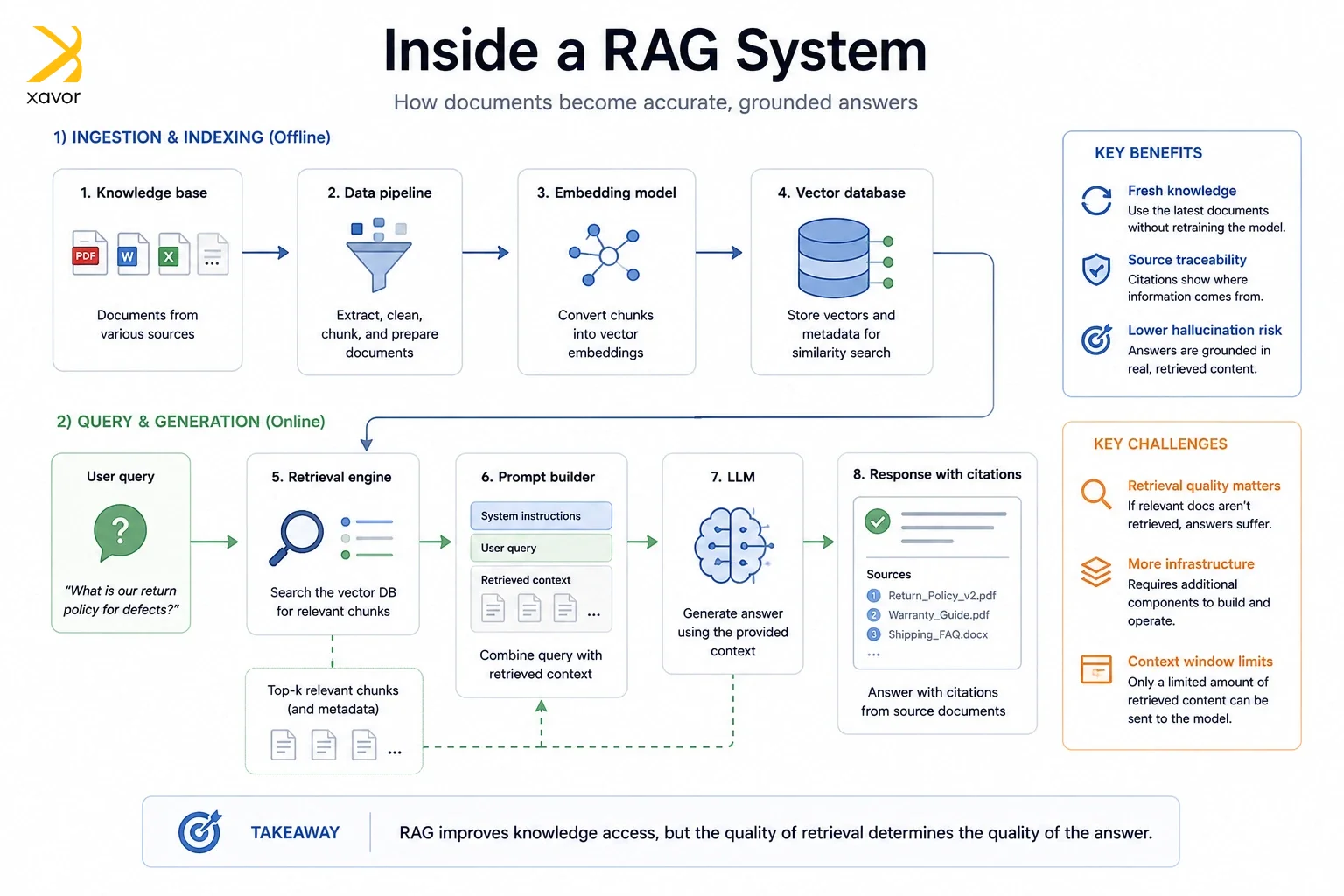
You can also use RAG to surface relevant information at runtime with these benefits.
1. Access to up-to-date information
One of the biggest advantages of RAG is its ability to use fresh information. Since the knowledge is stored externally, organizations can update documents in the database without retraining the model.
This makes RAG ideal for applications involving:
- Company knowledge bases
- Legal documents
- Product documentation
- Research papers
- Financial reports
2. Lower cost
Fine-tuning large models can be expensive and computationally intensive. RAG eliminates the need for retraining by simply retrieving relevant information during inference.
3. Better explainability
Since responses are generated using retrieved documents, developers can often trace the source of information. This improves transparency and user trust.
4. Reduced hallucinations
LLMs sometimes generate inaccurate information, commonly known as hallucinations. By grounding responses in real documents, RAG significantly reduces this risk.
Challenges of RAG
Despite its advantages, RAG is not a perfect solution.
- Retrieval quality matters: If the retrieval system fails to find relevant documents, the generated answer may still be incorrect.
- Increased system complexity: A RAG architecture requires additional components, such as embedding models, vector databases, search infrastructure, and data pipelines. This increases operational complexity compared to using a standalone model.
- Context window limitations: LLMs can only process a limited amount of context. If too many documents are retrieved, important information may be truncated.
Benefits of Fine-tuning
1. Improved domain expertise
Fine-tuning allows a model to deeply understand specific terminology, writing styles, and workflows.
Examples include:
- Medical diagnosis assistants
- Legal document drafting
- Financial analysis tools
- Software engineering copilots
2. Faster inference
Since knowledge is embedded within the model, there is no need to perform document retrieval before generating responses. This can reduce latency in production environments.
3. Consistent output style
Organizations often require responses to follow specific formats or tones. Fine-tuning helps enforce consistency across outputs.
4. Enhanced task performance
For specialized tasks such as classification, summarization, or code generation, fine-tuning can significantly improve accuracy.
Challenges of fine-tuning
- High training costs: Training large language models requires substantial computational resources and expertise.
- Knowledge becomes static: Once the model is fine-tuned, its knowledge remains fixed until it is retrained. Updating information requires additional training cycles.
- Risk of overfitting: Poor-quality datasets can cause the model to overfit, reducing its ability to generalize to new inputs.
- Maintenance Overhead: Managing multiple fine-tuned models for different use cases can become operationally challenging.
RAG vs fine-tuning: Key differences
The fundamental difference lies in where knowledge is stored. In a RAG system, knowledge remains external and is retrieved when needed. On the other hand, in a fine-tuned model, knowledge becomes part of the model’s parameters.
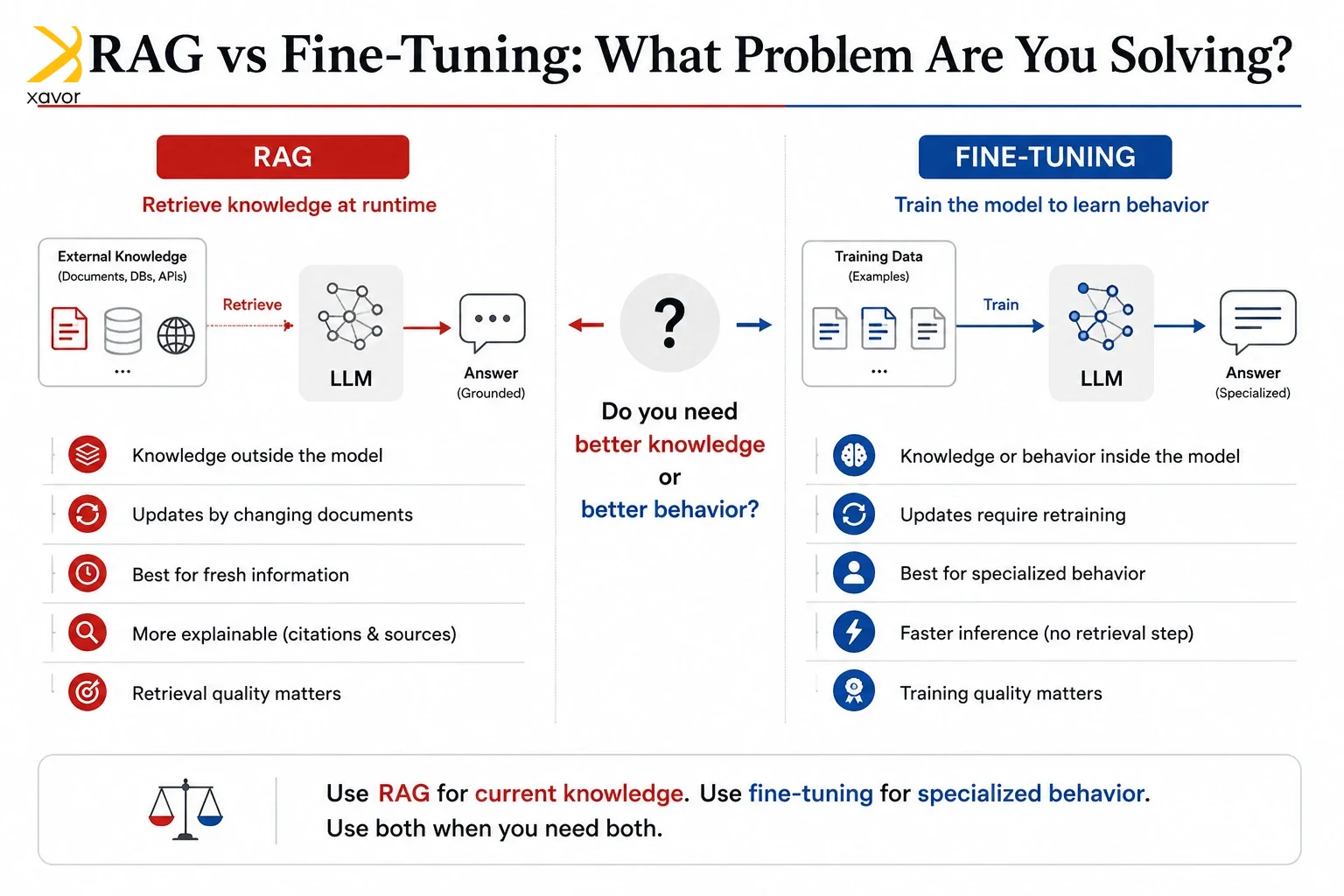
RAG excels when information changes frequently and must remain current. Fine-tuning excels when the goal is to improve behavior, style, or domain-specific understanding.
When should you choose RAG?
RAG is often the preferred choice when:
- Information changes regularly.
- You need access to large document collections.
- Transparency and source attribution are important.
- Budget constraints make training expensive.
- Hallucination reduction is a priority.
Common examples include enterprise chatbots, customer support systems, internal search assistants, and research assistants.
When should you choose fine-tuning?
Fine-tuning is usually the better option when:
- The task requires specialized behavior.
- Consistent output formatting is critical.
- Domain-specific language is heavily used.
- Low-latency responses are required.
- Training data is available and relatively stable.
Examples include coding assistants, legal drafting tools, healthcare applications, and sentiment analysis systems.
Combining RAG and fine-tuning is the best solution
In modern AI systems, organizations increasingly combine both approaches.
Fine-tuning can teach the model how to behave, while RAG provides access to current information.
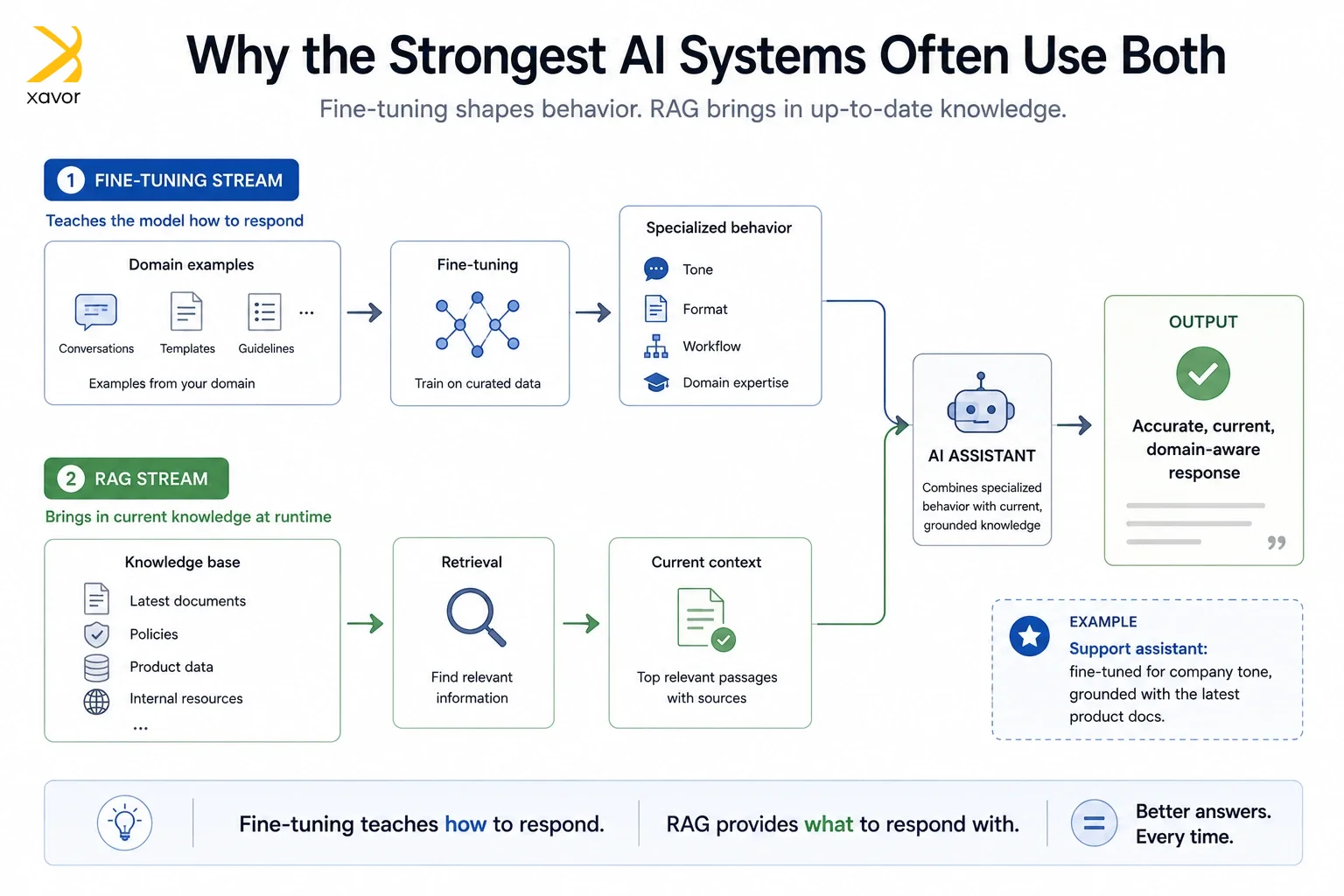
For example, a customer support assistant may be fine-tuned to communicate in the company’s tone and follow support workflows. At the same time, a RAG pipeline can retrieve the latest product documentation and policy updates.
This hybrid architecture provides the benefits of both approaches:
- Strong domain expertise
- Access to real-time information
- Reduced hallucinations
- Improved user experience
Conclusion
RAG and fine-tuning are far from competing technologies. They are complementary tools for adapting large language models to real-world business problems. RAG focuses on providing accurate and up-to-date information through external retrieval. While fine-tuning enhances the model’s behavior and domain expertise through additional training.
For many organizations, RAG offers the quickest and most cost-effective path to production. However, when specialized knowledge, formatting, or performance is required, fine-tuning becomes valuable.
The most powerful AI systems often combine both methods to achieve the best balance between accuracy, scalability, and maintainability.
We can help you understand and decide when and how to leverage RAG and fine-tuning. Contact us at [email protected] to book a free consultation session with our AI experts.

FAQs
Generally, yes. RAG is better at reducing hallucinations because it grounds responses in relevant external documents retrieved at runtime. Fine-tuned models rely on learned knowledge alone, so they are more likely to generate inaccurate information if the required knowledge is outdated or missing.
Yes. Many production AI systems use both techniques together. Fine-tuning teaches the model domain-specific behavior, tone, or formatting, while RAG supplies up-to-date knowledge at runtime, resulting in more accurate, relevant, and reliable responses.
No. While RAG uses prompts, it goes beyond prompt engineering by automatically retrieving relevant information from external knowledge sources and adding it to the prompt at runtime. This allows AI models to generate responses based on current, grounded data rather than relying only on their built-in knowledge.