Data governance is at the top of the agenda of many enterprises this year. And the reason for this surge is none other than AI.
Enterprise AI systems use a lot of data to make business decisions. However, they cannot be given a free rein to do whatever they want with company data, as AI is not infallible. That’s why enterprise data governance solutions are in high demand, helping organizations ensure that accurate, secure, and compliant data powers their AI initiatives.
A data governance platform also removes general operational inefficiencies that stem from bad data management. So, the right data governance software will go a long way in your enterprise.
And to find that right tool, read this piece to know about the five best data governance tools in the market in 2026.
What are data governance tools?
Data governance solutions integrate business and technology capabilities to help companies manage their data assets. They provide the whole infrastructure and enforce rules around everything pertaining to data, such as:
- Who owns what data?
- How is data transferred?
- Who has access to data?
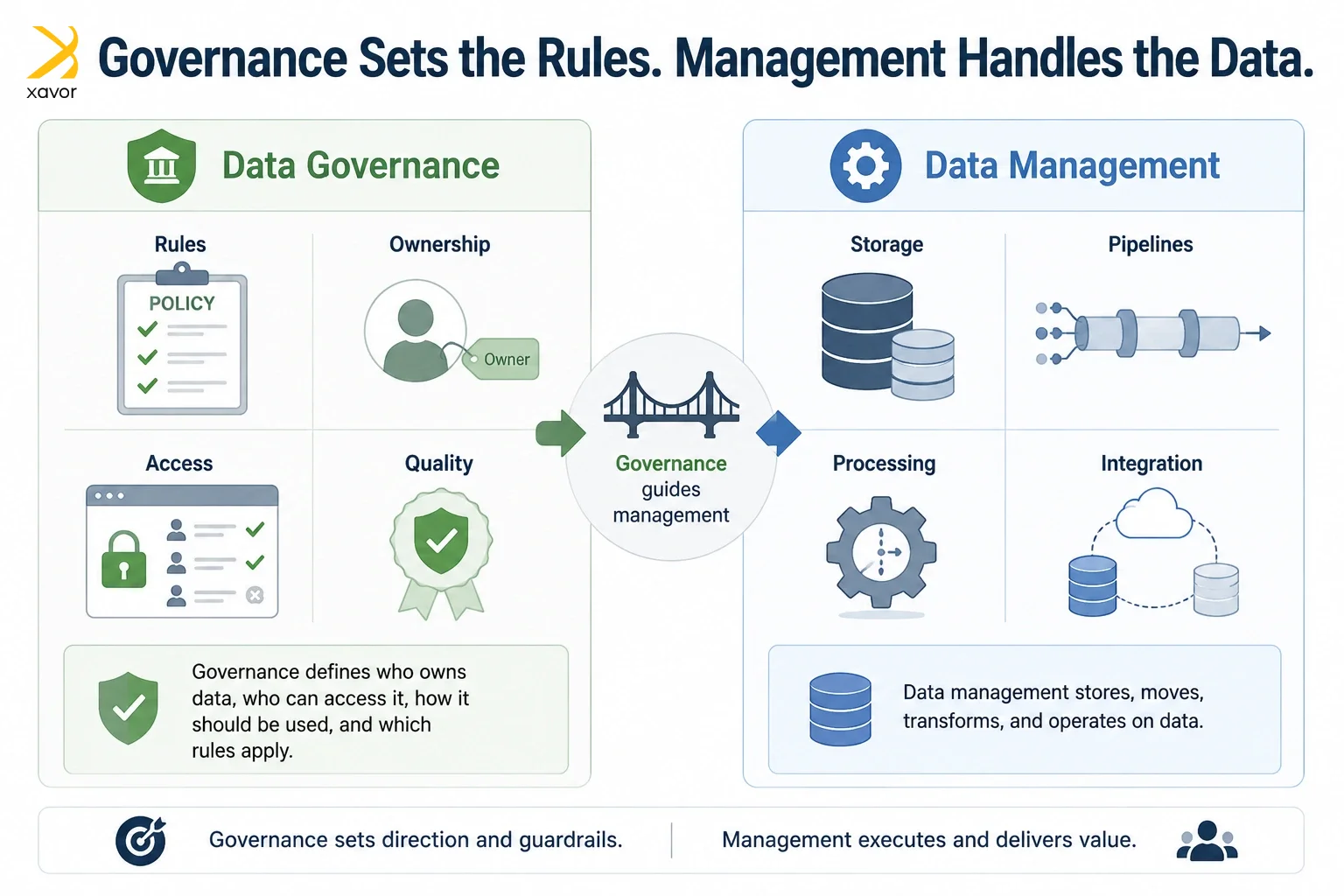
Keep in mind that a data governance platform is not the same as its data management counterparts. Data governance tools only set and manage the policies around data, but they don’t actually handle any data. That is the job of data management platforms to execute and handle data directly to execute those policies.
How to choose the right data governance platform?
Ultimately, choosing the right data governance software comes down to a blend of your particular needs and some key evaluation metrics. Here’s what we recommend when choosing between data governance tools.
| Evaluating factor | What it means | Why it matters | Things to look for |
| Data discovery | Can people find and understand the right data? | If users can’t find data or understand what it means, governance fails before it starts | Strong data catalog, metadata management, automated classification, tagging, and intuitive search capabilities |
| Data Lineage | Can you trace where data came from and how it changes? | Essential for troubleshooting, compliance, and audits | End-to-end lineage, impact analysis, dependency mapping, visibility into data transformations, and audit-ready traceability |
| Governance | Can the tool enforce policies and manage access? | Governance is essentially about having control | Role-based access controls, identity provider integration, policy automation, data masking, row-level security, compliance monitoring, and audit trails |
| Data quality | Can you ensure data is accurate and consistent? | Analytics and business decisions are only as good as the underlying data | Data quality monitoring, stewardship workflows, ownership assignment, validation rules, issue management, and accountability mechanisms |
| Scalability | Will it fit your environment today and tomorrow? | A great tool that doesn’t integrate becomes shelfware | Open architecture, cloud and on-premise support, broad integrations, API connectivity, scalability, and enterprise readiness |
| AI readiness | Can it govern data used by AI and govern AI-generated outputs? | AI introduces additional dimensions to traditional governance | Integration with modern data stacks, support for AI workflows, machine-readable metadata, governance for AI-generated content, and AI policy controls |
| Adoption | Will people actually use it? | Even the most powerful governance platform fails if nobody adopts it | Intuitive user experience, self-service data discovery, collaboration features, business-friendly interfaces, and low learning curve |
| Implementation | Can your organization successfully deploy and sustain it? | Governance is as much an organizational challenge as a technology one | Reasonable implementation effort, strong vendor support, training resources, transparent pricing, measurable business value, and manageable total cost of ownership |
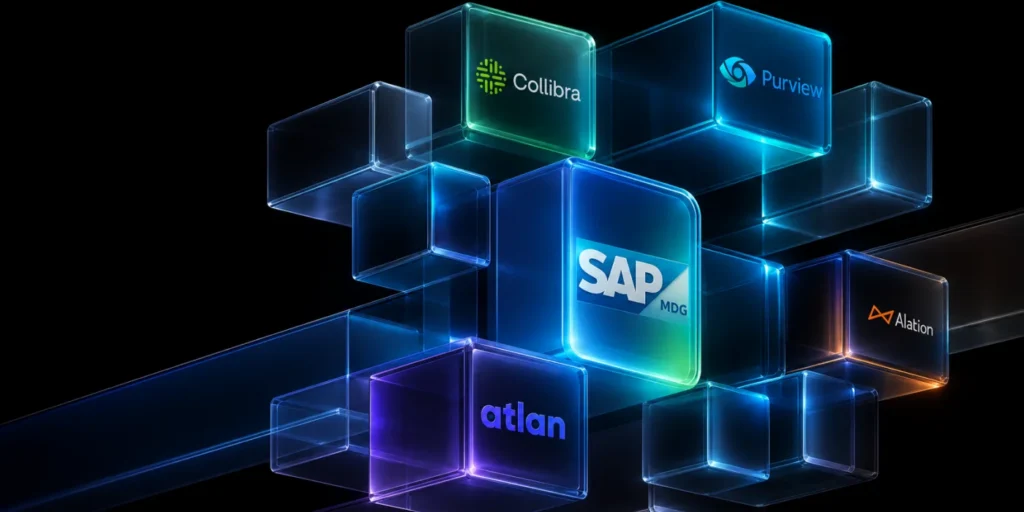
5 leading data governance tools in 2026
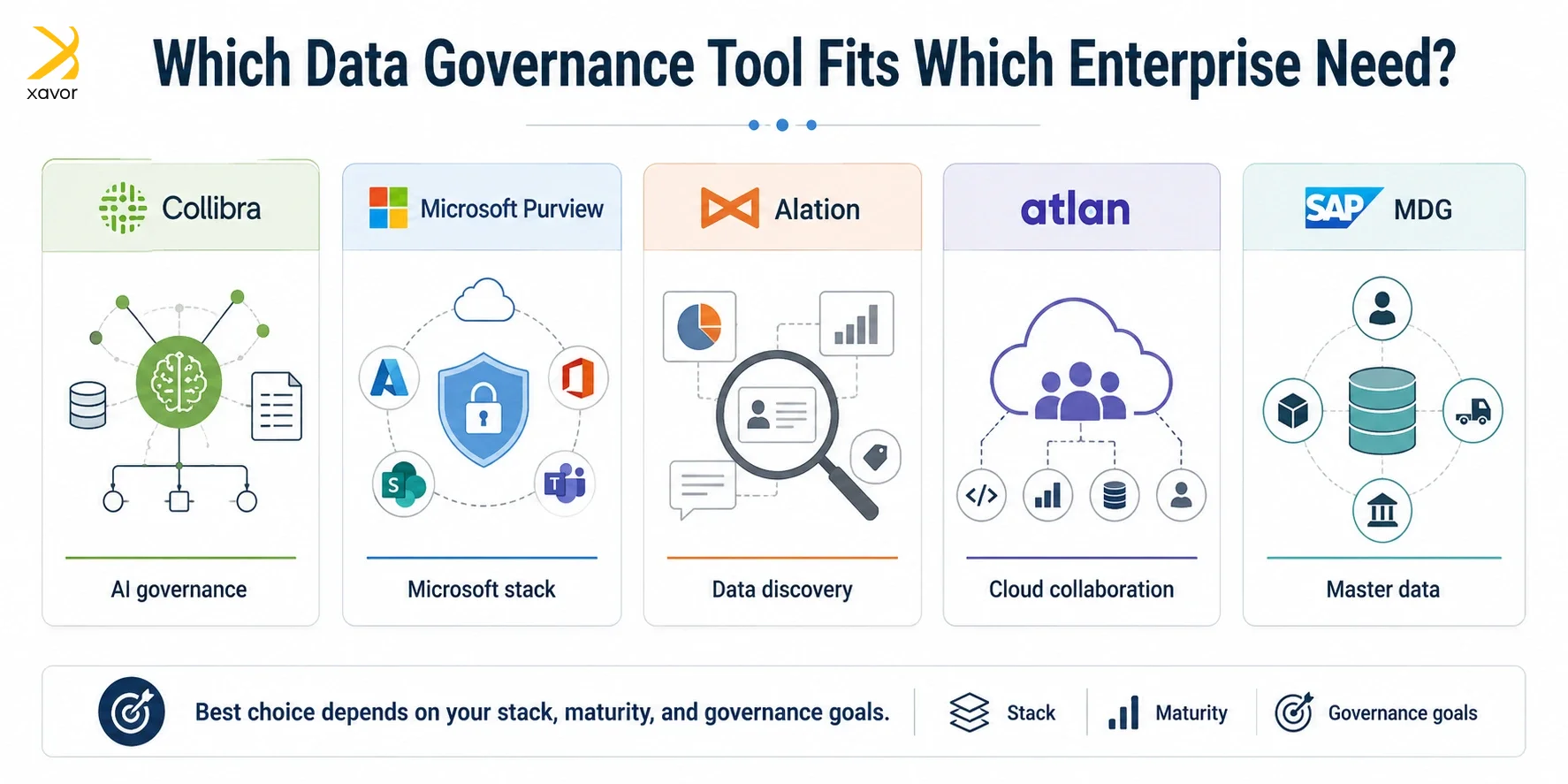
There are several data governance vendors in the market. And all of them provide great products. But choosing between data governance tools ultimately comes down to your specific challenges.
1. Collibra
Collibra is an all-rounder data governance platform that is an excellent choice for AI-first enterprises in this current tech milieu. Because in creating and deploying AI solutions, lots of data exists. The challenge is knowing which data is reliable enough to feed an AI model in the first place.
And not all data governance tools are cut out for AI governance requirements. Only a data governance software like Collibra that acts as a complete governance layer fits the bill. It gives you complete stewardship of your data. As AI governance becomes more important, organizations should also consider the safety of foreign AI models when evaluating models for enterprise use, particularly where security and data governance are involved.
For example, it creates a searchable inventory of enterprise data. So, data teams don’t have to hunt through warehouses and spreadsheets. They can quickly identify the datasets that are officially recognized and governed.
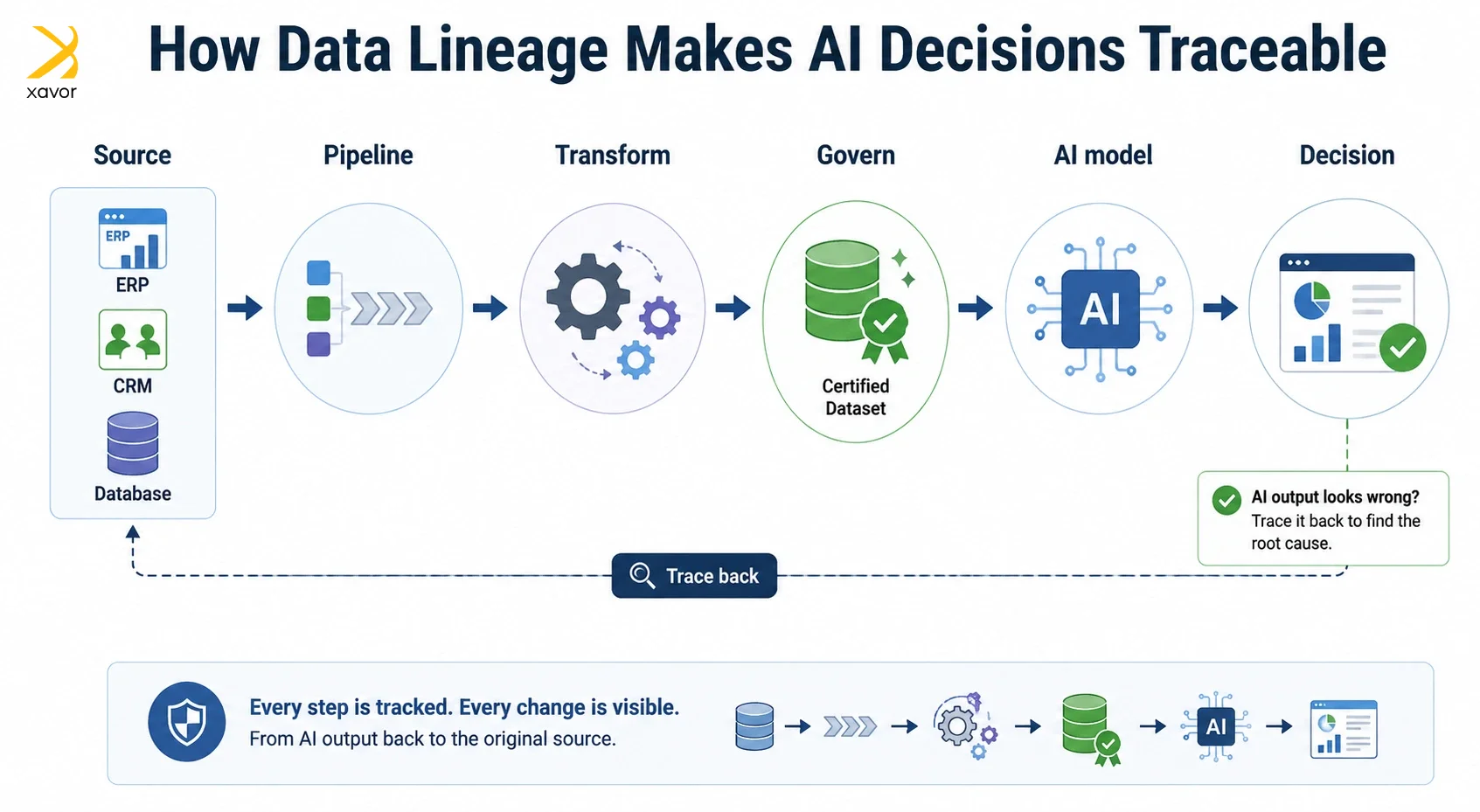
Data lineage in particular matters for AI. Collibra traces everything about a piece of data, such as:
- Its origins,
- How it moved through systems
- Transformations if any
When an AI model produces an unexpected outcome, organizations can trace the inputs back to the source rather than treating the model as a black box.
2. Microsoft Purview
Microsoft Purview is the kind of data governance platform that manages governance as a core business discipline.
Many data governance tools focus on helping organizations understand their data. But Purview focuses on helping them control it. That distinction becomes increasingly important as AI and distributed workforces expand the enterprise attack surface.
It excels at identifying sensitive information and ensuring it remains protected wherever the info travels. Furthermore, Purview’s data loss prevention capabilities help organizations monitor and control how sensitive information moves around and is accessed.
But if you ask us, Purview’s most compelling advantage is its unified visibility. Organizations using the Microsoft ecosystem gain a centralized view across Microsoft 365, Azure, SharePoint, OneDrive, and other Microsoft services.
3. Alation
According to Merriam-Webster, alation means the state of wings. That is very fitting, because in enterprise data, Alation gives organizations something very close to lift. It helps teams rise above the sprawl of scattered datasets and conflicting definitions.
Alation does that by making data more discoverable and not just a maze of rules and policies. Many data governance tools give you catalogs that tell you what data exists. But Alation helps you understand which data matters.
The data governance platform combines metadata with usage patterns and business definitions to create context around enterprise data. Users can see not only where a dataset lives, but how frequently it is used and whether it is considered trustworthy by the organization.
4. Atlan
Atlan is a modern data governance platform that is quickly gaining momentum. Particularly, Atlan is a user favorite for cloud-native data environments where data lives across Snowflake, Databricks, and other BI tools.
In that cloud world, governance cannot sit in a corner wearing a badge. It has to move with the work.
Atlan’s major advantage is that it treats AI-driven governance as a team sport. Data engineers, analysts, product teams, AI teams, and business users can annotate assets, ask questions, assign owners, document definitions, and resolve issues inside the platform.
5. SAP Master Data Governance
SAP Master Data Governance (MDG) helps companies keep their most important business data accurate and under control across SAP systems.
Think of it as the master data governance platform that stores the core information a business relies on every day, such as:
- Customers
- Products
- Suppliers
Without governance, the same customer or supplier can end up appearing multiple times across different systems, often with slightly different details. That creates confusion, to say the very least.
SAP MDG solves this by creating a single, trusted version of that information. Instead of every system maintaining its own record, everyone works from the same source of truth.
It also gives companies structured workflows and approval processes. For example, if someone wants to add a new supplier, the request can be routed to the right teams for review and approval before the data becomes official.
The biggest advantage of SAP MDG is that it’s built specifically for SAP environments. For organizations that rely heavily on SAP, it helps ensure that critical business data remains consistent and governed, and reliable across the entire enterprise.
Conclusion
Data governance has always been about creating trust in enterprise data. AI has simply raised the stakes.
That is why data governance has become the foundation that determines whether enterprise AI systems are accurate and reliable. Data organization is just one aspect of the right data governance tools. They also give you confidence that the data powering your business and AI applications is trustworthy.
There is no universal “best” data governance platform. The right choice ultimately depends on your technology stack coupled with governance maturity and ambitions.
Partner with Xavor’s business intelligence and data Analytics experts to design a governed data foundation that powers trusted insights and enterprise-ready AI solutions.
Drop us a line at [email protected] to turn trusted data into trusted AI now.

FAQs
There isn't a single best platform for every organization. The right choice depends on your technology stack, governance maturity, regulatory requirements, and AI strategy. For example, Collibra excels at enterprise governance, while Microsoft Purview is a strong fit for Microsoft-centric environments.
Start by identifying your biggest data challenges, then evaluate tools based on data discovery, lineage, governance, data quality, scalability, AI readiness, and integration capabilities. The best platform is the one that aligns with your current needs and future growth.
Look for capabilities such as metadata management, data catalogs, lineage, policy enforcement, access controls, data quality monitoring, AI governance, and seamless integration with your existing data ecosystem.