

A Power BI implementation partner covers data integration, modeling, dashboards, governance, and training across your reporting estate. We do this work at Xavor Corporation in Irvine, California, through our BI and data analytics services, so read on, knowing we are one of the firms you might be evaluating. Most Power BI engagements fail because of data readiness, not report quality. Published consulting rates run from twenty dollars to six hundred dollars an hour. Five phases appear in every strong proposal, and a missing phase tells you something specific.
The work spans four competences, and most firms are genuinely strong in two of them.
What a Power BI implementation partner delivers
Five areas of work sit inside a Power BI engagement, and proposals differ most in how they scope them. Every partner will claim all five. What separates them is which ones they price properly.
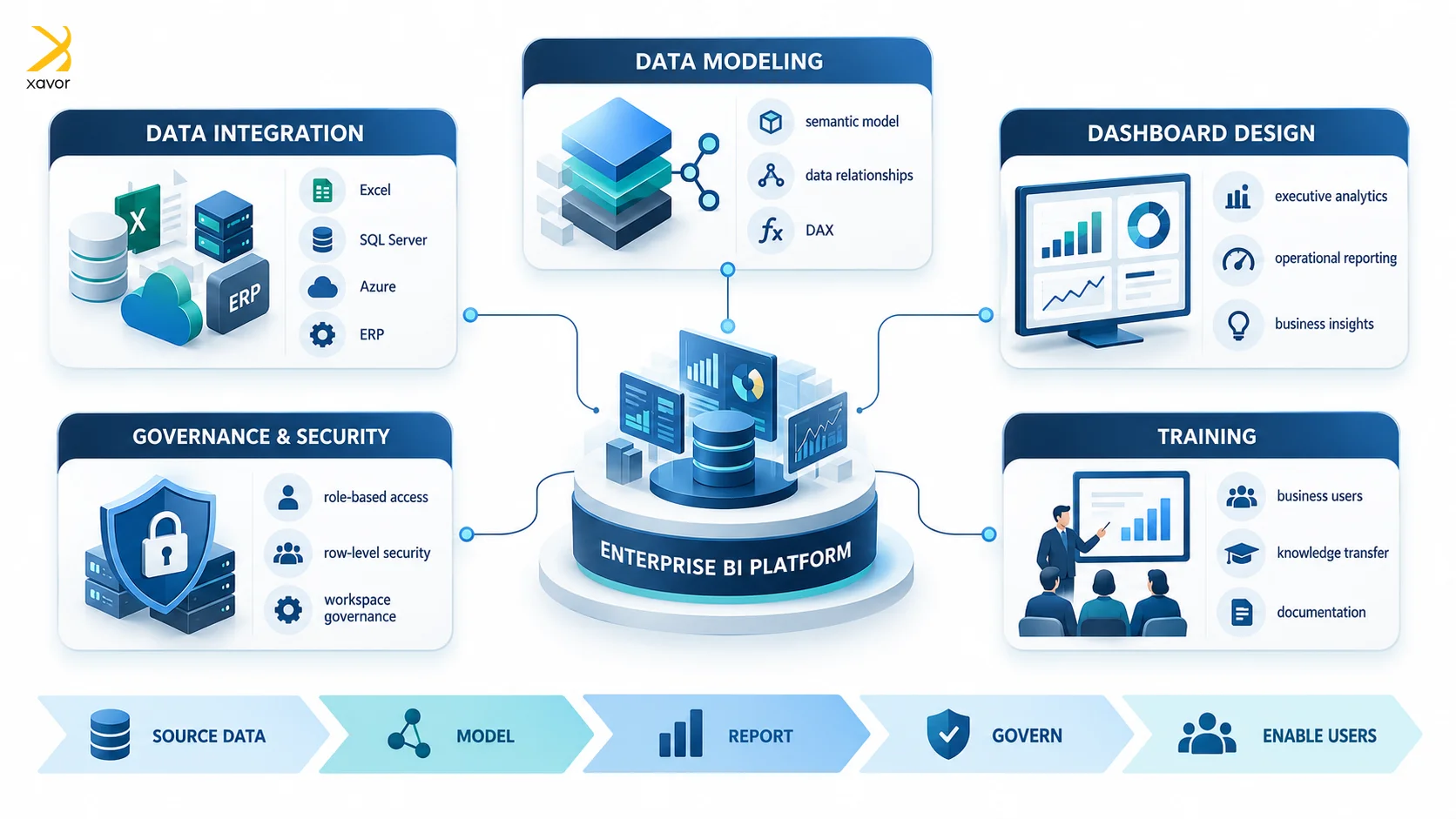
- Data integration: connecting Excel, SQL Server, Azure, and ERP sources into one reporting foundation.
- Data modeling: structuring that data and writing DAX that performs at volume.
- Dashboard design: building the executive and operational views people open daily.
- Governance and security: role-based access, row-level security, and workspace structure.
- Training: moving capability into your team rather than leaving it with the vendor.
Microsoft Fabric competence now sits underneath several of these, since a growing share of estates run reporting on Fabric capacity.
Two proposals can both say Power BI implementation and price four of these five areas differently.
Reading a proposal means checking which of the five carry named deliverables and which appear as a sentence. We cover how Power BI presents complexity to business users separately.
Which kind of firm fits which kind of problem
Most Power BI engagements fail on data readiness rather than on report quality. The dashboard is rarely the hard part. Getting four systems to agree on what a customer is usually is.
| Independent consultant | Boutique specialist | Engineering firm | |
| Suits | One report, clear scope | DAX and model depth | Multiple sources, no warehouse |
| Strength | Speed and cost | Platform expertise | Data engineering |
| Limit | No backup if unavailable | Assumes clean data | Less visual specialism |
A firm that builds excellent reports on clean data is the wrong choice when the data is the problem.
The reverse holds too. An engineering firm brought in to polish an existing model is expensive for what you get.
Two of our own engagements show the split. Standardizing global data reporting on Power BI and Snowflake was a data problem before it was a reporting one. Modernizing real estate analytics with governed Power BI turned on governance, not visuals.
Work out which shape your problem is before you shortlist.
Nine questions to ask before you sign
Each question below has a strong answer and a weak one, and the weak answers reveal more than the strong ones. Ask all nine of every firm on your shortlist, and note where answers get vague.
Three of these are questions we would answer with a qualification, and we’ve marked them.
Who does the work
The people on the pitch and the people on the build are frequently different. These three questions surface that gap early.
1. Which consultants will be on my engagement, and what are their certifications?
A strong answer names individuals who hold PL-300 or DP-600. A weak answer cites certifications the firm holds, without saying who on your team carries them.
2. Who builds the semantic model, and where do they sit? ⚠️ We answer this one with a caveat.
A strong answer gives a role, a location, and honest time-zone overlap. A weak answer means senior architects pitched and junior staff will build. Xavor delivers through embedded pods across three offices, so buyers who need everyone in one time zone should raise it early.
3. What happens when the person who built it leaves?
A strong answer covers documentation standards, source control, and a named backup. A weak answer leaves the knowledge in one person’s head, which becomes your problem at renewal.
What they actually do
A firm claiming equal depth in every area usually has genuine depth in none. These questions test the claim.
4. Are you a Power BI specialist or a broader engineering firm? ⚠️ We answer this one with a caveat.
A strong answer picks one and says which suits you. Xavor is an engineering firm with a BI practice, so a specialist better serves a buyer whose only issue is DAX tuning.
5. If my data is not ready, what happens to the scope?
A strong answer assesses readiness before quoting and prices the engineering separately. A weak answer carves data preparation out of the quote, which is where budgets double.
6. How do you handle row-level security, and who governs it after go-live?
A strong answer designs row-level security alongside the model and names a post-launch owner. A weak answer treats security as a configuration step. The definitions the security sits on are covered in what a semantic layer holds and why it is governed.
What happens after go-live
An engagement that ends at delivery leaves you with dashboards nobody updates. These three questions test for that.
7. What does your proposal include for training and documentation?
A strong answer itemizes both with named deliverables. A weak answer treats enablement as an assumption.
8. What is your current Microsoft Solutions Partner designation, and in which area? ⚠️ We answer this one with a caveat.
A strong answer names a designation you can verify. A weak answer uses Gold or Silver language, which Microsoft retired. Xavor’s own materials carry legacy wording in places, and we are correcting it.
9. What does month four look like?
A strong answer describes a support model, a change process, and backlog ownership. A weak answer describes go-live and stops.
How to verify a Microsoft partner claim
Microsoft retired the Gold and Silver partner tiers in September 2022 and replaced them with Solutions Partner designations. The Microsoft AI Cloud Partner Program now recognizes six designations, and the one relevant to Power BI work is Solutions Partner for Data and AI.
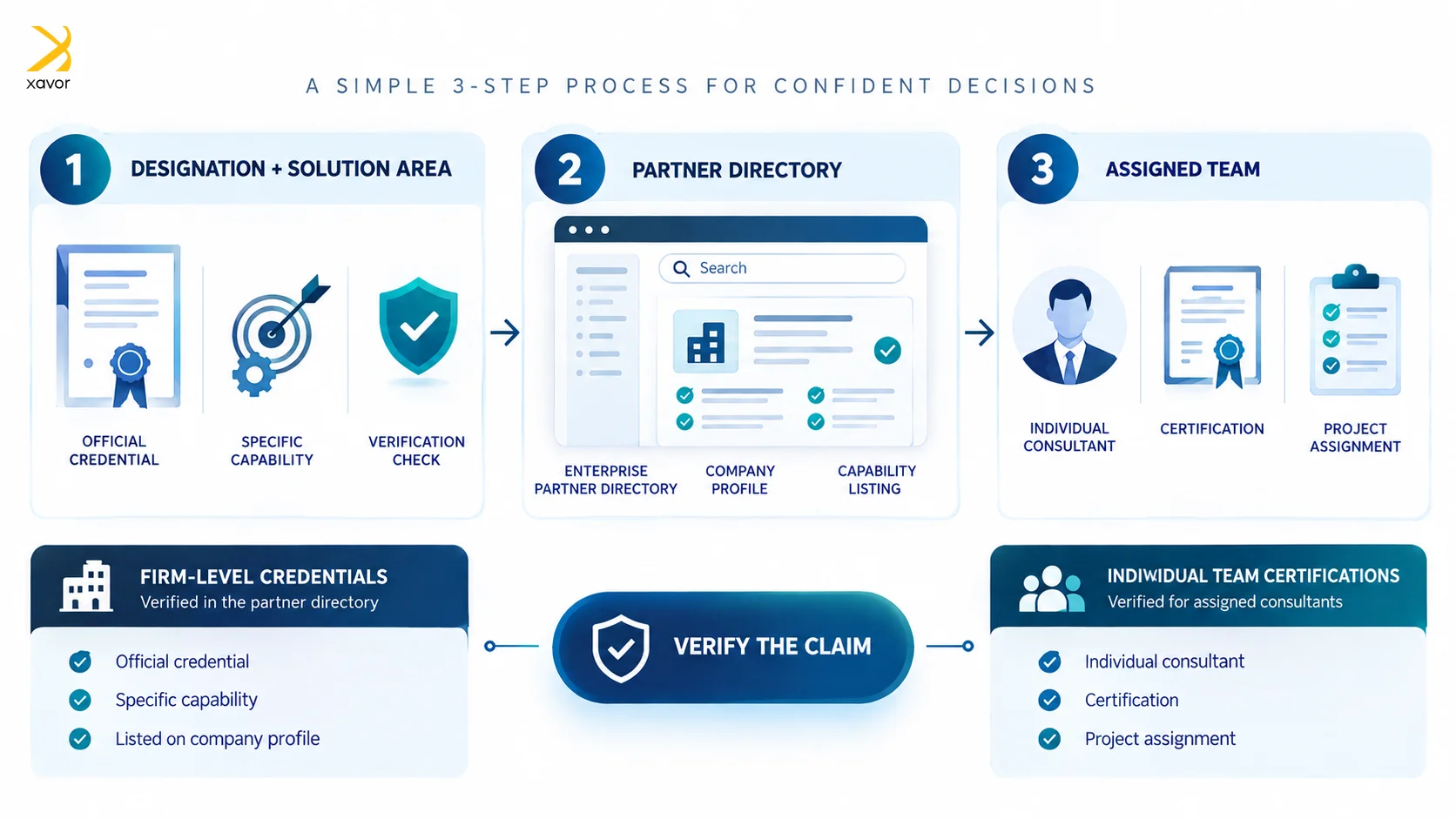
Three steps make a claim checkable:
- Ask for the designation and the solution area: a designation without a named area tells you little.
- Check the Microsoft Power BI Partners directory: Microsoft publishes it, and it lists firms by capability.
- Confirm individual certifications sit with your team: a firm-level credential is separate from who is assigned.
A firm still describing itself as a Gold Partner in 2026 is using language Microsoft asked partners to stop using.
That does not make the firm incapable. It does mean the badge has not been revalidated under the current framework, and a CIO should ask why.
What published consulting rates measure
Published Power BI consulting rates run from twenty dollars to six hundred dollars an hour. Those figures come from vendor guides, rate surveys, and practitioner forums, and they describe the same market in the same year.
The spread is not disagreement. It reflects four different purchases:
- Offshore development: published ranges around $40 to $90 an hour.
- Independent specialists: published ranges around $80 to $200.
- Boutique firms: published ranges around $150 to $250.
- Major integrators: the upper end, with a brand premium attached.
The spread measures four different purchases rather than four opinions about one price.
Licensing sits separately and is easier to pin down. Microsoft publishes Power BI Pro at $14 per user per month and Power BI Premium Per User at $24 per user per month, both paid yearly.
One figure gets misread often. Job platforms report average Power BI consultant pay near $55 an hour. That is what a person earns, not what a firm bills.
Four things move a quote: how many source systems, how ready the data is, how many reports, and whether enablement is in scope.
What a properly sequenced implementation looks like
Five phases appear in every strong proposal, and a missing phase tells you something specific. Read a proposal against this sequence and the gaps become visible.
| Phase | What it produces | What its absence reveals |
| Discovery | Data readiness assessment | A quote built on assumptions |
| Architecture | Semantic model design | Reports built on raw sources |
| Build | Models, then reports | Dashboards before definitions |
| Enablement | Training and documentation | Dependency on the partner |
| Support | Named owner, change process | An engagement ending at delivery |
A proposal that starts at build has assumed answers to questions nobody asked your data.
The order carries weight too. Reports built before the model gets settled need rebuilding once it does. Cloud deployment changes some of this, and we cover how cloud BI changes the way organizations decide separately.
Five things in a proposal worth a second look
Some warning signs appear in the document rather than the conversation. These five turn up often enough to check for directly.
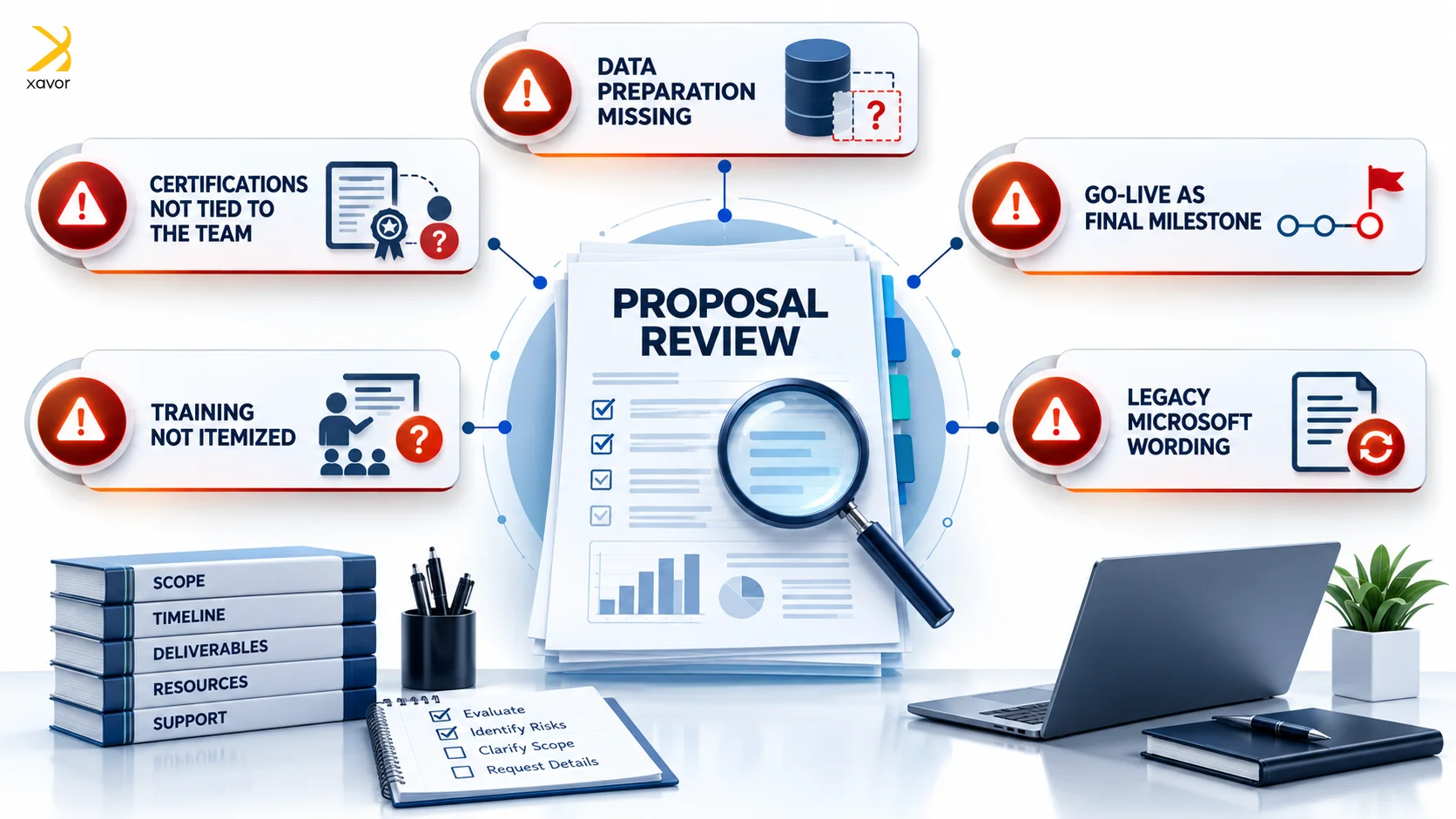
- Data preparation missing from the scope: the quote covers reports and leaves the source work undefined, which is where budgets move most.
- Certifications held by the firm rather than the team: credentials listed at company level, with no named individual attached to your engagement.
- Go-live as the final milestone: no support model, no change process, no named owner past handover.
- Training described rather than itemized: enablement appears as a sentence instead of a deliverable with hours attached.
- Legacy Microsoft wording: Gold or Silver language, which Microsoft retired in September 2022.
None of these makes a firm incapable, and each one is a question worth asking before signature rather than after.
A proposal with two or three of these is common. A proposal with all five has been written to win rather than to deliver.
Take the questions with you.
The nine questions work the same way regardless of which firm you put them to.
Use them on every shortlisted partner, note where answers turn vague, and compare the gaps rather than the pitches. The firm that answers all nine plainly is usually the one that has done this before.
Take these nine questions to whoever you are considering, including us. If you want them answered against an estate you already run, send the shape of your Power BI or Fabric setup to [email protected], and our BI team will work through them with you.

FAQs
A Power BI implementation partner handles data integration, data modeling, dashboard design, governance and security, and training. Scope varies widely between firms, so compare which of the five carry named deliverables in each proposal.
Ask who will build your semantic model, what happens if your data is not ready, and what month four looks like. Weak answers to those three reveal more than strong answers to any other question.
Published rates range from about $20 to $600 an hour depending on the delivery model. Licensing is separate: Microsoft prices Power BI Pro at $14 per user per month and Premium Per User at $24, both paid yearly.