

Leaving any potential quality issue unresolved in product development can upend a whole enterprise. Just look at the catastrophic failure of the Boeing 737 Max and how it sullied the reputation of a company like Boeing. There was a time when people used to say that “If it’s not Boeing, then I’m not going” because of its supreme quality standards for aircraft manufacturing.
Quality management software (QMS) is often offered as a standalone system separate from the product lifecycle management (PLM) process. But tighter regulatory requirements across industries now demand that quality is integrated with the product design and development from the get-go.
Propel PLM services unify PLM and QMS to give manufacturers the visibility to detect and resolve quality issues early before they escalate.
Keep reading further if you want to know how it does that.
What is QMS?
Quality management software is a framework that ensures products or services meet quality and customer requirements. It emphasizes continuous improvement by documenting everything with clear responsibilities and regularly evaluating processes to identify and fix weaknesses.
QMS software treats mistakes as opportunities to improve processes rather than simply fixing individual issues.
Using a quality management system software, an organization can:
- Adapt to changing customer needs and product requirements.
- Improve communication and planning through standardized processes
- Identify and manage risks before they become major problems
- Capture customer feedback and incorporate it into future product improvements
- Reduce costly rework by detecting issues earlier in development
- Minimize errors caused by manual processes and late design changes
Why integrate quality management software with PLM
Every product goes through a lifecycle that PLM systems manage. There are different stages in the whole PLM process, and quality must be maintained in each of those stages. A QMS software ensures products meet quality standards by tracking issues or improvements through inspections, so that the product meets compliance.
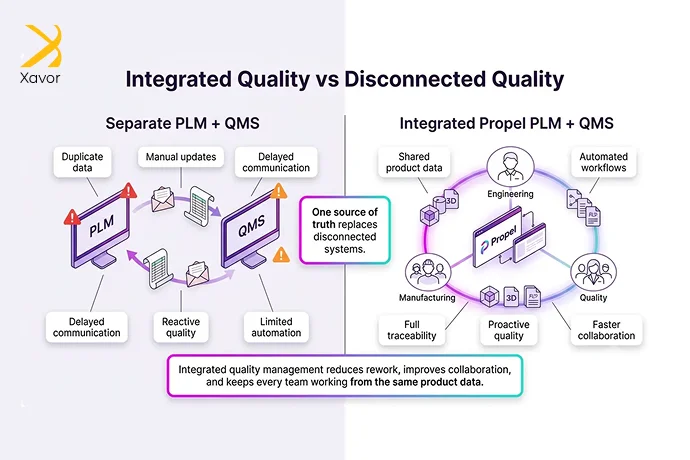
However, PLM software and quality management software are often offered as separate systems. Companies have to buy PLM software from one vendor and a quality control system from another.
Without integrating quality information into product data, organizations cannot fully understand product performance or make informed decisions.
1. Poor product quality and repeated mistakes
Quality issues don’t remain connected with product data if your PLM and QMS system software are not on the same page.
Engineers may unknowingly reuse defective components or flawed designs in future products because past problems and their resolutions are not easily visible.
2. Inefficient collaboration and communication
When PLM and QMS operate as separate systems, information becomes duplicated and scattered across multiple platforms. Therefore, managers spend extra time searching for documents and reconciling inconsistent data.
3. Inconsistent quality processes
You can’t adapt workflows to their specific business needs if quality processes are managed outside the PLM environment. Different teams may follow inconsistent procedures, which makes quality management harder to standardize and enforce across the organization.
4. Limited automation and scalability
Separate quality management software often makes it hard to automate routine quality tasks and reporting.
That’s why manual work increases, which subsequently decreases efficiency. Moreover, scaling quality operations requires additional effort and time.
Here is a comparison table showing the difference in integrating enterprise quality management software with PLM. It is based on our internal audits and analyses using different PLM platforms with or without QMS over the years.
| Metric | PLM-QMS Integrated | Without integration |
| Overall Equipment Effectiveness (OEE) | High | Moderate |
| Product Compliance | Very High | Moderate |
| Failure Costs | Low | High |
| Quality Prevention | Proactive | Reactive |
How Propel PLM delivers excellent quality products with a native QMS
Propel QMS is a native quality management software that offers all of the key features you expect in the best quality management software.

It traces and resolves product issues and other complaints during the product design phase. Not only that, Propel QMS remains on the watch after production to pinpoint any post-launch issues.
These are the key quality management capabilities that the platform includes:
1. Document management and change control
Propel QMS centralizes all quality-related documents and ensures every revision is tracked and controlled. To start off, you can maintain version history with real-time redline comparisons for easy change reviews.
It also has collaborative editing through Microsoft 365 services and Google Docs integration. We also use Propel’s configurable approval processes to automate document reviews and approval workflows.
Tightly regulated industries like healthcare can use this quality management software for complete audit trails and traceability. Your documents are always ready for inspection and audit in Propel QMS.
2. Training management
Employees need to be trained on the latest procedures as a product advances in its PLM process. Propel’s QMS software ensures that training is automatically assigned whenever controlled documents are updated.
Team managers can use the quality control software to train employees through quizzes. And handle employee assignment with assessment options to monitor their training performance.
Furthermore, once training is complete, you can integrate training data with reporting and analytics to monitor workforce readiness.
3. Quality management modules
There are some core modules that are necessary in quality management software. But most management systems don’t offer all of them in a single integrated platform like Propel. So, clients have to rely on separate quality applications.
Here are the main modules available in Propel QMS:
- Complaints Management records and investigates customer complaints.
- CAPA (Corrective and Preventive Actions) identifies root causes and prevents recurring issues.
- NCMR (Non-Conformance Management Reports) is used to track products or processes that fail to meet specifications.
- Audits are designed to plan and conduct internal or external quality audits with full documentation.
- Deviation Management records and manages departures from approved processes.
- FAI (First Article Inspection) verifies that the first manufactured product meets design requirements.
- Equipment Calibration schedules and tracks the calibration of inspection and manufacturing equipment.
- Supplier Evaluations & SCAR (Supplier Corrective Action Requests) assess supplier performance and manage supplier quality improvements.
Propel PLM is a natural home for quality management
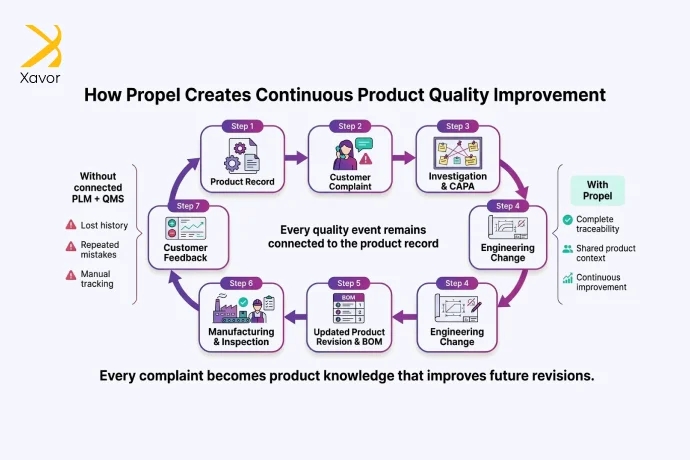
Propel integrates PLM and QMS into a single platform for continuous quality improvement throughout the product lifecycle.
1. Product-centric quality
- Quality events are directly associated with product records, revisions, configurations, and Bills of Materials (BOMs) in Propel. So, engineers can trace defects to specific product versions or suppliers and ensure corrective actions become part of future product revisions rather than repeating historical mistakes.
2. Process-driven quality management
Propel integrates quality processes such as CAPA and non-conformance management into configurable workflows. These workflows enforce standard operating procedures with audit trails and ensure quality activities occur within the engineering process instead of alongside it.
3. Contextual data
While most QMS systems software store quality information in isolated documents or spreadsheets, Propel links them to the corresponding product. This contextual relationship enables better analytics, faster investigations, and more informed decision-making while preserving complete traceability.
Conclusion
Quality management is inherently product-centric and therefore belongs within the PLM environment rather than existing as a standalone system. Many companies use archaic manual methods or standalone QMS software to manage product quality.
These options aren’t effective without integration with PLM when you’re talking about big numbers and multiple systems. And they certainly become a bane when more and more people are involved across the distributed supply chain.
Propel’s quality management software is the modern and by far the better option to understand quality issues in the context of the product itself. It maintains a single product record where everything on the PLM and QMS side of things is linked together.
Partner with Xavor if you also want to make quality management a default part of your PLM processes. We are certified partners of Propel PLM with over 30 years of experience in delivering PLM solutions to Fortune 500 clients.
Drop us a line at [email protected] to talk to our Propel experts and see how we can synchronize quality management with PLM for your organization.

FAQs
Yes, Propel QMS is built natively on the Salesforce platform, allowing quality, product, sales, and service teams to work from the same data without relying on disconnected systems. This also enables organizations to leverage Salesforce security, workflows, and reporting capabilities.
No, Propel QMS is built natively on Salesforce but is available with an OEM-embedded license, meaning organizations don't need to be existing Salesforce customers or purchase separate Salesforce licenses to use it.
Propel QMS includes capabilities to support compliance with regulations and standards such as FDA 21 CFR Part 11, ISO 9001, and ISO 13485 through document control, traceability, audit trails, electronic approvals, and configurable quality workflows.