

Enterprise automation solutions are the coordinated set of tools and workflows an organization uses to run business processes with less manual effort, spanning rules-based automation, workflow orchestration across departments, and AI systems that handle work rules alone cannot describe. We build and integrate these systems at Xavor Corporation in Irvine, California, including through our agentic AI development services.
Sequencing is a scoring problem, and five characteristics decide where a process lands. A high-volume process with few exceptions suits rules, and a process where exceptions outnumber rules needs a system that can interpret them. Three delivery models cover most of this work, and the choice rests on how much of the process already lives inside a system you own.
The characteristics that make a process worth automating are distinct from those that determine which technique to use for it.
What changes after the first wave of enterprise automation
The first ten processes an organization automates are the ones nobody argues about, and the next ten are the ones that cross departments, carry exceptions, and touch systems two teams both claim to own.
Invoice matching, form routing, and report generation clear quickly because a single owner signs off and the rules hold. That success sets an expectation, and the program moves on to a queue where none of those conditions apply.
Three things surface in the second wave. Ownership disputes stall builds when a process spans finance and operations, and no one holds decision-making authority. Exception volumes break a rules-based automation that tested cleanly against a sample. And candidate lists ordered by which department escalated most produce a program with no compounding return.
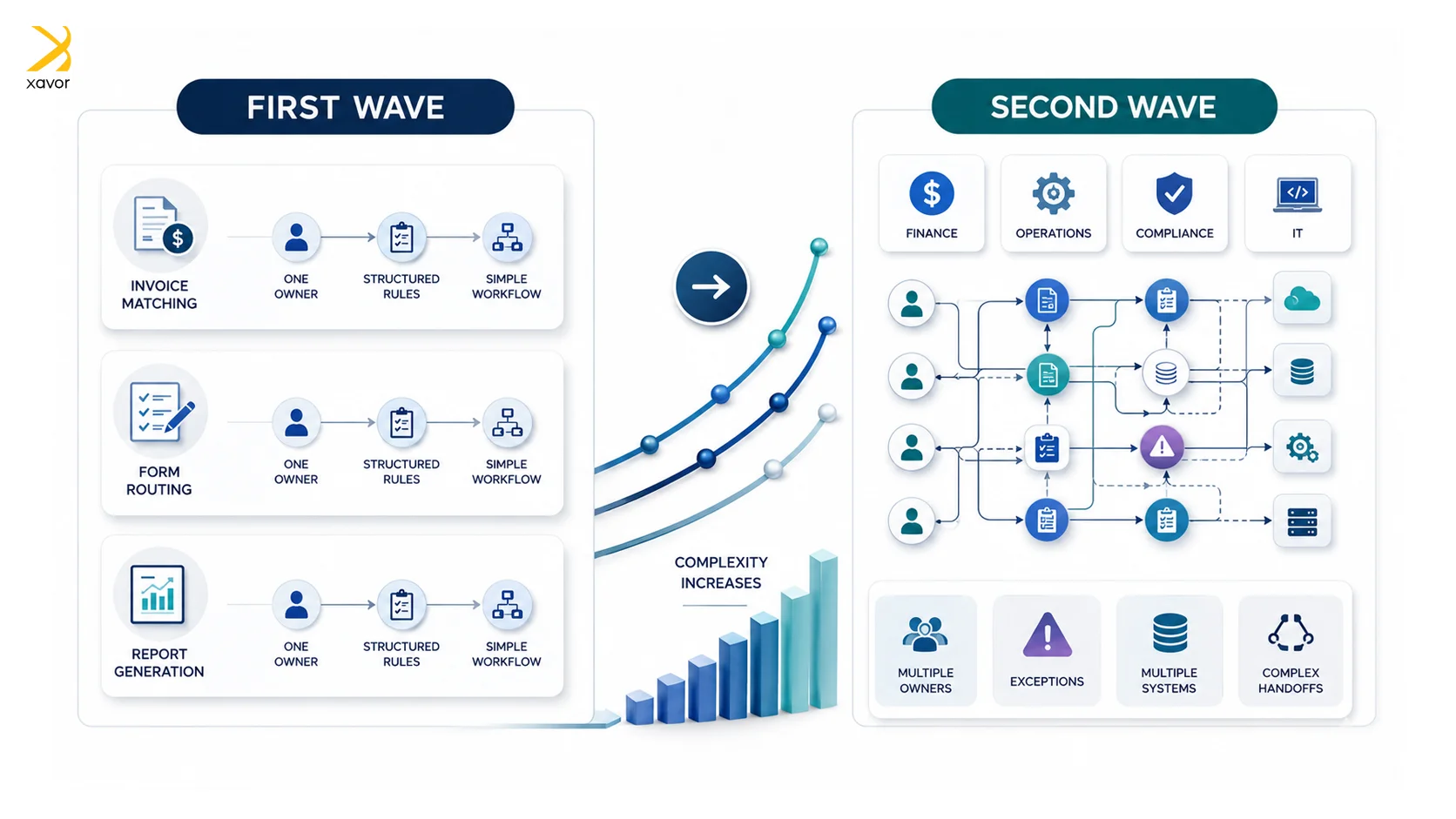
A second wave stalls for reasons the first wave never surfaced, because the easy processes were, by definition, taken first.
Enterprise automation systems handle the mechanics. The ordering problem sits with the operations leader who owns the queue.
How to sequence what gets automated next
Sequencing is a scoring problem, and five characteristics decide where a process lands: volume, variation, handoffs, data readiness, and consequence. Score each candidate against all five before choosing a technique, and roughly half the queue orders itself.
- Volume: how often the process runs, because frequency compounds every improvement.
- Variation: how many exceptions it carries, because exceptions decide the technique.
- Handoffs: how many teams touch it, because handoffs are where time disappears.
- Data readiness: inputs that arrive structured and reachable.
- Consequence: what breaks downstream when the process goes wrong.
| Criterion | Score high when | What it tells you |
| Volume | Runs daily or hourly | Where return compounds |
| Variation | Few exceptions | Which technique fits |
| Handoffs | Crosses three or more teams | Where time disappears |
| Data readiness | Inputs already structured | How long the build takes |
| Consequence | Failure shows downstream | How much oversight to design |
Volume and handoffs size the prize. Variation and data readiness size the build. Consequence sets how much human review the design carries.
An enterprise automation strategy built on this scoring survives a change of sponsor, because the ordering rests on process characteristics rather than on who requested what.
Sequencing by which department asks loudest produces a program that automates the noisiest processes rather than the ones where the return compounds.
Matching the technique to the process
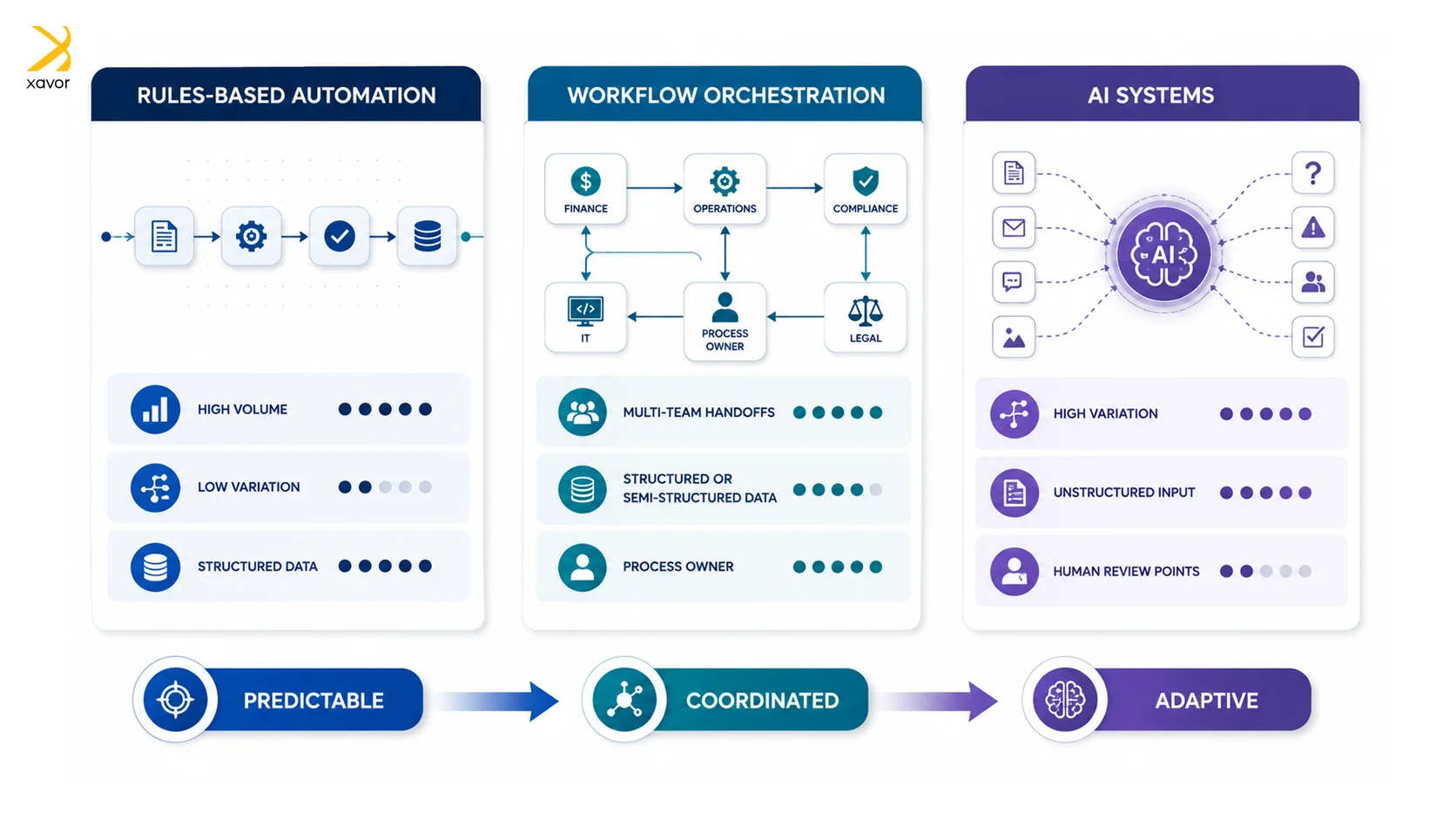
A high-volume process with few exceptions suits rules; a process crossing several teams suits workflow orchestration; and a process where exceptions outnumber the rules needs a system that can interpret them. The score from the previous section points to one of the three.
- Rules-based automation: robotic process automation (RPA) executes repeatable steps against structured data at high volume.
- Workflow orchestration: business process automation (BPA) routes work, approvals, and status across teams and systems.
- AI systems: intelligent automation and agentic AI interpret unstructured input and handle cases with no anticipated rules.
| Rules-based | Workflow orchestration | AI systems | |
| Suits | High volume, low variation | Multi-team handoffs | Exceptions outnumber rules |
| Input | Structured data | Structured or semi | Unstructured input |
| Breaks when | The format changes | Ownership is unclear | Training data is thin |
| Oversight | Exception queue | Process owner | Human review points |
Published guidance says to match tools to tasks and to stop before supplying the criteria that determine the boundary.
Enterprise automation tools cluster by category rather than by vendor, and platforms like UiPath, Microsoft Power Automate, and ServiceNow each have strengths across multiple categories. We cover the platforms and integration patterns behind AI automation separately. Platform selection and configuration are covered there; this section decides which technique the process needs first.
Once the technique is agents, the next question is which type, and we set that out in how enterprise AI agents work and how to choose an agent type.
Buy a platform, extend what you run, or build
Three delivery models cover most enterprise automation work, and the choice usually rests on how much of the process already lives inside a system the organization owns. Answer that question before comparing licenses.
- Buy a platform: suits organizations that are automating across many disconnected systems and have no dominant system of record.
- Extend an existing system: suits processes where the data, users, and audit trail already sit in one place.
- Build against the process: suits work that no platform models well, usually because the logic is specific to the operation.
Enterprise-level automation programs often default to the first model because it appears to be the widest option. The second is frequently cheaper and faster where the process is already anchored in an ERP, a PLM, or a service management platform.
Extending a system the organization already runs carries a cost advantage that a platform comparison rarely captures, because the integration work is already done.
We built a compliance automation for a medtech manufacturer within their existing Oracle Agile PLM environment rather than alongside it, which put control in the workflow that the Change Analysts already used. The connective work across systems is set out in the integration work that connects automated processes to existing systems.
Two automations, and what each one took
A medtech manufacturer ran a production schema with more than 1,100 tables, each with 60 to 70 columns, and every business question about scrap or yield was queued behind a small team of data analysts. High variation, unstructured questions, and a bottleneck measured in days.
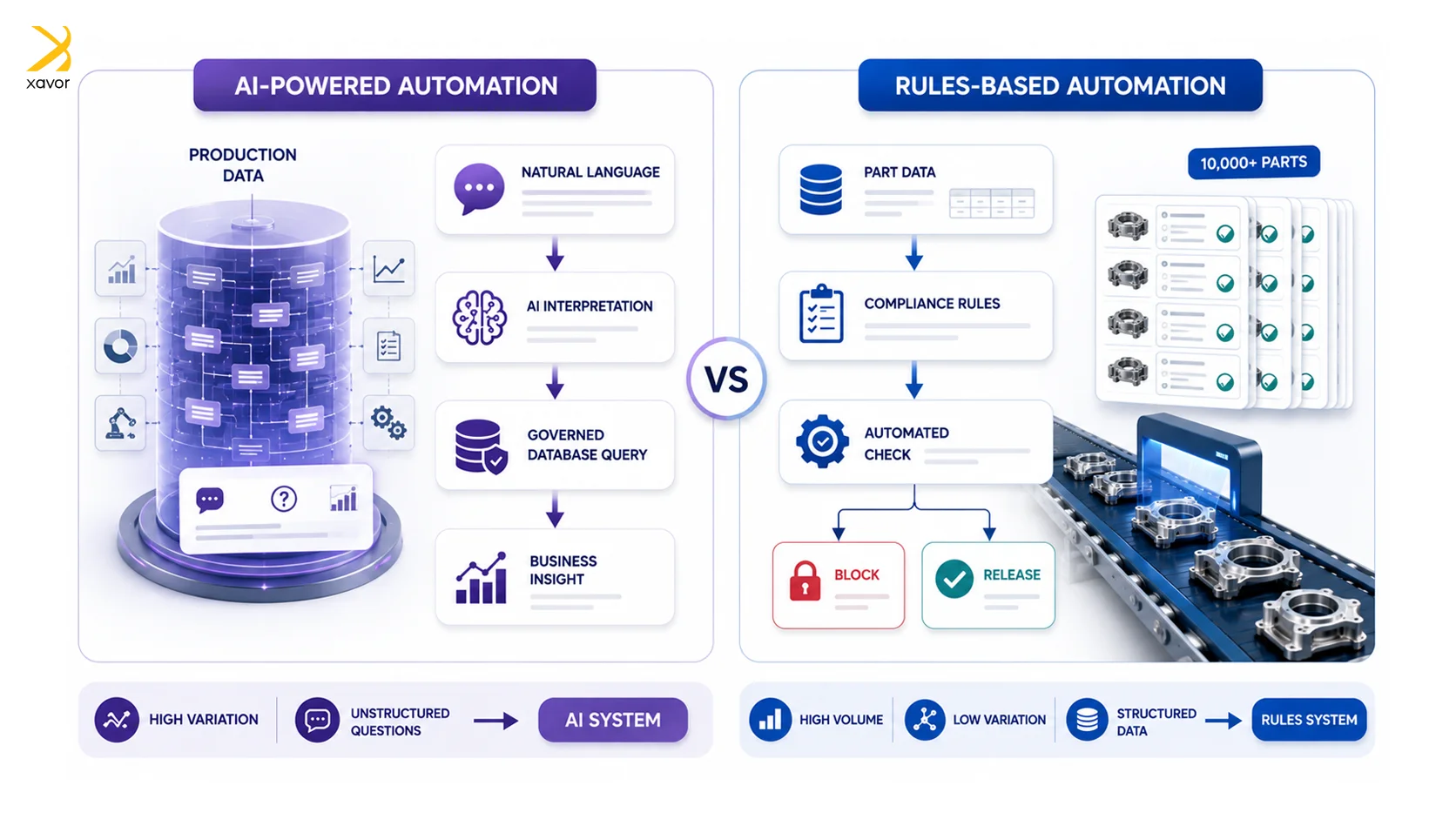
We built a private text-to-SQL agent that translates plain-English questions into governed queries against that schema, with results returned inside Power BI. The technique followed the score: exceptions outnumbered rules, so an AI system fit where a script would have failed.
Query response time dropped from 120 to 150 seconds to 5 to 7 seconds, a 95% reduction, and the analysts moved to work the agent could not do.
The second case scored differently. A medtech manufacturer facing the EU RoHS 3 update needed every part audited for non-compliant materials before a deadline, with Change Analysts screening thousands of parts by hand. High volume, low-variation, structured data, so a rules-based build in Oracle Agile PLM automatically blocked non-compliant parts from release.
The client’s Document Control Manager described it afterward as the automation being set up almost without needing clarification.
Both are documented in full: a private text-to-SQL agent that connects operations leaders to plant data and automates RoHS 3 compliance inside an existing Agile PLM system.
Score the list before you pick the tool
A candidate list scored against volume, variation, handoffs, data readiness, and consequence produces a sequence that survives the second wave.
Ask any enterprise automation services partner two things before scoping: how they rank candidate processes, and who owns the exceptions once the automation runs. The answers distinguish between a build and a program.
Every automation program we join arrives with a list of candidate processes and no agreed way to rank them. If you want yours scored against volume, variation, handoffs, data readiness, and consequence, [email protected] reaches our automation engineers.

FAQs
Published models describe three to five stages, moving from single-task automation through connected workflows to systems that handle exceptions independently. The stage count varies by source. What changes between stages is the extent to which the automation absorbs variation without human input.
Score each candidate on volume, variation, handoffs, data readiness, and consequence. High volume, few handoffs, and structured inputs make the strongest first candidate, because the build is short and the return compounds daily.
Robotic process automation automates repetitive, rule-based steps using software bots. Business process automation streamlines workflows spanning multiple teams. Intelligent automation adds AI to interpret unstructured input and make decisions rules cannot describe.