

Cloud application modernization is the process of changing an existing application’s architecture, code, or infrastructure so it runs effectively on cloud infrastructure, usually by moving from a monolithic design to containers, microservices, or managed cloud services. We do this work at Xavor Corporation in Irvine, California through our cloud application development and modernization services. Cloud migration changes where an application runs, and cloud modernization changes how it is built.
Most portfolios contain more applications than capacity, which makes selection the first decision rather than an approach. Every source describes the four modernization approaches, and almost none supplies criteria for picking one. No published benchmark exists for duration, so any estimate is built from scope, coupling, and how much data moves.
The approach is chosen per application, not per portfolio, because coupling and change frequency differ across an estate.
Cloud migration vs cloud modernization: What actually changes
Cloud migration changes where an application runs, and cloud modernization changes how it is built, which is why a migration can finish in weeks and leave the application exactly as constrained as it was. Rehosting relocates the workload. Refactoring changes what the workload can do.
| Cloud migration | Cloud modernization | |
| Main goal | Exit the data center fast | Long-term speed and scale |
| How it works | Rehosts with few code changes | Refactors, containerizes, rebuilds |
| Cost and time | Faster, lower upfront | Longer, higher upfront |
| Risk | Constraints move with you | Complex code changes |
Both are legitimate projects. A regulated firm facing a lease expiry rehosts to Amazon Web Services or Microsoft Azure and buys itself two years, which is a correct decision.
A migration that finishes on time and delivers no change in delivery speed has succeeded as a project and failed as an investment.
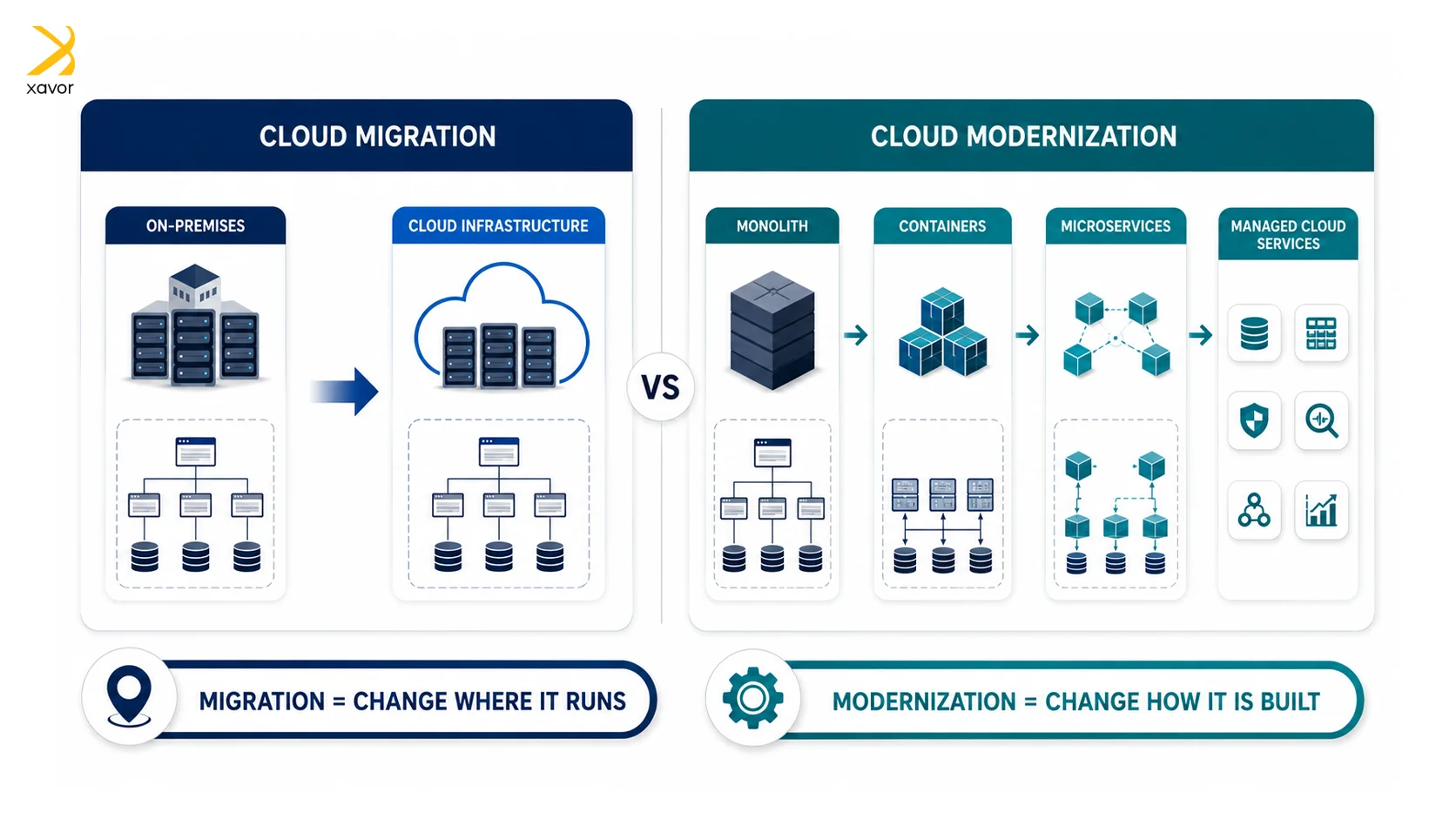
The distinction matters at budget approval because the two are frequently costed as a single line item and then scoped as the cheaper of the two. We cover the basics of application modernization and the types it covers separately. This piece assumes those basics and looks at how the decisions get made.
Which applications actually earn modernization
Most portfolios contain 40 or more applications and engineering capacity for 3 or 4 modernization efforts a year, which makes selection the first decision rather than an approach. Scoring the estate before choosing a technique is what separates a program from a series of projects.
Four factors decide which applications qualify:
- Change frequency: applications that change weekly return the investment; applications that change yearly rarely do.
- Coupling: tight dependencies on systems outside the scope cap what any approach can achieve.
- Business criticality: high-criticality systems constrain how much downtime the work can absorb.
- Data gravity: the database usually sets the ceiling on what is possible.
Change frequency does most of the work. An application your teams touch every sprint compounds the benefit of every architectural improvement. One that runs untouched for months compounds nothing.
An application that rarely changes and works correctly is a candidate for retention rather than refactoring.
Score the estate on those four factors first, and the approach question answers itself for roughly half the portfolio.
How to choose between rehost, replatform, refactor, and rebuild
Every source describes the four modernization approaches, and almost none provides criteria for choosing one, so the choice usually gets made by whichever consultant is in the room. The approaches are well documented. The selection logic is not.
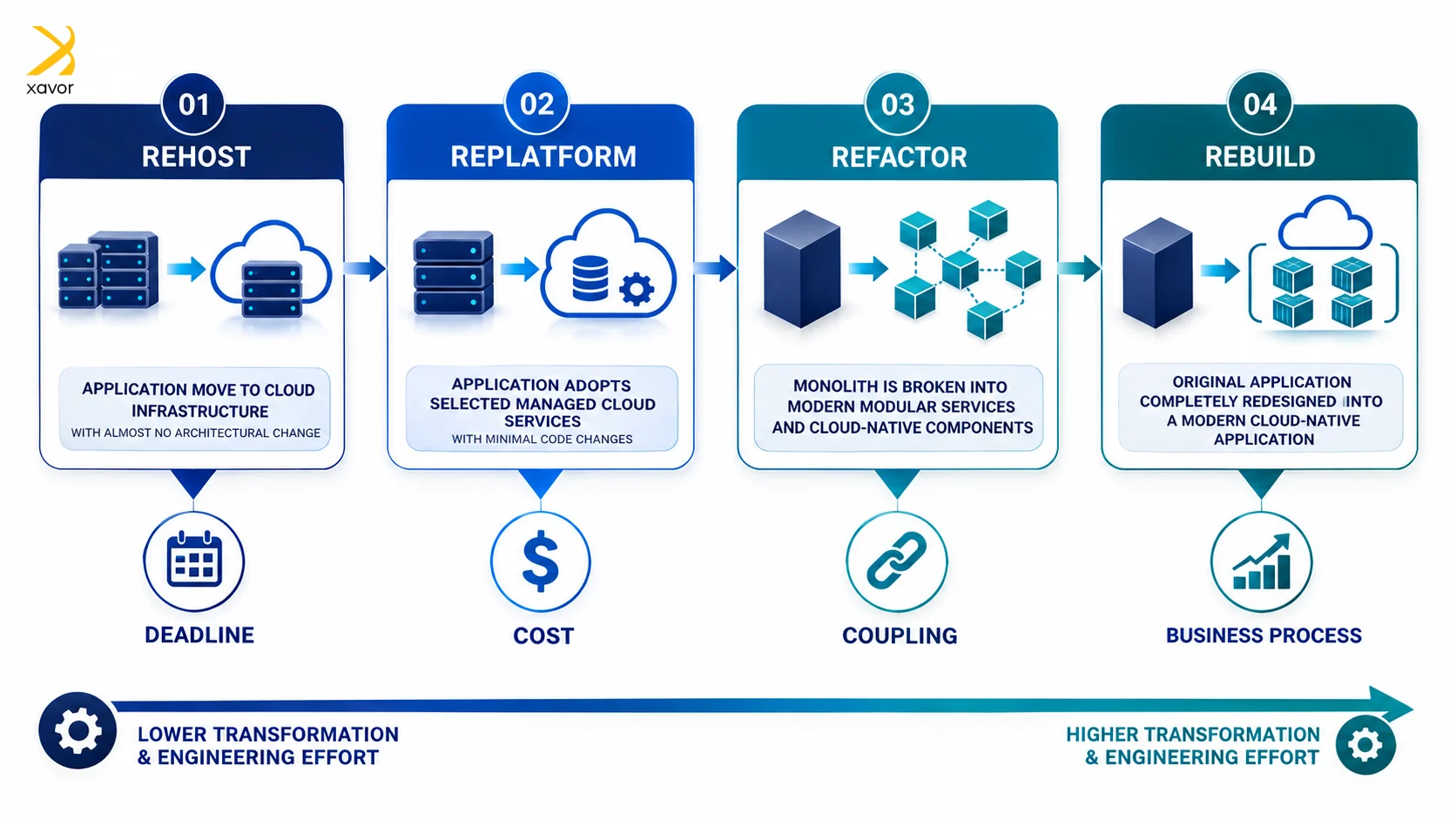
| Rehost | Replatform | Refactor | Rebuild | |
| Choose when | Deadline drives it | Cost drives it | Coupling blocks change | Domain has moved on |
| Code change | None | Minimal | Substantial | Total |
| Cloud benefit | Infrastructure only | Some managed services | Full cloud-native | Full cloud-native |
| Risk carried | Cost stays high | Partial gain | Delivery risk | Requirements risk |
Application replatforming suits systems where the runtime or database is the constraint and the code is sound. Application refactoring suits systems where coupling itself is the constraint, which is where containerizing with Docker and orchestrating with Kubernetes start to pay off.
Rebuild is the honest answer when the business process the application encodes no longer matches how the company operates. Modernizing an accurate implementation of an obsolete process produces a faster version of the wrong thing.
Choosing a single approach for the entire portfolio is the most expensive decision in modernization because it applies the same cost to applications with completely different returns.
Each approach is defined in the six Rs of cloud migration explained in full; this section covers which one fits which application. Our microservices and legacy migration services run discovery and assessment before architecture design for exactly this reason.
Decomposing a monolith: what the work looked like
A logistics provider running a single tightly coupled codebase found that vehicle tracking, route calculation, and maintenance scheduling all slowed down together whenever any one of them came under load. Adding a feature to one meant having to regression-test all of them.
We decomposed the system by business domain rather than by technical layer. Route optimization, fleet and driver management, vehicle tracking, and maintenance scheduling each became an independent service.
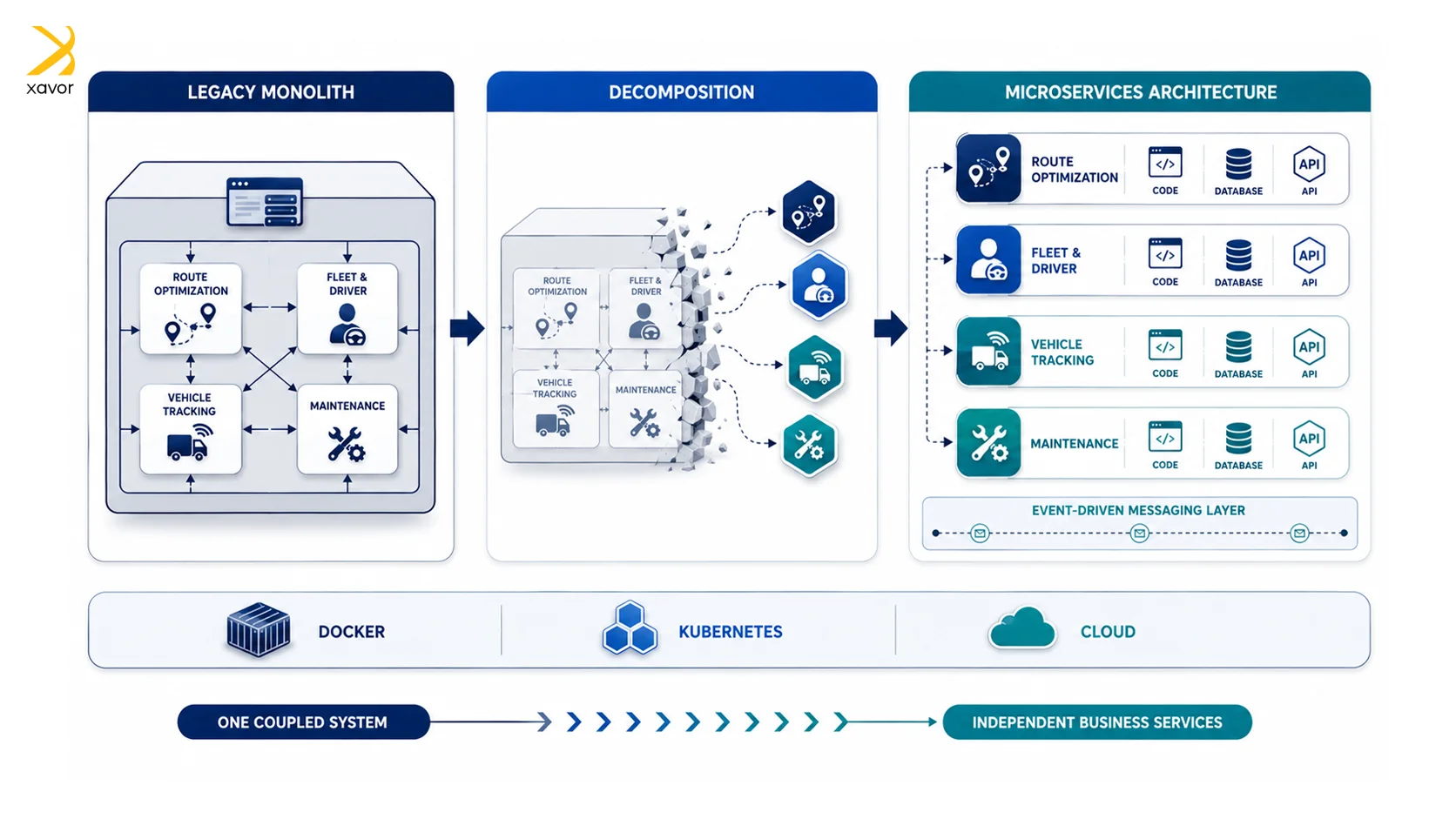
Each service owned its own database, codebase, and API, which is what allowed four teams to deploy without coordinating with each other.
Apache Kafka carried events between services, so a driver check-in updated tracking, routing, and management without point-to-point integrations between them. Node.js handled the backend services, with PostgreSQL for transactional data, MongoDB for documents, and Redis for caching. Docker and Kubernetes ran the containers across Amazon Web Services.
The platform now carries three times the previous traffic with no performance degradation, at 99.99% uptime. The full build is documented in “Modernizing Logistics Infrastructure with a Microservices Architecture.”
What cloud application modernization costs and how long it takes
No published benchmark exists for cloud application modernization duration, so any estimate you are given is built from the number of applications in scope, their coupling, and how much of the data layer has to move with them. Ask which of the three an estimate assumed.
Three variables move the number:
- Application count in the first phase: each additional system adds its own assessment, owners, and testing.
- Coupling to systems outside scope: every dependency you cannot change becomes a negotiation.
- Data layer movement: the database migration is usually the longest single task and the one most often underestimated.
For microservices work specifically, we publish indicative ranges on our service pages. Smaller projects start around $25,000 to $50,000, and enterprise microservices programs reach up to $200,000, with the figure driven by system complexity, the number of services, integrations, and infrastructure. Timelines follow the same pattern: individual services can be deployed quickly, while full implementation across an enterprise runs to several months.
Skill gaps in containers and orchestration move budgets more than licensing does, because the work stalls while people learn.
You already moved to the cloud and it did not help
A lift and shift that completed on schedule can still leave release cycles, scaling limits, and maintenance costs exactly where they were, because none of those were properties of the hosting. The bill changed. The architecture did not. Strong IT infrastructure management practices can also help organizations maintain performance, reliability, security, and scalability across modernized cloud environments.
Three failures account for most of it. Hidden dependencies that nobody documented surface only under production load in the new environment. A data layer that never moved leaves the application reaching back to on-premises systems across a slower link.
And over-decomposition, where a monolith gets split into dozens of services before anyone establishes ownership or observability.
Decomposing into too many services creates the coordination problem the monolith was blamed for, in a distributed form that is harder to debug.
Red Hat’s application modernization research names complexity of legacy systems as the top organizational challenge, with the barriers individuals reported most often being security concerns at 56%, integration challenges at 47%, and competing priorities at 44%. The pattern matches what we see: the technical work is rarely the hard part.
Start with the portfolio, not the platform
The decision about what modernization returns to allocate is made before any approach is chosen, and it is a decision about which applications deserve the capacity you have.
Ask a prospective partner two things: how they score an estate before recommending an approach, and whether the people who assess your applications are the people who will modernize them. The answers separate an assessment deliverable from a delivery plan.
Most modernization conversations start with a technology and stall on a portfolio. If you want a second opinion on which of your applications actually justify the work, [email protected] reaches our architects and engineers will review it.

FAQs
Sources list between four and seven, depending on whether retain, retire, and repurchase are counted alongside rehost, replatform, refactor, and rebuild. The count matters less than matching each approach to the right application.
Rehost when a deadline drives the move, replatform when running cost is the constraint and the code is sound, and refactor when the coupling itself blocks change. Score change frequency and coupling per application first.
Migration relocates an application to cloud infrastructure with minimal code change. Modernization changes the architecture so that the application can use cloud-native capabilities. Migration changes location; modernization changes what the application can do.