
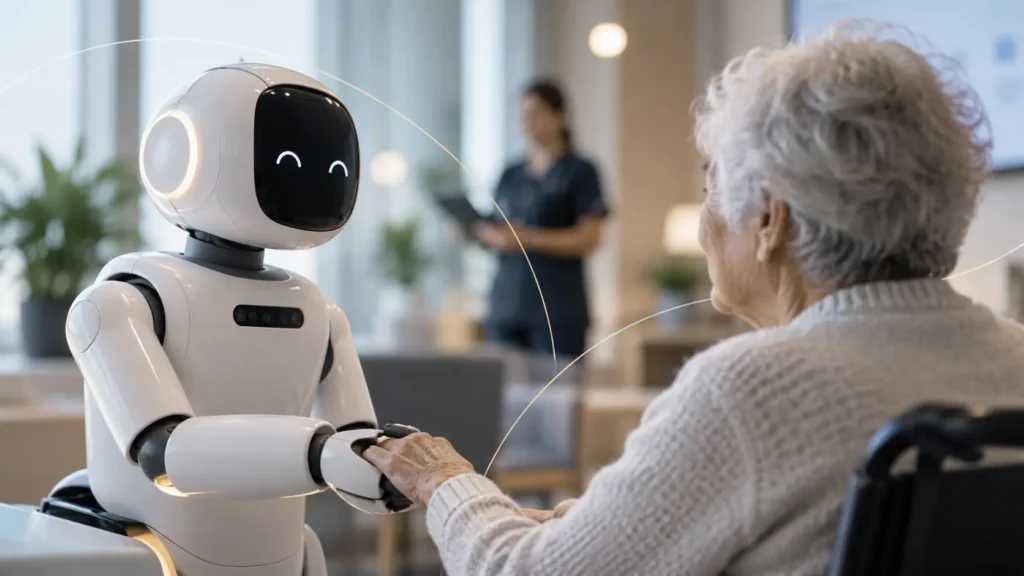
Embodied intelligence is the capacity of a system with a physical or simulated body to perceive its environment, decide, and act within it, closing a continuous loop between perception and action. We build these systems at Xavor Corporation in Irvine, California, through our physical AI engineering services for robotics, and most of what we have learned came after deployment rather than during development. A system that performs in a controlled environment provides three things that the field does not supply. Warehouse fleets split into four robot classes, and the class matters less than whether the fleet reconciles what it sees with what the warehouse management system believes.
A vision system that identifies a defect delivers value only when that finding is recorded in the quality record. Four units of Navi, our companion robot for elderly care, have now run more than 500 operational hours across two customer environments.
An embodied system is judged by what it survives in an uncontrolled environment, not by what it demonstrates in a controlled one.
What changes when an embodied system leaves the lab
A system that performs in a controlled environment meets three things on deployment that a lab does not supply: unpredictable people, degraded sensing conditions, and consequences that cannot be undone.
None of these are model problems. A perception stack that scores well on a benchmark still has to hold up when someone walks through the frame at an angle the training data never captured, or when afternoon glare washes out a depth camera.
The gap between a working demonstration and a working deployment is measured in named engineering constraints, not in model quality.
We assume the definition here rather than restating it, and cover what embodied AI is and how it differs from traditional AI separately. Simulation closes part of the distance, and how world models train systems before they touch the real world explains that layer. Six constraints shaped our own build, and they surfaced in the field rather than in the lab.
How embodied intelligence differs from the AI most people have used
Embodied intelligence takes continuous sensor input and produces physical motion, while generative models take prompts and produce content, which is why a mistake in one costs a bad answer and a mistake in the other costs a physical event.
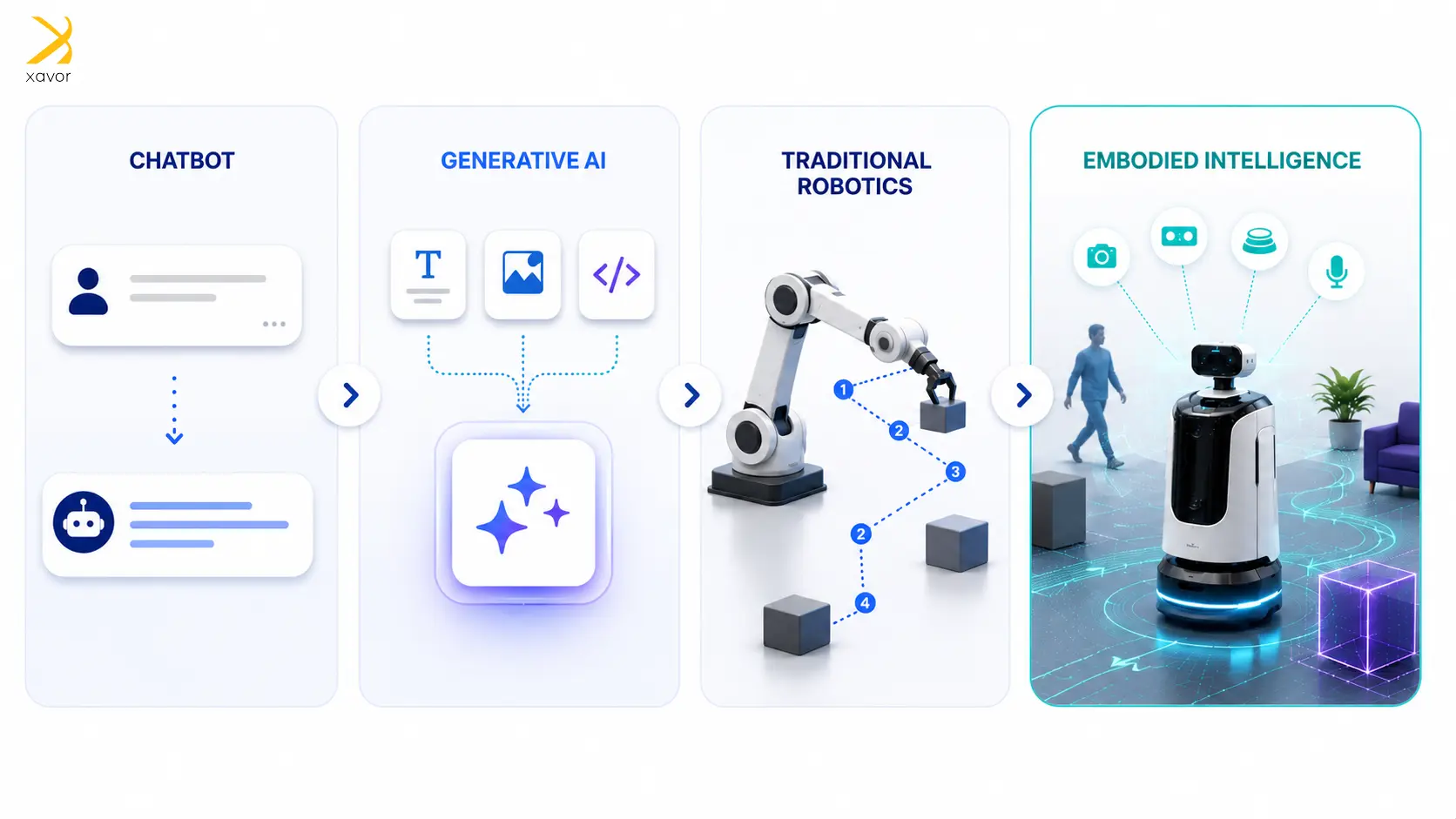
The two increasingly operate together rather than competing.
| Chatbot | Generative AI | Traditional robotics | Embodied intelligence | |
| Input | Text prompt | Text or files | Programmed path | Continuous sensor streams |
| Output | Text response | Words or pixels | Repeated motion | Adaptive physical action |
| Handles variation | No | No | Only if programmed | Yes, by design |
| Cost of an error | Wrong answer | Wrong content | Halted line | Physical event |
| Learns from doing | No | No | No | Yes |
Modern robots increasingly use generative models as the planning layer while the embodied system handles execution, and the strain shows up at the handoff.
A language model can interpret an instruction and select a sequence of actions. It cannot feel a gripper slip. Embodied intelligence sits inside the broader category of physical AI as the subset that acts on its environment, and how physical AI relates to embodied systems covers that boundary in full.
Embodied intelligence in warehouses: Four robot types and one integration problem
Warehouse deployments split into four robot classes, and the class matters less than whether the fleet can reconcile what it sees on the floor with what the warehouse management system believes is there. Choosing hardware is the visible decision. Reconciling state is the one that determines whether throughput improves.
- Autonomous mobile robots: navigate dynamically using LiDAR without fixed floor guides, adapting to people and layout changes.
- Automated guided vehicles: follow preset tracks or wires to move heavy pallets along fixed routes.
- Automated case-handling robots: retrieve totes and cases from high, narrow storage to increase vertical density.
- Robotic arms and manipulators: pick individual items or build and break down pallets using AI vision.
Warehouse automation robots in the first category are where embodied intelligence earns its name. An AGV following a wire executes a route. An AMR reading a changed aisle decides one.
A fleet that navigates perfectly and reports to a system nobody reconciled has automated the walking and left the counting.
The reconciliation problem is an enterprise integration problem wearing robotics clothing. We cover the hardware layer in building autonomous mobile robots on NVIDIA Jetson, though the harder work usually sits above it.
Embodied intelligence on the factory floor: Where MES and PLC integration breaks
A vision system that identifies a defect has produced value only when that finding reaches the quality record, the corrective workflow, and the planning system that decides what happens next. Detection is the demonstrable part. Propagation is where most factory-floor programs stall.
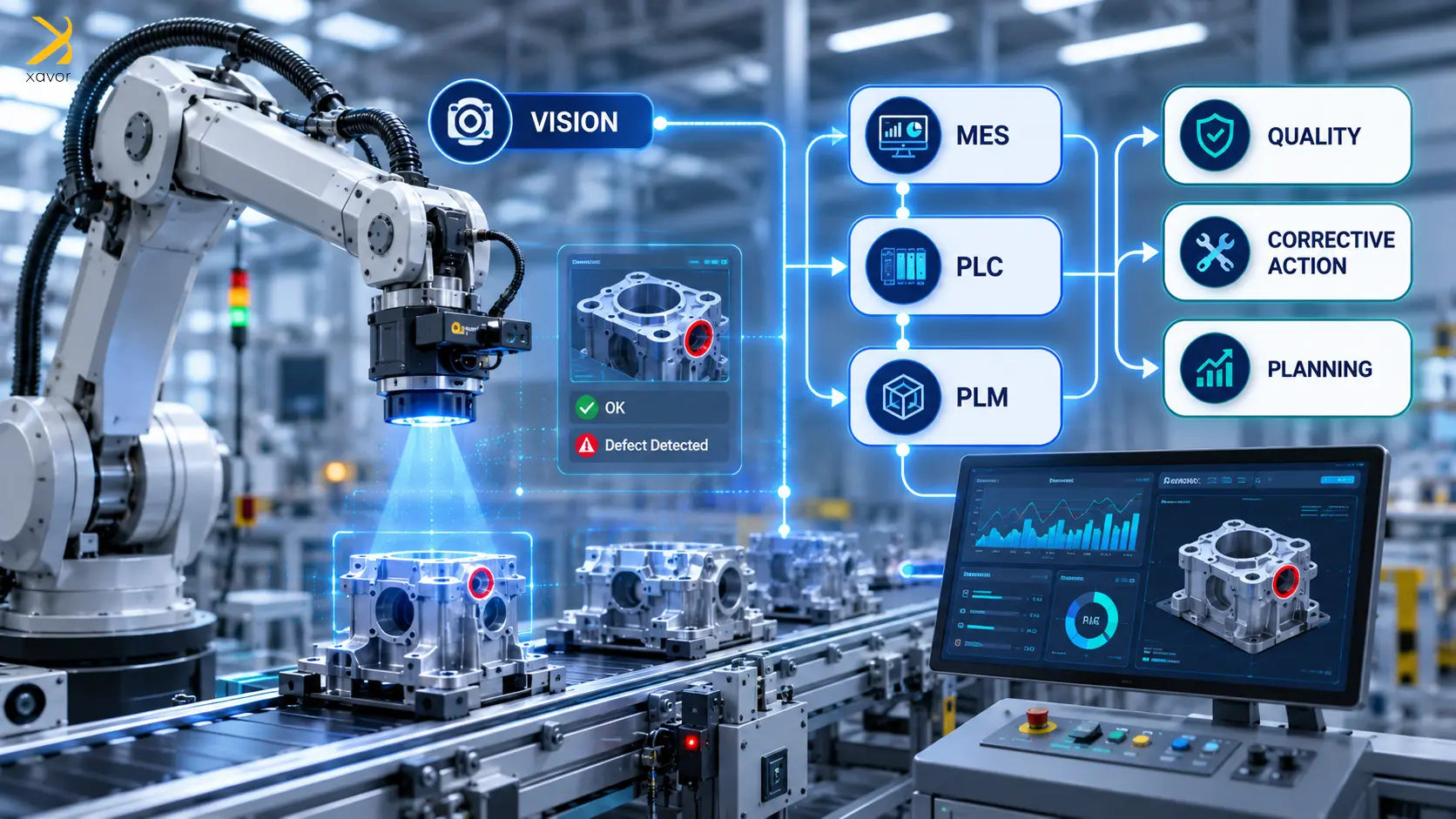
Three applications carry most current deployments:
- Vision-guided robotic cells: cameras and neural networks identify randomly oriented parts or shifting weld seams in real time.
- Tactile quality inspection: cobots and sensors detect micro-defects and surface anomalies that fixed inspection misses.
- High-mix assembly: systems adjust to changing product models without a custom engineering changeover.
Embodied AI in manufacturing rarely fails at perception. It fails when the perception output has nowhere to go, because the MES was never configured to accept it, the PLC logic assumes a fixed sequence, and the PLM record still updates manually.
Most factory-floor AI projects are scoped as robotics problems and fail as integration problems.
Xavor has integrated enterprise systems for 30 years, and that experience shapes how we scope robotics work. The broader case sits in the eight disciplines a physical AI program needs; this section shows one of them inside a single setting.
Embodied intelligence in healthcare: What Navi shows about care delivery
Navi is a companion robot Xavor built for elderly care, and four units have now run more than 500 operational hours across two customer environments, which is where the difference between a demonstration and a deployment becomes measurable. Structured feedback from those hours continues to drive system changes.
Four capabilities carry the deployment:
- Multi-class activity recognition: detects eating, drinking, sitting, standing, walking, transitional movements, agitation states, and falls.
- Gait analysis: measures step length, step width, and cadence to surface physical decline before it produces an incident.
- Autonomous navigation: maps its environment during setup using LiDAR and a 3D camera, then navigates and docks without staff involvement.
- Long-term memory: maintains a profile per resident so conversations build on shared history rather than resetting.
Navi runs on dual NVIDIA Jetson Orin processors in a distributed on-device architecture, one node dedicated to AI inference and perception, the other to robotics control and navigation. Critical processing stays on the device with no dependency on cloud connectivity.
Navi reduced manual observation time by roughly half, letting one caregiver monitor more than two residents where the previous model required one-to-one attention.
The full build is documented in the engineering behind a high-EQ companion robot for elderly care.
The six constraints that shaped the build
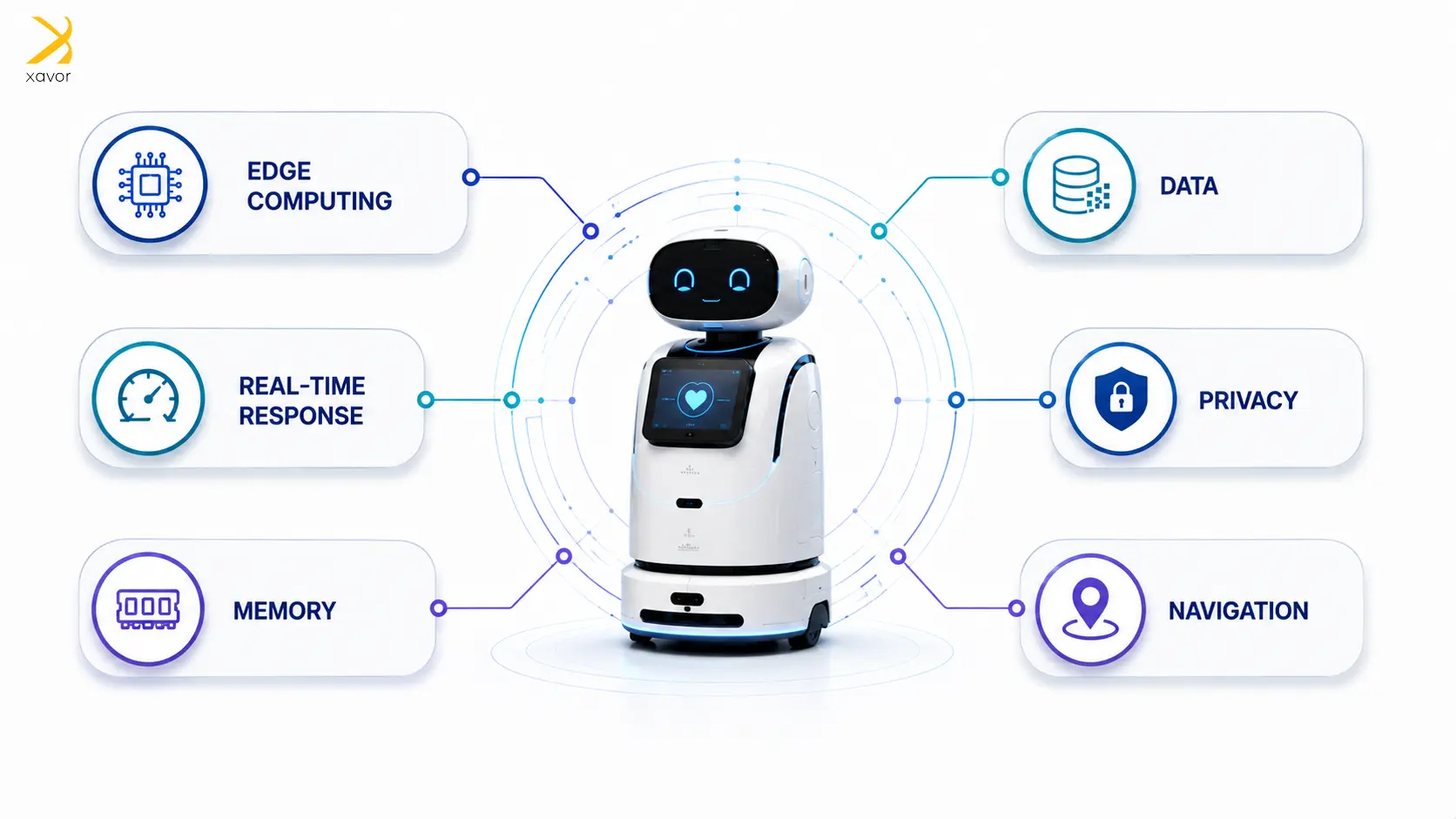
Six constraints shaped Navi’s architecture, and none of them were model-quality problems.
Running computer vision, conversational AI, and autonomous navigation on a single edge device pushed the limits of the Jetson Orin’s ARM64 architecture, where standard libraries often require custom adaptation. Fall detection had to operate with millisecond-level responsiveness, since delay in a care setting carries direct consequences.
Emotional continuity across sessions demanded a memory system that balanced long-term retention against real-time performance. Public datasets for patient activity recognition in clinical settings do not exist under privacy and regulatory restrictions, so the team designed simulated clinical environments and recorded a proprietary dataset from scratch.
Purpose-built living labs still missed navigation edge cases that only appeared with real users, including unpredictable movement patterns that controlled settings never produced.
What continuous monitoring requires before it is allowed in a building
A system that watches continuously makes data retention, consent, and access control engineering requirements rather than compliance steps applied afterward.
Vision and perception models run entirely on the device, so activity recognition, fall detection, and gait analysis never leave it. Response generation is configurable, letting an operator select a fully on-device model for privacy-sensitive deployments or a cloud-hosted one where that is acceptable.
Video, audio, and conversation logs store locally and expire after seven days by default, with organizations able to connect their own storage for permanent retention. Consent runs through IRB-approved protocols with written authorization from participants or their legally authorized representatives before any collection begins.
Role-based permissions limit caregivers to their assigned residents, and access events land in immutable audit logs aligned with HIPAA accountability requirements.
Consent, retention, and access were designed into Navi’s architecture rather than documented around it.
The systems worth watching are the ones already running
The useful signal in embodied intelligence right now is not capability demonstrations; it is hours logged in buildings where the environment does not cooperate.
Demonstrations show what a system can do once. Deployments show what it does on a Tuesday afternoon when the lighting changed, a resident moved unexpectedly, and nobody was watching the dashboard.
We keep publishing what we learn from systems that run in real buildings rather than demos. If you are working on something similar and want to compare notes, our physical AI team reads everything that lands at [email protected].

FAQs
Navi, a companion robot Xavor built for elderly care, is one. Four units run in two customer environments, detecting falls, analyzing gait, and navigating autonomously. More than 500 operational hours have informed changes to the system.
Four classes dominate: autonomous mobile robots that navigate dynamically with LiDAR, automated guided vehicles that follow fixed tracks, automated case-handling robots that retrieve totes from high storage, and robotic arms that pick or palletize items.
Embodied systems already operate in warehouses, factories, and care settings today. The open question is scale rather than viability, and the constraints slowing it are integration, safety validation, and cost rather than model capability.