

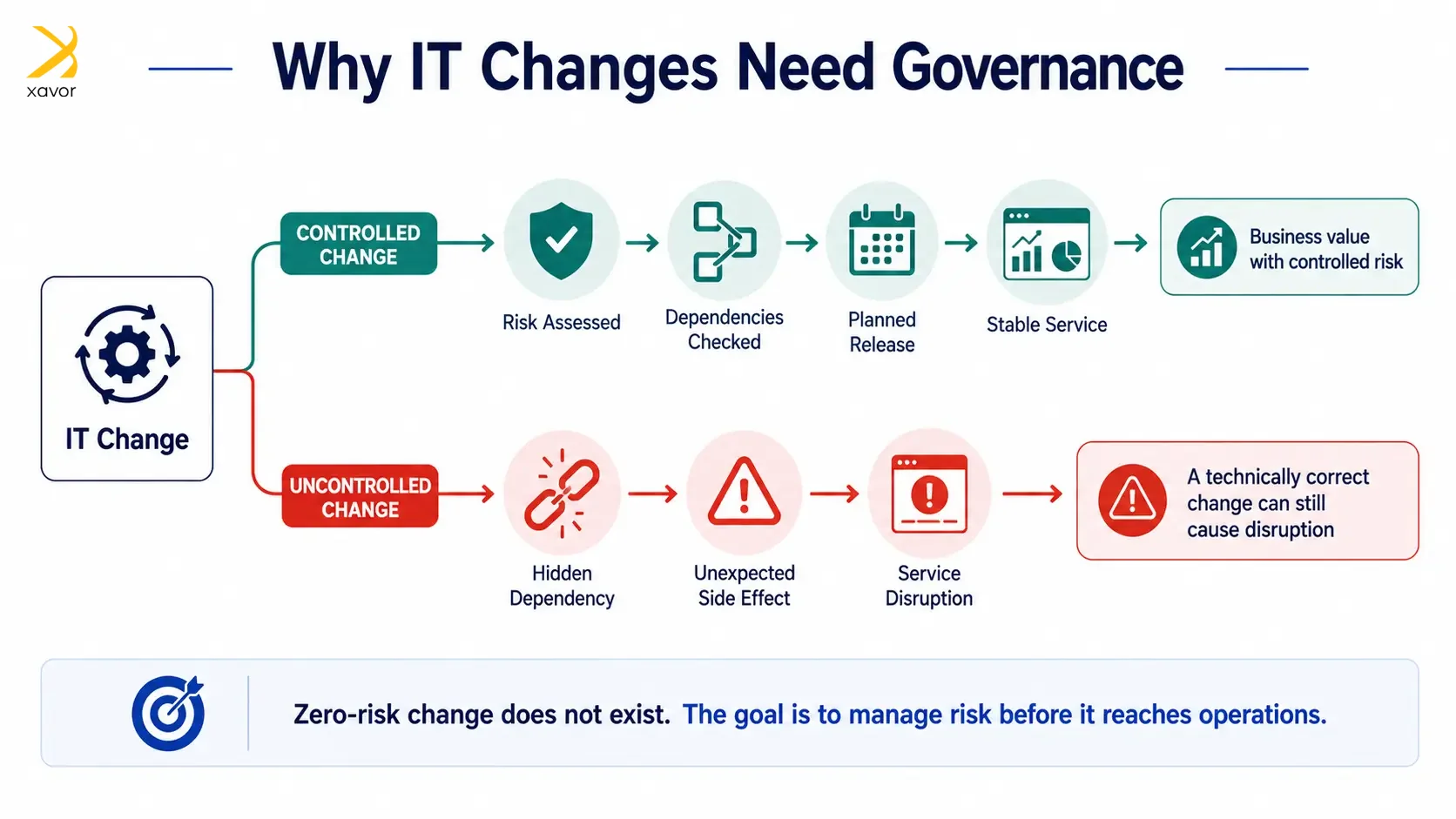
IT departments in every company are always striving to provide their customers and employees the finest services. But that necessarily requires change in the status quo. And zero-risk changes don’t exist in IT services.
Introducing an update can backfire and cause serious disruption in business operations. Sometimes an update or patch is implemented 100% as expected, but it has unexpected repercussions that no one had in mind.
IT service management (ITSM) professionals in the 1980s came up with ITIL Change Management to mitigate these risks. It is a standardized framework used by IT managed service companies that guides how to safely and accurately implement changes within an IT ecosystem of an organization.
If you want to now more about the ITIL process for Change Management, keep reading this piece.
What is ITIL?
ITIL stands for Information Technology Infrastructure Library. It’s a framework of best practices for ITSM. The ITIL process was first created under the UK government in the 1980s. And since then, its ownership and management have changed hands several times.
At its core, ITIL provides organizations with a structured way to manage technology services around business needs. This makes it useful for improving IT service delivery, especially when teams need to introduce frequent changes without compromising service quality or operational stability.
Right now, PeopleCert owns and operates ITIL. It owns the intellectual property rights to the framework and awards official ITIL certifications.
ITIL releases new versions of the framework when there are significant changes in the IT sector. ITIL 4 is the latest version released in 2019. ITIL 5 is also currently in the rollout phase and it’s centered around AI-native workflows according to PeopleCert.
| Version | Release year | Issuing authority | Focus |
| ITIL 1 | 1989 | UK government (CCTA) | Establishing best practices for managing IT operations and infrastructure |
| ITIL 2 | 2000–2001 | UK government (OGC) | Process-based ITSM, especially Service Support and Service Delivery |
| ITIL 3 | 2007 | UK government (OGC) | Shifting IT management from isolated technical tasks into a complete, business-driven service lifecycle |
| ITIL 2011 (update to ITIL 3) | 2011 | UK government (OGC) | Fixing bugs and improving ITIL 3 after feedback |
| ITIL 4 | 2019 | AXELOS | Addressed modern IT needs, like Agile, DevOps, cloud, and automation |
| ITIL 5 | 2026 | PeopleCert | Managing integrated digital products and services in fast-changing, AI-enabled environments |
ITIL Change Management definition
Change Management is a practice within ITIL. A very succinct way to put ITIL Change Management is to say:
“It is the process of maximizing the number of successful IT service and product changes while ensuring minimal disruption to business operations.”
Defining it through this contrast captures its essence and sticks in the memory. But more importantly, notice how this definition evinces ITIL’s emphasis on enabling change rather than restricting it.
That brings us to change enablement, which we will talk about after discussing the types of change management.
Types of change management
A change in IT services is the addition, removal, or modification of anything that can affect normal operations. ITIL further classifies changes in IT services into three categories.
| Type of Change | Characteristics | Example |
| Standard change | Low risk Pre-defined process Pre-approved | Installing approved software package |
| Normal change | Risk needs assessment Requires planning Requires approval | Production database upgrade |
| Emergency change | High risk Requires fixing an incident | Security flaw in production |
What is change enablement?
Change enablement is the new name for change management introduced with ITIL 4. However, the name change also signaled a paradigm shift in traditional change management.
Change management gives the impression that the purpose of the framework is to “control” changes in IT services. The word control has certain negative connotations in a business context. It implies stifling innovation and discouraging new things.
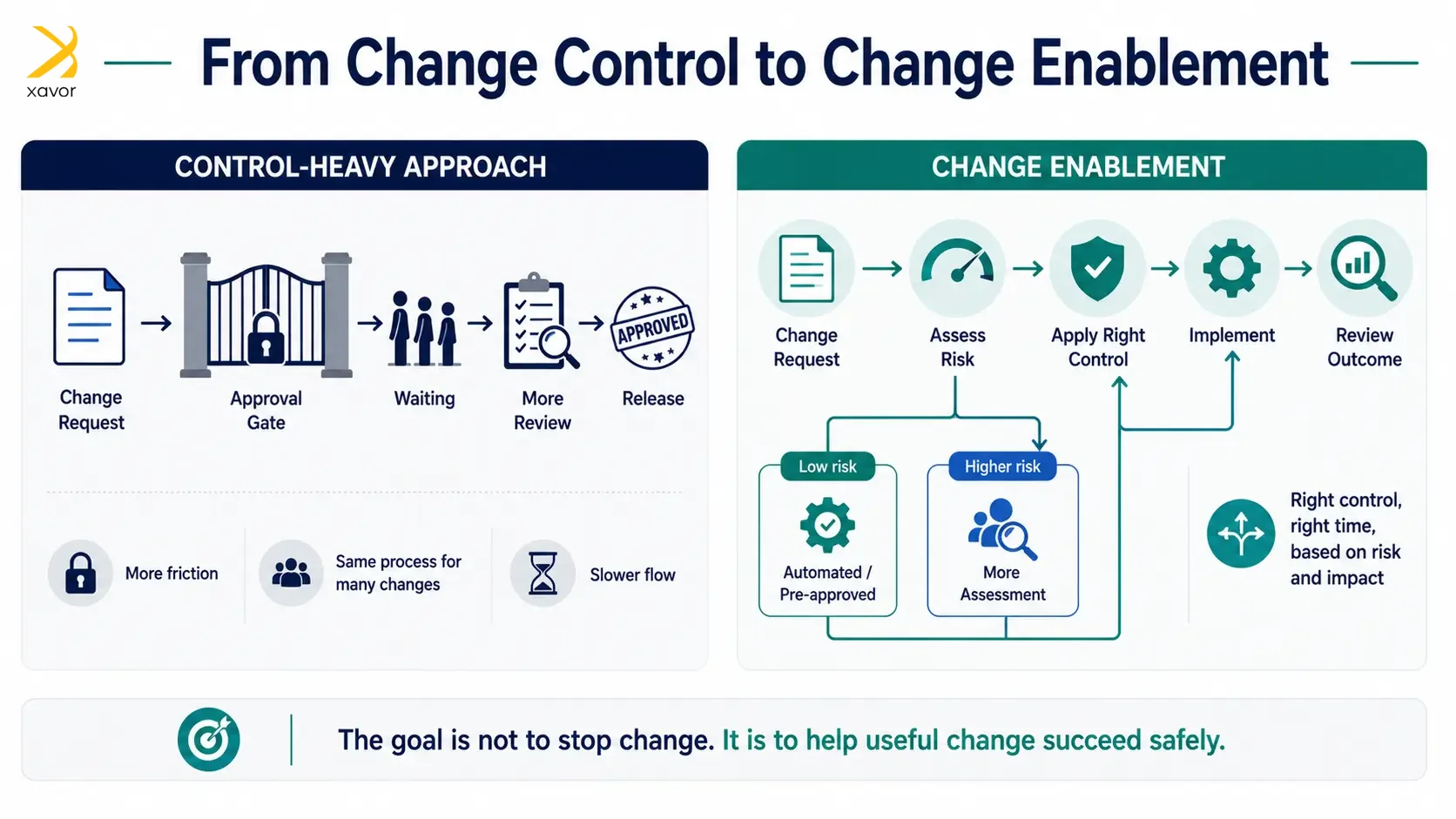
So, AXELOS, then owner of ITIL, changed the name to ITIL Change Enablement. It is a more fitting description for the framework because ITIL’s purpose is to encourage and ensure the success of IT service changes. It prevents uncontrolled changes that are dangerous.
However, ITIL Change Management is still used colloquially. So, we will be using both terms interchangeably in the rest of the article.
Key features of Change Enablement in ITIL 4
The fourth iteration of the ITIL process emphasized some factors more than ITIL 3. Conversely, some factors were also de-emphasized as they were no longer serving their purpose in a modern ITSM environment.
1. Sorting changes based on complexity
ITIL 4 clearly defines that not all changes should go through the rigmarole of IT bureaucracy. A routine security patch doesn’t need the same approval process as a major production architecture change.
Change management models are more than enough to handle low-risk, repeatable changes in an organization.
2. Limiting the role of CAB
Change Advisory Board (CAB) is a committee of stakeholders that evaluates and approves changes to IT services. CAB was frequently convened under ITIL Change Management V3.
However, CAB was becoming an impasse for routine changes. There is no need to wait for a monthly CAB meeting for every IT service change.
ITIL 4 introduces the concept of Change Authority to move away from CAB for every single change request. It is the appropriate person or automated tool assigned to authorize a given type of change.
3. Encouraging automation
Change Management in ITIL 4 calls for reducing manual workflows and frequent use of Microsoft Word and Excel for ITSM tasks. Wherever it is possible to automate routine changes, ITIL 4 recommends doing so.
Modern ITSM tools like ServiceNow are designed according to ITIL 4 practices and guidelines to reduce unnecessary manual work
4. Accommodating Agile and DevOps
Change Enablement practices are designed around Agile and DevOps to release small software updates frequently. The purpose is to use CI/CD pipelines to make change management faster and more flexible.
5. Focusing on user perspective
The customer and the user are equally important as the change itself in ITIL 4 Change Enablement. Even a successful change can become a nuisance for the user.
So, user perspective must be part of the change process from the outset. That requires effective communication and a change calendar to keep users updated about everything.
The ITIL Change Management process simplified
As per PeopleCert’s official certification, ITIL Change Management has two main processes:
- Change lifecycle management
- Change optimization
1. Change lifecycle management
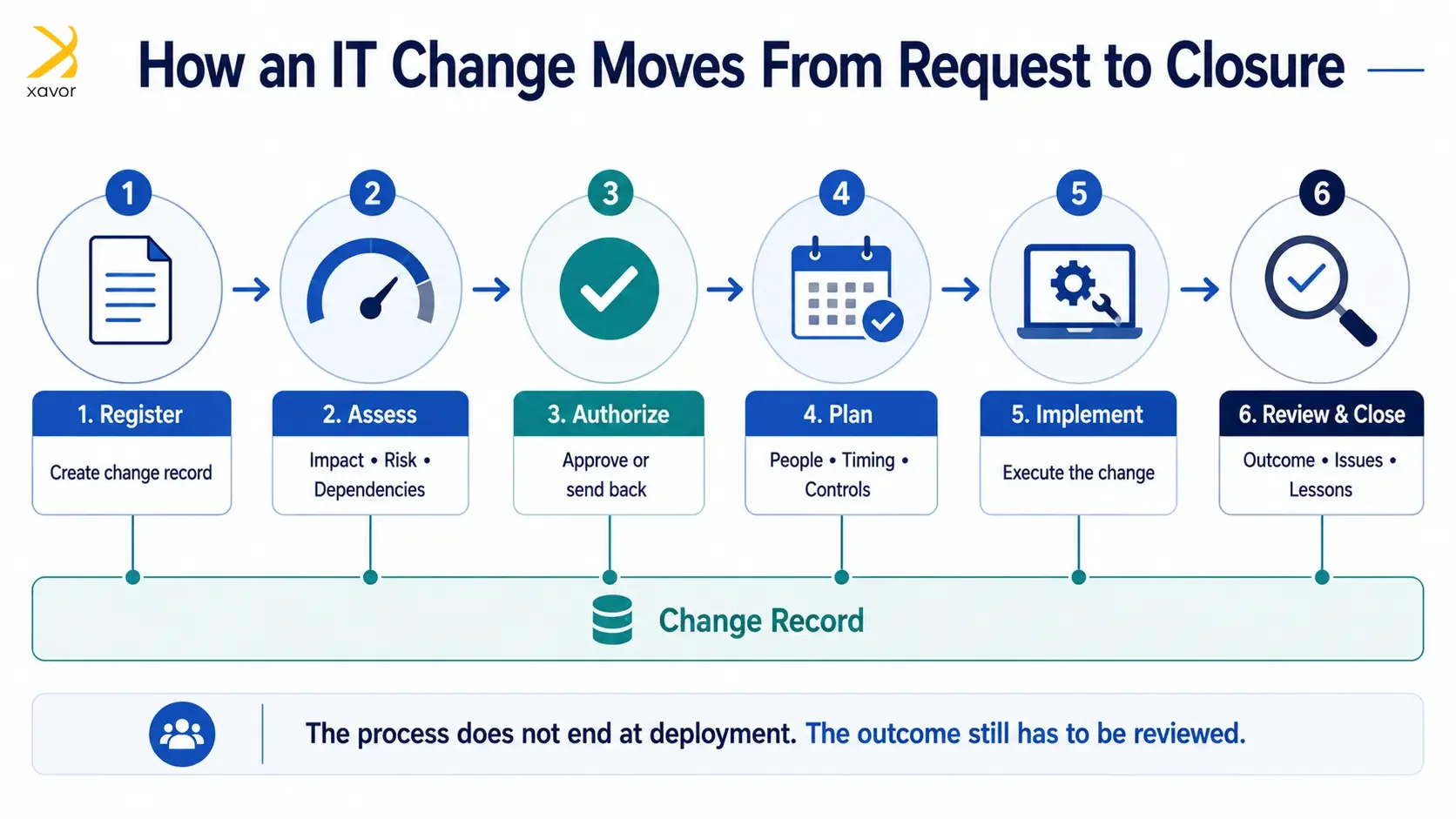
Here, you need to handle an individual change from start to finish. The proper sequence of change lifecycle management has the following steps.
1. Change registration
First off, a change record is created for the received change request. The record includes the initiator of the change, the reason behind it, and the affected services. All of that is written down in a formal request for change (RFC) document.
2. Change assessment
The change request is then assessed for any accompanying risks. Subject matter experts (SMEs) are usually engaged in this step to gauge every possible outcome. The assessment report is then added to the change record.
3. Change authorization
The designated Change Authority decides whether the proposed change is approved or not. They can send the request for further risk assessment if they need more information to make a decision.
However, standard changes don’t need authorization because they are pre-approved.
4. Change planning
Authorized changes are implemented through a plan. The required people and timing of the change are set accordingly. The formality of the plan depends on the change management model.
5. Change realization control
Finally, the actual change specialists perform the change in IT services. The technical people are in the driving seat in this step. Developers and engineers implement the change as per the agreed controls.
6. Change review and closure
ITIL Change Management process reviews every change after implementation. The focus is to see whether expected outcomes were achieved or not. Unexpected issues or side-effects are also part of the review.
The complete review is added to the change record, and the change request is closed.
2. Change optimization
ITIL Change Management isn’t just about managing individual changes. Change Enablement in ITIL 4 makes it explicitly clear that the system must be continuously improved.
1. Change review analysis
The review of previous changes is carefully analyzed to find areas of improvement. For example, analysis can show that some database patches have a high success rate without many approvals. So, you can change its status to a standard change.
2. Change management model improvement
Companies and ITSM professionals have created several change management models based on real-life use cases. These are free, open-source sets of guides and principles you can follow for your ITIL Change Management process.
Sometimes analysis can show you that another model may be more suited to execute a certain change.
For example, Lewin’s Change Management model is very useful if an IT service change will have an impact on employee behavior and working style.
Xavor aligns ITIL Change Management with your business goals
Change is not easy. We know that sounds like a platitude, but it really is hard. Even if you follow the ITIL Change Management process to a T, you can still miss your business objectives.
Xavor ensures that doesn’t happen. We begin ITIL Change Management with business outcomes. Technology comes later. That makes Change Enablement meaningful.
Then we take that business outcome all along the way at every step. It becomes the linchpin of the entire ITIL process.
Remember that not every successful deployment is a successful change. And not every successful change is a successful business decision.
Contact us at [email protected] if you want to want success in all three domains.

FAQs
ITIL is a set of best practices that helps organizations manage IT services in a structured and reliable way. Its goal is to improve service quality while aligning technology with business needs.
The classic five-stage ITIL service lifecycle comes from ITIL v3: Service Strategy, Service Design, Service Transition, Service Operation, and Continual Service Improvement. ITIL 4 moved away from this lifecycle model toward a more flexible service value system.
Yes. ITIL continues to evolve with modern IT practices such as Agile, DevOps, cloud, automation, and AI-enabled services. ITIL 5 is also being rolled out in 2026 with greater emphasis on AI-native digital environments.