

CFOs are probably one of the most misunderstood executives in software development. Developers tend to think of them as blockers in the way of innovation; they don’t understand the product, or their function is considered back office. But these are all false perceptions.
Nowadays, managing a software project isn’t solely the responsibility of developers. The financial side of a software is as important as its development. But managing the accounts in agile software development isn’t easy. An agile software development company has to create functional software within time and budget under vague circumstances, which are part and parcel of the approach.
So, how can a CFO keep all parties happy in an agile project? Keep on reading this piece, as we’ll discuss the real things that impact the budget and timelines.
Budgets are killing software projects
The number one stereotype about CFOs is that they are conservative about spending. Like a Grinch-type figure that stops the show for developers to express their creativity and ideas. Well, even if they are, there are good reasons for that.
According to the Chaos Report by the Standish Group, about 70% of software projects end in budget overruns or don’t meet deadlines. And a significant portion of them are abandoned altogether after these failures. Therefore, CFOs must bring a reality check, even if it causes a little bit of business disagreement. They look at spending and risk management from a bird’s-eye view that developers and other C-level executives often don’t.
Why agile is perfect for budgeted development
Custom software development is all about budgeting. You will get a wide range of quotes for building the same project, depending on how you want to go about building it. For example, your choice of development frameworks and processes can change the final price of the product by a few million bucks.
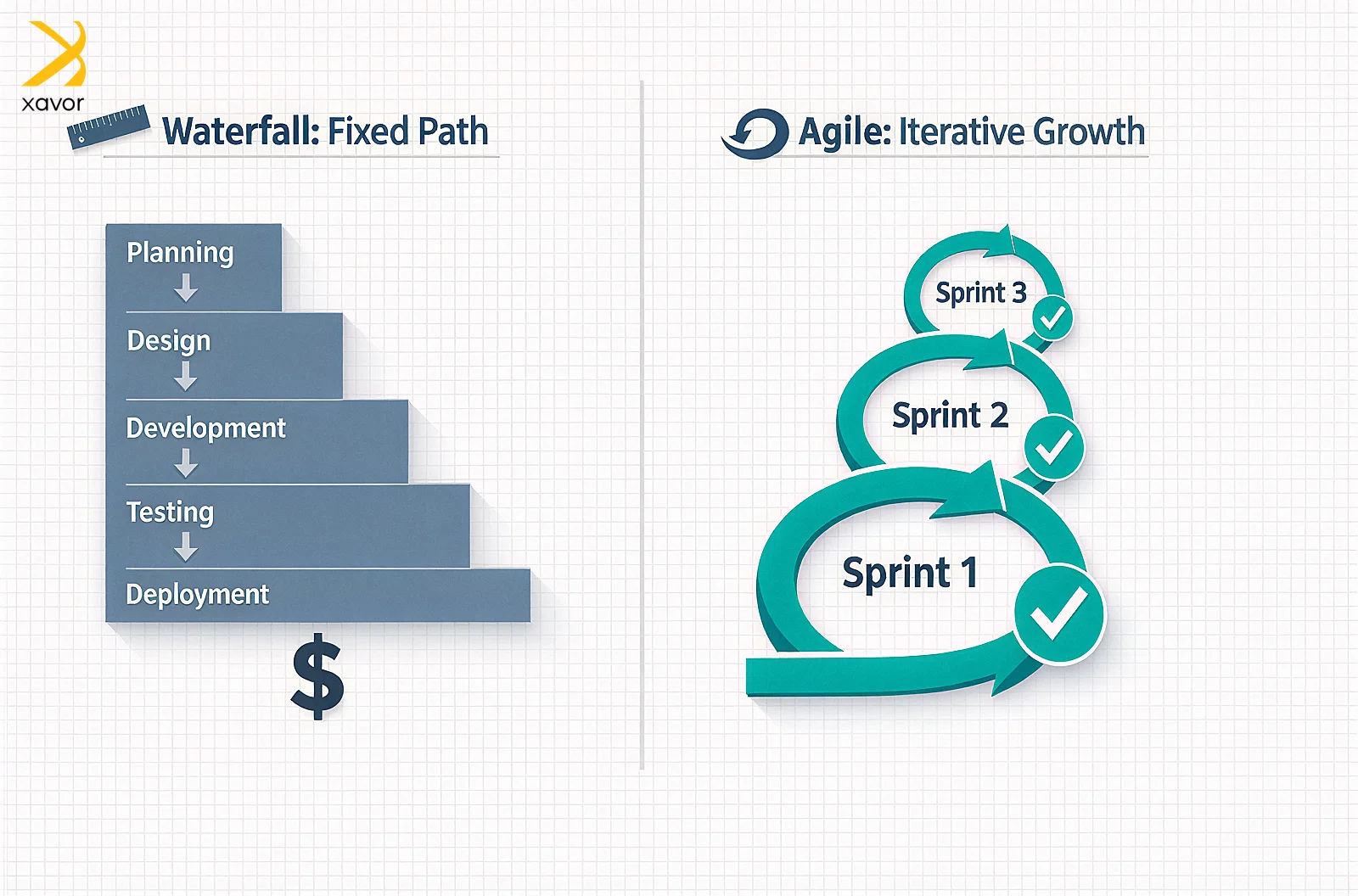
However, modern software development isn’t so black and white. Teams often have to change direction, add new features, or accommodate eleventh-hour demands from stakeholders or users. Those changes affect costs, which is why you don’t always get clear numbers to plan your budget and timelines.
The agile way
Agile software development resolves this with its iterative approach. It is an approach to building business software in small steps instead of all at once. Rather than planning the entire project in full detail upfront, the work is split into short sprints. In each sprint, the team delivers something usable that can be reviewed, tested, and improved.
It is the opposite of the Waterfall development approach, which is more traditional with fixed sequences. Asking an agile software development company, “How much will it cost?” is a bit like asking a builder for an exact price before the blueprints are finalized. You can still get a range or a starting point, but a precise fixed quote is hard because the plan will keep getting refined as you learn.
So instead of relying on a single detailed cost estimate, agile projects work better with two anchors:
- A budget: How much time/money you’re willing to invest.
- An MVP (Minimum Viable Product): The smallest version that still delivers real value.
When you have those, the team can plan around capacity, build a timeline, and focus first on making sure the MVP gets delivered within the budget. If things go smoothly, you can add more features as you go, but the minimum “must-have” is protected.
According to McKinsey, agile development usually results in a “30% increase in efficiency, customer satisfaction, and employee engagement.”
How to budget in agile software development
Just like any other development approach, costs will escalate out of control in agile as well, without proper project management. Agile software development services will help reduce project overhead and administrative costs, but the CFO still plays a critical role in setting clear budget guardrails.
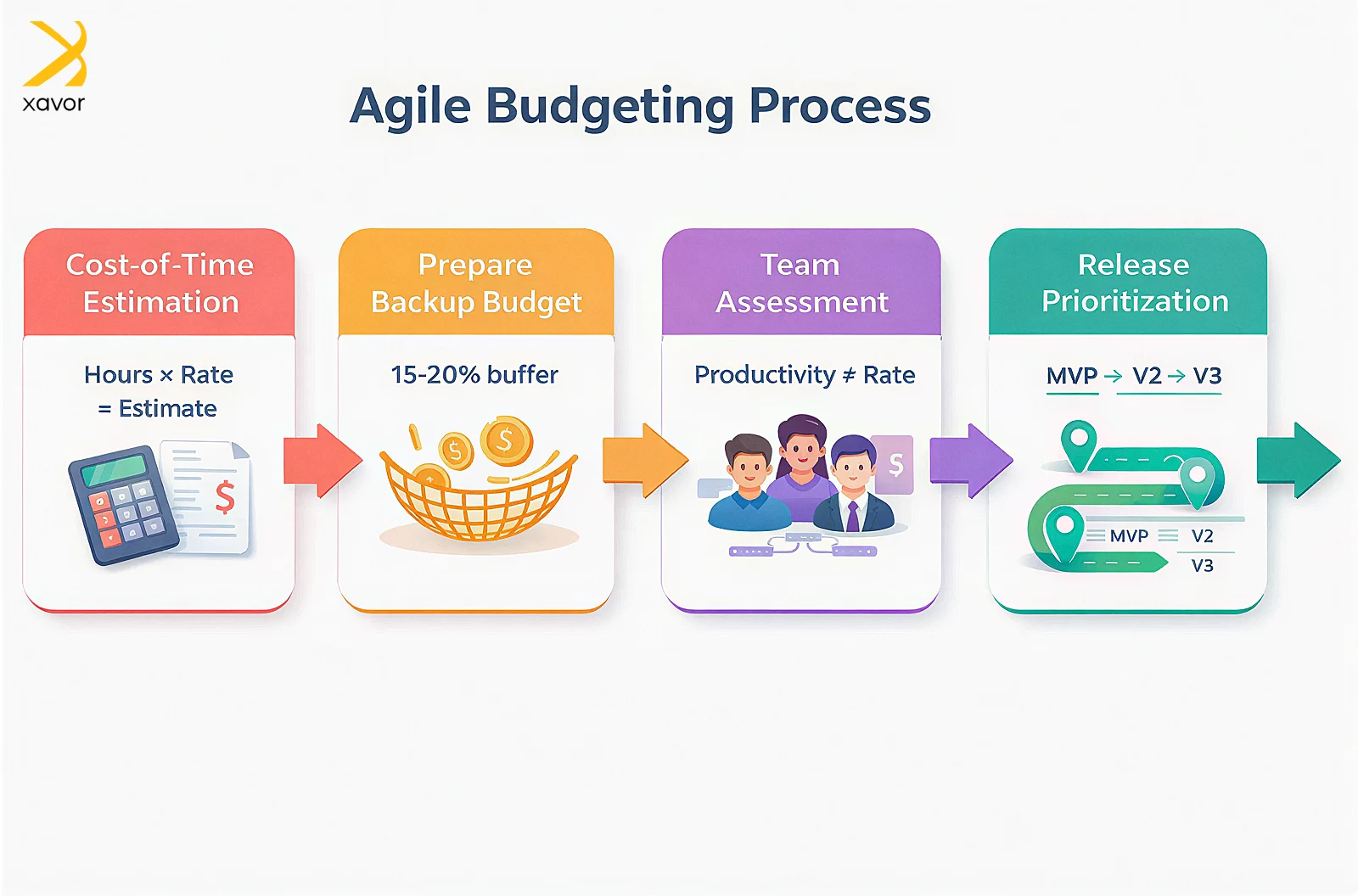
So, before reaching out to an agile software development company, here are some things you need to prepare for.
1. Cost-of-time estimation
This should be the first move in any CFO’s playbook when working on agile projects. Simply ask your internal team or an experienced advisor how long it will take to build the target functionality, then multiply that time by the cost of the people who will do the work.
It gives you a fast, understandable ballpark, and it’s often the first number leaders want. However, there is a catch: early estimates tend to focus on “development time” as if development is the whole job, when it’s really only part of the story.
The real budget needs to include the other things that quietly eat time and money, like planning, testing, security reviews, and whatnot. But it is still useful, if you remember it’s an early sketch, not a verbatim contract with an agile software development company.
2. Prepare a backup
In agile, your initial budget should not assume everything will go exactly as planned. Almost always, something will come out of the blue, such as:
- Complicated integrations that are harder than expected
- A key person is going on sick leave
- User feedback that forces changes
That’s why it’s smart to set aside a portion of the budget to cover the unplanned work that shows up once delivery starts.
This backup doesn’t mean you expect to waste money or that the agile software development company is overcharging. Think of it as risk insurance. Most of the time, you may not need to use all of it. But if something unexpected happens, you can keep momentum without stopping development, renegotiating approvals, or cutting corners on quality to stay within a too-tight number.
3. Don’t think estimates are set in stone
An estimate in agile is not a universal price tag that you can move from one service to another. It’s really a prediction based on how a specific team works: their skill level, how quickly they deliver, the quality of their work, and how much time they can actually spend on the project.
So, if one agile software development company estimates the project will take X hours, that number is tied to their team’s way of working. Another agile software development company might charge a lower hourly rate, but if they are slower, need more guidance, produce more defects, or require more rework, the total hours can increase significantly.
In that case, the cheaper per option can easily become more expensive overall, because you end up paying for more hours, plus extra costs from delays, quality issues, and additional coordination.
The nuance is that productivity differences are not small or linear. A stronger team often completes work faster with fewer mistakes and less back-and-forth, which reduces total effort. A less experienced team may need more iterations to reach the same outcome. That’s why you can’t assume the same estimate will hold across teams just by swapping the hourly rate.
4. Prioritize based on releases
After the initial planning and discovery, you don’t try to build everything at once. Instead, you organize the work by what needs to be released first, second, and third. The order you deliver things affects how quickly you get value and feedback.
A common approach is to launch something small first, like a landing page, so the business can test interest, collect sign-ups, and build a waiting list. Then you move to an MVP, which is the first version of the product that users can actually use. Once the MVP is live, you add improvements in a deliberate sequence. Starting with the features that unlock the most value or remove the biggest pain points for users, rather than the features that looked good on paper at the start.
Real user experience and behavior becomes your best source of truth. When people interact with the product, you learn what they actually need, where they get stuck, and which features they ignore. That evidence can overturn early assumptions. As a result, the team may change priorities, drop some planned features, or add new ones that weren’t originally considered.
When that happens, the scope and timeline can shift because the plan is being updated based on real-world learning.
Budgeting metrics to watch in agile development
Every CFO must know these metrics at fingertips if they want to manage an agile software budget. These metrics should be tracked at all times, and communicated to all the relevant stakeholders.
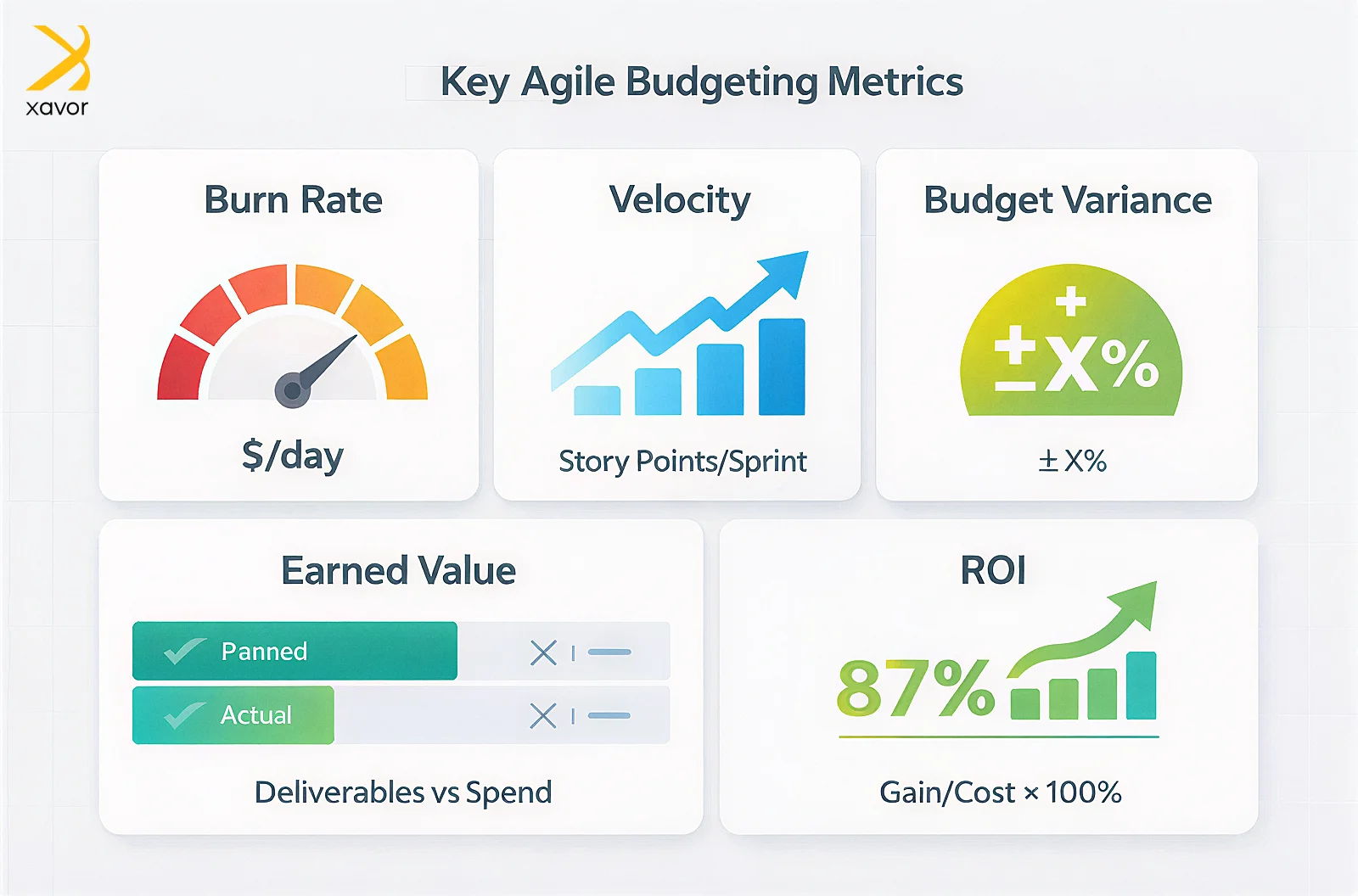
1. Burn rate
Burn rate is pretty simple, it means how fast your project is spending money. If the burn rate is higher than expected, you’ll run out of budget earlier than planned. You can calculate burn rate of per day and of the entire month.
2. Velocity
Velocity is how much work the team finishes per sprint. If your burn rate is stable, then velocity becomes your output. So, you can estimate how many sprints it will take to complete the backlog, and therefore how much it will cost.
3. Budget variance
This metric asks a question: are you spending more or less than planned? A yes signals overspending and negative underspending. Budget variance is the simplest budget health signal. It quickly tells you if cost is drifting.
4. Earned value
Earned value helps you see whether spending is translating into completed deliverables. This metric comes from traditional project controls, but you can use it in agile if you map it to sprints carefully.
5. Return on investment (ROI)
ROI is pretty self-explanatory. It tells you was the project financially worth doing. If your gain from investment wasn’t much from the cost of investment, probably not. ROI connects engineering spend to business outcomes. It helps justify budget and decide what to fund next.
Conclusion
Software projects are never truly done. You need to fix some bugs that somehow managed to slip through or add new features after feedback. Now, if you have a cash cow, you can keep throwing money at it, but chances are you don’t. That’s why budgeting is your best bet to manage your software project without draining your bank balance.
Agile software development is the best approach to managing your resources without compromising on quality or opportunities. While the factors we mentioned in this blog are a great start, working with an agile software development company will help you plan your budget much faster.
Xavor’s agile software development services give you a precise estimate of your project costs. We ensure that you neither overestimate nor underestimate your software goals. Plus, we have a crystal-clear payment model with straight communication, so you don’t have to worry about hidden charges.
Contact us at [email protected] to book a free consultation session with our agile experts. They’ll provide you with an early assessment to start planning your budget.

FAQs
The total cost of software development depends on various factors such as delivery model, scope, complexity, and integrations. Xavor delivers a structured estimate once you share your actual requirements, technical limitations, and business objectives.
Additional costs to consider in software development encompass infrastructure and hosting expenses, ongoing maintenance and updates, as well as compliance and security measures. These factors are essential for ensuring a successful and sustainable software project.