

When you think about what limits retail growth, what comes to mind first? Many leaders point to pricing pressure, rising acquisition costs, or shifting consumer behavior. But in practice, one of the most common growth blockers is simpler and more operational: inventory that is in the wrong place, at the wrong time, in the wrong quantity.
The scale of the problem is hard to ignore. Industry research on retail inventory distortion estimated the global impact at $1.77 trillion in 2023, driven by out-of-stocks and overstocks across retail supply chains. That figure reflects more than inefficiency. It reflects capital tied up in the wrong stock, missed revenue from empty shelves, and planning processes that struggle to keep pace with modern buying behavior.
This is why inventory optimization has become a strategic capability. AI in retail improves forecast precision and helps quantify demand and lead-time uncertainty. Data engineering solutions provide the foundation by standardizing data, reconciling events across systems, and delivering trusted signals into planning workflows. When these pieces work together, inventory optimization becomes a consistent way to improve availability while reducing excess stock.
What is inventory optimization in retail
Inventory optimization refers to the process of aligning inventory levels with expected demand while meeting service goals and cost constraints. In retail, this means ensuring products are available where customers expect them, without excess stock accumulating across the network.
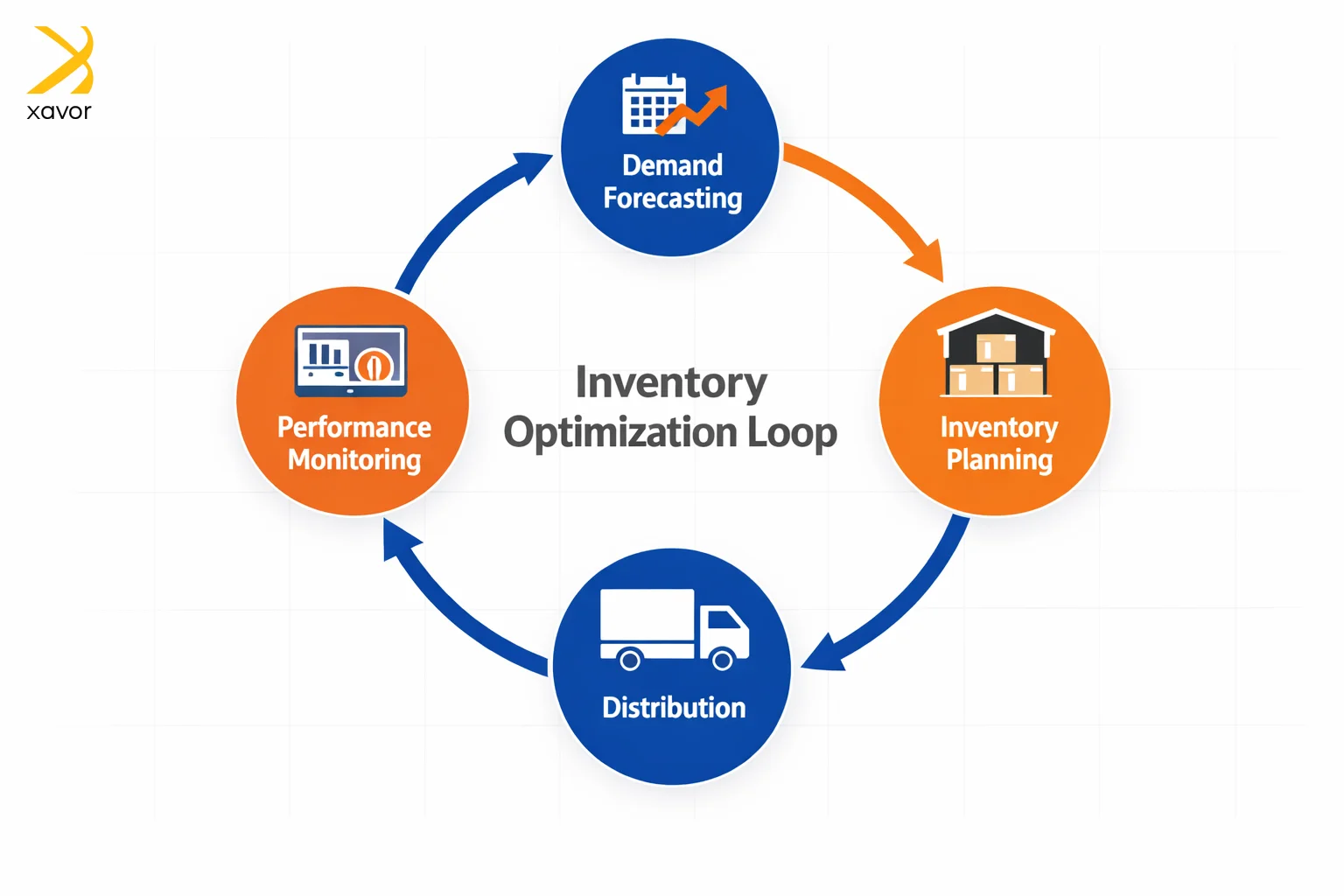
Retail inventory decisions are influenced by many variables: demand volatility, lead times, supplier reliability, promotions, seasonality, and returns. As these variables increase, manual planning and rule-based approaches become less effective. This is why supply chain inventory optimization has gained importance. Instead of optimizing inventory at individual locations, retailers view the supply chain as a connected system.
Through supply chain inventory optimization, retailers coordinate inventory across suppliers, distribution centers, stores, and fulfillment hubs. This approach helps reduce overall inventory while maintaining service levels across channels. Allocation and seasonal planningThrough supply chain inventory optimization, retailers coordinate inventory across suppliers, distribution centers, stores, and fulfillment hubs. This approach helps reduce overall inventory while maintaining service levels across channels.
Why traditional approaches fall short
Many retailers still rely on historical averages, static safety stock formulas, and manual overrides. These methods struggle to keep pace with changing customer behavior and operational complexity.
Another challenge is data quality. Inventory systems often show quantities that differ from what is physically available due to shrinkage, mis-scans, delayed updates, or returns. When data accuracy declines, even well-designed planning logic produces unreliable results.
This gap has led many organizations to seek inventory optimization consulting and inventory management consulting services to address both process and data issues before deploying advanced Data engineering solutions.
The role of data engineering
Data engineering provides the foundation for effective inventory optimization. It ensures that data from different systems can be trusted, combined, and analyzed at scale.
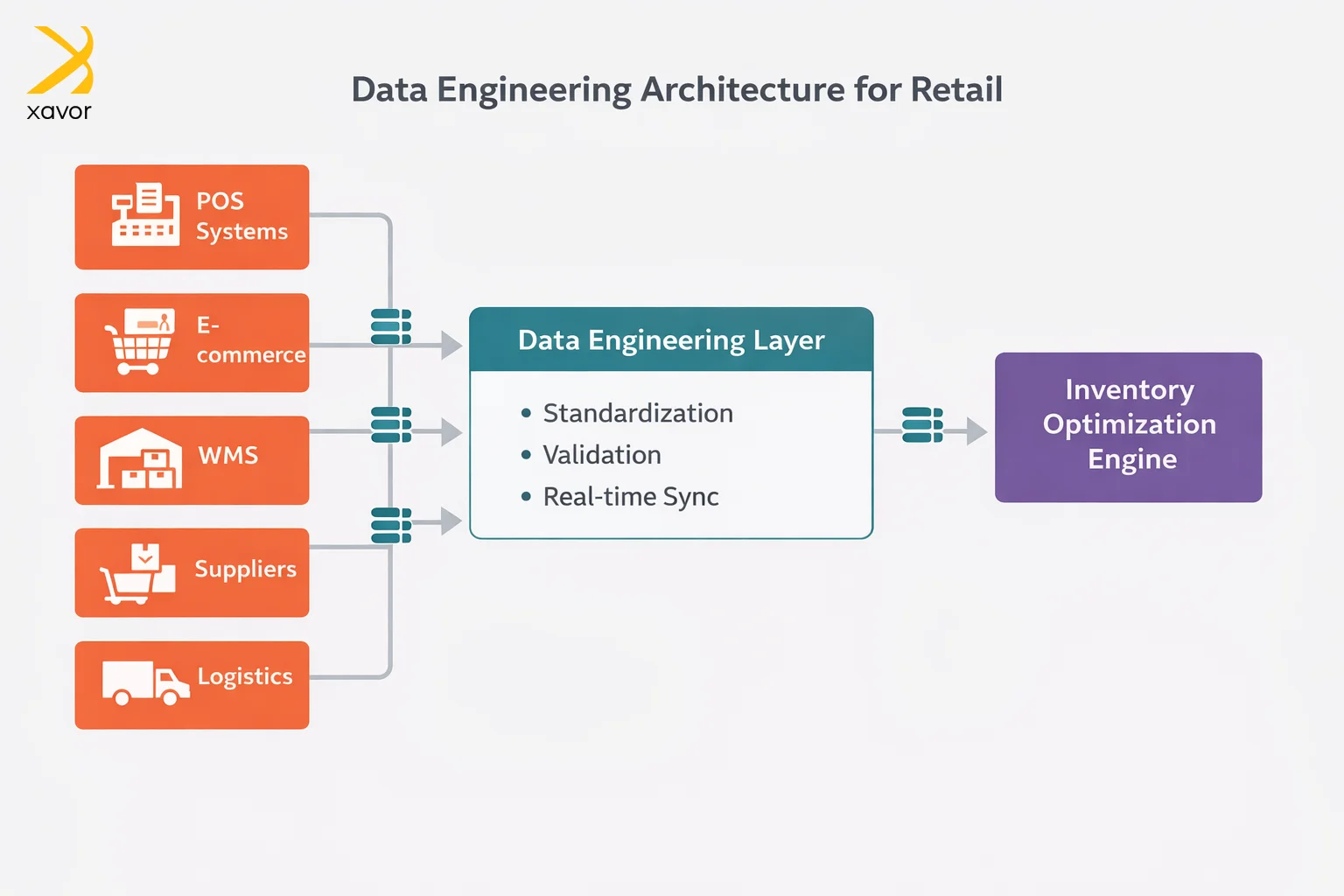
Retail data comes from multiple sources: point-of-sale systems, e-commerce platforms, warehouse management systems, supplier feeds, and logistics providers. Each source operates at a different speed and with a different structure.Data engineering enables AI deployment by aligning these inputs into a consistent format, ensuring reliable planning and decision-making.
Strong data engineering solutions focus on three areas:
1. Data consistency
Product, location, and supplier identifiers must be standardized across systems. Without consistency, inventory models cannot correctly associate demand and supply signals.
2. Data timeliness
Inventory decisions depend on knowing what happened recently. Data pipelines must support near-real-time updates when required and handle delays without introducing errors.
3. Data reliability
Monitoring, validation, and reconciliation processes help identify missing or unusual data before it affects planning outcomes.
These capabilities allow inventory optimization tools to operate on reliable inputs rather than assumptions.
How AI supports inventory decisions
AI in retail applies advanced analytics and machine learning to predict demand, assess uncertainty, and recommend actions. In inventory planning, AI is used across several decision areas.
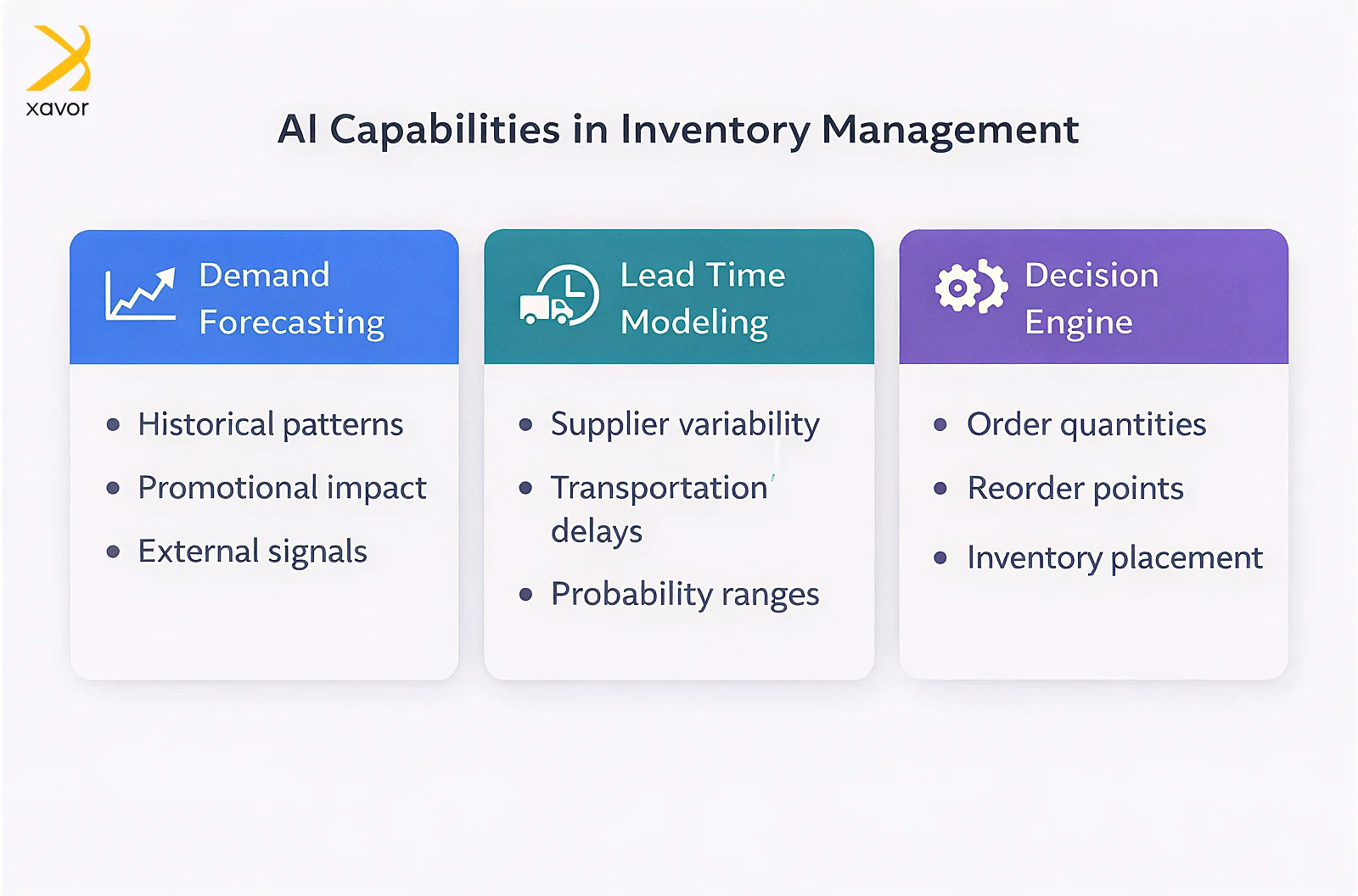
Predictive analytics and demand forecasting models analyze historical sales, pricing, promotions, and external signals to estimate future demand at the SKU and location level. These forecasts serve as the basis for replenishment and allocation decisions.
AI also supports lead-time modeling by capturing supplier variability and transportation delays. Rather than assuming fixed lead times, models estimate ranges and probabilities, which improves safety stock calculations.
Decision engines within inventory optimization software use these predictions to recommend order quantities, reorder points, and inventory placement. These recommendations consider constraints such as storage capacity, minimum order quantities, and service-level targets.
When combined with data engineering, AI outputs become actionable rather than theoretical.
Inventory accuracy and visibility: the missing chapter in many projects
One of the largest barriers to effective inventory optimization is inaccurate inventory records. If systems report stock that is not physically available, replenishment decisions are delayed or incorrect.
Technologies such as RFID, shelf scanning, and automated cycle counting help close this gap. These tools provide more frequent and accurate inventory signals. Data engineering ensures that these signals are cleaned, aggregated, and linked to master data so they can be used by planning systems.
With improved visibility, inventory optimization software can respond faster to demand changes and reduce both stockouts and excess inventory.
Where AI-driven inventory optimization delivers value
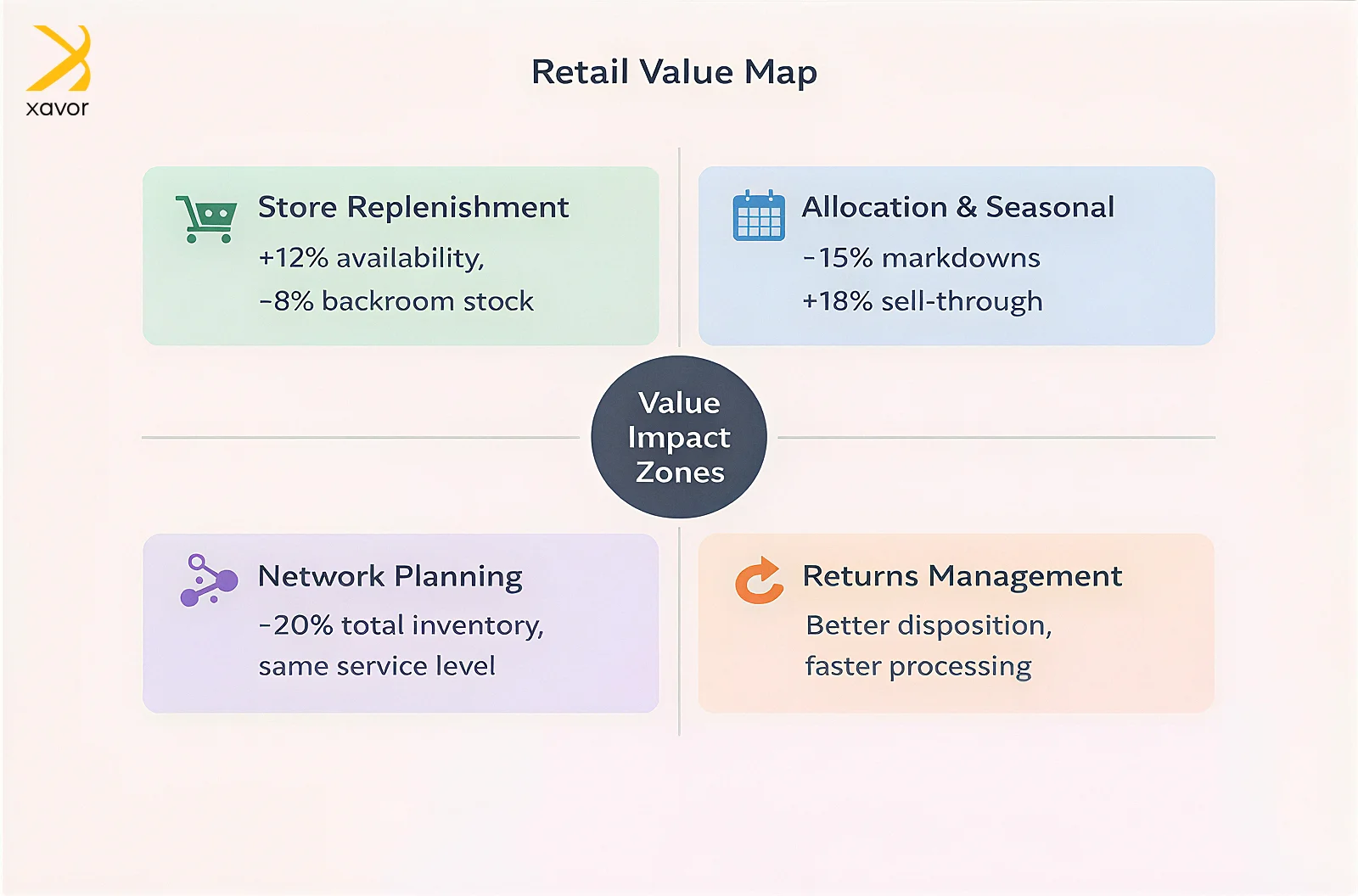
1. Store replenishment
At the store level, inventory decisions must balance shelf availability and backroom space. AI-driven forecasts estimate demand by store and product, while inventory optimization tools recommend replenishment quantities that align with service goals.
Data engineering ensures that sales, returns, and adjustments are reflected accurately, so replenishment plans remain relevant.
2. Allocation and seasonal planning
Product launches and seasonal assortments require careful inventory placement. AI models estimate regional demand patterns and expected sell-through. Supply chain inventory optimization enables planners to allocate limited inventory across locations—even deploying flexible mobile storage units in Sydney to handle regional overflow—based on expected performance.
This approach reduces markdown risk while supporting availability during key selling periods.
3. Network-level planning
Multi-location networks benefit from coordinated inventory policies. Rather than holding excess safety stock at every node, supply chain inventory optimization distributes inventory buffers across the network.
Advanced inventory optimization software evaluates trade-offs between upstream and downstream inventory, helping retailers reduce total inventory without sacrificing service levels.
4. Returns and reverse flows
Returns represent a growing share of retail volume. AI solutions predict return rates by channel and product, allowing planners to account for returned inventory in future availability calculations.
Data engineering links return events with original sales and condition data, enabling inventory optimization tools to recommend the best disposition paths.
Choosing the right inventory optimization software
Successful implementations depend on selecting software that aligns with operational realities. Effective inventory optimization software typically includes:
- Integrated data ingestion across retail systems
- Support for uncertainty and variability
- Transparent recommendation logic
- Intelligent workflows and exception management features
Retailers often engage inventory optimization consulting during this phase to define requirements, evaluate vendors, and design operating models. For broader initiatives, inventory management consulting services help align planning processes with data and technology capabilities.
Building a practical roadmap
Retailers seeking to improve inventory optimization can follow a structured approach:
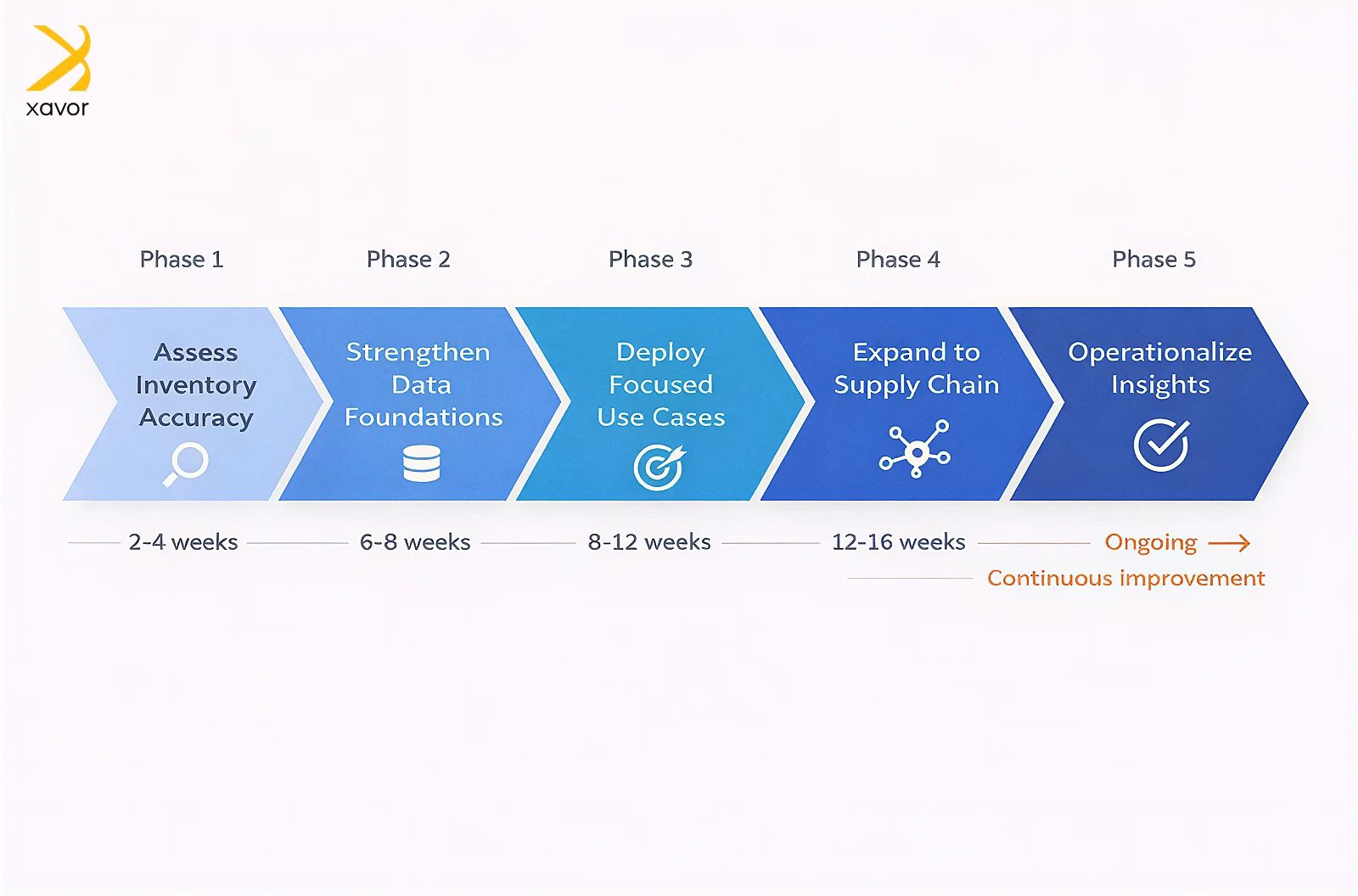
- Assess inventory accuracy: Identify gaps between system and physical inventory and improve measurement processes.
- Strengthen data foundations: Standardize master data and build reliable pipelines for inventory-related events.
- Start with focused use cases: Deploy inventory optimization tools in high-impact categories before expanding scope.
- Expand to supply chain inventory optimization: Coordinate planning across stores, distribution centers, and suppliers.
- Operationalize insights: Embed recommendations into daily workflows and monitor performance continuously.
How Xavor supports inventory optimization
Xavor helps retailers design and implement AI-driven inventory solutions grounded in strong data engineering. Our teams combine expertise in inventory optimization services, data platforms, and AI deployment to address both technical and operational challenges.
From building scalable data foundations to deploying inventory optimization software and decision tools, Xavor works closely with retail organizations to improve availability, reduce excess stock, and support long-term growth.
If your organization is pursuing inventory optimization, supply chain inventory optimization, or modern inventory optimization tools, Xavor can help you move from pilots to production outcomes. Talk to Xavor to explore a roadmap of Data engineering solutions that fit your retail network and planning maturity. Contact us at [email protected]

FAQs
Inventory optimization is aligning inventory with expected demand while meeting service goals and cost constraints so products are available where customers expect them without building excess stock.
They rely on static formulas and manual overrides that cannot handle demand volatility and operational complexity. They also break down when inventory data is inaccurate due to shrinkage, mis scans, delayed updates, or returns.
Data engineering standardizes and reconciles data across systems and delivers reliable signals. AI uses those signals to forecast demand, model lead time variability, and recommend order quantities and inventory placement.