

A software development team is similar to a football team in many ways. It has a manager, i.e. the project manager, each member has a distinct role, and the ideal team is usually comprised of 9-11 members.
If you ask someone who is their favorite footballer player, you’ll get answers like Ronaldo, Messi, Zidane, and the likes. Hardly anyone will ever say a defender is their favorite player. This made us think, who are the defenders in a software team? The unsung heroes who do a lot of hard work to ensure team success but rarely get the spotlight.
The answer was pretty obvious: quality assurance testers. Software quality assurance teams form the defense of software development to ensure no threat will lead to software failure. Much like how defenders protect the goal from the threat of the opposition.
In this article, we’ll explain why is a quality assurance tester needed on a software development team.
The Role of a Quality Assurance Tester
Football and software development both require a blend of individual talent and teamwork. Quality assurance testers bring their expertise to proactively detect and prevent defects rather than fixing them only after the software is released.
Software quality assurance teams don’t take part in developing the software for the most part. But they test it thoroughly to ensure the digital product is functional, reliable, secure, and meets the highest quality standards.
Just like there are different types of defenders in a football team, there are different roles played by a QA tester in a software quality assurance team.
1. Manual Tester
Manual testers are like the center backs of SQA testing. Think of Puyol, Nesta, and Van Dijk because manual testers ensure overall stability of the product by defending against threats directly.
They use manual testing tools to perform systematic, exploratory, and regression testing. But that job, like that of center backs, involves a lot of arduous, and at times dirty work to “clear” the software of any possible defects.
2. Automation Tester
Full backs provide both defense and attacking assistance from the wings. The Brazilian legend Roberto Carlos was one of the most attacking minded full backs in the history of the game.
In a software QA team, automation testers take the role of full backs. They write automation tests to cover repetitive, wide test cases. This involves them working closely with developers during the build process, while still remaining focused on the post-development testing phase. Resources such as Functionize’s end-to-end testing guide, along with practical documentation from tools like Tricentis, Sauce Labs, and LambdaTest, can help QA teams understand how to structure broader test coverage across real user workflows.
3. QA Manager
Every software quality assurance team has a head of QA, which is like the goalkeeper. They are the last line of defense and ultimately responsible for every error and mistake in the software.
Goalkeepers also ensure that their defensive line is well organized so no attacker can slip past through. That is why you often see them shouting their lungs out at defenders. A QA lead does the same. Although they don’t shout, at least most of the time, they maintain communication between QA and development team to ensure they remain aligned.
Five Reasons Why a Quality Assurance Tester is a Must on Every Software Development Team
These are some of the core reasons why is a quality assurance tester needed on a software development team.
1. Bug Detection and Prevention
QA testers carefully check the software to catch issues early. These issues can be small glitches or serious crashes. But finding problems before launch requires software quality assurance teams to anticipate bugs like a defender anticipates attacks.
They proofread the code, double-check features, spot root causes of issues, and provide reports developers can act on. This safety net helps teams release software that’s both reliable and fast.
2. Security and Privacy
The role of a sweeper is now obsolete in football, but players like Franz Beckenbauer perfected it. In QA testing, that role is well alive as security testers are an integral part of any software quality assurance team. While manual and automation testers focus on catching bugs in functionality and performance, they spot security weaknesses that may slip past regular testing.
With cyber threats increasing, security testers act as protectors of user data. They simulate hacks to find weaknesses early and verify that encryption and privacy rules are followed. This ensures sensitive information stays safe and builds trust with users. Exploring how big data applications are tested for quality and reliability also highlights the depth of challenges QA teams face today. This ensures sensitive information stays safe and builds trust with users.
3. Performance Optimization
Software quality assurance teams keep an eye on app speed and responsiveness. If something feels slow, they run checks to figure out what’s causing the delay. Their feedback helps developers fine-tune apps so they load and run faster, which makes users happier.
They also test new features as they’re added, making sure existing ones still work properly. This ensures apps can grow and improve without breaking what’s already there.
4. Enhanced User Experience
Software quality assurance teams put themselves in the place of users. They use apps the way regular users do. If they feel the design is confusing or navigation is clunky, they give their feedback to developers.
This QA and Dev communication helps spot issues in user experience that don’t necessarily affect functionality. Their feedback creates smoother, more intuitive apps that people actually enjoy using.
5. Cost Savings and Faster Delivery
Fixing bugs in your software program post-release is very expensive. A bug discovered during testing might cost just $100 to fix, but ame bug found after release could cost $1,000 or more. That is because additional rework is required post-release to not just fix the code, but to retest, redeploy, and sometimes even redesign affected features.
Software quality assurance teams save teams money on fixes and reduce delays. This allows companies to release software at the right time, stay ahead of competitors, and deliver high-quality apps without overspending.
What is AI-Enhanced QA Testing?
QA testing is the backbone of software reliability, ensuring seamless functionality and exceptional user experiences. Integrating AI into QA processes enhances defect detection, optimizes test coverage, and accelerates test execution. This shift toward AI in QA helps teams move from reactive defect fixing to proactive quality engineering, making testing smarter, faster, and more aligned with business goals.
Modern AI-driven QA incorporates:
- Generative AI for automated test case creation and bug prediction
- Agentic AI that autonomously identifies software weaknesses and self-corrects errors
- AI-powered anomaly detection to preemptively find defects before they impact users
- Predictive analytics to forecast potential risks and ensure proactive issue resolution
By embracing AI-enhanced QA, organizations can reduce risks and deliver high-quality software faster and more efficiently.
The Evolving Role of a QA Tester in the AI Era
The role of a QA tester has expanded beyond manual testing to include AI-driven validation and predictive analytics. Here’s how software quality assurance teams are using AI tools to optimize software quality:
- Test Planning and Strategy Development: AI-powered tools like Microsoft Azure Test Plans and Google Cloud Test Lab help testers create dynamic test strategies by analyzing historical test data and predicting areas prone to failure.
- Test Case Creation and Execution: AI-driven frameworks such as NVIDIA Clara Guardian and OpenAI Codex automate test case generation, reducing manual effort and improving accuracy.
- Defect Identification, Reporting, and Tracking: AI-powered bug tracking tools like IBM Watson AIOps and Oracle Cloud Observability and Management Platform enable real-time defect detection and predictive analytics to minimize software failures.
- Documentation and Test Result Analysis: Top AI tools such as Meta’s Llama and AWS DevOps Guru automate documentation, analyze test results, and generate insightful reports for stakeholders.
How QA Testers and Developers Collaborate with AI Assistance
AI is transforming how QA testers and developers collaborate, enhancing efficiency and communication:
- AI-Powered Communication: Platforms like Google Gemini facilitate natural language-based test reporting and collaborative debugging sessions between developers and QA testers.
- Predictive Issue Resolution: AI-driven code analysis tools such as DeepCode and CodeGuru Reviewer (AWS) flag potential defects before deployment, helping testers and developers proactively resolve issues.
- Intelligent Bug Fixing: With Agentic AI, AI agents can suggest bug fixes and even autonomously implement minor corrections based on learned patterns from past defect resolutions.
AI-Driven Strategies to Enhance Developer-QA Collaboration
Fostering a culture of collaboration between developers and QA teams is crucial for success. AI-driven tools can optimize teamwork through the following:
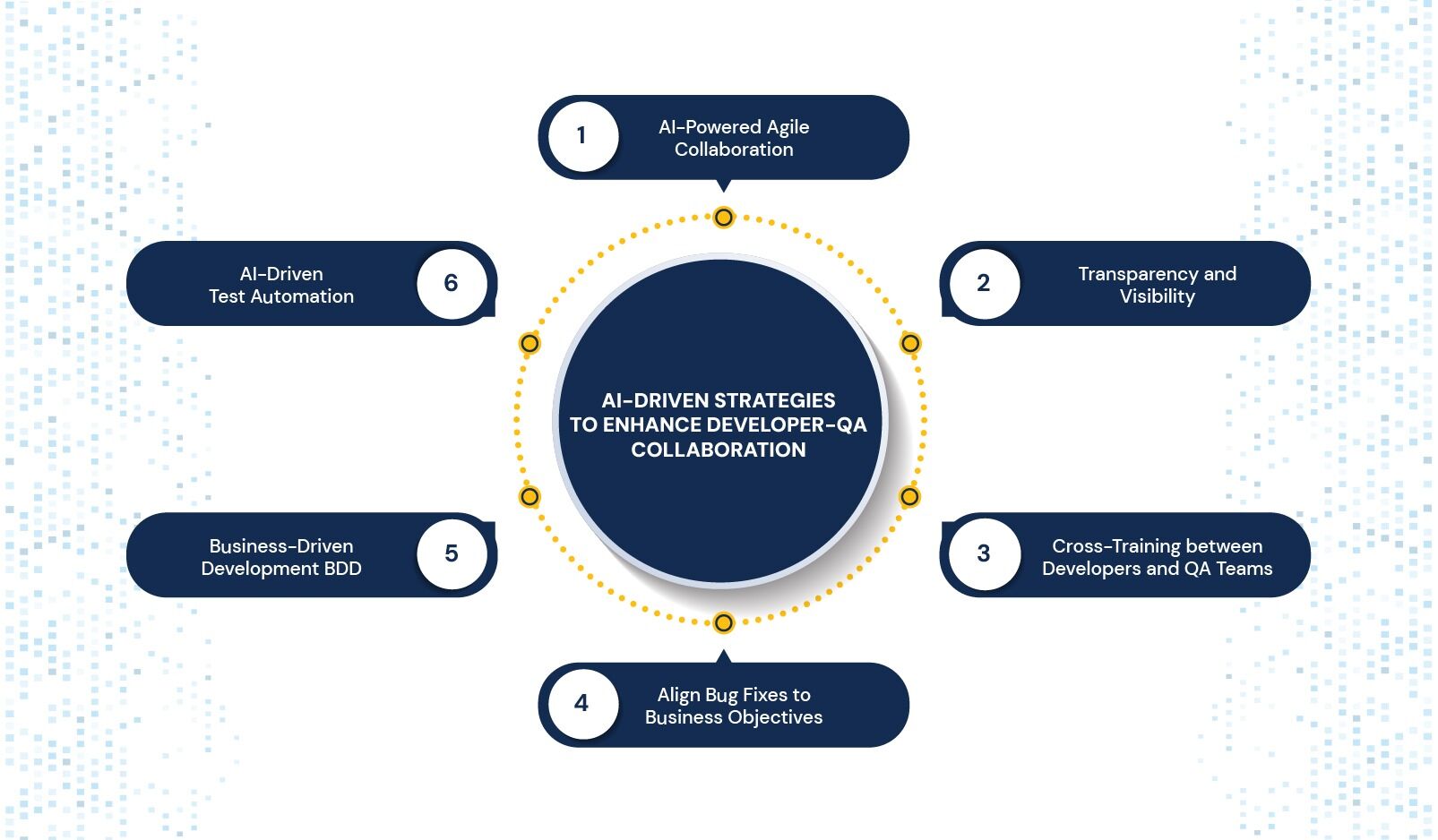
- AI-Powered Agile Collaboration: Tools like JIRA Align AI enhance project tracking, enabling transparent task management and real-time issue tracking.
- Transparency and Visibility: It should provide all team members with visibility into activities. Transparent communication avoids duplicated work and aligns teams toward the same objectives. Use workflow management tools to support updates and ensure clarity.
- Cross-training between developers and QA teams: This should be promoted to enhance each party’s understanding of processes. This mutual understanding helps optimize performance through proper communication.
- Align Bug Fixes to Business Objectives: Develop a comprehensive understanding of User needs and business objectives. This empowers teams to decide on bug fixes, solve major problems, or address customer grievances.
- Business-Driven Development BDD: Implement BDD where QA forms test cases against specific business requirements and developers develop code. It accelerates the feedback cycles and aligns software with a business need.
- AI-Driven Test Automation: Frameworks like Selenium with AI-based self-healing scripts adapt test cases dynamically as applications evolve.
Challenges Faced by QA Testers in an AI-Powered World
While AI has revolutionized QA, testers still face challenges that require expert intervention:
- Rapidly Changing Requirements: AI-based requirement analysis tools such as Google Cloud AI-powered Insights help manage evolving project needs.
- Time Constraints & Scalability: AI-driven parallel test execution frameworks reduce testing bottlenecks and accelerate release cycles.
- Test Data Management: Synthetic test data generation with Microsoft’s Turing AI ensures realistic test scenarios without exposing sensitive user data.
- Maintaining Automated Test Scripts: AI-based self-healing automation in tools like Testim.io minimizes script maintenance efforts.
- Complex Test Environments: Diverse test environments often require complicated setup and management when testing across various platforms, devices, and configurations.
- Defect Management: Monitoring and managing defects at every stage of their lifecycle – from identification to resolution – requires careful organization and communication.
The Future of AI in Software Quality Assurance Testing
AI-driven QA is not just a trend—it’s the future. AI is reshaping QA, enabling faster, more efficient software testing. As businesses adapt, integrating AI-driven QA solutions becomes essential for maintaining quality and competitiveness. As AI continues to advance, QA testers will increasingly utilize it:
- Self-learning AI for autonomous bug detection and resolution
- AI-powered performance optimization for real-time monitoring and tuning
- Conversational AI test execution, where testers interact with AI agents to refine test cases dynamically
Conclusion
The role of QA testers has never been more vital. By integrating AI into the QA and testing services, businesses can enhance software reliability, accelerate development cycles, and minimize costly defects.
However, implementing AI-driven QA solutions requires expertise, customization, and ongoing optimization. Quality control and defect detection software development services help you with that by blending AI in your QA testing procedures.
At Xavor, we provide AI-powered QA solutions to help businesses deliver superior software. Our experts customize and integrate AI-driven tools, such as AWS DevOps Guru, Microsoft Azure Test Plans, and Google Cloud AI-powered Insights, to streamline your QA processes.
You can contact us at [email protected]. We will schedule a free consultation session to explore how Xavor can assist you in this matter.

FAQs
QA testers help prevent defects before launching, protect the product from failures, and make sure the software is stable, secure, and user-friendly. They also validate features from a real user’s perspective and reduce costly fixes after release.
AI-enhanced QA testing means using AI to speed up and strengthen the testing process. It can generate test cases, predict bug-prone areas, detect anomalies earlier, and improve overall test coverage, helping teams release software faster without sacrificing quality.
AI improves collaboration by making defect reporting clearer, supporting faster debugging, and helping teams identify issues earlier in the development cycle. It reduces back-and-forth, aligns both teams around shared goals, and makes releases smoother and more predictable.