

For many years, organizations have relied on traditional ticketing systems to manage IT issues and service requests. These systems were created at a time when IT environments were relatively simple, business operations were less digital, and employee expectations were minimal. The goal was simple: log an issue, assign it to a technician, and close it once it was resolved. But as companies grow and IT demands increase, many also start exploring ServiceNow managed services to ensure support processes stay efficient, scalable, and consistent.
However, as businesses evolved, technology became deeply embedded in every function of the organization. Employees now depend on digital tools for nearly every task, from communication and collaboration to customer service and data management. With this increased reliance on technology came higher expectations for speed, transparency, and quality of support.
Traditional ticketing systems, while once sufficient, have struggled to keep up with these changes. They often lack automation, provide limited visibility, and fail to scale as organizations grow. As a result, IT teams spend more time managing tickets than solving problems, and employees become frustrated with slow or unclear support processes.
This is where ServiceNow stands apart. Rather than being just another ticketing tool, ServiceNow is a comprehensive digital workflow platform that streamlines, automates, and optimizes work across the entire organization. It goes beyond basic issue tracking and enables companies to manage the full lifecycle of work efficiently and intelligently.
Traditional ticketing systems: Built for the past
Traditional ticketing systems were designed when IT environments were simpler, and business expectations were lower. At that time, the main goal was to record issues and ensure someone would eventually fix them. These tools were not built to support fast growth, complex workflows, or high service expectations.
Most traditional ticketing tools include only a few basic capabilities:
- They allow basic incident creation, where users can submit a ticket describing an issue. Once the ticket is created, it usually requires manual assignments, meaning someone must decide who should work on it. This process takes time and often causes delays, especially when many tickets are coming in.
- These systems also have minimal automation. Tasks like approvals, escalations, and follow-ups are usually handled manually. Because of this, support teams spend more time updating tickets and tracking status than actually fixing problems.
- Another major limitation is limited reporting. Traditional ticketing tools often provide only basic counts, such as the number of open or closed tickets. They do not clearly show patterns, recurring issues, or overall system health. This makes it difficult for leadership to understand what is really happening in the support environment.
- In addition, information in these systems is often siloed. Ticket data stays within the tool and is not easily shared across teams or departments. This creates communication gaps and slows decision-making.
Smaller teams might benefit from this, but expanding companies soon notice the gaps rather than resolving issues. The teams spend more time updating tickets. Users wait without clarity. Leadership struggles to understand trends or system health. In simple terms, these systems are good at collecting tickets but not good at managing work efficiently.
ServiceNow: A Modern Workflow Platform
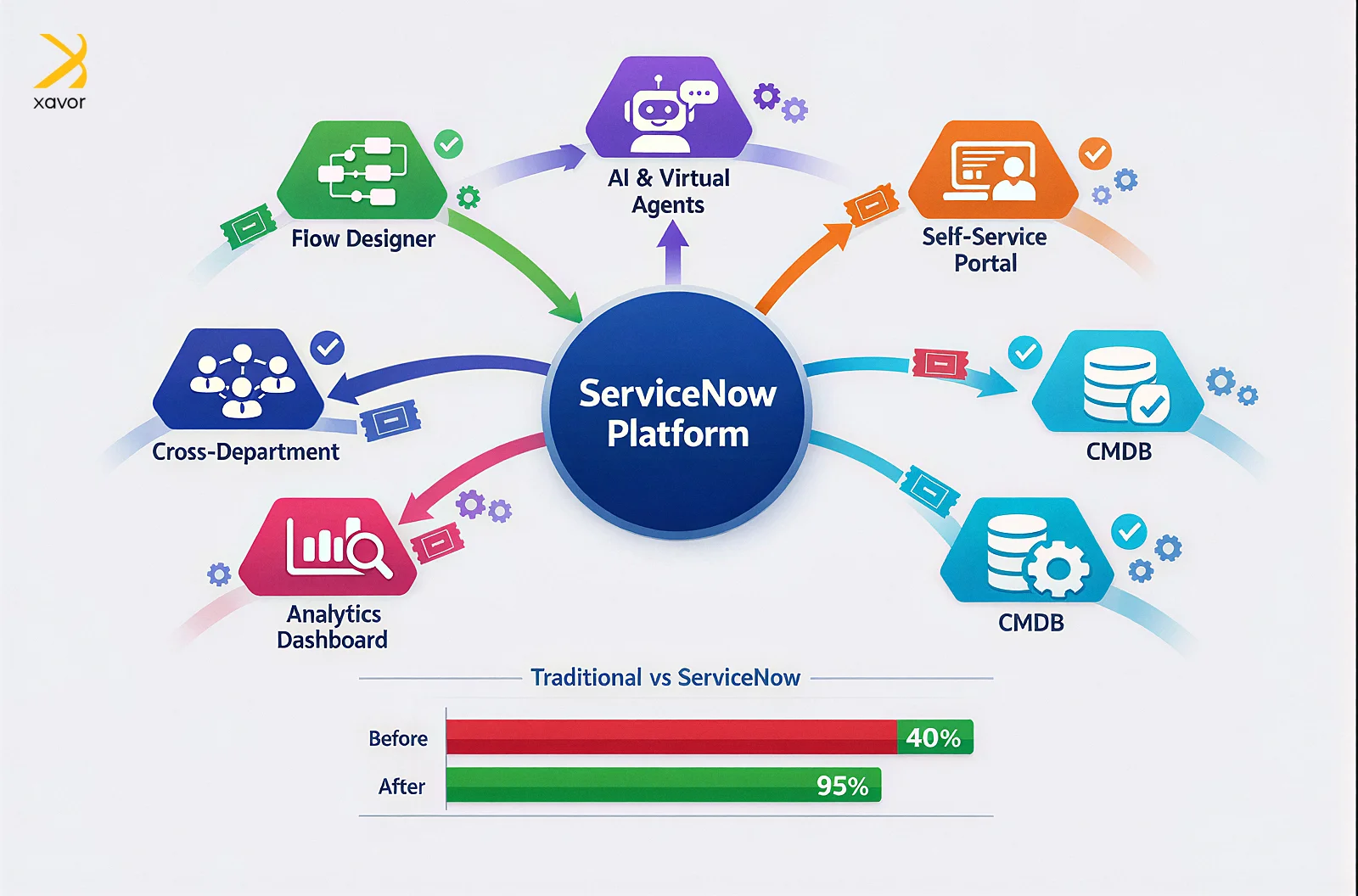
ServiceNow is changing what “ticketing” means. Instead of being just a place to log issues and wait for someone to respond, it turns service management into an efficient system where work flows automatically across teams through interconnected ServiceNow modules. In other words, it is not simply tracking requests. It is building a networked ecosystem that helps organizations handle work faster, smarter, and more consistently.
Traditional tools often rely on people to manage everything manually. Someone has to assign the ticket, decide who should handle it, follow up, track deadlines, and update the requester. ServiceNow removes much of that manual effort. It automates, routes, measures, and continuously improves how work gets done, using capabilities like:
- Flow designer to build automated workflows and approvals
- AI search and virtual agents to help users find answers quickly or get instant support
- Self-service portals so employees can solve common issues without contacting support
- Integrated CMDB (Configuration Management Database) to give complete visibility into assets and services
- Analytics and dashboards to track performance, spot bottlenecks, and improve processes
- Cross-department collaboration across IT, HR, Facilities, Security, and more
This is where the difference is clear. Conventional tools are mainly designed to store and manage tickets. ServiceNow goes beyond that by managing the entire lifecycle of work from the resolution request. It helps organizations not only respond to issues but also improve the process behind them, so the same problems do not keep repeating.
In short, ServiceNow is not just a ticketing tool. It is a modern workflow platform built to connect people, processes, and systems across the enterprise.
For a deeper look at why large enterprises rely on ServiceNow for round-the-clock IT operations, you can read the top reasons why enterprises choose ServiceNow ITSM for 24/7 IT operations.
Where ServiceNow truly outperforms legacy tools
1. Automation reduces manual work
Instead of people figuring out who should handle an issue, ServiceNow:
- Auto assigns tasks
- Sends smart notifications
- Triggers approvals
- Creates follow-up tasks
- Escalates automatically when SLAs are at risk
This saves time and ensures faster resolution.
2. A better experience for employees
With traditional systems, users raise tickets and hope for updates.
ServiceNow changes that by offering:
- A clean, modern self-service portal
- Knowledge articles for quick self-help
- Real-time ticket tracking
- Chat-based assistance using virtual agents
Employees feel empowered instead of confused.
3. Visibility for leadership
Most older ticketing tools lack meaningful reporting.
ServiceNow provides:
- Live dashboards
- Team performance analytics
- Root cause patterns
- SLA trends
Leaders can see what is slowing down operations and where improvements are needed.
4. Integrations that make everything work together
ServiceNow connects easily with:
- ERP systems
- Cloud tools
- Monitoring platforms
- HR applications
- Security systems
Instead of working in silos, information moves seamlessly across departments.
Scalability for growing organizations

As a company grows, things naturally get more complex. More employees mean more service requests, more departments, more approvals, and more systems that need to work together. The tools that once felt simple and effective can start to struggle under the added pressure.
That is why many traditional tools become a problem over time. They may work well at a smaller scale, but as usage increases, they often slow down, become harder to manage, and force teams into manual workarounds. Instead of supporting growth, these tools can create delays and confusion.
ServiceNow is built to avoid that experience. It is designed for enterprise-scale operations, which means it can handle growth without losing performance or reliability. Whether an organization has 100 employees or 100,000, ServiceNow remains consistent while supporting more users, workflows, and business functions across the company.
In the long run, this makes growth easier to manage. Instead of constantly upgrading or replacing systems as the organization expands, companies can rely on ServiceNow as a stable platform that scales with them. It keeps teams aligned, processes organized, and service delivery smooth as the business continues to evolve.
A quick real-world example
Imagine a company still using an older ticketing tool to manage IT support. It technically works, but every morning starts the same way. The IT team logs in and immediately feels behind because the system does not give them the structure or visibility they need.
What the IT team deals with every day
- Many unassigned tickets are waiting in the queue
- No SLA tracking, so there are no clear deadlines or priorities
- No easy way to spot recurring issues or patterns
- Too many repetitive tasks are done manually, such as routing and follow-ups
- A backlog that keeps growing and becomes harder to control
Now imagine the company switching to ServiceNow. Instead of reacting to chaos, the IT team starts operating with clarity and control.
What improves after switching to ServiceNow
- Dashboards surface recurring issues, making it easier to fix root causes
- Tickets are automatically assigned to the right team, so nothing sits unowned
- SLAs are built into workflows, helping the team stay on track
- Approvals move faster through automated and intelligent workflows, reducing delays
- Users get real-time updates, which cuts down on follow-up emails and calls
The outcome
With less manual work and more visibility, productivity increases, the backlog shrinks, and IT support becomes predictable. The team spends less time managing tickets and more time solving problems.
Conclusion: ServiceNow vs traditional ticketing systems
Ticketing is one of those things most companies don’t think about until it starts causing pain. When requests pile up, updates are unclear, and minor issues keep turning into recurring disruptions. It becomes obvious that the system behind support needs to change. That is why many organizations are moving toward platforms that do more than just record problems. They want something that helps work move smoothly, keeps teams aligned, and makes support feel reliable instead of reactive.
ServiceNow fits that shift because it brings structure and consistency to how requests are handled across the business. It helps teams stay ahead of the workload, makes it easier to understand what is really happening behind the scenes, and creates a stronger foundation for long-term operations.
If you are thinking about making that move, Xavor can help you evaluate the right approach and get the most out of ServiceNow. Reach out to us at info@xavor.com, and we will walk you through the next steps.

FAQs
Traditional ticketing tools mainly focus on logging and closing requests. ServiceNow goes further by connecting people, processes, and systems so that work can move automatically across teams. It helps organizations handle requests more effectively through better routing, automation, visibility, and ongoing process improvement, rather than just tracking issues.
ServiceNow can handle many types of requests, including incidents, service requests, problems, changes, access requests, HR requests, facilities issues, and security-related tickets.
ServiceNow is not just a ticketing tool. It is a workflow platform that includes ticketing features, but also supports automation, self-service, approvals, reporting, and integrations.