

For years, industrial teams have used predictive maintenance solutions to spot trouble early. By analyzing sensor data and operating patterns, it can flag when an asset is likely to fail. But a prediction is still only an early warning. Once an alert appears, the real work begins: deciding what it means and what action to take.
That is where the gap between predictive and prescriptive maintenance shows up. Turning an alert into a practical plan requires the right procedure, the right parts, and the right safety steps, often under tight time pressure. This is where retrieval-augmented generation (RAG) models add value. By pulling relevant information from trusted sources such as OEM manuals, site procedures, and work order history, RAG can generate clear, evidence-based recommendations that teams can consistently follow.
In this article, we break down predictive maintenance vs preventive maintenance, explain why moving from one to the other is difficult in daily operations, and show how RAG can help address the last-mile problem so teams can respond faster and with more confidence.
What is predictive maintenance?
Predictive maintenance (PdM) helps businesses identify equipment issues before they cause a breakdown. It uses real-time data from sensors and applies machine learning and predictive analytics to spot patterns and predict when a failure may occur.
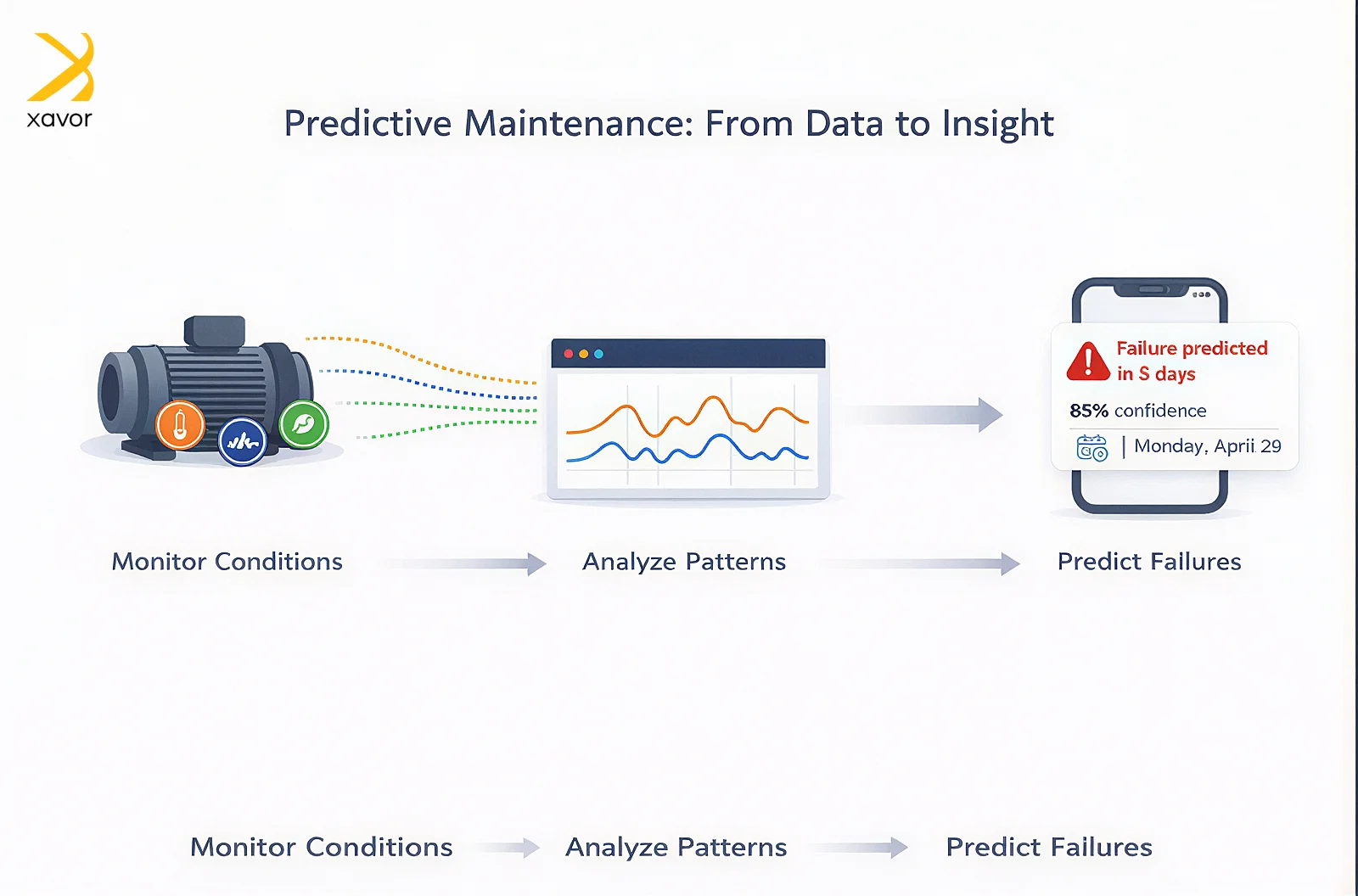
Predictive maintenance use cases often rely on condition-monitoring tools such as vibration analysis can alert teams when a machine begins to exhibit unusual behavior that may indicate wear or damage. Predictive maintenance software collects real-time data, analyzes it, and alerts maintenance staff so they can fix the issue early.
This proactive approach leads to fewer breakdowns, smoother operations, and longer machine life. It also improves scheduling by doing maintenance only when needed. This helps reduce costs and frees up resources.
Challenges of predictive maintenance
Predictive maintenance has clear benefits, but it also comes with a few challenges:
- Needs high-quality data: If sensor data is missing or inaccurate, the system can give wrong alerts or miss real problems.
- High setup cost: Companies often need to buy sensors, custom software, and supporting systems.
- Skills and training required: Teams must know how to read the insights and act on them. Training is usually needed.
- Hard to connect systems: It can be challenging to integrate new tools with older machines and existing software.
- Ongoing upkeep: Sensors and models need regular checks and updates to stay accurate.
What is prescriptive maintenance?
Prescriptive maintenance builds on predictive maintenance. It not only warns you about possible equipment failure but also tells you what steps to take next. It uses AI and machine learning to study data and give clear, practical recommendations.
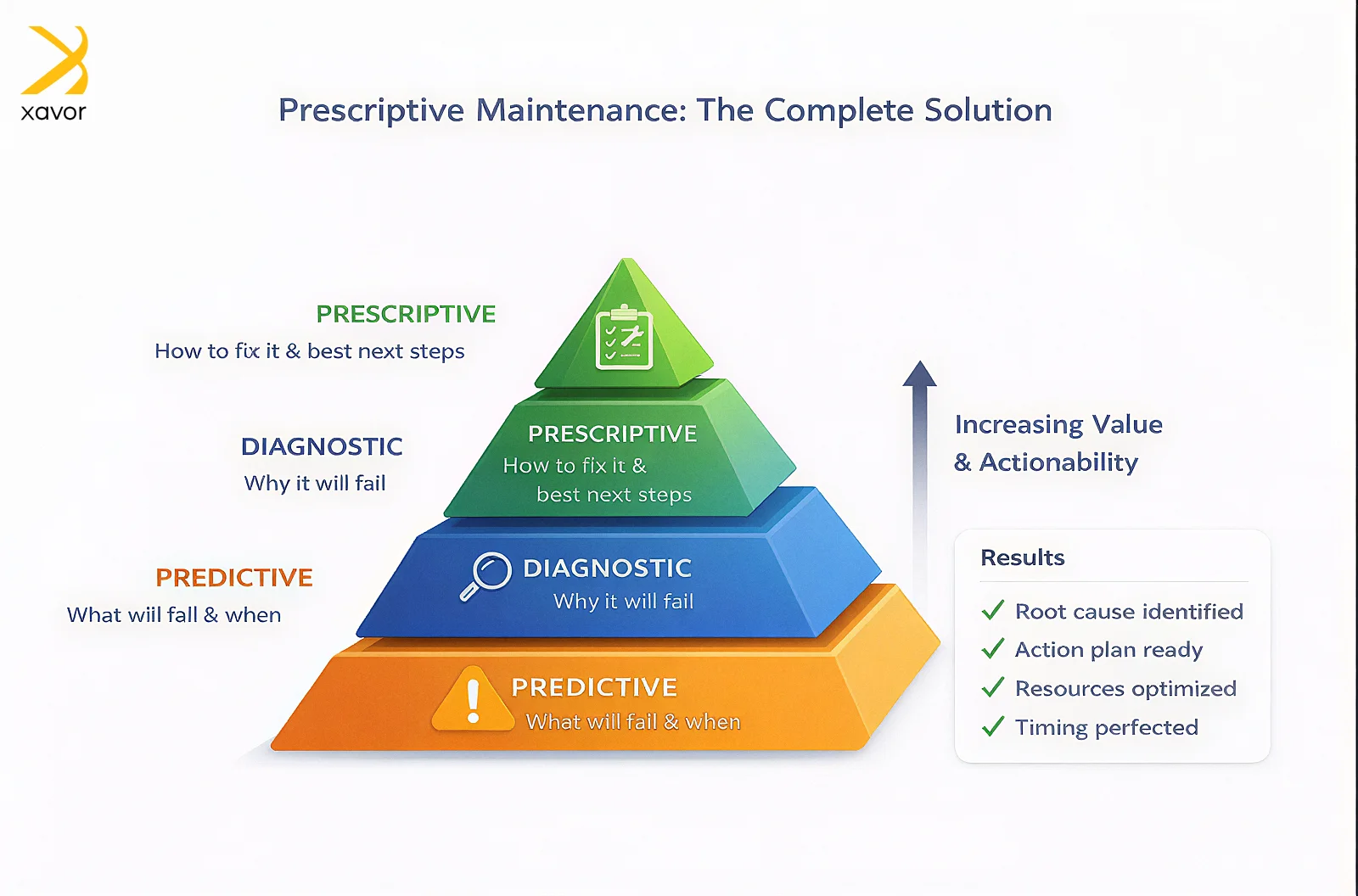
In simple words, it tells you what could go wrong, why it could happen, how to fix it, and when you should take action.
This makes maintenance planning more effective. Teams can identify the real cause of a problem and respond appropriately, such as changing machine settings, ordering parts, or booking repairs at the right time.
Benefits of prescriptive maintenance
- Finds the real cause of problems in detail
- Helps plan maintenance better, so work is done at the right time
- Supports better decisions with clear recommendations
- Improves safety and keeps machines running longer with fewer breakdowns
Overall, it helps companies achieve bigger goals by making equipment more reliable and ensuring maintenance funds are spent wisely.
Why teams struggle to move from predictive maintenance to prescriptive maintenance
When teams implement predictive models effectively, they often face a gap in daily maintenance work. A predictive system can highlight risk. Yet the team still spends time searching for manuals, job plans, safety procedures, and past work records to decide the correct response. In practice, maintenance scheduling tools like Sockeye often play a supporting role here by helping teams translate predictive alerts into coordinated service plans that fit production constraints.
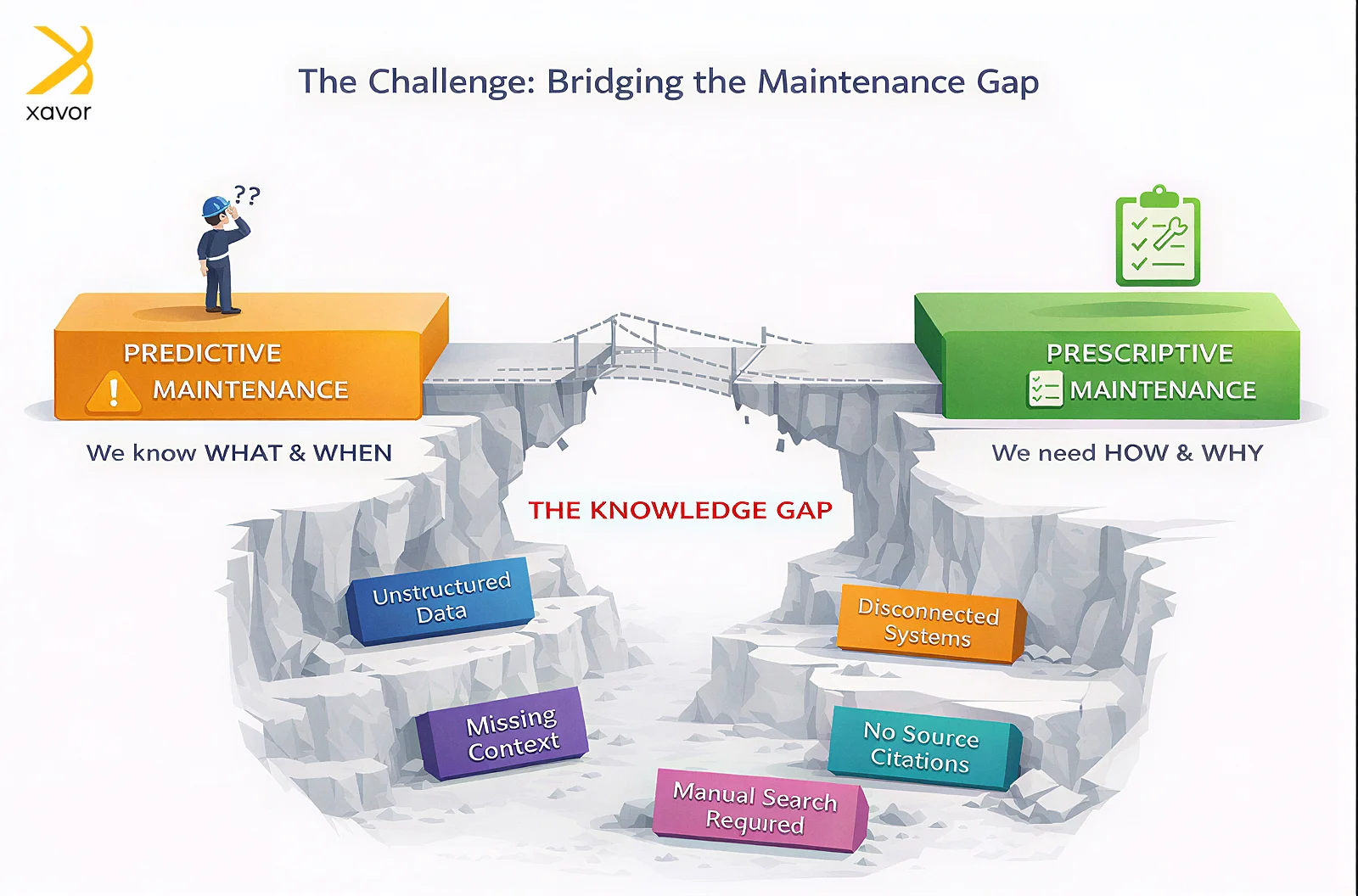
This gap appears for several reasons:
- Procedures and context do not live in the prediction
A prediction indicates a risk or impending failure. It does not contain a work plan or the site context required to decide what to do next. The predictive model usually knows only the signal patterns and the time window. It does not know the detailed procedures for each asset type and failure mode. - Maintenance knowledge is often unstructured
Static sources such as manuals, PDFs, text files, emails, and technician logs contain critical knowledge for fixing equipment. Knowledge base software can help teams organize and centralize this information, making maintenance documentation easier to search and retrieve. These sources are rarely indexed for fast retrieval. Technicians might know where to find a given manual, but often still need to search through hundreds of pages to find the right step in a procedure. - Context changes the right action
Two similar warning signals may require different responses depending on site conditions, spare parts availability, production schedule, crew expertise, and safety constraints. A prescriptive response should reflect these differences to be useful. - Technicians need evidence, not only recommendations
Technicians and planners often want to see the source of guidance. They want to confirm that a recommended step comes from an approved manual section, site standard, or reliable work history. Without these references, teams may mistrust automated suggestions.
This is the context where RAG can play a key role.
What RAG models do
Retrieval-augmented generation (RAG) combines retrieval and generation in a two-step process:
- Retrieve relevant information from a knowledge base, such as manuals, work orders, procedures, and logs, supported by data engineering foundations that enable reliable AI deployment.
- Generate a clear answer that uses the retrieved content as evidence.
RAG systems work differently from general large language models that generate text without direct access to source documents. A RAG model finds related content from a trusted knowledge store and produces a response that cites those sources.
In maintenance, RAG helps link predictive alerts to maintenance knowledge, such as manufacturer instructions and historical work order notes. That allows the system to formulate suggested steps that align with what the plant knows about the asset and the type of failure predicted.
RAG can use a vibration alert to locate the relevant manual section for a specific machine. It can also search stored work orders for similar issues. Based on that information, it can suggest actions and provide references to the sources.
How RAG bridges the predictive-prescriptive gap
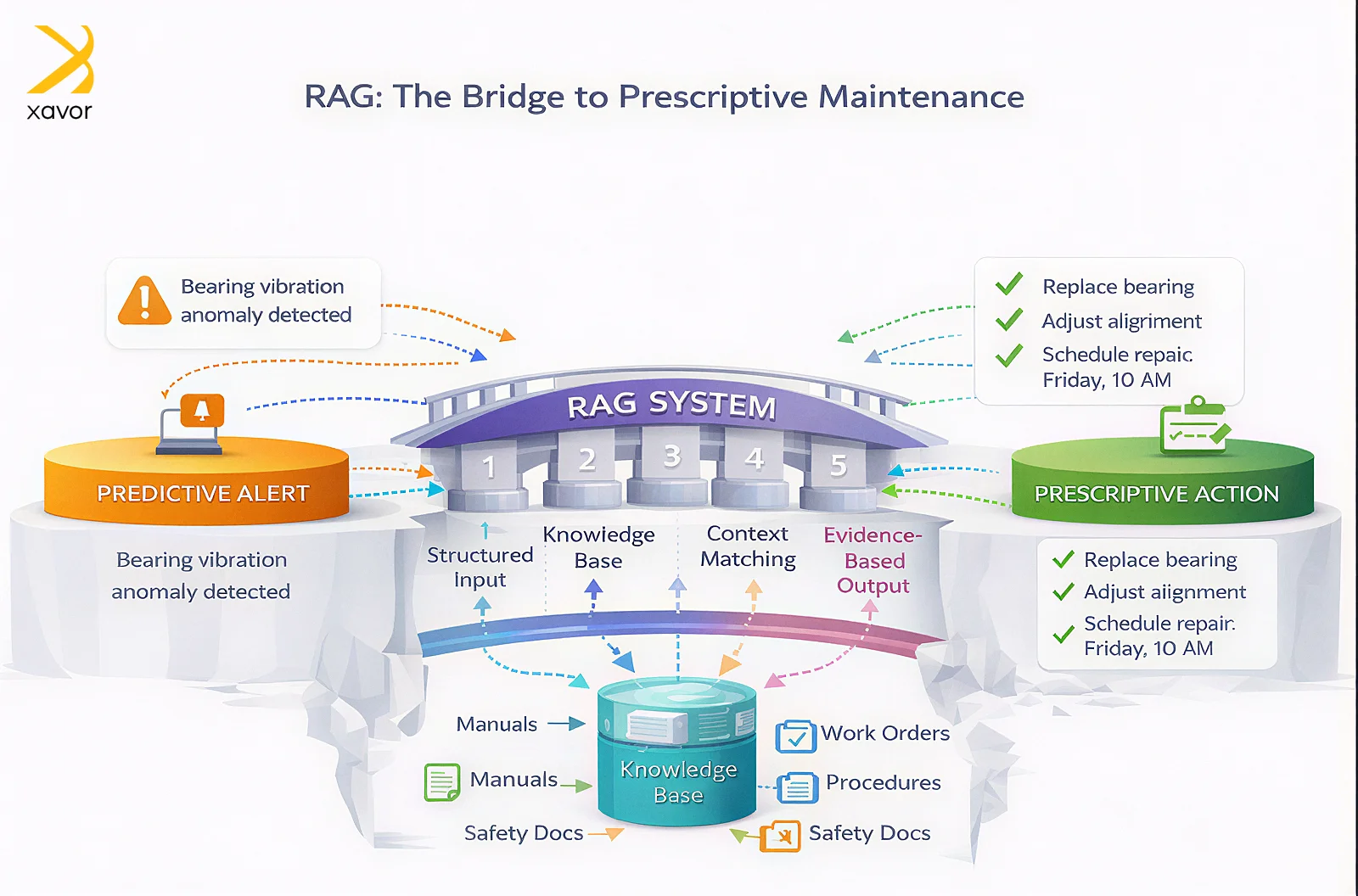
To connect predictive systems with a RAG-based assistant, teams can follow these steps:
1. Make predictive outputs structured
A predictive alert should include enough context so the RAG system can know which documents to check. It includes:
- Asset identifier, including asset type and model
- Likely failure pattern or encoded symptom label
- Severity and confidence levels
- Time window for planned action
- Snapshot of the key signals or metric values
This sets the context for the next stage.
2. Build a maintenance knowledge base
A good knowledge base must contain relevant and accurate content. Types of documents include:
- OEM manuals and procedural guides
- Site job plans and safety lockout steps
- Parts catalogs and approved substitutes
- Past work order text with technician notes
- Root cause analysis reports and engineering comments
Unstructured sources such as PDFs and logs should be converted to searchable text using modern data management tools that make maintenance content easier to organize, index, and retrieve. Each document should carry metadata such as an asset model, component type, document type, revision number, and safety tags.
3. Chunk and index content
Break large documents into smaller chunks that match how technicians use information. Good chunking might include one procedure section, one safety checklist, or one work order note per chunk.
Metadata lets the RAG system filter and retrieve the most relevant chunks first. For example, it can filter out documents for other asset types before running a similarity search.
4. Retrieve precise content, not just general matches
RAG retrieval must focus on relevance by asset model, revision, and context. The system should prefer the latest approved procedure sections and include at least one safety procedure chunk when the task requires isolation or locking out energy.
5. Generate prescriptive results with references
A prescriptive output should have a clear format that guides the user and references the sources:
- A brief situation overview
- Likely cause and why
- Step-by-step recommended actions
- Required parts, tools, and skills
- Safety and isolation steps
- Verification steps after the work
- Optional alternatives when constraints differ
- Source citations and links
The RAG model should always refer to the retrieved document sections rather than generating text that could invent values or steps without evidence.
Benefits of using RAG for maintenance
Across real-world rag use cases, RAG improves maintenance execution in three practical ways:
- Removes documentation silos: Technicians do not have to waste time digging through manuals. The AI quickly pulls up the right information for the issue they are facing.
- Automates root cause analysis: By reviewing data sources such as photos of damage or machine sounds, RAG can determine why a breakdown occurred, not just that it occurred.
- Preserves knowledge: When experienced technicians retire, their experience can be lost. RAG can save and use past repair notes so that new technicians can learn from the same advice later.
How Xavor can help you apply RAG to your maintenance workflows
Xavor can help you apply RAG to your maintenance workflows by connecting predictive maintenance alerts with the knowledge your teams already use. Instead of leaving technicians to interpret an alert on their own, Xavor brings together OEM manuals, site procedures, safety steps, and past work orders to support the next decision.
Xavor works alongside your existing predictive maintenance and CMMS systems. When an alert is triggered, it uses the asset and failure context to retrieve the most relevant information and present it as clear, actionable guidance. Each recommendation is tied back to approved documents, so teams can trust what they see and act faster.
This approach helps reduce time spent searching for information, improves consistency across sites, and makes it easier to turn early warnings into the right maintenance actions.
Conclusion
Predictive maintenance has already proven it can reduce failures by spotting risk early. The next opportunity is to make sure those insights lead to faster, more consistent decisions on the floor. That does not require replacing existing tools. It requires connecting them to the knowledge and context that technicians and planners rely on every day.
RAG models provide a practical way to do that by bringing the right guidance. Instead of relying on time-consuming searches or informal know-how, teams can use approved procedures and pull in relevant work history. They can also apply asset-specific context within a single workflow. Over time, this improves standardization, speeds of response, and helps scale best practices across sites.
If you want to explore how Xavor can help you apply RAG to your maintenance workflows, reach out to us at [email protected].

FAQs
Predictive maintenance tells you when an asset is likely to fail based on sensor data and patterns. While prescriptive maintenance goes further by telling you what to do next. It can include recommended steps, required parts, safety procedures, and timing so the team can act with clarity after an alert.
Because a prediction is mainly a risk signal. It usually does not include the procedures, site context, or evidence needed to turn the alert into an executable plan. Teams still spend time searching manuals, job plans, safety steps, and work history. The correct action can also change based on parts availability, production schedules, and safety constraints.
RAG, which stands for retrieval-augmented generation, helps by retrieving relevant information from trusted sources such as OEM manuals, site procedures, and work order history. It then generates a clear prescriptive recommendation using that content as evidence. This helps teams respond faster and with more confidence because they can verify where the guidance comes from.