

Enterprise resource planning (ERP) systems are the linchpin of modern business organizations. These enterprise-wide software systems integrate different departments into a single database. So, the top executives always know who’s doing what and how it affects everyone else in the company.
But as you would’ve guessed, a task of that magnitude is bound to be complex. An ERP implementation project requires careful planning for successful, timely results. Therefore, our ERP implementation services follow a phased-based ERP lifecycle that makes your system go live quickly without any roadblocks. The speed of execution directly affects how smoothly and successfully the system goes live.
It’s a 6-step ERP system integration process. So, go through this blog if you want to know the essentials of ERP implementation to apply to your own project.
What is ERP implementation?
An ERP is deployed through an implementation plan. It is the roadmap for putting your ERP system into place. ERPs are not magical software products that give desired outcomes ex nihilo. It is the implementation plan that determines how ERP software performs data integration to make a positive difference.
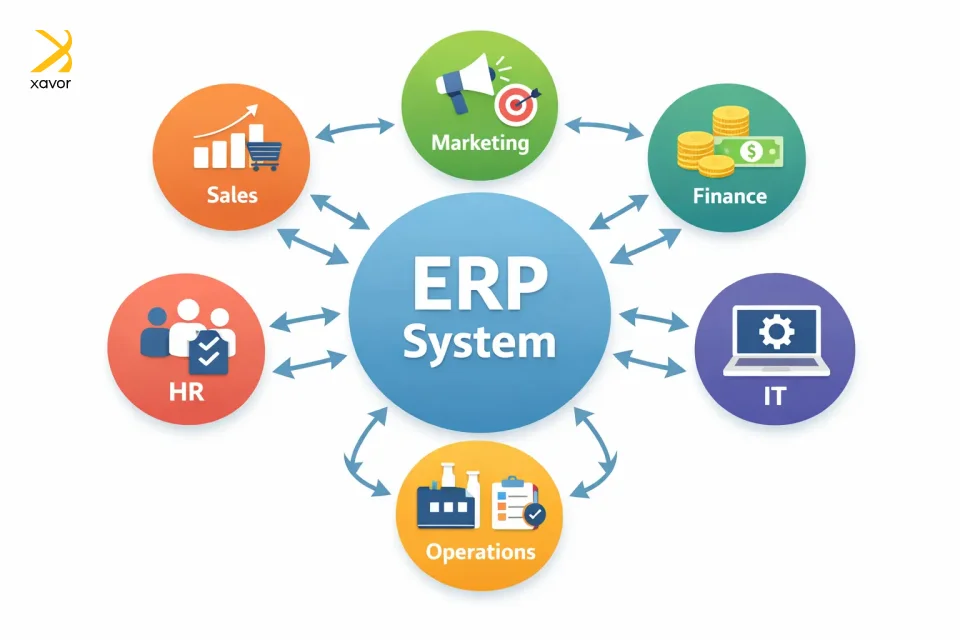
It’s a long process that can take a few months because ERP systems collect and centralize data from different departments, such as:
- Sales and marketing
- Finance
- Human resource (HR)
Now, usually companies prefer partnering with ERP implementation services for this purpose. The complexity of ERP integration solutions requires configuration and adoption. Only then can you connect often complex and high-impact business functions through an ERP system.
But what are those challenges that make it so difficult? Let’s go through it in the next section.
Why is ERP implementation challenging?
“70% of recently implemented ERP initiatives will fail to fully meet their original business case goals,” predicts Gartner in its report for 2027. “As many as 25% of these will fail catastrophically.” There is a reason why the advisory firm has a pessimistic outlook on the state of ERP software.
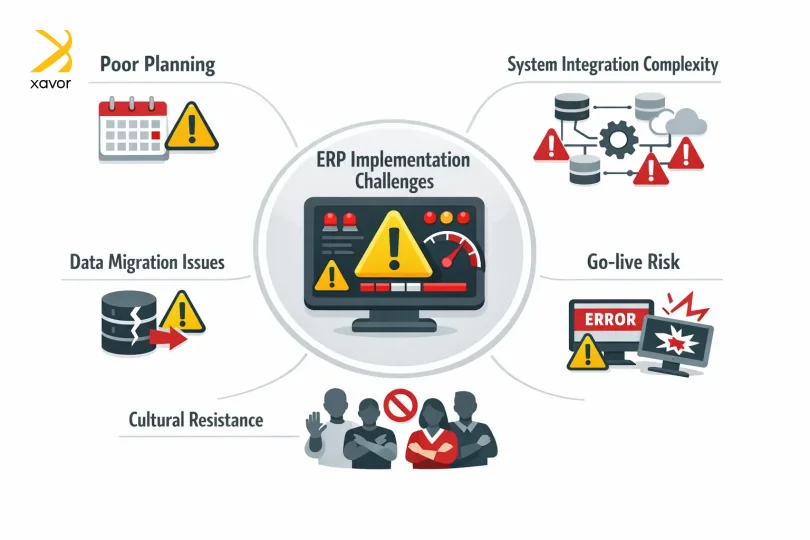
ERP integration challenges stem from complexity and sometimes the scale of the project. The whole process is about people as much as it is about technology. That is why ERP implementation services run into both human and technical roadblocks along the way.
Ultimately, every ERP project exists to serve the business, which makes alignment with business needs critical for success.
1. Project planning
Many organizations go over budget or miss deadlines simply because they didn’t plan realistically from the start. ERP projects follow strict timelines, and when those timelines are unrealistic, they directly increase implementation risk.
Two of the biggest culprits for this are ad hoc feature addition and underestimating how much IT staff and time the project will need.
2. Data migration
ERP is all about bringing all your data into one reliable place, but getting there isn’t always easy. Data migration from old systems into the new ERP can be tricky. And when that data is scattered across tools and departments, it’s 2X the challenge.
3. Data integration
Businesses run ERP systems along with a ton of other business tools, like CRM, PLM, ITSM, and other platforms. So, ERP integration services often need to connect ERP systems with these applications, which are difficult to customize and configure.
4. Cultural resistance
People prefer their comfort zones. Especially if things work the old way, employees don’t bother adapting to newer technologies. And when they do try, struggling to adopt new workflows and responsibilities slows down implementation and reduces ERP value.
5. Go-live risk
ERP implementation services that rush testing before launch put organizations in great trouble. Problems that could have been caught early become far more expensive once the system is already live. Skipping thorough testing also means workflows may not reflect how the business actually operates.
What Xavor’s ERP implementation services do different
Our ERP consultants follow a tried and tested strategy to shape the implementation plan. This strategy balances risk while driving speed, enabling faster execution without compromising stability.
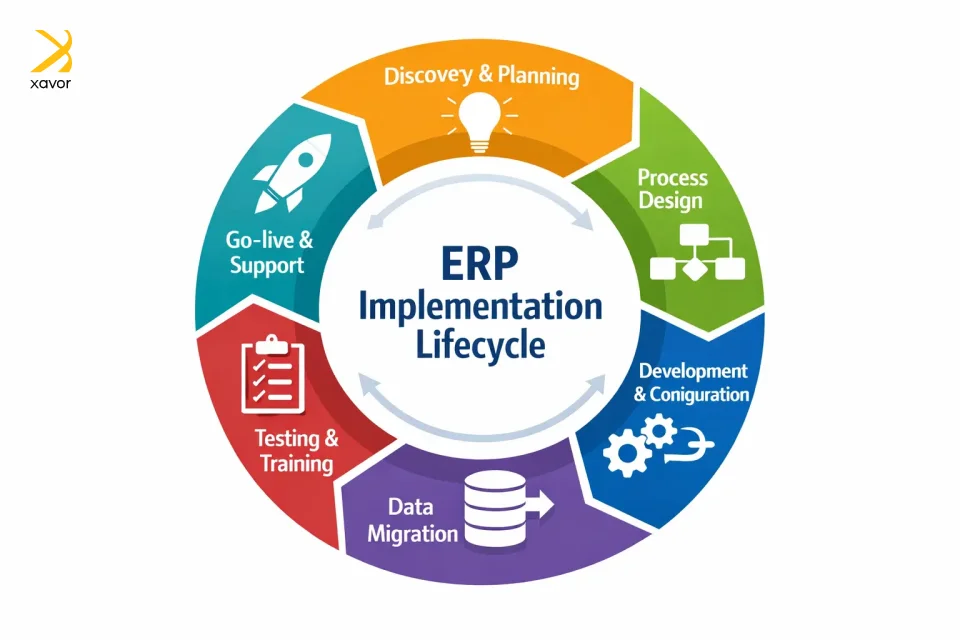
So, what do we do? We divide implementation into six phases. These phases structure the project so that each stage contributes to controlled and measurable progress.
1. Discovery and planning
Our ERP consulting services start things off by laying a solid foundation before any implementation begins. This means understanding where your current processes are falling short, defining what you need the ERP system to do, and building a clear picture of what success looks like.
Our dedicated project team is essential at this stage, including an executive sponsor, a project manager, and representatives from key departments like operations and IT. Moreover, our ERP implementation services engage your senior leadership, which is critical to drive the organizational change that comes with a new system. Doing this is very important for B2B ERP integration.
Xavor’s ERP consulting also provides expertise to find blind spots that your internal teams might miss.
At the same time, we gather inputs from across the organization since each group offers a different view of what’s working and what isn’t. Usually, we select the right ERP system for your needs in this phase as well. For example, the choice between on-premises and cloud-based ERP integration solutions.
Once done, this phase sets the direction for everything that follows. That is why our ERP implementation services treat it as one of the most important investments of time in the entire implementation.
2. Business process design
With a clear picture of business needs in hand, our experts get into the specifics of designing the business process for your new ERP system. In practice, that involves:
- Mapping out existing workflows
- Identifying where the gaps are
- Deciding how the new ERP system will address them
Gap analysis is essential for doing all of this. Our ERP implementation services examine the difference between how things currently work and how they should work. Furthermore, we determine whether the ERP needs to be customized or certain processes need to be adjusted to align with the system’s standard capabilities.
Involving end users in this phase is just as important as technical work. The people who use these processes daily have the clearest understanding of how things actually operate. Therefore, we bring them in early to improve the design, which builds familiarity and buy-in before the system goes live.
3. Development and system configuration
Next comes building and setting up the ERP system. Our ERP implementation services configure the software to match your redesigned workflows. And customize it to fit requirements if the standard system can’t meet your needs out of the box.
For on-premises deployments, we also install the necessary hardware and infrastructure, while cloud-based implementations require decisions about where critical data will be stored.
Alongside the technical work, Xavor’s team runs two equally important tasks. First, we develop training materials, so users are ready when the system goes live. Second, our ERP implementation services plan data migration beforehand. A common mistake here is migrating everything indiscriminately. But we pinpoint selective data that’s actually relevant and accurate.
4. Data migration with strategy
Moving data from old systems into the new platform carelessly can lead to a plethora of issues that can wreck your whole project.
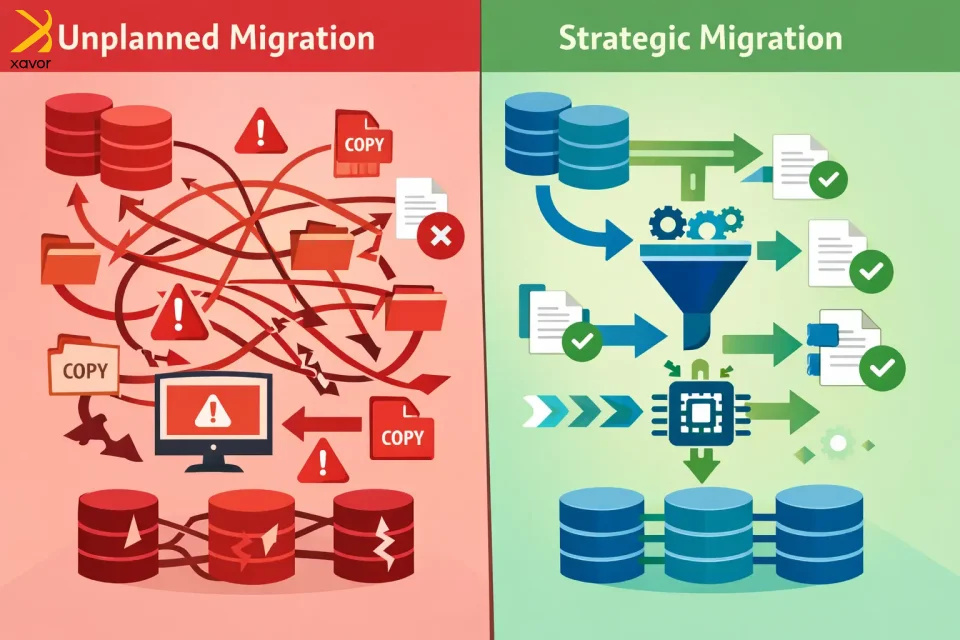
Xavor follows a solid migration strategy, which starts before any data is moved. Our ERP implementation services audit what data you currently have and then decide what’s actually worth migrating. This is followed by cleaning up duplicates and errors. Finally, we map how data from old formats will translate into the new system.
Furthermore, it is our principle to test migration in stages rather than do it all at once. A phased approach gives our teams the chance to catch and fix issues early to reduce the risk of a large-scale failure. Having a recovery plan in place is equally important in our playbook.
5. Testing and training
We make sure testing and training happen side by side for a successful go-live.
On the testing side, Xavor’s ERP implementation services conduct a thorough testing process, which covers:
- Individual modules
- End-to-end workflows
- Migrated data accuracy
- System security
- Compatibility with other tools
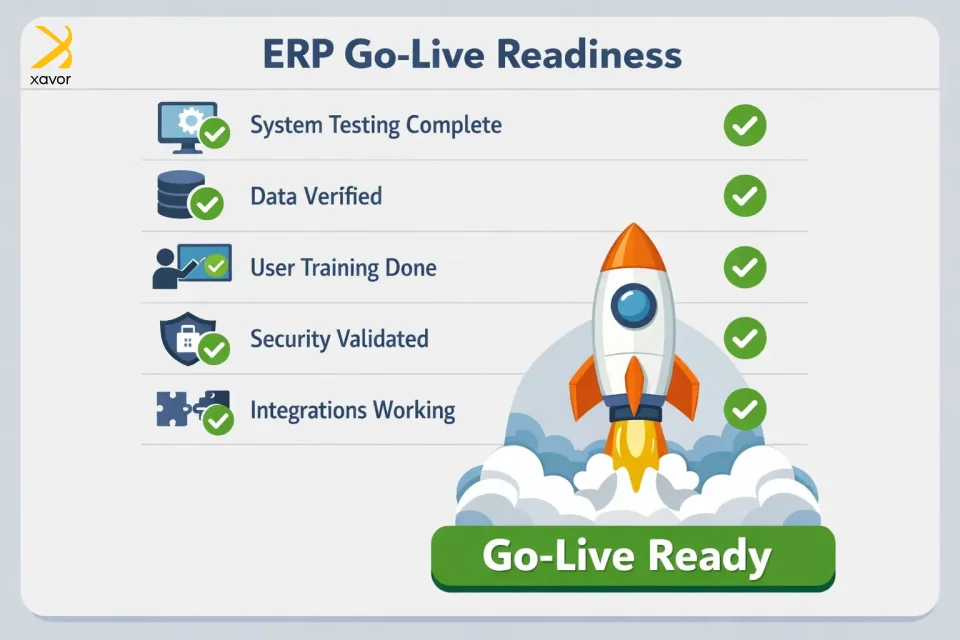
Furthermore, we particularly emphasize on User acceptance testing (UAT), so actual employees test the system against their real day-to-day tasks. UAT surfaces usability issues that technical teams might miss. And our testing approach is iterative to identify issues, fix them, and retest before moving forward.
On the training side, a one-size-fits-all approach rarely works. Therefore, we tailor training programs around different user roles and business scenarios. Our aim is to make employees feel confident when the system goes live. And that is where the role-specific materials developed during the earlier phases are far more effective.
6. Go-live and support
Go-live is the moment everything comes together. Our approach is to start with a soft launch, rolling the system out to a small group of users first before a full company-wide deployment. This is a smart way to catch any last-minute issues.
Once live, Xavor’s ERP implementation services ensure real-time user access, data accuracy, and proper security. It’s important to set realistic expectations at this stage. Productivity may dip initially as employees adjust to the new system. This is normal, so you don’t need to panic because of it.
That is why our implementation team is on hand to support users through the transition. We also employ self-service resources for minor issues. The more support channels available, the smoother the adoption.
Finally, go-live isn’t the end of the journey. Therefore, we schedule regular reviews to assess system performance, install upgrades, and identify areas for improvement. This is necessary to ensure the ERP continues to deliver value long after launch. In this sense, the implementation process is never truly finished. Each round of improvements feeds back into a new phase of discovery and refinement.
Conclusion
Implementing new software is a test of organizational readiness. ERP systems are no different. The persistent failure rates of ERP integration solutions reveal that most companies underestimate what they’re actually signing up for. A forced reckoning with data quality, process inefficiency, and human resistance to change, all at once.
The technical complexity is real, but it’s not the biggest worry. Instead, leadership alignment, employee buy-in, and realistic planning most often determine whether an ERP delivers on its promise or becomes an expensive cautionary tale. Compounding this is the strategic weight of decisions made early in the process.
Yes, that is quite a lot to process for companies at once. That’s why you should partner with ERP implementation services. Xavors’s software integration services provide you with expertise in ERP system integration to build a system that actually works for your business. Contact us at [email protected] to plan your ERP transition.

FAQs
ERP implementation is the process of planning, configuring, deploying, and integrating an ERP system into a business’s operations. It typically involves aligning the software with business processes, migrating data, training users, and testing the system before go-live.
An ERP manages core business operations like finance, supply chain, inventory, and HR across the organization. A CRM focuses on customer-facing activities such as sales, marketing, and customer service.
Yes, ERP implementation can be challenging because it involves more than installing software. It requires process changes, data migration, system integration, and user adoption. With the right planning and implementation partner, though, the process becomes far more manageable and successful.