

A shopper searching for a sofa may have a specific budget and limited living room space, yet an online furniture store could have hundreds of options to choose from. An ecommerce recommendation engine narrows those choices using product information and shopper behavior, helping retailers suggest products that match customer needs. Building such experiences requires reliable data and well-designed systems, supported by custom ecommerce development services.
What is an ecommerce recommendation engine?
An ecommerce recommendation engine is a software system that suggests products based on shopper interests and available product information. It uses customer behavior and defined business rules to identify suitable items, then determines which products to display.
Retailers use recommendation engines to help customers discover relevant products from large catalogs. A furniture store, for example, might suggest sofas similar to one a customer has viewed or recommend a coffee table that other customers frequently purchase with it.
Depending on the system, these recommendations can be generated through predefined rules or machine learning algorithms. Many ecommerce businesses use a combination of both approaches.
How does an ecommerce recommendation engine work?
A product recommendation engine analyzes shopper behavior alongside product information to identify suitable items. It then filters the available options based on specific requirements before ranking the most relevant products for display on the storefront.
Collecting shopper and product data
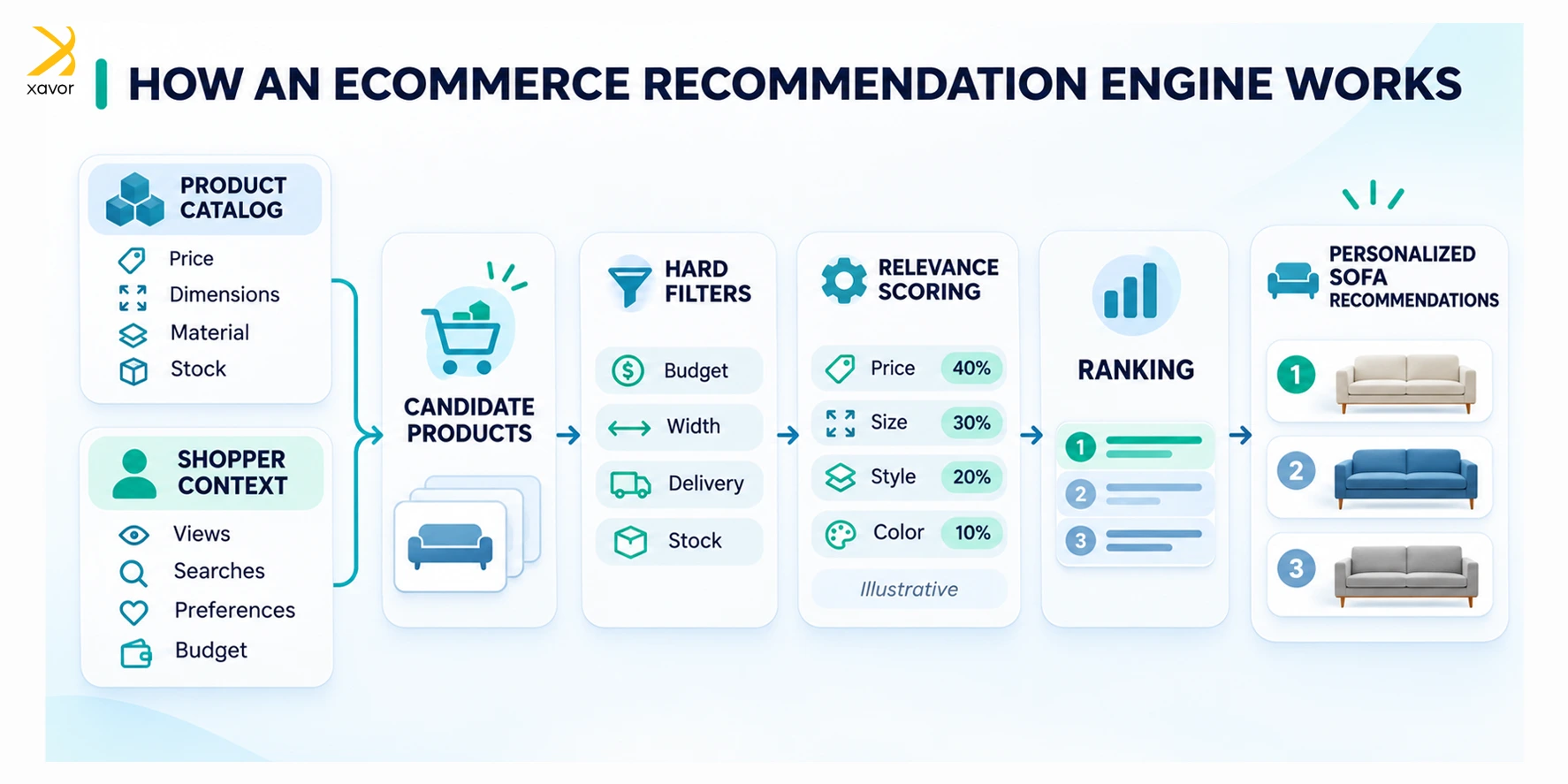
The engine starts by gathering catalog information, including product dimensions, materials, prices and stock availability. It may also use customer browsing activity alongside purchase history and stated preferences to understand what a shopper is looking for.
For example, suppose a shopper has viewed several beige sofas priced between $800 and $1,200. This behavior suggests an interest in that style and price range, although it does not necessarily indicate purchase intent. The engine can use these signals to generate an initial group of candidate products, reducing the number of items that require detailed evaluation in larger systems.
Filtering products based on attributes
Product filtering removes items that fail the shopper’s requirements or the retailer’s conditions. If a customer specifies a maximum sofa width of 80 inches, the engine excludes wider models. Products that exceed a mandatory budget limit or cannot be delivered to the customer’s location may also be removed.
These conditions are known as hard filters. Once a product fails a required condition, a high relevance score cannot make it eligible again. Amazon Personalize’s filtering documentation explains how recommendation systems can include or exclude products using catalog metadata and customer interaction history.
Calculating relevance through weighted scoring
After filtering, the engine can evaluate the remaining products through weighted scoring. A weighted scoring recommendation engine assigns different levels of importance to matching criteria based on their relevance to the shopper. For a furniture retailer, price and dimensions may carry more weight than color when determining how closely a sofa matches customer preferences.
Consider this illustrative formula:
Relevance score = (Price match × 40%) + (Size match × 30%) + (Style match × 20%) + (Color match × 10%)
Each factor receives a normalized score, which is multiplied by its assigned weight to calculate the overall relevance. Products that more closely match the shopper’s preferences receive higher scores. These percentages are hypothetical and demonstrate one possible approach. Machine-learning systems may instead calculate relevance using trained models rather than manually assigned weights.
Ranking and displaying recommendations
Once relevance scores are calculated, a product ranking algorithm determines the order in which eligible products appear. Merchandising rules may further influence this order, such as giving preference to products with shorter delivery times. The system then returns the selected products to the storefront, where they appear through a recommendation widget or an API connected to the ecommerce website. Xavor’s guide to ecommerce microservices architecture explores how recommendation engines can operate as independent services within an ecommerce platform.
Recommendation engine workflow
The following diagram illustrates how an ecommerce recommendation engine processes product data and shopper information to generate relevant suggestions. The exact sequence may vary depending on the system.
Recommendations may also change as customers continue browsing. Some systems use recent activity to update suggestions during a shopping session, while others rely on previously calculated results.
What data do ecommerce recommendation engines use?
Recommendation engine data requirements depend on the algorithm and the desired level of personalization. Product attributes can support recommendations without customer history, whereas collaborative methods typically require interaction records from multiple shoppers.
| Data type | Examples | How the engine uses it |
| Product catalog | Price, category, dimensions, material | Matches products to requirements |
| Browsing behavior | Product views, searches, clicks | Identifies current interests |
| Purchase history | Previous orders, products bought together | Finds purchasing relationships |
| Spending patterns | Typical purchase price, past order values | Estimates suitable price ranges |
| Preferences | Selected colors, saved categories | Refines product selection |
| Shopper context | Current page, cart contents, delivery location | Adjusts recommendations to the current request |
Data quality affects every stage, as missing furniture dimensions may exclude otherwise suitable sofas from size-filtered results, while incorrect inventory information could lead to recommendations for unavailable products.
Xavor’s article on Salesforce Customer 360 explains how businesses can connect purchase history with digital behavior to develop a more consistent understanding of customer activity.
Types of product recommendation algorithms
Product recommendation algorithms identify relevant items using different methods, depending on the available data.
Rule-based recommendations
Rule-based systems follow conditions set by the retailer. A furniture store might recommend matching ottomans when someone views a sofa from a particular collection.
These recommendations offer direct control and work with limited behavioral data. However, rules require maintenance as products change.
Content-based filtering
Content-based filtering recommends products with characteristics similar to items the shopper has shown interest in.
For example, someone browsing a compact velvet sofa may see other compact velvet sofas within a similar price range.
A recommendation engine that relies on product attributes can suggest newly listed products based on their characteristics, even before they accumulate purchase history.
Collaborative filtering
Collaborative filtering in ecommerce identifies relationships through customer interactions.
If many shoppers purchase a particular sofa alongside a matching coffee table, the system may recommend that table to someone considering the sofa.
The relationship comes from observed behavior rather than product descriptions. As Algolia’s recommendation guide explains, collaborative methods use interaction patterns to identify products that may interest the same shoppers.
Hybrid recommendation systems
A hybrid recommendation system combines multiple methods to improve product selection.
A furniture retailer could use content-based filtering to find sofas with suitable dimensions, collaborative filtering to identify related products, and business rules to enforce availability requirements.
| Approach | Main advantage | Main limitation |
| Rule-based | Direct merchant control | Requires rule maintenance |
| Content-based | Works with detailed catalog data | May repeat similar suggestions |
| Collaborative | Learns relationships from behavior | Needs sufficient interaction history |
| Hybrid | Combines different relevance signals | Requires more configuration and oversight |
How does AI improve ecommerce product recommendations?
An AI recommendation engine for ecommerce learns from historical customer interactions to identify patterns and predict which products shoppers may find relevant.
For example, a model might identify that customers browsing certain contemporary sofas frequently purchase particular lighting styles. The system can use this relationship to generate recommendations for another shopper with similar interests. Machine learning can also calculate relevance scores based on learned patterns, allowing the engine to rank products according to their estimated suitability.
Some systems incorporate recent browsing activity to adjust recommendations during the shopping session. Clerk.io’s technical documentation describes an approach that combines previously calculated models with live visitor behavior to generate product suggestions. Business rules continue to control eligibility, ensuring that recommendations meet requirements such as stock availability or product suitability.
Xavor’s custom AI development services cover machine-learning development and the integration of AI into business systems.
What happens when there is not enough customer data?
The cold-start problem occurs when a recommendation system lacks sufficient customer interaction data to suggest relevant products.
Several fallback methods can help:
- Use bestsellers or trending products when a shopper has no history.
- Recommend products with similar attributes when an item is newly listed.
- Use current-session browsing behavior to identify immediate interests.
- Apply category-based recommendations or manually defined merchandising rules.
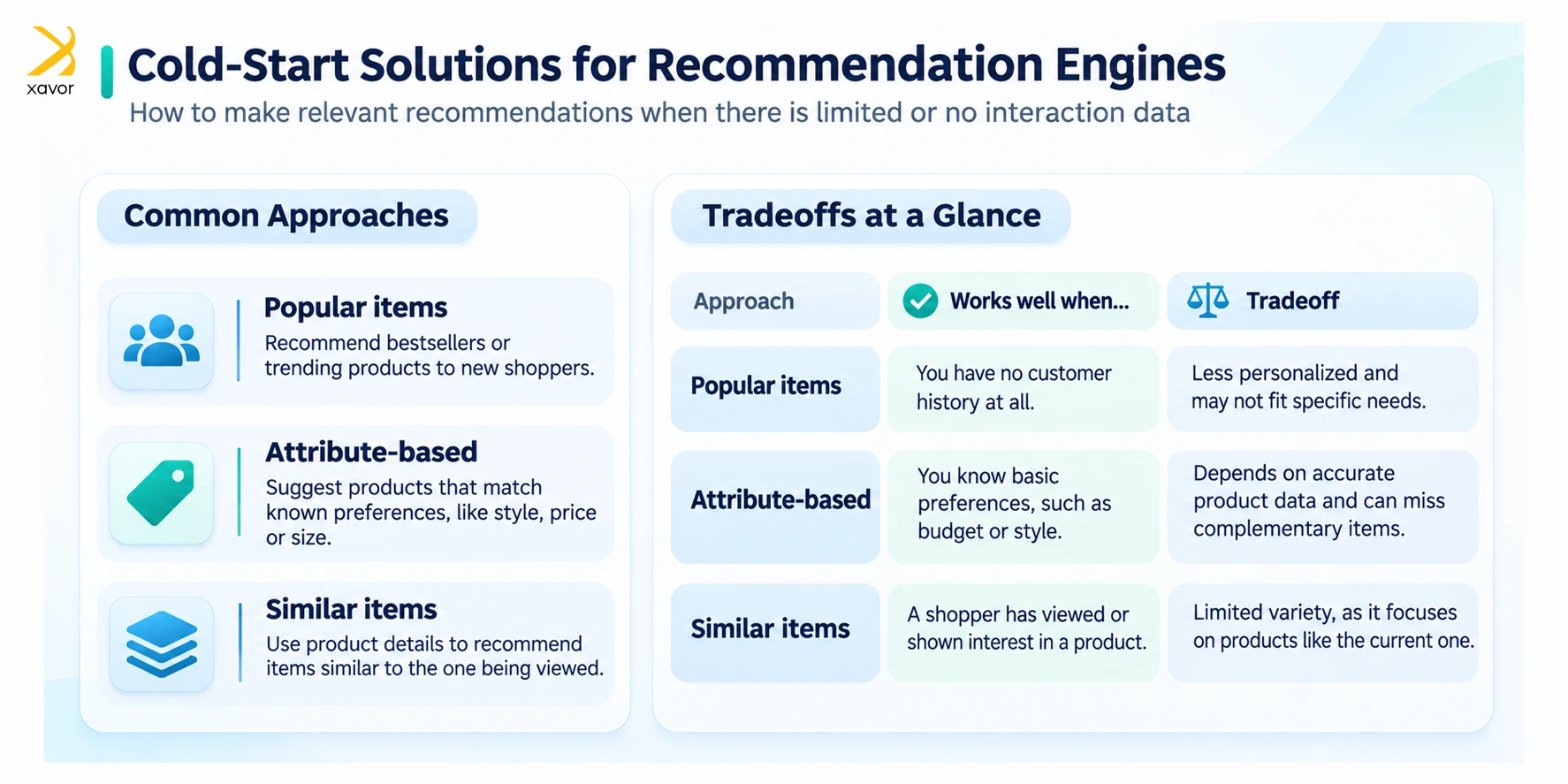
Each method involves tradeoffs. Popularity-based suggestions are easy to generate but may be generic. Attribute-based recommendations depend on accurate catalog information and may overlook complementary products.
How can businesses choose the right recommendation approach?
Businesses should choose a recommendation approach based on the data available to them and the complexity of their product catalog. Product requirements also influence which method will work best.
Three considerations deserve attention.
First, assess the available data. Stores with limited purchase history may benefit from attribute-based recommendations and defined rules. Businesses with extensive customer interactions can evaluate collaborative filtering or machine learning.
Next, examine product constraints. Where compatibility or dimensions determine suitability, filtering requirements should be established before ranking preferences.
Finally, consider the integration and maintenance work. The recommendation system needs reliable access to product information, current inventory, and relevant shopper activity. Xavor’s retail AI case study shows how a multi-agent AI solution can support personalized product discovery using retail catalog information.
Conclusion
An ecommerce recommendation engine uses product data and shopper behavior to deliver relevant product suggestions. Filtering ensures that products meet the required conditions, while scoring and ranking determine which options best match customer preferences. AI can further improve recommendation accuracy when sufficient data is available, helping businesses create more personalized shopping experiences.
To implement personalized product recommendations with Xavor’s web application development and AI services, contact us at [email protected] to discuss your ecommerce requirements.

FAQs
A search engine retrieves products based on a shopper's query. A recommendation engine selects products using available context, such as browsing behavior or product relationships. Ecommerce websites can use both systems together.
Yes. Rule-based systems can recommend products using predefined conditions. Popularity rankings and manually defined product relationships can also produce useful recommendations without machine learning.
Weighted scoring assigns different importance levels to product matching criteria. The system combines those scores to determine how closely each eligible product meets the shopper's preferences.