

Healthcare is undergoing a significant transformation, and healthcare data analytics is at the heart of this change. With the rise of digital tools and a vast amount of patient data, healthcare organizations now can predict patient needs, improve care delivery, and streamline operations. The power of data analytics goes beyond just managing information; it’s about using that data to make better decisions and improve patient outcomes.
In healthcare, data analytics can detect patterns, predict health risks, and optimize resources before issues become critical. By analyzing health records, treatment histories, and other data sources, healthcare providers can respond faster, provide personalized care, and improve efficiency. Healthcare organizations are seeking the support of healthcare data analytics services to utilize the expertise and tools that enable the successful implementation of data-driven strategies.
In this article, we’ll explore how healthcare data analytics is being used to predict patient needs, its various types, and how it’s impacting patient care and operational performance. We’ll look at the tangible benefits, share real-world examples, and examine the future of healthcare analytics by 2026. Additionally, we’ll discuss the challenges healthcare organizations face as they integrate data-driven solutions into their operations.
Why is data analytics important in healthcare
Healthcare data analytics is important because it helps identify patient needs earlier. Many health conditions develop over time, and warning signs often appear before symptoms become obvious. By using data from patient records and past outcomes, healthcare organizations can spot these early signals and respond before problems grow.
Data analytics also helps bring clarity to decisions. When patient information is reviewed over time and across groups, it becomes easier to understand who needs care, when that care is needed, and how urgent the situation is. This supports more consistent decisions and reduces reliance on late observations or guesswork.
At a broader level, data analytics helps healthcare systems work better for patients, especially as the growing role of AI in healthcare continues to shape how care is delivered. Earlier understanding of patient needs leads to fewer complications and better use of available resources. This helps healthcare systems provide steady and patient-focused care.
Benefits of big data analytics in healthcare
Big data analytics offers significant advantages for healthcare organizations. Here are the key benefits:
1. Improved patient outcomes
Big data analytics allows healthcare providers to personalize treatment based on a patient’s medical history and current condition. Predictive models identify risks early, enabling timely interventions that can prevent complications and improve long-term health outcomes.
2. Cost reduction
Predictive analytics helps healthcare organizations reduce unnecessary treatments and hospital readmissions by identifying high-risk patients early. This proactive approach avoids expensive emergency interventions and improves the overall efficiency of healthcare delivery, ultimately saving costs.
3. Efficient resource allocation
Analytics help ensure that healthcare resources are used effectively. Predictive models can determine which patients need the most urgent care, allowing hospitals to allocate medical staff, equipment, and beds where they are needed most. This improves the organization’s ability to manage high patient volumes without overburdening staff.
4. Faster decision-making
Access to real-time data allows healthcare professionals to make quicker, more informed decisions. With predictive analytics, providers can identify risks early and decide on the best course of action more efficiently, improving care delivery and reducing wait times.
5. Better patient satisfaction
Personalized care increases patient satisfaction. With the help of data analytics, healthcare providers can adjust care plans based on individual needs and preferences. This leads to a better experience for patients, as they receive timely and targeted care, reducing frustration and improving overall health outcomes.
To fully take advantage of these benefits, healthcare organizations need a solid plan for using data analytics effectively. Check out our article on best practices for building a successful analytics strategy to get started.
Key types of healthcare data analytics
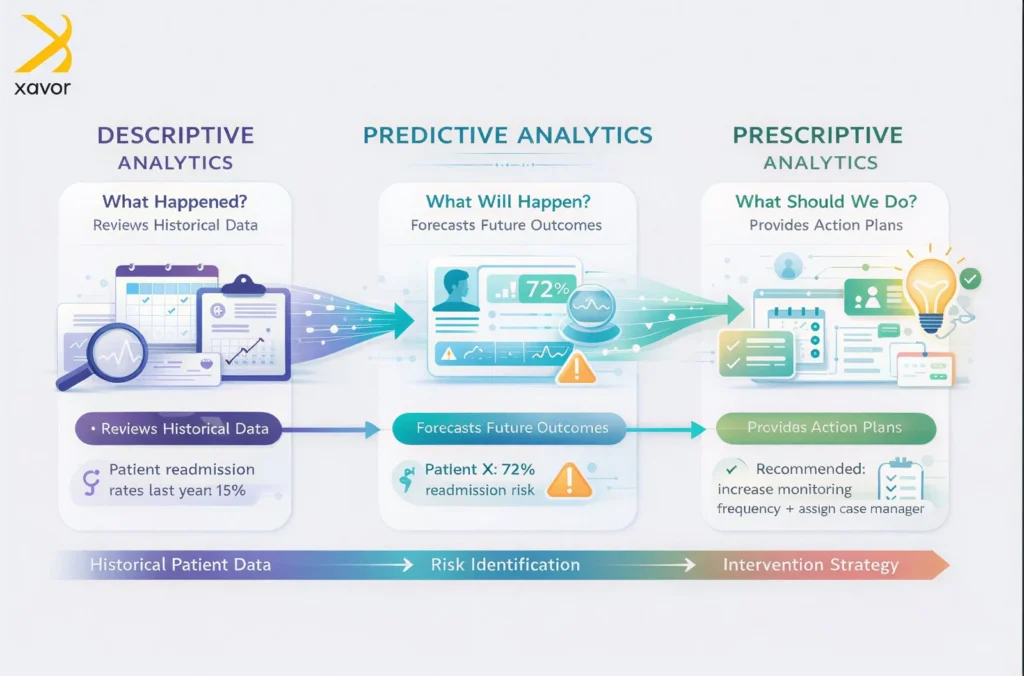
Healthcare data analytics can be divided into three main types:
1. Descriptive analytics
Descriptive analytics reviews historical data to identify trends and performance patterns. This helps healthcare organizations evaluate past outcomes and improve care delivery strategies.
2. Predictive analytics
Predictive analytics forecasts future outcomes based on past data. It allows healthcare providers to identify at-risk patients and intervene early, reducing the likelihood of complications and hospital readmissions.
3. Prescriptive analytics
Prescriptive analytics provides actionable recommendations based on insights from descriptive and predictive analytics. It helps healthcare professionals make informed decisions on patient care, treatment planning, and resource allocation.
Proven examples of data analytics improving patient need prediction
1. Early risk prediction
One of the most established roles of healthcare data analytics is early risk prediction. By analyzing historical patient data, vital trends, and longitudinal patterns, analytics can identify deterioration before symptoms become clinically obvious.
Hospitals using predictive analytics have reported significant reductions in readmissions and mortality, driven by earlier intervention rather than post-event response.
A widely cited example is UCSF Health, where data-driven models are used to predict sepsis and respiratory failure before clinical symptoms appear. This allows care teams to intervene earlier, reducing adverse events and improving survival rates.
Earlier identification of patient needs shifts care from crisis response to planned intervention.
2. Personalized care
Healthcare data analytics also improves the prediction of treatment needs by identifying which interventions are most appropriate for individual patients earlier in the care process.
Memorial Sloan Kettering Cancer Center, working with Flatiron Health, analyzes large volumes of real-world oncology data to guide treatment decisions. This approach allows clinicians to match patient treatment needs more accurately from the outset.
The results include:
- Better clinical outcomes
- Fewer treatment-related side effects
- Lower treatment waste
This demonstrates how analytics improves prediction accuracy related to patient treatment needs, not simply treatment selection.
Emerging trends expanding patient need prediction
AI predictive models that forecast 1,000+ diseases
Healthcare data analytics is extending patient need prediction beyond near-term risk.
The Delphi-2M model, developed using health records from approximately two million patients, analyzes long-term health trajectories to predict risk for over 1,000 diseases decades in advance. Research indicates that this model outperforms traditional clinical risk scores by identifying disease patterns earlier across a patient’s life course.
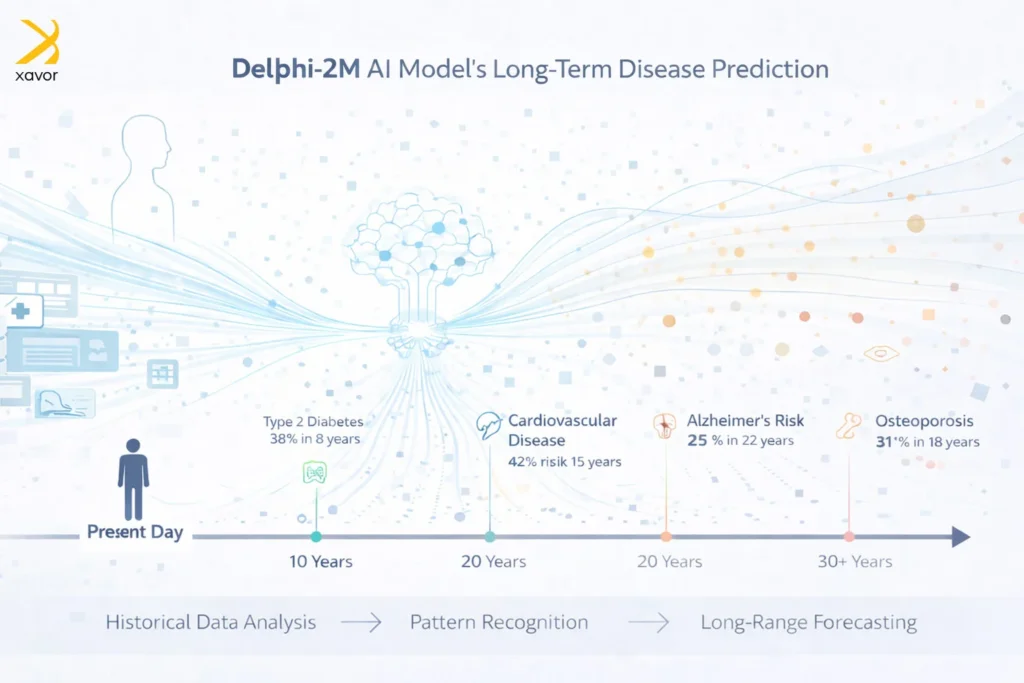
This capability allows healthcare organizations to anticipate patient needs long before symptoms emerge, supporting prevention planning and early engagement strategies.
This represents a shift from short-term reaction to long-range patient need forecasting.
Digital twins for patient simulation
Digital patient models, often referred to as digital twins, are emerging as another extension of predictive analytics.
These models simulate patient outcomes by analyzing existing data and projected scenarios. The objective is to anticipate how patient needs may develop under different conditions and interventions.
While still evolving, this approach enables:
- Earlier identification of potential patient risk
- More informed planning around patient needs
- Improved prioritization of care resources
Digital patient modeling reinforces the expanding role of analytics in predicting future patient needs rather than responding after escalation.
Virtual wards and risk stratification care delivery
Predictive analytics is also being applied to identify patient needs outside traditional inpatient settings.
Virtual ward programs, such as those implemented by the UK National Health Service, rely on predictive risk scoring to identify high-risk patients suitable for remote monitoring. Analytics determines which patients require escalation and which can be safely managed through continuous observation.
These programs have demonstrated:
- Reduced hospital load
- Lower cost per patient
- Maintained or improved patient outcomes
This model depends entirely on accurate prediction of patient needs, reinforcing the importance of analytics-driven foresight.
The impact of data analytics in healthcare
The financial and strategic impact of healthcare data analytics is profound. According to McKinsey, the improved use of healthcare data analytics could save the U.S. healthcare system up to $300 billion annually. These savings are driven by:
- Lower readmissions
- Reduced adverse events
- More efficient allocation of care resources
Moreover, predictive analytics helps healthcare organizations transition from a fee-for-service model to value-based care, which prioritizes patient outcomes over the volume of services provided. The ability to predict and address patient needs early not only leads to better care but also supports the long-term sustainability of healthcare organizations.
Why many healthcare organizations struggle to predict patient needs
Many healthcare organizations face challenges in using data analytics to predict patient needs early. A major problem is that the insights often come too late, are unclear, or are not trusted by healthcare providers. As a result, many healthcare systems continue to rely on traditional methods of observation instead of using predictive analytics to identify patient needs sooner.
For analytics to be effective, it must be integrated into everyday workflows, offering real-time insights that are clear and easy to act on. The issue isn’t that the tools are unavailable, but that they need to deliver timely and understandable information.
How Xavor supports healthcare organizations in predicting patient needs
Xavor provides healthcare data analytics consulting and analytics services that help healthcare organizations turn data into actionable insights. Here’s how Xavor supports healthcare providers:
1. Custom predictive models
Xavor develops tailored predictive models that analyze patient data to forecast future health needs. These models help healthcare organizations identify high-risk patients and intervene early.
2. Integration with existing systems
Xavor ensures seamless integration of predictive analytics solutions with existing healthcare systems, such as EHRs and patient monitoring devices, creating a unified view of patient health.
3. Scalable solutions
Xavor’s solutions are scalable to meet the needs of any healthcare organization, from individual departments to entire healthcare systems. This ensures that predictive analytics tools grow with the organization.
4. Real-time insights
Xavor provides real-time analytics, empowering healthcare professionals to make quick, informed decisions and improving patient outcomes and care delivery efficiency.
Conclusion
Healthcare data analytics is becoming indispensable in predicting patient needs and driving better healthcare outcomes. By applying predictive models, organizations can enhance decision-making, improve patient care, and reduce unnecessary costs. The ability to anticipate patient needs leads to proactive interventions that not only prevent complications but also optimize the use of resources, creating a more efficient and sustainable healthcare system.
At Xavor, we’re dedicated to helping healthcare organizations make the most of their data. Our solutions are designed to turn insights into action, helping you deliver more personalized care and optimize how resources are used. It’s all about making the system work better for both patients and providers.
To learn more about how Xavor can help your organization, contact us at [email protected].

FAQs
It analyzes patient data to identify risks early, allowing providers to act before conditions worsen.
Data typically includes EHRs, medical history, lab results, and real-time patient monitoring data.
Yes. Solutions are designed to meet healthcare regulations like HIPAA and protect patient data.