

Businesses are on the verge of another industrial revolution. AI agents have become mature and intelligent enough to transform enterprises across the board. But the conversations about enterprise automation and AI agents often go to extremes. Some think AI should do all of the work, while others are more skeptical about its influence in enterprise workflows.
The truth seems to lie somewhere between the lines. However, one thing is certain: agentic AI development can expedite business processes by a considerable margin. Enterprise AI agents can handle all sorts of tasks, like data management, customer support, lead qualification, and much more.
In this blog, we’ll explain how deploying AI agents makes your business workflows better and more accurate. And we’ll also discuss what the right approach is for enterprise workflow automation with AI agents.
What are enterprise AI agents?
Enterprise AI agents are intelligent systems that can perform internal organizational work. Consider them as your digital coworkers, but much faster than you. AI agents are not your regular enterprise automation software, though. They are autonomous entities that can reason, plan, and act based on changing conditions.
Unlike robotic process automation, which only follows fixed rules, AI agents figure their way out if they encounter an unknown problem. Agentic automation pulls information from your internal resources and infers decisions based on it to manage business processes.
How do AI agents work?
Agentic AI is more advanced than generative AI because it can notice what’s going on, think, and then choose to do something about it. That is why agentic AI development services use a stack of AI capabilities to make it happen, such as:
- Natural language processing (NLP)
- Machine learning
- Large language models (LLMs)
- Retrieval-augmented generation (RAG)
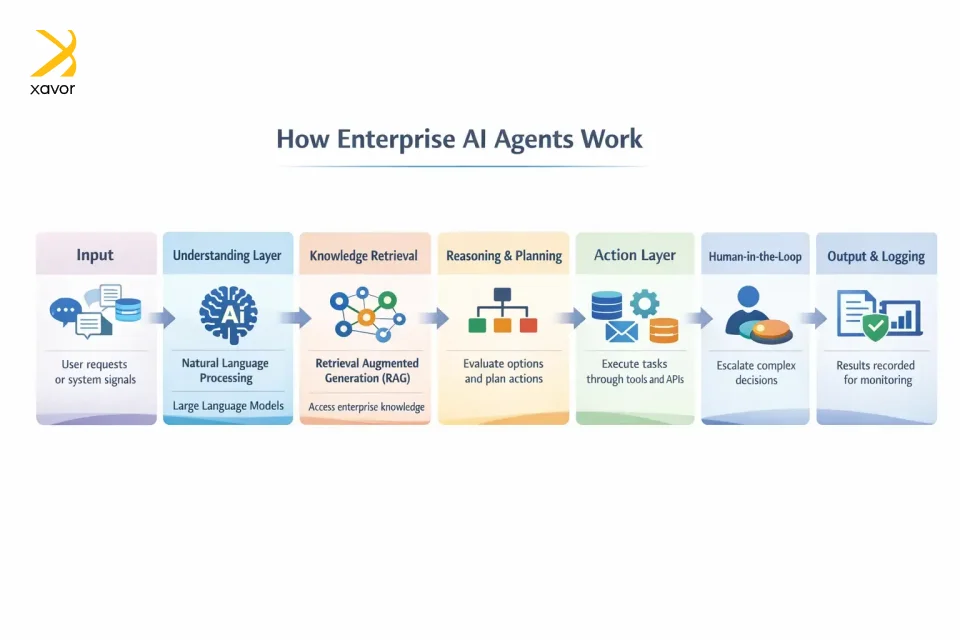
First, enterprise AI agents take in information from an input. It could be a person’s prompt or sensors like cameras. Inside the agent, an LLM processes the input to decide what action best moves toward the objective. Then comes action, the agent takes a path of action to perform enterprise automation.
This action could be anything, like completing tasks, generating some content, or coordinating with other agents. Anything that helps do the job.
However, keep in mind that it is up to you to decide the autonomy an agent can have. For critical tasks, you can design it to hand off to a human when needed or for final judgment.
Why businesses use agentic AI for enterprise automation
In the words of ChatGPT, agentic automation is not only about efficiency—it’s about adaptability and continuous improvement. According to Gartner, 40% of enterprise applications will be integrated with task-specific AI agents by the end of 2026.
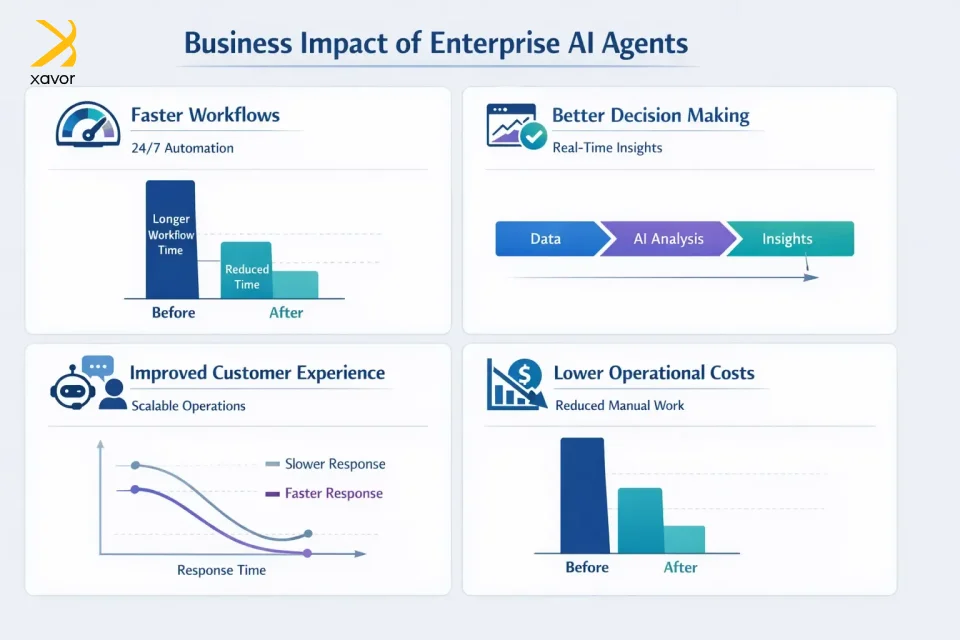
AI tools for business automation are particularly useful when minimal or no human intervention is required. It can save organizations more than 50% of their time.
1. Automatic work execution
AI agents help businesses run faster by taking over routine work that normally eats up a lot of time. Process automation solutions like these are especially good at repetitive, predictable tasks, such as:
- Entering or updating data
- Answering customer queries
- Sending reminders and coordinating schedules
When these tasks are automated, employees don’t have to spend hours on admin work. Instead, they can focus on higher-value things that need human judgment and creativity, like solving complex problems or planning a strategy.
2. Better decision-making capabilities
Agentic AI development services improve your decision-making with AI agents. They help you understand what’s happening right now, or in the future, using real-time data. Without enterprise automation, you have to manually pull reports from different sources and piece everything together to make sense of your data.
But enterprise AI agents can collect data from multiple sources and then process huge volumes quickly. Finally, they turn that into clear, actionable insights you can use immediately.
For example, an AI agent can pull signals from Salesforce along with your web analytics to analyze customer behavior.
3. Improved customer experience
Customers are the lifeblood of any business. According to McKinsey, companies that prioritize customer experience outperform competitors in annual growth by nearly 80%. AI agents help businesses keep customers happy and coming back by making support faster, responses more personal, and experiences smoother. Enterprise automation solutions like AI chatbots and virtual assistants can provide 24/7 help, so customers don’t have to wait for office hours or long queues.
Xavor has developed an enterprise AI agent, Xavor HR Bot, to automate our internal employee affairs. It can handle common HR needs like:
- Answering FAQs
- Troubleshoot basic issues
And when a request is complex, the agent can hand it off to a human with the right details already collected.
For e-commerce businesses, enterprise AI agents can also make interactions feel more relevant by using data like a customer’s past purchases and preferences. When customers get quick answers and useful, personalized help, they feel supported and understood. Over time, that leads to higher satisfaction and brand loyalty.
4. Lower operational costs
Lower operational costs. There is nothing more euphonious for CFOs than these words. That is why enterprise automation should be one of their priorities. IT automation with AI agents helps businesses reduce costs by doing routine work faster and more accurately than manual processes.
Many entry-level job roles take up a lot of time and resources. But when enterprise AI agents handle these repeatable tasks, companies can reduce manual labor and scale operations without hiring at the same rate.
5. Safer, built-in controls for workflows
Manual work often leads to small errors, like typos, duplicated entries, or inconsistent formatting. These little issues can have a snowball effect and create a bigger problem. AI agents can follow consistent rules and checks, which improves precision and prevents such problems from aggravating.
For example, an AI agent can be connected to your identity and access systems to:
- Only read the documents the user is allowed to read
- Only take actions the role is allowed to take
Enterprise automation with well-designed agents minimizes what they access and what they reveal. Otherwise, they can be exposed to agentic AI security threats like the lethal trifecta.
Lastly, enterprise AI agents can log what happened to provide you with a complete trail. So, in case something goes wrong, you will know exactly why the agent took this decision and what the factors involved were.
Industry-specific enterprise automation with AI agents
You can rely on agentic AI development to automate your workflows across industries. Xavor has created intelligent process automation solutions in some of the following industries, which gives you an idea about what enterprise automation can do for your business.
1. Logistics and supply chains
Enterprise AI agents expedite procurement and logistics operations with equal accuracy. A normal supply chain goes through a rigmarole of reviewing supplier quotes, matching carriers, checking documents, and whatnot.
But enterprise automation abstracts all of that to reduce costs and delays by automating decisions that normally require a lot of manual effort.
2. Retail
In retail, enterprise automation helps avoid stockouts and reduce excess inventory by predicting demand and keeping stock levels balanced. This improves fulfillment and reduces waste.
For example, computer vision solutions in retail can manage inventory in real time. AI monitors stock levels, detects when items are running low, and can automatically trigger reorders or transfers to keep inventory at the right level.
And if you want to go more advanced, enterprise AI agents can analyze sales patterns, seasonality, promotions, and other signals to forecast future demand.
3. Healthcare
Healthcare is really benefiting from enterprise automation. AI in healthcare is easing the burden on care providers and improving the overall quality of life for patients. Enterprise AI agents in healthcare augment both clinical and administrative workflows.
They help triage patient inquiries, book appointments, and handle prior authorizations by pulling the right data from EHRs and payer systems. Agents can highlight risk factors and draft clinical documentation to reduce clinician workload.
On the operations side, they automate medical billing and coding checks, improve claims accuracy, and monitor compliance.
Types of AI agents, and how to choose the right one
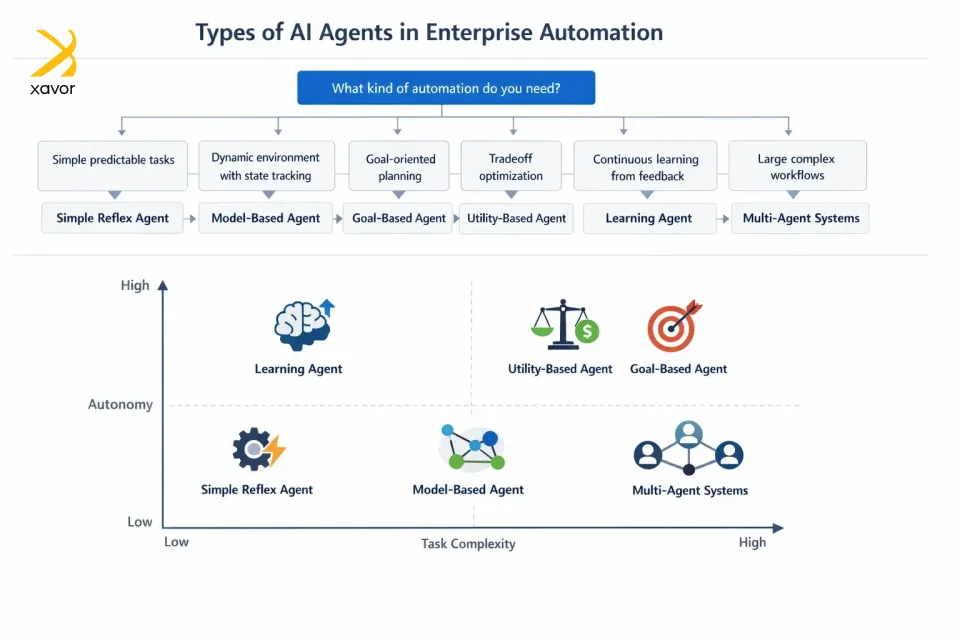
There are lots of enterprise automation tools and services in the market. While enterprise automation is their common function, they differ in how they choose their course of action, namely:
- Reacting to inputs
- Context tracking
- Planning
- Analyzing pros and cons
- Continuous learning
Based on these factors, enterprise AI agents are broadly classified into the following categories.
1. Simple reflex agent
As the name implies, simple reflex agents are the most basic kind of enterprise AI agents. They sense something and react to it immediately like a watchdog. Such process automation solutions work using a set of if–then rules. If this happens, do that, or if that happens, do this.
These AI agents don’t remember the past, nor can they predict the future. Use these agents for enterprise automation when conditions rarely change. For example, predictable environments where you only need to monitor and alert are right up their alley.
2. Model-based reflex agents
These enterprise agents are the smarter cousins of simple reflex agents. They are pretty much like the latter, but they keep an internal model of the world.
Model-based agents’ if–then logic is not only restricted to what it senses right now. They also use the agent’s internal state to best guess the current situation based on past observations and actions.
That is why they are more reliable for enterprise automation in dynamic situations. Use this enterprise workflow automation approach to add adaptability and robustness while staying predictable.
3. Goal-based agents
These enterprise AI agents have their eyes set on a target. Goal-based agents work by keeping a clear goal in mind and choosing actions based on whether they move closer to that outcome.
Instead of reacting instantly, they plan a sequence of steps to reach the goal. And if something changes, they can adjust the plan and try a different path.
Goal-based agents are the ideal choice for complex enterprise automation that may take longer periods. However, there are some tradeoffs. They can be slow and more resource-intensive because they don’t just follow simple rules.
4. Utility-based agents
Utility-based agents are like goal-based agents, but more nuanced. Instead of treating outcomes as simply success or failure, they assign a score to different results and pick the action that is expected to produce the best overall value.
They compare options based on trade-offs and choose what delivers the highest expected utility. For example, in data analytics, these agents can use a utility score to run a fast but less accurate query most weeks, but switch to a deeper, yet longer run when they detect unusual spikes or missing data.
Their decision-making can be more transparent, because you can explicitly encode priorities rather than relying on hidden rules or ad-hoc requests. But designing the utility function for enterprise automation is hard.
5. Learning agents
Learning agents get better over time by using feedback from the real world. That feedback can come from things like labeled examples, user ratings, or signals such as whether people accepted the agent’s suggestion or had to correct it.
Because they learn, these agents can handle situations that are too complex or unpredictable for fixed rules. That said, learning adds uncertainty to enterprise automation. The agent’s behavior can change over time, performance can drift, and results can become harder to predict and control.
6. Multi-agent systems
Multi-agent systems are an emerging type of enterprise workflow automation. It uses multiple AI agents working together instead of relying on one agent to do everything. This helps when problems are too large or complex for a single agent, or when the work can be split up and done in parallel.
In this way, different agents handle different parts of enterprise automation. They might collaborate on the same goal or operate independently, but still affect each other in a shared environment.
Xavor’s approach for implementing agentic automation
Enterprise AI agents require careful planning and execution to get the desired results. Keep in mind that it is a complete business transformation project. Treating it as a merely technical process is a recipe for failure.
1. Build your AI-ready data foundation
AI agents can only make accurate decisions if the data they use is accurate and up to date. That’s why unifying data, enforcing governance, and keeping systems synced in real time is essential.
AI-ready data for enterprise automation means that the data is:
- Clean and curated
- Traceable with complete data lineage
- Controlled and has proper guardrails
- Synchronized with other platforms
Without trustworthy data, agents will produce wrong outputs and reduce productivity instead of improving it.
2. Keep humans in the loop (HITL)
Ensure that people still act as workflow architects. They must design the process and make final calls. AI agents only accelerate enterprise automation steps that don’t require expert judgment, but they don’t replace experience or ethical decision-making.
The approach we take at Xavor is controlled autonomy. We let agents handle routine work for speed, consistency, and traceability, while humans guide outcomes to match the organization’s goals and safeguards.
3. Focus on ethics and governance
There are many safety and ethical reservations around AI agents. To use enterprise AI agents safely in a business, you need strong governance and ethics, so agents stay reliable, secure, and accountable over time.
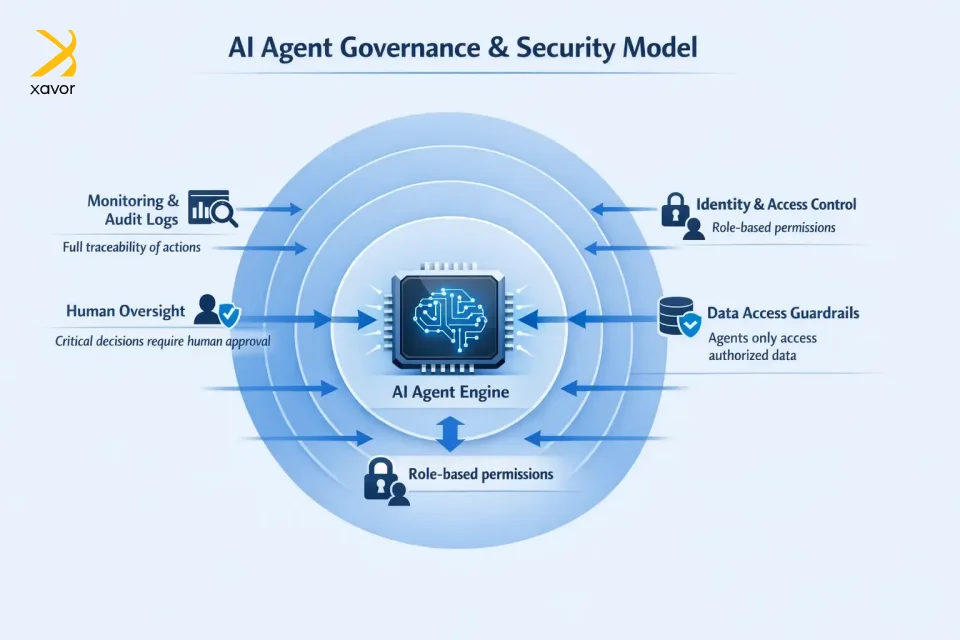
Clearly define what agents are allowed to do and not to do. On top of that, put monitoring in place to confirm that the agent is following policies and outputs are appropriate.
4. Learn and improve from experience
Successful enterprise automation requires investing in change management and continuous improvement from the start. Communicate early and often about what agents will change, how they’ll make work easier, and which workflows will be affected so employees aren’t surprised.
Also, provide strong training to employees to make them understand how enterprise automation tools work, so they can build new skills as their roles evolve. At the same time, monitor performance from day one. Collect user feedback, refine the agent over time, then share progress openly across the organization.
Conclusion
Enterprise AI agents are unique compared to all other enterprise automation software. They represent a shift in how work gets done. And when implemented thoughtfully, the real value of agentic automation comes from combining intelligent agents, trustworthy data, human oversight, and strong governance into a system that improves how decisions and processes flow through an organization.
Businesses that approach AI agents this way gain more than efficiency. Every organization will need to rethink how work gets done with AI as a copilot and collaborator. Those who delay this transformation may find themselves left far behind in the business world.
If you’re ready to transform your workflows with intelligent automation, partner with Xavor to build secure, scalable AI agents tailored to your enterprise needs. Our agentic AI development services help organizations design, deploy, and govern AI agents that deliver measurable business impact.
Drop us a line at [email protected] to talk to our agentic AI experts.

FAQs
RPA follows fixed rules and breaks when conditions change. AI agents can interpret context, plan steps, and adapt to new scenarios—often using enterprise knowledge via RAG and tool integrations.
They can be, with the right guardrails: least-privilege access, action limits, human-in-the-loop approvals for critical steps, and full logging/monitoring. Safety is more about governance and design than the model alone.
Start by picking 1–2 high-volume, low-risk workflows and define success metrics. Build an AI-ready data layer, connect the agent to approved tools, and ship with guardrails. Roll out with human-in-the-loop approvals, monitor performance, then expand to more complex workflows once reliability is proven.