
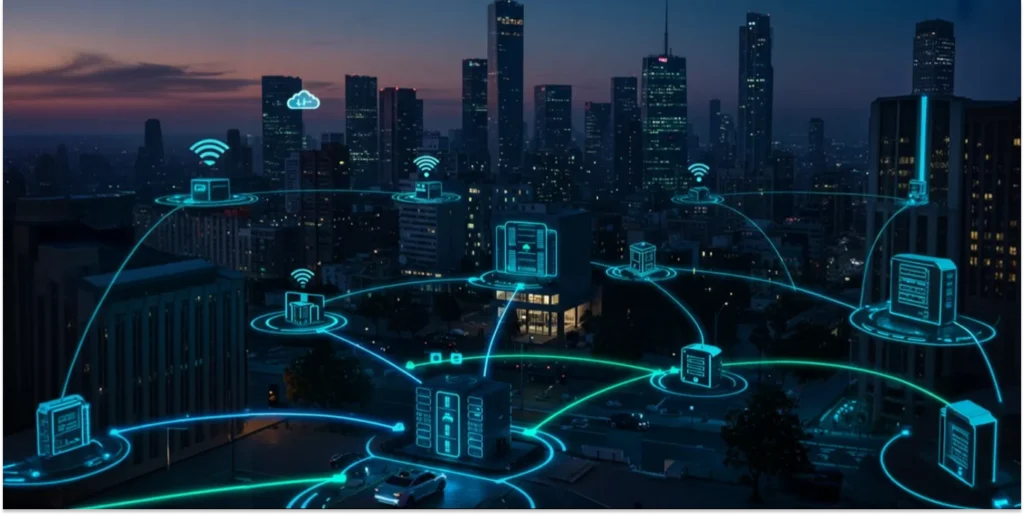
It’s not uncommon to see someone wearing Internet of Things (IoT) devices these days. Someone at your office might wear a smart watch, and there are plenty of joggers wearing wearables that monitor their fitness.
However, IoT is still in the liminal stage of its evolutionary cycle. There are 18 billion IoT devices in the world in 2025. But it’s not as ubiquitous as other general-purpose technologies.
So, where’s the impasse? Two words: data processing. Using cloud platforms to process gigabytes or terabytes of data is archaic and super slow. That is why edge computing in IoT is the logical way forward.
Embedded engineering services employ IoT edge computing devices to collect and process data locally near the machine in real-time. This is exponentially faster and more efficient.
In this article, we’ll discuss what is the purpose of edge computing in IoT. But first, let’s get clarity on the essential concepts.
What are IoT and edge computing?
IoT and edge computing are two distinct technologies that often work hand-in-hand.
IoT
IoT refers to a network of physical devices that share data with each other over the internet, all on their own. Anything “smart” in its name is essentially working on the principle of IoT.
Common IoT devices that you are probably most familiar with are:
- Smart watches
- HealthTech devices
- Smart home appliances
IoT devices generate data instantaneously. For example, a wearable blood monitoring device continuously measures your blood sugar levels. It generates data about your health 24/7 to share with you and care providers.
Healthcare was just to give you an idea. There are several use cases for IoT devices. Like Industrial IoT (IIoT) devices, which are now widely adopted in manufacturing to modernize industrial workflows.
Traditionally, cloud is connected to IoT devices. Cloud platforms are used for data storage, management, and analysis. But as mentioned earlier, this approach works at a snail’s pace.
And one last thing, IoT is almost always used in tandem with AI/ML.
Edge computing
Edge computing is an IT infrastructure approach where data is stored, processed, and analyzed close to the source of generation. This is the opposite of sending the data to centralized locations like cloud data centers first. Then that data is processed, analyzed, and sent back to the device.
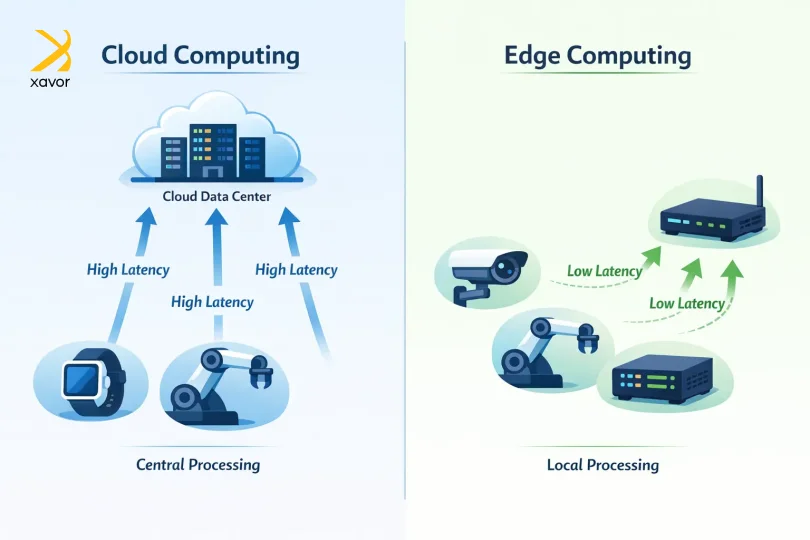
On the other hand, edge computing skips sending and receiving data between the source and a cloud platform. Edge computing supports latency-sensitive applications, which improves user experience.
It is a great way to scale processing power to meet the demand of multiple hardware devices.
What is the role of edge computing in IoT?
So far, reading the blog may have given some cursory idea about the role of edge computing in IoT. It’s all about making data processing fast and efficient, so IoT devices can act instantly without any lag.
IoT edge computing brings great benefit by bringing computer power as close as possible to the data source. Edge computing provides local processing and storage for IoT devices. This enables local analytics and decision making.
However, that doesn’t mean edge computing in IoT replaces the cloud altogether. Rather, edge computing distributes resources across locations to share the workload.
Modern chips like NVIDIA Jetson or even smartphone-grade ARM processors are powerful enough to handle this at low cost and power. But edge devices require network connectivity at all times to make this happen.
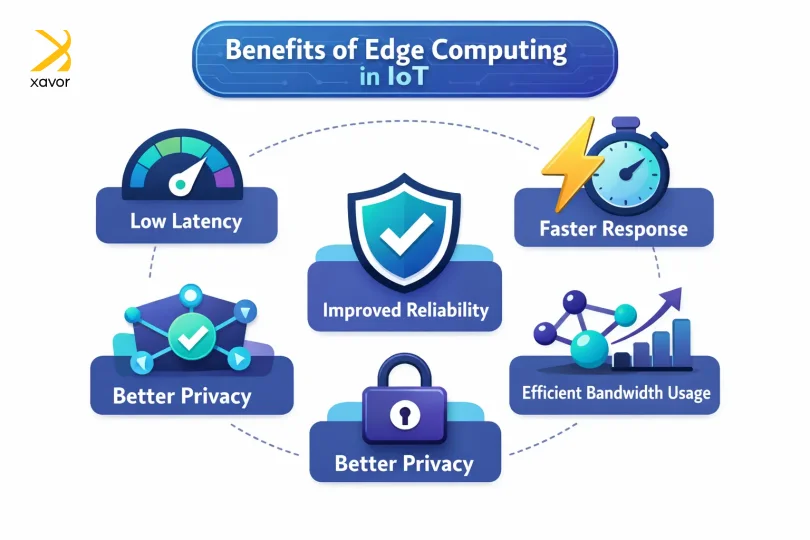
Such edge connectivity IoT products are different from traditional IoT devices in veritable ways, such as:
- Less latency between IoT devices and central networks
- Increased operational efficiency due to faster responses
- Better reliability, as devices can still work even if the internet is slow
- Sensitive data stays on the device to improve privacy
Essential components of IoT edge devices
IoT edge computing devices require a specific set of hardware. These hardware pieces are used to process data locally, while keeping edge computing in IoT energy efficient.
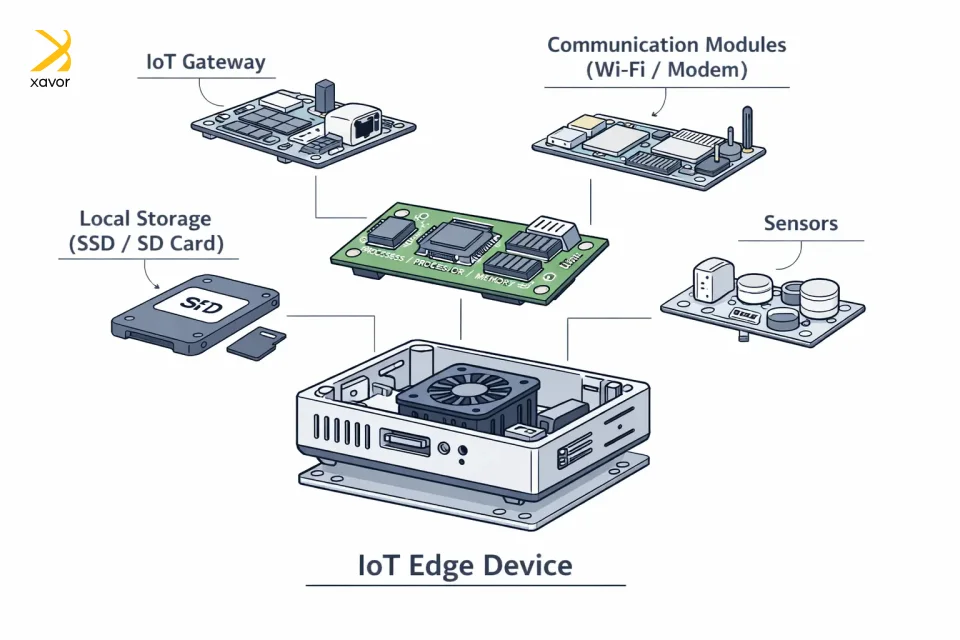
1. IoT gateway
An edge computing IoT gateway acts like a middleman between devices and the rest of the system. It can send data upward to the cloud or a central data center for storage, analysis, or long-term tracking, or route it nearby to local edge systems for faster processing.
2. Local storage
The edge device contains memory, processing power, and compute resources. Options like SD cards or SSDs are needed in most cases. They are used to store data temporarily for real-time buffering and analysis.
3. Embedded hardware
Sensors and controllers like Wi-Fi modules and modems are installed for communication between devices and the system.
How does edge computing for IoT works?
An IoT edge device uses the above hardware devices to distribute data processing workloads. This division of labor is the fundamental principle behind the working of edge computing in IoT.
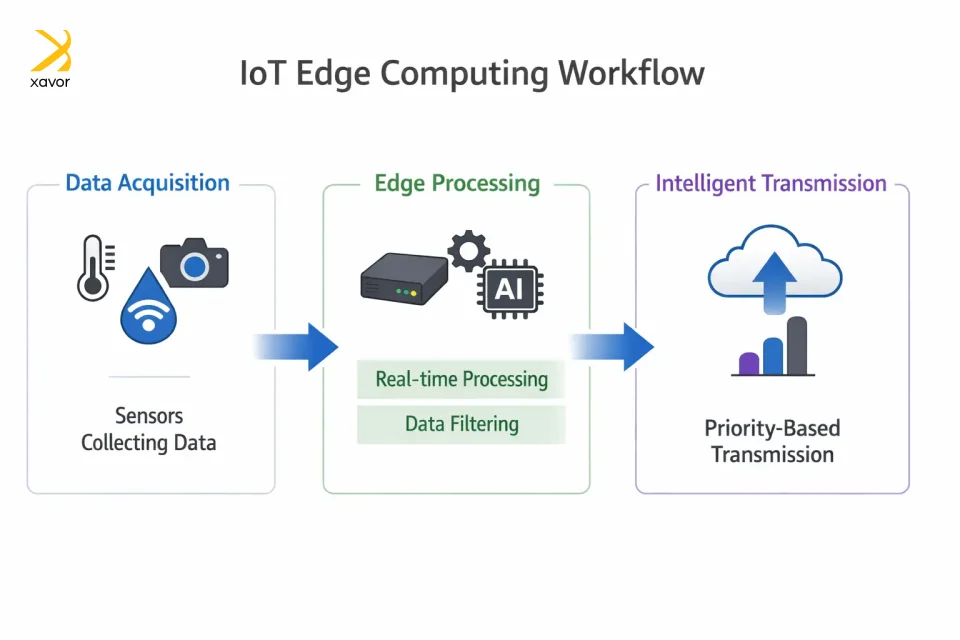
Below is a breakdown of the IoT edge computing workflow:
1. Data acquisition
IoT sensors generate data in different formats. For example, IoT sensors attached to machinery may give different outputs than computer vision devices. Therefore, the IoT gateway first connects to many different devices and gathers all kinds of data.
The gateway connects to all of them and translates every signal into one common format, so the rest of the system can handle it uniformly.
2. Edge processing
Next comes the edge layer, which processes raw data on the spot before going further in the pipeline. Edge computing in IoT only keeps meaningful, relevant data. That is why IoT edge solutions perform data cleaning by removing errors, like faulty readings from a sensor.
They also find any data patterns and compress the data size to reduce the transmission volume. For this purpose, edge computing for IoT also runs lightweight AI models directly on the device.
It is important to remember that sensor data can be used for predictive maintenance. And predictive maintenance reduces downtime, which is why the data needs to be as accurate as possible.
3. Intelligent transmission
Finally, IoT edge devices decide what data is sent to the cloud for further processing. An IoT edge computing gateway has a priority queue where IoT devices perform automated decision-making in real-time for some data.
Whereas heavy computations are offloaded to the cloud when its own processor is under load.
Edge computing in IoT splits work this way between the cloud and the edge device to save up to 80% of bandwidth in many cases.
Is an IoT device the same as an edge device?
Short answer, not necessarily. IoT devices are pieces of physical hardware that are connected to the internet and just generate data. On the other hand, it is the edge device that collects and processes that data.
Edge devices are more powerful and placed near where the data is generated. Now, near doesn’t always mean physically next to the IoT device. Rather, it sits on-site or nearby in the same network and processes that data.
For example, an edge device in a factory could be a local server in the same building. Similarly, an edge device for a blood monitoring IoT device can be placed on the patient as a wearable or as a router in the patient’s home.
Sometimes, a device can be both. If an IoT device has enough computing power to process data and make quick decisions on its own, it can also function as an edge device.
Navi: Our real-life case study of IoT edge computing
Navi, previously known as Rui, is our social aid robot for elderly care. It is made and launched under Xavor’s spinoff NaviGait. We have designed Navi to be an emotionally intelligent social companion.
We couldn’t have made this possible without edge computing and IoT.
Even though we had an excellent cloud infrastructure on AWS and Azure. Achieving the level where Navi could match human-like emotional intelligence required an enormous amount of data processing.
So, we relied on edge computing in IoT to make Navi capable enough to:
- Provide emotional presence and cognitive support
- Everyday monitoring and safety
- Smart processing at the edge with full privacy
- Conversational AI for empathetic conversations
Navi doesn’t just respond to what a patient says; it understands how they say it. Using edge computing in IoT, it analyzes voice tone, speech cadence, and facial micro-expressions directly on-device.
This means responses feel immediate and natural. More importantly, it means the most intimate moments of a person’s day stay private by design.
Why choose Xavor for IoT on the edge?
Most companies get lost evaluating platforms and devices, forgetting that IoT only delivers real value when it dovetails with your business processes that actually matter. That is why Xavor architects your IoT edge solutions that integrate with your existing enterprise systems to drive outcomes you can measure.
Our architecture practice reflects that philosophy. The proof, of course, is in the work. Navi is the clearest demonstration of what Xavor’s IoT expertise looks like when it’s fully realized.
Building a robot capable of genuine emotional intelligence meant solving problems at the absolute frontier of edge computing and IoT. That’s pushing edge computing in IoT to its limit.
Conclusion
New technologies are usually promising. But those promises need to be backed by infrastructure. AR/VR failed to deliver on its initial potential because of this reality check.
IoT is also at a crucial juncture vis-à-vis infrastructure. Cloud-only architectures introduce a stagnation that real-life IoT devices can’t afford. Edge computing in IoT is the need of the hour to make IoT devices become the new normal.
Edge computing for IoT puts intelligence exactly where consequences live. That matters because IoT can then finally behave the way it was always meant to. That is autonomous, reliable, and with genuine awareness of the world it’s embedded in.
If you’re ready to build something that works at that frontier, partner with Xavor. We engineer IoT solutions that move the needle on what your business can actually do.
Contact us at [email protected] to book a consultation session.

FAQs
IoT refers to the network of connected devices that collect and exchange data, like sensors, machines, and smart devices. On the other hand, edge computing is how that data is processed, locally on or near the device instead of sending everything to the cloud.
A common example is a smart factory machine where sensors monitor equipment health and an edge device analyzes the data locally to detect faults in real time. Instead of sending all data to the cloud, it immediately triggers alerts or shuts down the machine to prevent damage.
The four main types of IoT are: 1) Consumer IoT like smart homes and wearables. 2) Commercial IoT includes retail and healthcare systems. 3) Industrial IoT (IIoT) covers manufacturing and automation. 4) Infrastructure IoT is broader in scale, such as smart cities, energy grids, and transportation systems