

Aras Innovator and ServiceNow are big players in the PLM and ITSM world, respectively. Many companies use both as part of their enterprise software arsenal. Integrating Aras PLM with ServiceNow enables organizations to create a direct flow of information between their engineering/manufacturing and service teams.
However, not all Aras ServiceNow integrations deliver the same results. Poorly planned integrations often cause more problems than they fix. Choosing the right integration solutions is very important to connect these two platforms for optimal results.
In this guide, you’ll learn how to perform data synchronization between Aras and ServiceNow through a secure, bidirectional integration that supports enterprise growth.
Why integrate Aras PLM with ServiceNow?
Aras Innovator and ServiceNow are, on their face, unlikely companions. They can live in the same enterprise IT stack for years and never once exchange data. That’s because their operational realities sit on opposite ends of the product lifecycle.
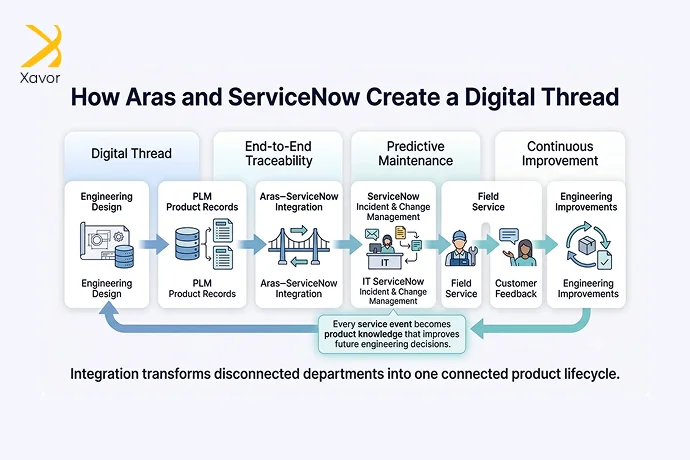
But that doesn’t mean there is no demand for Aras ServiceNow integration. In fact, in the age of AI, it is more needed than ever to ensure critical product information flows seamlessly across the enterprise.
Two systems, two worlds
Engineering and service teams often work in separate systems and on different floors of a building. They rely on emails or spreadsheets to manually update each other on areas of common interest.
You probably need some context to understand why this manual process is problematic.
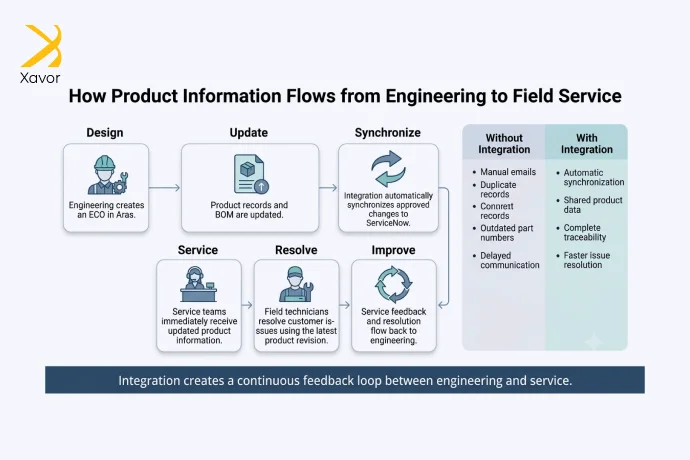
For example, an engineer in Ohio finalizes a bill of materials in Aras Innovator on a Tuesday afternoon. He is confident that the revision is final. However, he is unaware that three floors up, a service technician is dispatching a field repair in ServiceNow based on a part number that was deprecated the previous week.
Nobody did anything wrong, exactly. The two systems simply never spoke. And this is not a hypothetical drawn from a consultant’s slide deck. According to McKinsey’s research into manufacturing digital transformation, it is the daily condition of roughly 60% of manufacturing executives, who cite data silos as a significant obstacle to modernizing their operations.
Bringing both worlds together
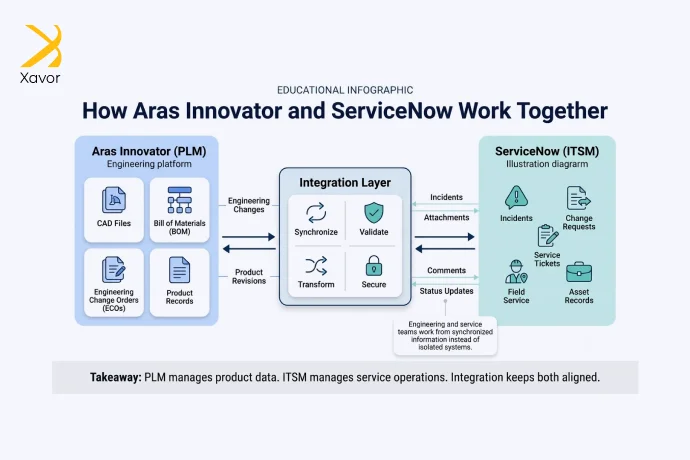
An Aras ServiceNow integration eliminates these silos by automatically synchronizing relevant data between both platforms.
Some of the key benefits of integrating Aras Innovator with ServiceNow include:
- Streamlined engineering change management: Automatically synchronize Engineering Change Requests (ECRs), Engineering Change Orders (ECOs), and approval statuses with ServiceNow Change Management processes.
- Faster incident resolution: Enable service teams to link customer incidents directly to affected parts, product revisions, or engineering records in Aras, reducing the time required to identify root causes.
- Improved cross-functional collaboration: Engineering, quality, manufacturing, and IT teams work with consistent, up-to-date information instead of maintaining separate records.
- End-to-end traceability: Create a complete audit trail from a customer-reported issue through engineering investigation, corrective action, implementation, and final resolution.
- Reduced manual data entry: Eliminate repetitive copy-and-paste tasks by automatically synchronizing records, attachments, comments, and status updates.
- Better compliance and governance: Maintain accurate records for regulated industries by ensuring engineering and service activities remain synchronized throughout the product lifecycle.
- Scalable digital transformation: Support enterprise-wide initiatives such as digital thread, digital twin, predictive maintenance, and connected product lifecycle management by integrating PLM and ITSM systems.
How many ways are there to do Aras ServiceNow integration?
There are four common integration solutions to connect Aras Innovator with ServiceNow. The right approach depends on some factors that we’ll discuss ahead.
At a high level, the four integration methods are:
| Method | Best for | Coding required | Scalability |
| Native APIs | Simple, custom integrations | High | Medium |
| Middleware | Enterprise-grade integration | High | Medium to High |
| Custom integration | Niche business requirements | Medium | High |
| Third-party platforms | Fast, low-maintenance deployments | Low | High |
1. Native API integration
Both Aras Innovator and ServiceNow expose APIs that allow applications to exchange data. Developers can use these APIs to build direct connections between the two platforms. But this means writing custom code that calls Aras Innovator’s API on one side and ServiceNow’s API on the other.
So, be ready to spend significant development time on this method. But it’s worth it because of the complete control it gives you over Aras ServiceNow integration.
2. Middleware integration
Middleware integrations, aka iPaaS integration, route data through an integration platform instead of directly connecting Aras with ServiceNow. Popular middleware platforms include MuleSoft, Boomi, Azure Integration Services, IBM App Connect, and Informatica.
Performing Aras ServiceNow integration using middleware software is the easier option for managing multiple systems. However, you will need to pay the additional licensing costs of the middleware platform plus have expertise in using it.
3. Custom integration
Some organizations build an entirely custom integration using technologies such as Java or Python. It is a great method for maximum flexibility and supporting highly customized workflows in Aras and ServiceNow. Moreover, you can even integrate legacy systems with the two systems in this way.
Custom integrations are common in industries such as healthcare, where business processes are often highly specialized. That said, this method for Aras ServiceNow integration is also costly and requires greater maintenance.
4. Third-party platform integration
Some vendors and integration partners offer ready-made connectors specifically built for Aras-ServiceNow integration.
Like OpsHub Integration Manager, it is designed to synchronize data between Aras and ServiceNow without requiring organizations to build and maintain integrations from scratch.
You’re mainly configuring settings rather than writing code on third-party platforms.
Conclusion
Integrating Aras Innovator with ServiceNow is about more than connecting two enterprise applications. It connects the people and processes that carry a product from engineering design to field service.
Connected product strategies, like Aras ServiceNow integration, are now central to modern manufacturing.
Whether you choose native APIs, middleware, custom development, or a third-party platform, the right integration approach depends on your business processes and long-term goals. The objective is to create a reliable flow of trusted product information across the enterprise.
Partner with Xavor’s integration services to connect Aras and ServiceNow the right way. We design secure, scalable enterprise integrations that keep teams working from the same source of truth.
Drop us a line at [email protected] to assess your Aras ServiceNow integration strategy.

FAQs
Organizations commonly synchronize engineering change orders (ECOs), change requests, product records, bills of materials (BOMs), incidents, attachments, comments, and status updates. The exact data exchanged depends on the integration design and business workflows.
There is no one-size-fits-all approach. Native APIs offer maximum control, middleware simplifies enterprise integrations, custom development supports specialized workflows, and third-party connectors provide the fastest deployment with less maintenance.
Integrating Aras with ServiceNow helps engineering and service teams work from the same product information. It reduces manual data entry, improves engineering change management, speeds incident resolution, and creates end-to-end traceability across the product lifecycle.