
We are currently witnessing the second generation of enterprise AI systems. What distinguishes them from their predecessors is that they push governance and context to the center of enterprise AI strategy.
Snowflake Cortex AI is a leader in this generation of platforms. It has already changed how companies use AI by bringing it directly into the Snowflake Data Cloud. And now it has upgraded its data governance solutions to make sure AI agents deliver reliable results in line with enterprise data governance policies.
In this blog, we’ll show you how Xavor’s Snowflake implementation services build a governed Cortex agent platform that aligns with modern AI governance practices.
What is Snowflake Cortex AI?
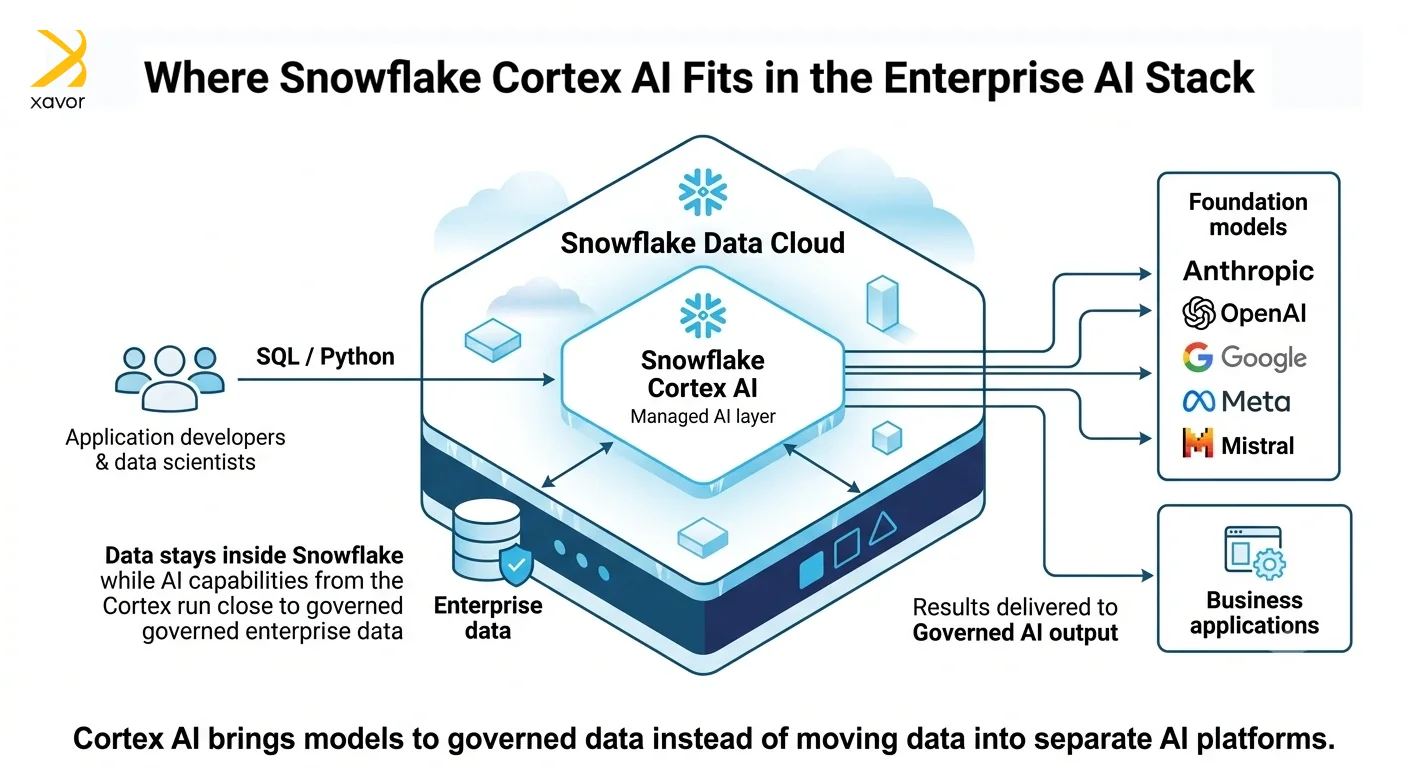
Snowflake Cortex AI is a fully managed AI service built directly into the Snowflake Data Cloud. It lets businesses use machine learning and large language models (LLMs) on their data without moving it to separate AI platforms or managing complex infrastructure.
The platform is a major move by Snowflake to lift its AI software stack capabilities. And also, a signal that Snowflake has bigger ambitions than just being a cloud data warehouse company.
Snowflake Cortex AI features
Cortex runs inside Snowflake. Therefore, it automatically follows your existing policies related to:
- Security and governance
- Role-based access controls (RBAC)
- Data residency policies
Developers and analysts can access the platform’s AI capabilities using familiar tools like SQL or Python. On top of that, Snowflake Cortex AI allows you to use leading foundation models from Anthropic, OpenAI, Google, Meta, and Mistral.
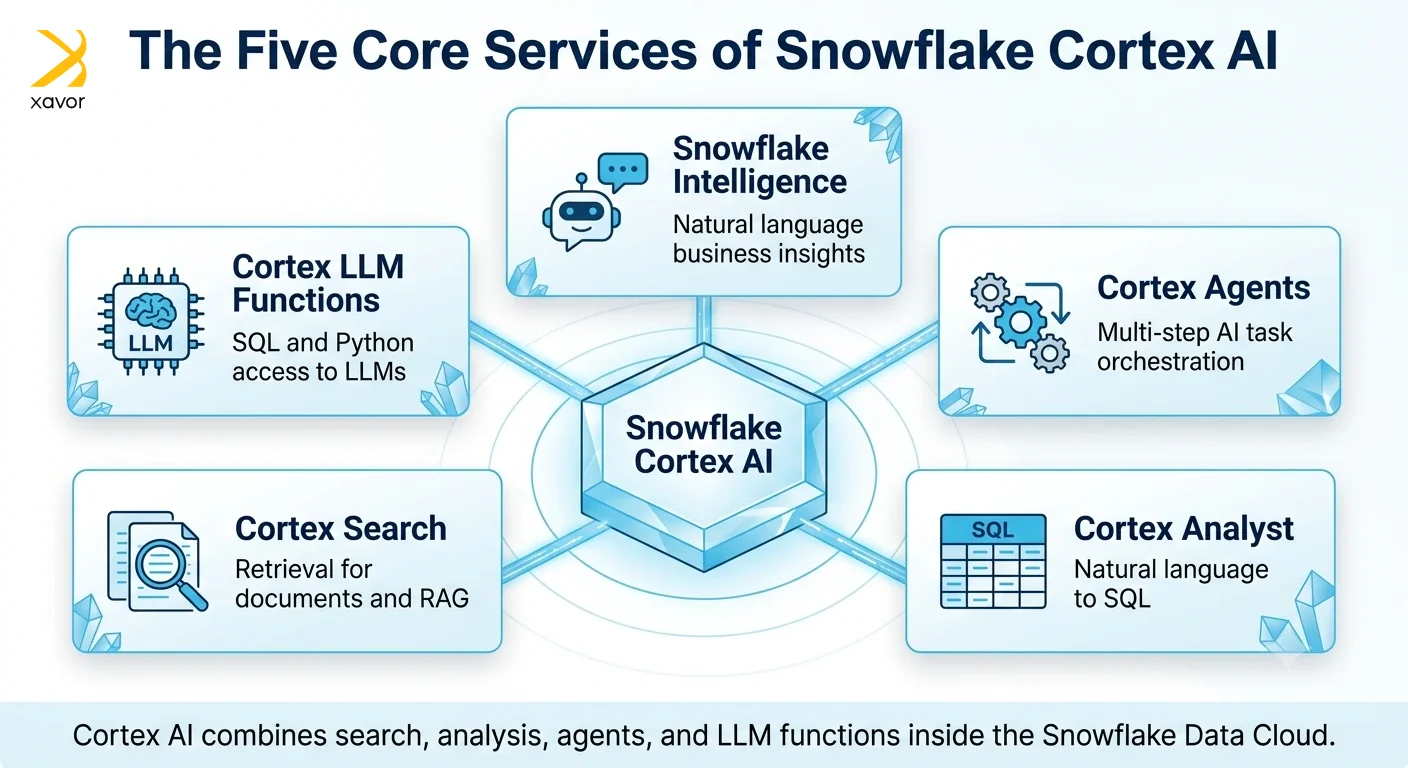
Here are the five core services in Snowflake Cortex AI that work together to help organizations build AI-powered applications and agents directly within Snowflake.
- Snowflake Intelligence: A conversational AI assistant that lets business users explore data and generate insights using natural language instead of SQL.
- Cortex Agents: These are AI agents that coordinate multiple Cortex services that use data ingestion to complete complex, multi-step tasks.
- Cortex Analyst: Cortex Analyst converts natural language questions into accurate SQL queries, so you can analyze structured data without writing SQL.
- Cortex Search: It is a managed retrieval service that combines semantic and keyword search to find relevant information from large collections of documents. We personally find Cortex Search ideal for Retrieval-Augmented Generation (RAG) applications.
- Cortex LLM Functions: These are built-in SQL and Python functions that provide access to leading large language models for common tasks like text generation and information extraction.
How we ensure enterprise data governance in Snowflake Cortex AI
Before getting into this topic, you need to understand how Cortex agents work with data.
A Snowflake Cortex Agent answers business questions by using different Cortex services behind the scenes. When it needs structured data, it uses Cortex Analyst, which reads semantic views instead of querying raw database tables directly.
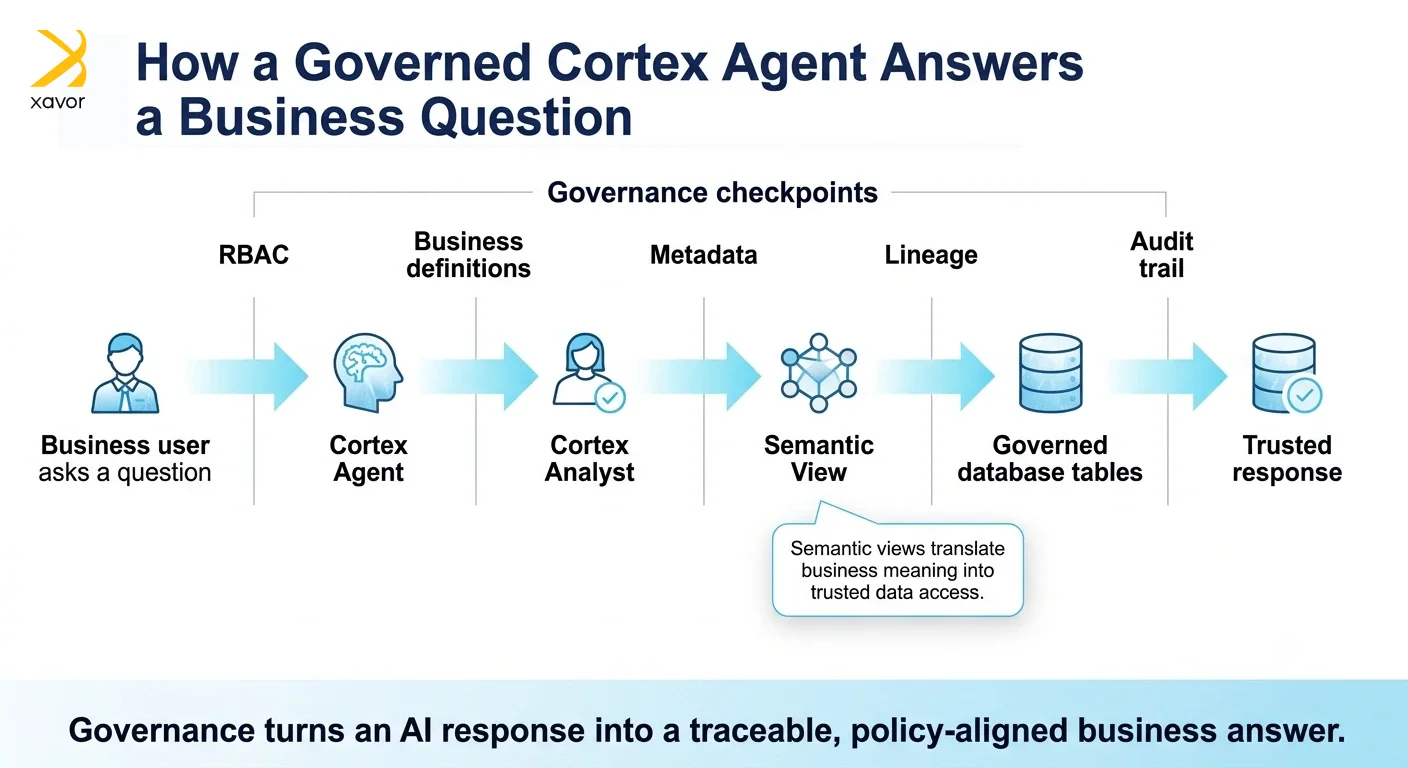
A semantic view is a business-friendly layer on top of your data. It contains trusted business definitions and maps them to the underlying tables. This helps AI agents understand your data the same way your business does.
With this in mind, let’s look at our approach for building a fully governed Snowflake Cortex AI platform.
1. Making AI data access transparent
A Cortex agent never works directly with raw tables. Instead, it follows a predictable path that goes like this:
- Cortex Agent → Semantic View → Database Tables
That sounds simple until you have dozens of agents and hundreds of semantic views across different business domains.
Therefore, we scan your Snowflake environment and build this relationship automatically. Instead of treating agents as isolated AI applications, it maps them back to the semantic views they consume and the underlying data assets those views depend on.
Setting up Snowflake Cortex AI using this method directly answers many key questions. It also saves a lot of time because you don’t have to dig through YAML files and documentation. A single lineage explains how the pieces fit together.
2. Governing semantic views as data products
Semantic views already tell Cortex Analyst how to query data. So, Xavor adds another layer by connecting those semantic views to business context, such as:
- Glossary terms
- Ownership
- Data products
- Metadata
That might sound like documentation, but it has real value. Suppose both the finance and sales teams calculate “revenue.” If they’re defined differently, the AI shouldn’t be free to choose whichever interpretation seems reasonable. That is why we ground semantic views in governed business definitions; every Cortex Agent works from the same agreed-upon meaning.
3. Building AI from trusted business context
The quality of an AI agent depends on the context it has about your business. An AI agent doesn’t just need access to data. It also needs to understand what that data means. Without business context, agents can make comical mistakes at best and serious blunders at worst.
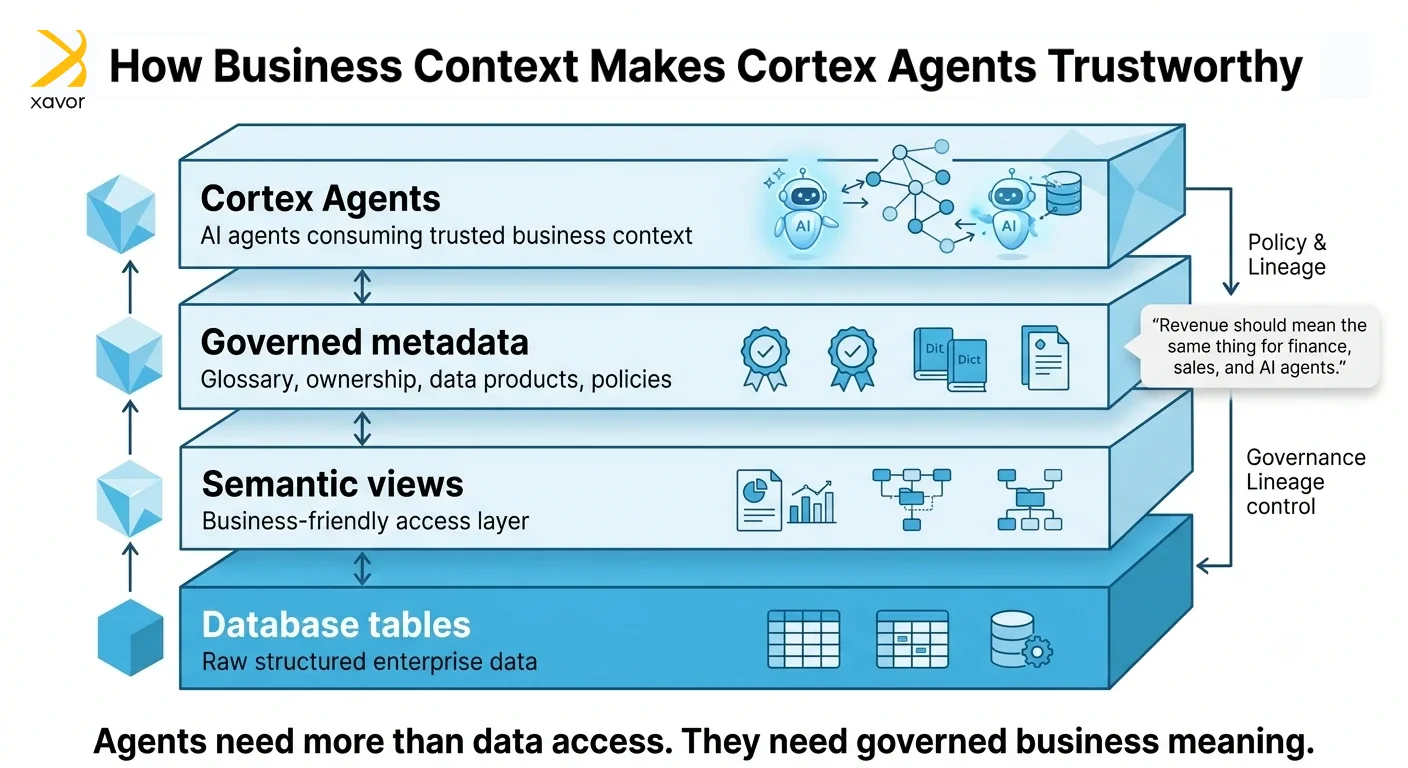
To address this, Xavor publishes governed business metadata as Snowflake semantic views. Instead of rebuilding metrics and business logic inside Snowflake, we generate semantic views directly from their governed metadata repository.
As a result, business definitions are created once, and Semantic views remain consistent across teams. Moreover, Cortex agents consume standardized business knowledge, which means changes to business logic can be managed centrally.
4. Supporting governed multi-agent architectures
Many of our clients deploy multiple specialized AI agents rather than a single general-purpose assistant. And that is a common pattern among modern businesses.
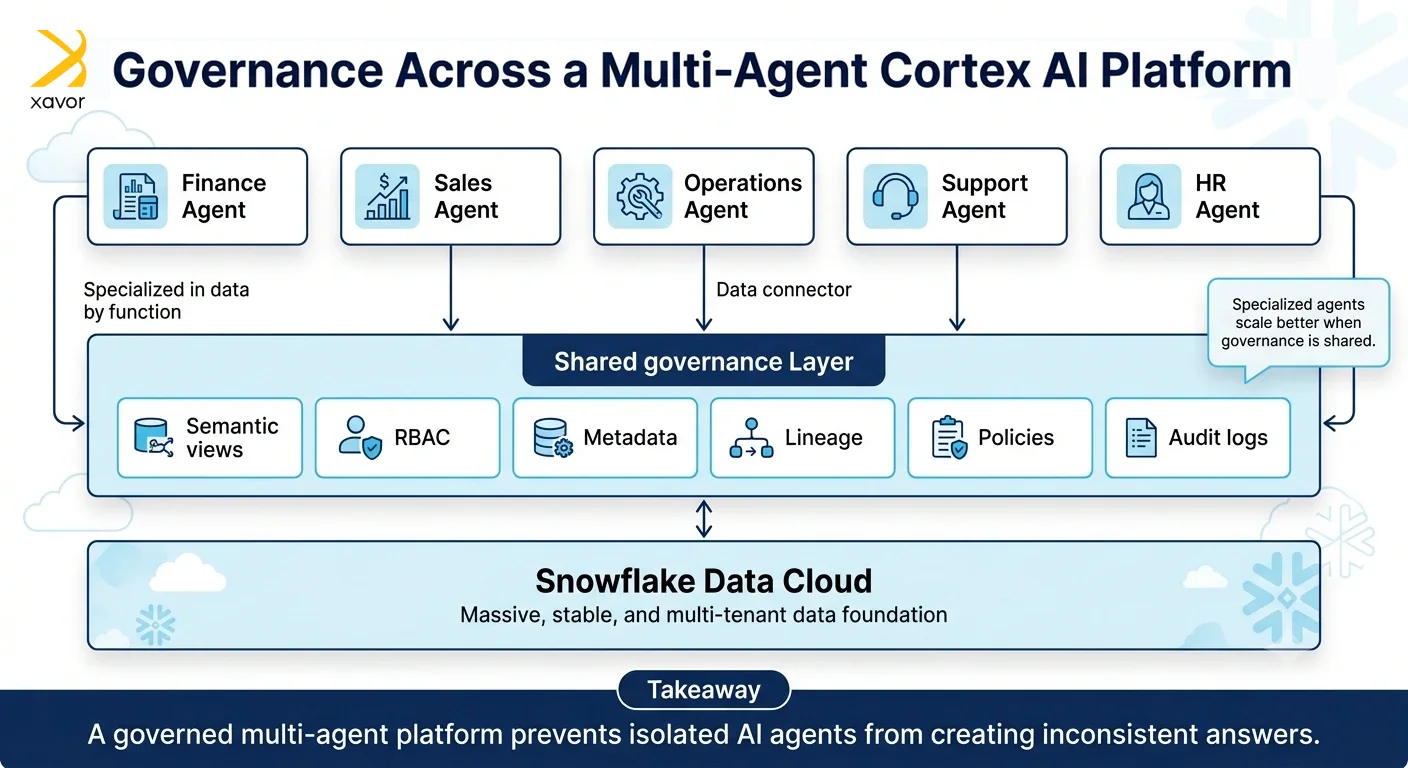
In light of this, we make sure each Cortex agent is responsible for a specific function. It could be retrieving information or querying structured data. Compartmentalization makes AI systems easier to scale and govern.
We provide the governance layer across these agents to give a complete picture of the AI ecosystem instead of isolated agents operating independently.
Conclusion
Most enterprises think the challenge with AI agents is making them smarter. In reality, the harder problem is making them trustworthy.
A Cortex Agent is only as reliable as the business context behind it. If any of the key aspects of a governed agent in Snowflake Cortex AI is missing, even the most advanced language model will produce inconsistent answers.
That’s why Xavor approaches Snowflake Cortex AI as a governance platform first and an AI platform second.
Drop us a line at [email protected] to talk to our cloud experts on how to build AI agents in Snowflake Cortex AI that your business can trust.

FAQs
Snowflake Cortex AI is included with supported Snowflake editions, but usage-based charges apply for AI inference, search, and foundation model consumption. The total cost depends on the Cortex services and models your organization uses.
Yes. Cortex AI runs directly inside the Snowflake Data Cloud and inherits existing security controls, including role-based access control (RBAC), data governance policies, and data residency requirements. Your data remains within your Snowflake environment.
Yes. Cortex Search provides built-in semantic and keyword retrieval that can power RAG applications. Combined with Cortex Agents and Cortex Analyst, organizations can build AI assistants that retrieve answers from governed enterprise knowledge instead of relying solely on LLM training.