
Case Study
Salesforce App Modernization
Solution
CRM | Salesforce App Modernization | UI
Industry
Salesforce | REST APIs | Apex
Core Technology
SaaS | Technology
Overview
Salesforce AppExchange offers countless apps to run business operations smoothly. But a Saas provider’s app was going obsolete, which was seriously slowing down their productivity.
The application was used by multiple customer organizations and was primarily built using the older technology of Aura Components. Over time, performance issues, technical debt, and maintainability challenges increased.
Their goal was to modernize the user interface and improve performance by gradually migrating the application from Aura Components to Lightning Web Components (LWC). To address these challenges, they needed experienced Salesforce development services that could modernize the application without disrupting existing users.
But a complete rewrite was not possible because the application was already being actively used by multiple customers. Xavor was called in to migrate the app piece by piece without any disruptions using a phased approach without affecting existing functionality or customer environments.
Business Challenge
The existing application architecture was heavily dependent on Aura Components. And that was causing some major issues for the client.
- Slow performance: Some pages in the app had become heavy and sluggish. A lot of the work that should've been handled efficiently was being done on the client side, which consumed too many resources and made the experience feel slow for users.
-
Tangled codebase:
Different parts of the codebase had become deeply intertwined with each other. So, when developers changed one thing, it risked breaking something else.
-
Incompatible technologies:
Aura and LWC are two different generations of Salesforce's UI technology. They weren't designed to be permanent neighbors. Yet during the migration, both had to live inside the same application and work together reliably. Getting them to communicate correctly and behave consistently was a tough engineering problem,
-
Delayed development:
Technical debt from the past started slowing down development. Adding even small new features required working through layers of legacy code, bogging down the whole team.
Since the package was distributed through AppExchange and installed in multiple customer organizations, any major breaking changes could impact production customers. The business required a solution that improved performance while maintaining backward compatibility.
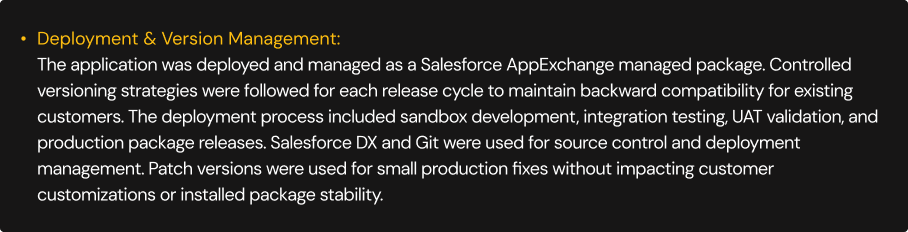
The application also needed to comply with Salesforce governor limits, AppExchange managed package restrictions, and Salesforce security best practices. Version management and deployments had to be carefully controlled because the application was distributed as a managed package.
the solution
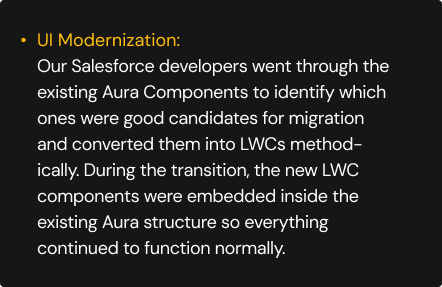
We went with a hybrid migration strategy where Aura Components and Lightning Web Components worked together within the same application. Aura Components were kept in place as the outer shell, while new functionality was built fresh using LWC from the ground up. This phased approach minimized risk and allowed customers to continue using the application without interruption.

outcomes & benefits
- 30%-40% improved page performance and faster load times
- 25%-35% reduced client-side processing overhead
- Migrating to LWC’s leaner syntax Improved code maintainability and readability
- Reduced technical debt within the application
- 0 disruptions across all existing customer organizations
- A strong foundation for future LWC-based development
- Engineers no longer had to work around tightly coupled code which simplified future feature development
Tools & tech stack
Frontend Technology Lightning Web Components (LWC), Aura Components
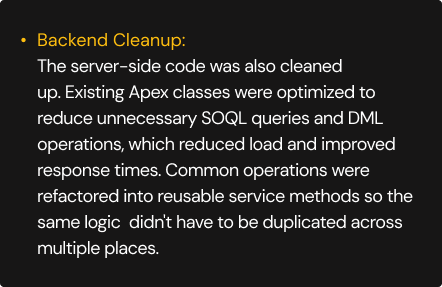
Backend & Logic Apex Classes, SOQL, DML Operations
Deployment & Version Control Salesforce DX, Git, AppExchange Managed Package
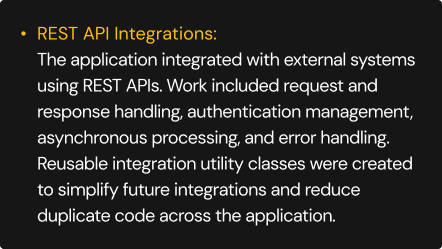
API & Integration REST APIs, Reusable Integration Utility Classes
Process Hybrid Phased Migration, Component-Driven Architecture
conclusion
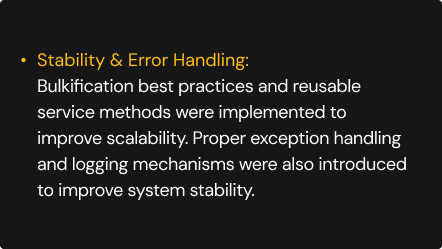
The project successfully modernized a legacy Aura-based Salesforce managed package application using a phased Lightning Web Components migration strategy. The hybrid approach allowed the organization to improve application performance, scalability, and maintainability without affecting existing customers. The implementation strengthened overall platform stability while preparing the application for future Salesforce UI modernization initiatives.
Upgrade your Salesforce ecosystem
Keep your CRM operations up and running with expert help.