
Case Study
Providing Timely Healthcare with a Private AI Support Agent for an iOS app
Solution
Conversational AI | iOS App Integration
Industry
Healthcare | MedTech | Field Healthcare Operations
Core Technology
iOS | RAG | AI
Overview
A healthcare provider’s iOS app was backed by lengthy training documentation that healthcare workers and field operators found difficult to navigate. It slowed down onboarding of end users and overall field usage.
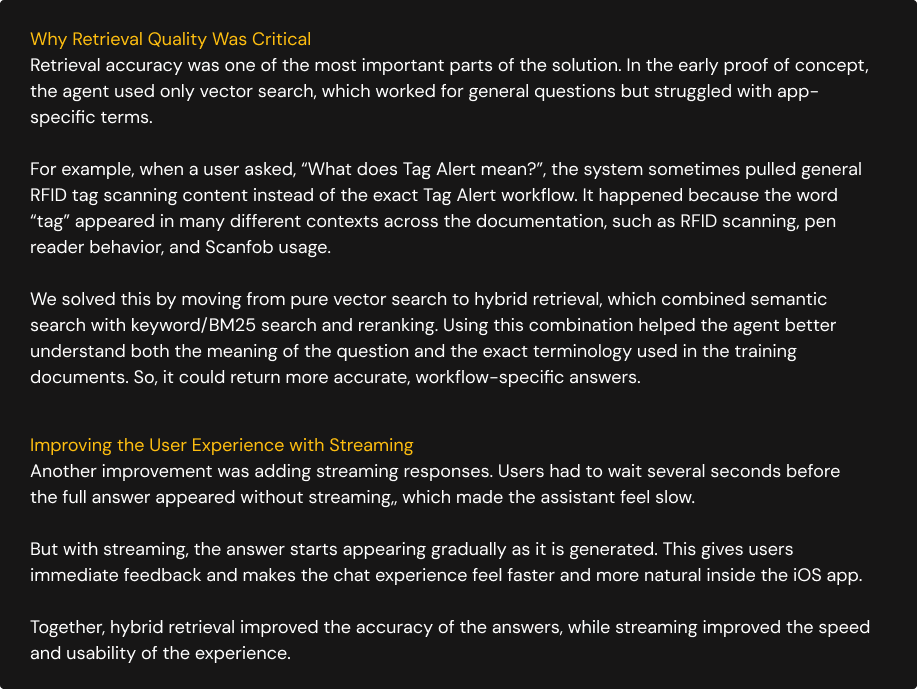
The issue was caused by the complexity of the training material and the highly specific terminology used in the app. So, we built a private AI-powered support agent using a RAG-based approach that lets users ask natural-language questions and receive instant, accurate answers pulled directly from the client’s approved training documents.
Business Challenge
The client’s users needed fast, accurate answers from lengthy training documentation. All the answers existed in the training material, but users had to manually search through many pages to find them.
So, the challenge for us to solve was about accessibility. Moreover, the client also had an important privacy requirement that the training data needed to remain private and controlled. That meant the solution couldn’t rely on OpenAI or public AI APIs.
- Slow Access to Critical Guidance:Users had to manually search through long training manuals to find answers about app workflows, device behavior, and troubleshooting steps, slowing down onboarding and day-to-day app usage.
- Operational Friction for Field Users:When users needed help during active work, they could not get immediate guidance inside the iOS app. This created delays, disrupted workflows, and increased dependence on support teams.
- Inconsistent Knowledge Retrieval:Important instructions were spread across dense documentation, making it easy for users to miss key details or interpret workflows incorrectly, especially around app-specific terms like device status and Tag Alert handling.
- Higher Support Burden:Repetitive questions that were already answered in the documentation still required human assistance, increasing the workload for support and training teams.
- No Scalable Knowledge Access System:As the app and user base grew, relying on static manuals and manual searching was not sustainable. The client needed a smarter way to deliver approved answers without rebuilding the app experience.
- Privacy Constraints Limited AI Adoption: The client could not use OpenAI or other public AI APIs because their training data needed to remain private and controlled, limiting their ability to use off-the-shelf AI tools.
the solution
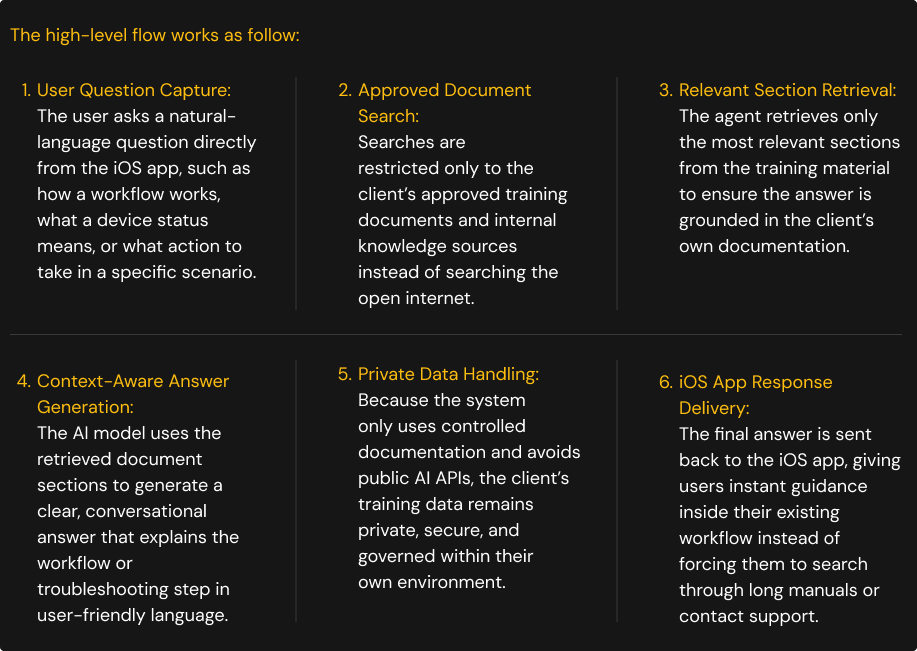
We built a Retrieval-Augmented Generation, or RAG-based, AI agent. Instead of training a model from scratch or sending the full document to an external API, the system retrieves only the relevant parts of the training document and uses those sections to generate an answer.
outcomes & benefits
- Faster Access to Training Knowledge60%–70% reduction in time spent searching training material.
- More Consistent Guidance40% improvement in consistency of user guidance across training and support scenarios.
- Better onboarding New users learned workflows faster by asking questions inside the app instead of relying only on static documentation.
- Improved Field Productivity 25%–35% improvement in task continuity during field usage and troubleshooting scenarios.
- Privacy-Conscious AI Adoption The solution avoided public AI APIs and could be deployed in controlled infrastructure to align with the client’s privacy expectations.
Business Support Impact
The agent is able to support multiple areas of the client’s business operations:
- User supportAnswers routine app and device questions instantly.
- Field operationsProvides quick guidance for every scenario.
- Training and onboarding Helps new users understand workflows and terminology faster.
- Quality and compliance workflowsSupports users in following documented steps for complaint handling and device status interpretation.
- Product scalabilityReduces the need for one-on-one support as the user base grows.
Tools & tech stack
For the proof of concept, we used a private local AI architecture that could later be moved to production. The main components included:
FastAPI backend
exposed chat and retrieval APIs for the iOS app.
Document ingestion pipeline
read training documents to extract text and clean repeated noise, splitting the content into searchable chunks.
Large Language Model (LLM)
were used to generate answers from retrieved training document sections.
Production Architecture Path
The POC validated the concept, but a production deployment requires stronger infrastructure.
The recommended production architecture includes:
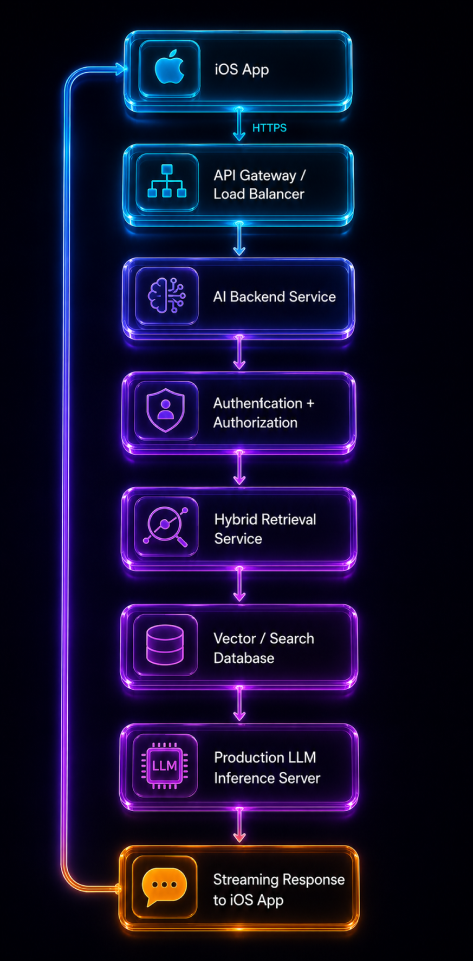
For production, the local POC components can be upgraded as follows:

conclusion
The client needed a private, document-grounded AI assistant for an iOS application. We addressed this by building a RAG-based AI agent that retrieves relevant sections from approved training documents and generates answers from that context.
Our POC demonstrated that AI can make complex training documentation easier to use, especially for app-specific workflows, device status interpretation, and troubleshooting scenarios.
Fusing hybrid retrieval with local model inference and streaming responses delivered a practical path toward a secure, production-ready AI assistant that can improve user support and operational efficiency.
Looking to implement AI in your app?
Xavor helps client make their iOS and Android apps AI-based.