
Anyone can code with vibe coding now. However, the problem with most AI training programs is that they’re teaching people to only focus on tools that are ephemeral, like fashion. Six months from now, Cursor will be different; the next model of GPT will be out. The syntax will change. That is why tools don’t matter in the bigger picture.
What matters is whether you can walk into an unknown problem with unfamiliar tools and figure it out anyway. And that’s a psychological skill, not a technical one, which can’t be taught. This was exactly our philosophy behind the recently concluded Xavor Vibe Coding Bootcamp (VCB) 2025. We gave 12 participants a little nudge in the right direction, and they had to slog around the rest of the journey to vibe code real-world projects using AI tools.
And they certainly didn’t disappoint. Keep on reading this blog as we share our reflections on VCB 2025, along with some of the top projects from the program.
The experiment
Rousseau was a big proponent of constructivist pedagogy, which is a fancy term for learning things by doing them on your own. In December 2025, we launched VCB with the same premise: no classes, no lectures, no hand-holding. We didn’t want participants to passively ingest instructions like they were elementary school kids. 12 people were given four weeks and a challenge to build four working AI products from scratch.
While some may consider this negligence, our aim was to push participants to imbibe the meaning of their own learnings in this bootcamp. Doing projects on their own with little to no supervision helped them build their own understanding and knowledge of AI in a way that no cramming or formal lessons could have done.
Moreover, we weren’t looking for any Einsteins. No prior credentials were required as the bootcamp was an open session for everyone: students, professionals, those looking for a career shift, or anyone just wanting to learn new things. And we got applications from economics majors, aerospace engineers, computer science students, and people who’d never written a line of code. They only needed to prove that they can learn something hard, all on their own.
And before you ask, the curriculum was as follows:
“Build something that solves a real problem. Use AI. You have one week. Figure it out. Good luck”
Looks unorthodox? Well, no one backed out. All 12 participants in the bootcamp crossed the finish line. They delivered the required projects for each week, but more interesting than who finished is how they finished.
What really happened: Three projects that won
On Demo Day, a jury of technical and business leaders evaluated all submissions. And three projects stood out, not just for execution, but for the thinking behind them.
First place: AI Web Studio
The first-place participant solved a very pertinent problem for small and medium enterprises (SMEs), which has been lingering around for quite some time now. Around 40% of small businesses still don’t have a website in 2026. The same year that is pitched as the year when humans will settle on Mars.
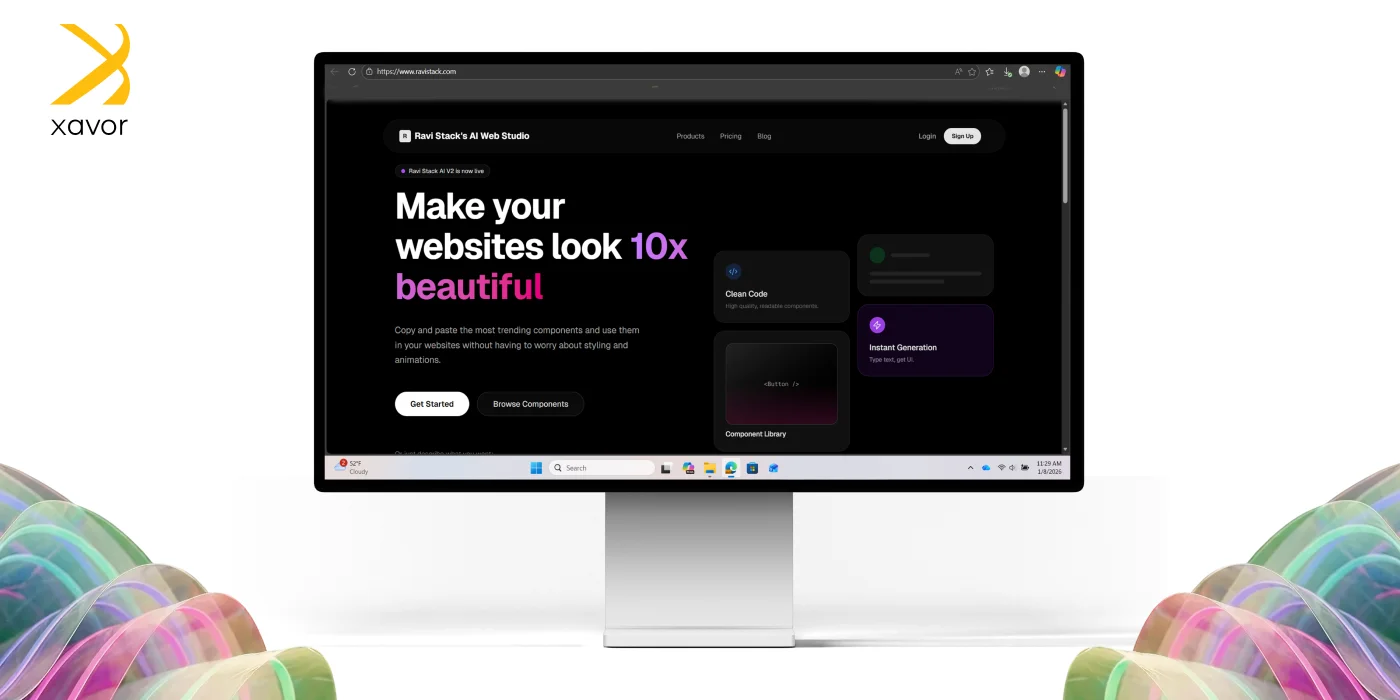
However, unlike reaching Mars, the reasons preventing SMEs from putting up a website are pretty benign, to be fair. It’s not because they can’t afford one. Basic hosting is cheap as dirt these days. It is the psychological barrier that is too high. And the fact that tools like WordPress, Squarespace, and Wix don’t really make life easy with their steep learning curve and technical gibberish doesn’t help either.
For a small business owner who is already stretched thin, this gives the excuse to procrastinate building a website, maybe next year, or maybe never. But never put off building a website until tomorrow when it can be done today with AI Web Studio.
It is a super-fast, super-simple AI program that lets you build a functioning business website in minutes. You may know zilch about website development; just describe your business and what kind of website you want for it. The platform generates a complete, business-ready website with a clean structure, editable sections, and a professional design before you can say Jack Robinson.
The jury loved the technical execution of the project, but what really impressed them was the problem framing. He went out of the box to build a solution for a specific psychological friction in website development.
While building this project, he never stopped when he encountered something new or challenging. As they say, when the going gets tough, the tough get going. He certainly got going by asking Claude to explain, building prototypes, breaking things, and debugging until the code worked. Four weeks from zero web development knowledge to a working product.
That’s the mindset that refuses to let “I don’t know how” become “I can’t.”
Second place: Safegaurd AI
This participant started with a question, not a solution. “What’s a problem AI can actually solve better than humans?” Two days of research led him to workplace safety. The numbers are brutal: approximately 140,000 workers die annually from workplace hazards in the United States alone. Countless more are maimed for the rest of their lives.
And the sobering fact is that most accidents happen despite safety protocols existing. So, where is the issue? You might have guessed it; it’s due to non-compliance and negligence by workers, their bosses, or both. You can’t have a supervisor watching every worker on every shift in every corner of every factory floor.
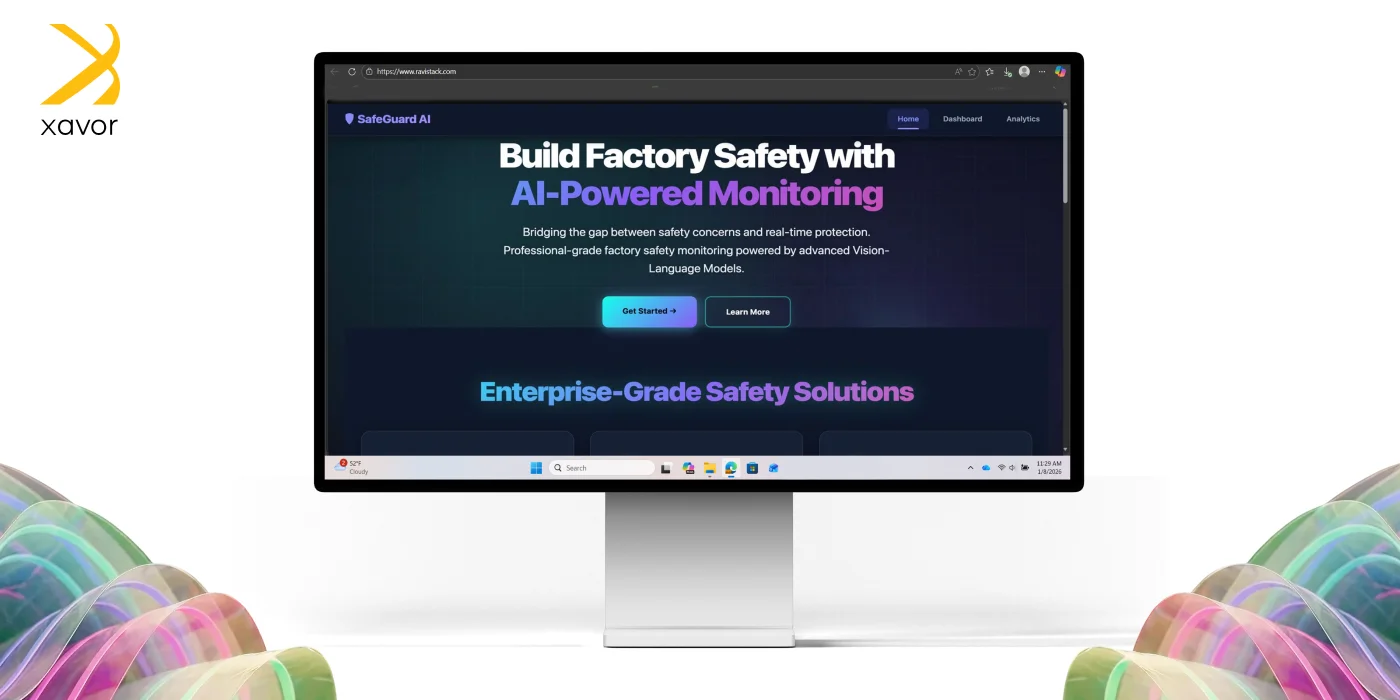
But this participant used AI to do exactly that. SafeguardAI is an AI-driven monitoring system that identifies whether workers are wearing proper PPE and following safety protocols in real-time. When it detects non-compliance, it sends instant alerts to safety teams. The solution uses computer vision applied to a literal life-threatening problem.
What made this project win second place was the disciplined problem selection. He could have built anything. But he chose to spend 48 hours just thinking about what problem was actually worth solving. That research phase, that willingness to think before building, separated great projects from the good ones.
Third place: PhysioTwin Clinical
This participant really did not know how to quit. During this project, she hit a wall as she’d never worked with computer vision. Processing video feeds was alien to her. And she had doubts about whether what she was attempting was even technically possible.
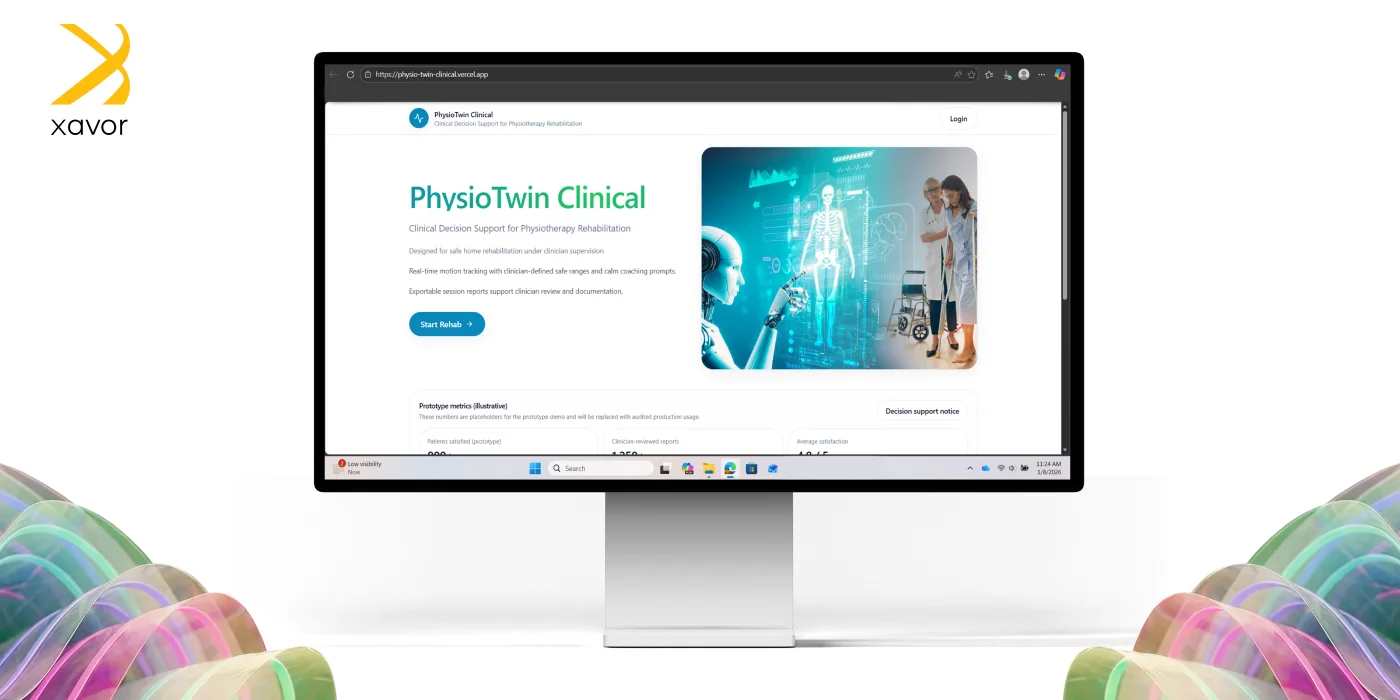
But she removed her doubts with action. She built an app, PhysioTwin Clinical, to help physiotherapy patients perform exercises correctly at home, addressing a real gap in healthcare. According to the National Institute of Health, most patients stop performing home exercises correctly within two weeks of initial instruction. This stalls their recovery and persists in the pain.
She created this app to close this gap between supervised clinic sessions and unsupervised home routines. But she had just four days, and with her back against the wall, she asked AI to explain computer vision like she was five. Then, like she was a developer.
Finally, she asked it to write the code, and it didn’t work. She went back to the drawing board, debugged the code by pasting error messages into ChatGPT to find the missing link.
On Demo Day, her app detected incorrect exercise form in real-time using a webcam with perfection. Patients could do exercises at home while the system provided real-time feedback on their form, mimicking what a clinician would correct in person.
What was the missing link? When asked how she did it, she shrugged. “I just kept trying things until something worked.” This may sound odd, but that is how a lot of great inventions were made.
Her journey of going from knowing nothing about computer vision to building a functioning app in just 96 hours is what our bootcamp is all about.
What surprised us
Now, to be honest, we were expecting to give the participants some hints and a pep talk every now and then. But we have never been so happy to be proven wrong. All the participants had a precocious talent for technology. Somewhere between week 1 and week 3, they stopped asking for help, permissions, or any validation from us.
They started treating problems like a jigsaw puzzle that they were entitled to solve. None of these projects required groundbreaking AI innovation. All that was needed was insight into which problems AI could solve better than existing solutions, combined with the nerve to build something without formal credentials or approval.
It is safe to say that traditional education doesn’t instill this confidence. We just gave them the space to be creative, and everything else followed.
What this reveals about the AI transition
There is a lot of noise around the AI transition in the world, and how it will impact the job market. But this bootcamp made us realize, and we know this sounds controversial, that the AI transition is a permission crisis masquerading as a skills crisis.
Most people have been trained, literally trained through years of formal education, to wait for instructions. To look for the approved method. They fear being wrong more than they value being useful.
But AI makes that psychology obsolete. There is an AI tool for almost anything these days, which are your first steps to pick up any new field. When tools can generate code, write documentation, debug errors, and explain complex concepts on demand, the bottleneck becomes something else entirely.
You just need the confidence to say, “I don’t know how to do this yet, but I’ll figure it out,” and stick by it. Now, we can’t teach that confidence. We can only create conditions where people discover they already have it.
The bootcamp structure was designed to discover that confidence. No safety net meant every participant had to confront the moment where they didn’t know what to do next, and then do something anyway. Ask a better question. Try a different approach. Break the problem into smaller pieces. Even if something was imperfect the first time around, it was all part of the learning experience.
This built their decision-making muscles that atrophy in environments that are optimized for certainty.
Why other companies are training for the wrong thing
It hurts to say this, but walk into any corporate AI training program, and you’ll find the same structure: modules on prompt engineering, tutorials on specific tools, certifications proving you’ve mastered today’s platforms. All of this will be obsolete in the coming years.
The participants who succeeded in VCB weren’t the ones with prior coding experience. They were taken aback, got confused, and were even frustrated at times. However, they didn’t interpret this as a failure. They knew they could do this, maybe not yet, but it was within their grasp at all times.
The future workforce won’t be siloed like it is today. It is dynamic and interdisciplinary. HR won’t be looking at resumes to see whether the candidate knows how to use Claude or not. Instead, they’ll be looking for the candidates who pushed themselves the hardest to learn something new and challenging.
And the best way to prepare for that future workforce is to expand your learning and develop a tolerance for ambiguity.
What we got wrong, and then right
As mentioned earlier, we expected some participants, particularly those without any coding experience, to stumble on the way and struggle to keep up with the pace of the program. But they outperformed our expectations because they weren’t burdened by assumptions about the “proper” way to build software.
They weren’t damsel in distress who needed help. They just needed permission and the liberty to try, fail, and keep trying again and again until it clicked for them. This entire bootcamp experience could be distilled to four words: “Yes, you can try.”
What happens next
The Winter 2026 edition of VCB is already underway with more participants. We plan to push harder on the problem selection phase in this edition. Our focus will be on promoting participants to research problems that are worth solving, and worry about implementation later on. Because the former is what gave us the best projects last time.
“Software developer” will mean something completely different in the future than it does today. Will AI write code? It is already out of the question. The ball is now in our court, whether we can stay weird and ambitious enough to matter.
The participants who can frame the right problem, navigate ambiguity, and ship imperfect solutions quickly will run circles around people with perfect credentials and no bias for action. VCB is our small bet on finding those people early. We’re positioning Xavor Venture Studio as a platform for grassroots innovation, not because we’re altruistic, but because we’re pragmatic. The talent we need doesn’t have a résumé yet. They’re building it right now, one weird project at a time.
Conclusion
This is not to talk down on traditional education, which is an important part of society. But such teaching methods optimize for certainty: clear requirements, known solutions, measurable outcomes. This is fine and dandy, but the AI economy rewards the opposite. The ability to build toward a vision you can barely articulate, using tools you learned yesterday, for users you haven’t met yet.
We can’t teach that. We can only show the path and get out of the way. Most companies won’t do this. It’s too risky, too unstructured, and too hard to measure ROI. They’ll keep running certification programs and wondering why their teams can’t move faster.
Xavor intends to run the experiment anyway. If you’re curious about Xavor Venture Studio, our approach to innovation, or you want to talk about how we’re thinking about AI and talent development, reach out at [email protected].
Or better yet: try this with your own team. Give them a week. Give them a hard problem. Give them AI tools. Then get out of the way. You might be surprised by what people build when you stop teaching them.
The Xavor Vibe Coding Bootcamp runs quarterly. Winter 2026 edition is currently underway. Applications for future cohorts open on a rolling basis.

FAQs
No. The Vibe Coding Bootcamp is open to beginners and non-technical participants as well as experienced professionals. Past cohorts included people who had never written a line of code.
Each cohort runs for four weeks. Participants are challenged to build one working AI product per week, culminating in a Demo Day where projects are evaluated by technical and business leaders.
You can reach out directly at [email protected] to learn more about Xavor Venture Studio, its approach to AI innovation, and upcoming Vibe Coding programs.