

Retail customers notice the small breaks that retailers often miss. A product shows “in stock” online but is unavailable in-store, a promotion works on the app but not at checkout, or a support agent cannot see the order history that explains the issue. These gaps usually come from the same root problem: customer, inventory, and service data living in different systems, handled by different teams, updated at different speeds. At the same time, expectations keep rising. Research shows 71% of consumers expect personalized interactions, and 76% feel frustrated when that does not happen.
Salesforce Retail Cloud is designed for retailers that want to remove these disconnects and run digital and store operations on one shared foundation. It brings customer profiles, order and inventory activity, marketing engagement, and service context into a connected platform, so teams work with the same information, and customers get a consistent experience across every channel. The result is not only better personalization, but also smoother fulfillment, faster support, and stronger in-store execution.
This article breaks down the core features of Salesforce Retail Cloud, the most common high-impact use cases, and the Salesforce integrations that help retailers build an end-to-end retail setup.
What is Salesforce Retail Cloud?
Salesforce Retail Cloud is a retail-focused platform within the Salesforce ecosystem. It helps retailers bring customer data into one place and deliver more relevant experiences across online and in-store journeys. With better visibility into customer preferences and shopping behavior, teams can engage customers in a more consistent way.
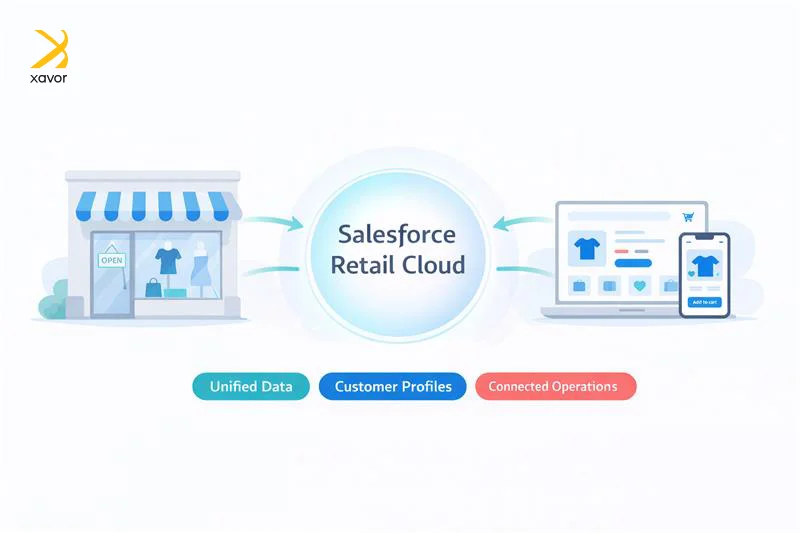
The platform supports key retail functions such as e-commerce, marketing, customer service, and store operations. These capabilities work together on a shared data foundation, which improves coordination and keeps information consistent across teams.
By providing a complete view of each customer, Salesforce Retail Cloud helps retailers improve service quality and increase customer loyalty. It also supports stronger day-to-day execution in stores and enables more informed decisions that contribute to steady, long-term growth.
Core features of Salesforce Retail Cloud
Salesforce Retail Cloud offers a set of capabilities that help retailers connect data, improve store execution, and deliver more personalized customer experiences.
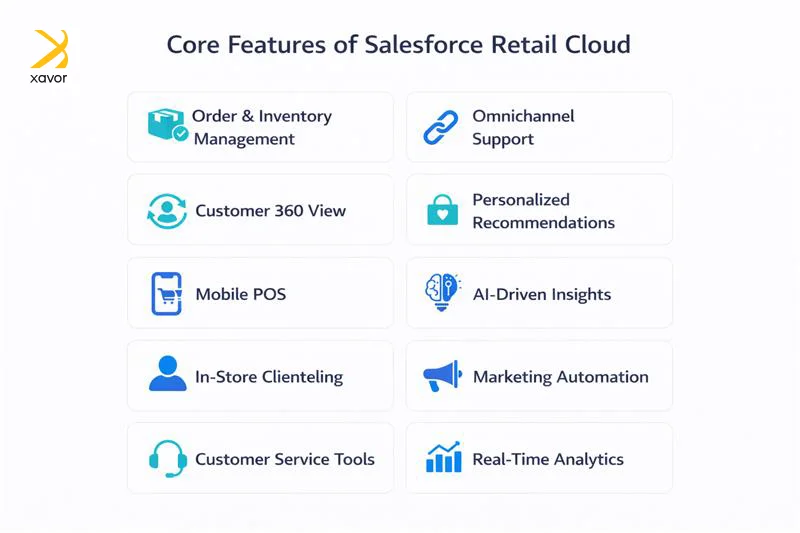
- Order and inventory management: Track stock, monitor order progress, and improve fulfillment to increase efficiency.
- Omnichannel support: Link in-store and online channels, so customers have a smooth experience across every platform.
- Customer 360 view: Build a complete customer profile that combines purchase history, browsing behavior, preferences, and related details.
- Personalized recommendations: Use AI solutions to recommend products that match each customer’s interests and past actions.
- Mobile POS: Let store associates complete sales anywhere in the store, check inventory, and view customer profiles on mobile devices.
- AI-driven insights: Use predictive intelligence to understand demand, support pricing decisions, and anticipate customer needs.
- In-store clienteling: Give associates tools to build stronger relationships through tailored suggestions and targeted offers.
- Marketing automation: Automate campaigns and send personalized promotions based on customer segments and behavior.
- Customer service tools: Provide support teams with customer context so they can resolve issues faster and more accurately.
- Real-time analytics: Use dashboards and reports to track key measures such as sales results, customer engagement, and inventory status.
How does Salesforce Retail Cloud support retail brands?
Salesforce Retail Cloud helps retail brands deliver consistent, connected experiences across digital and physical channels. It centralizes retail data and capabilities so teams can improve service quality, strengthen customer loyalty, and operate more efficiently.
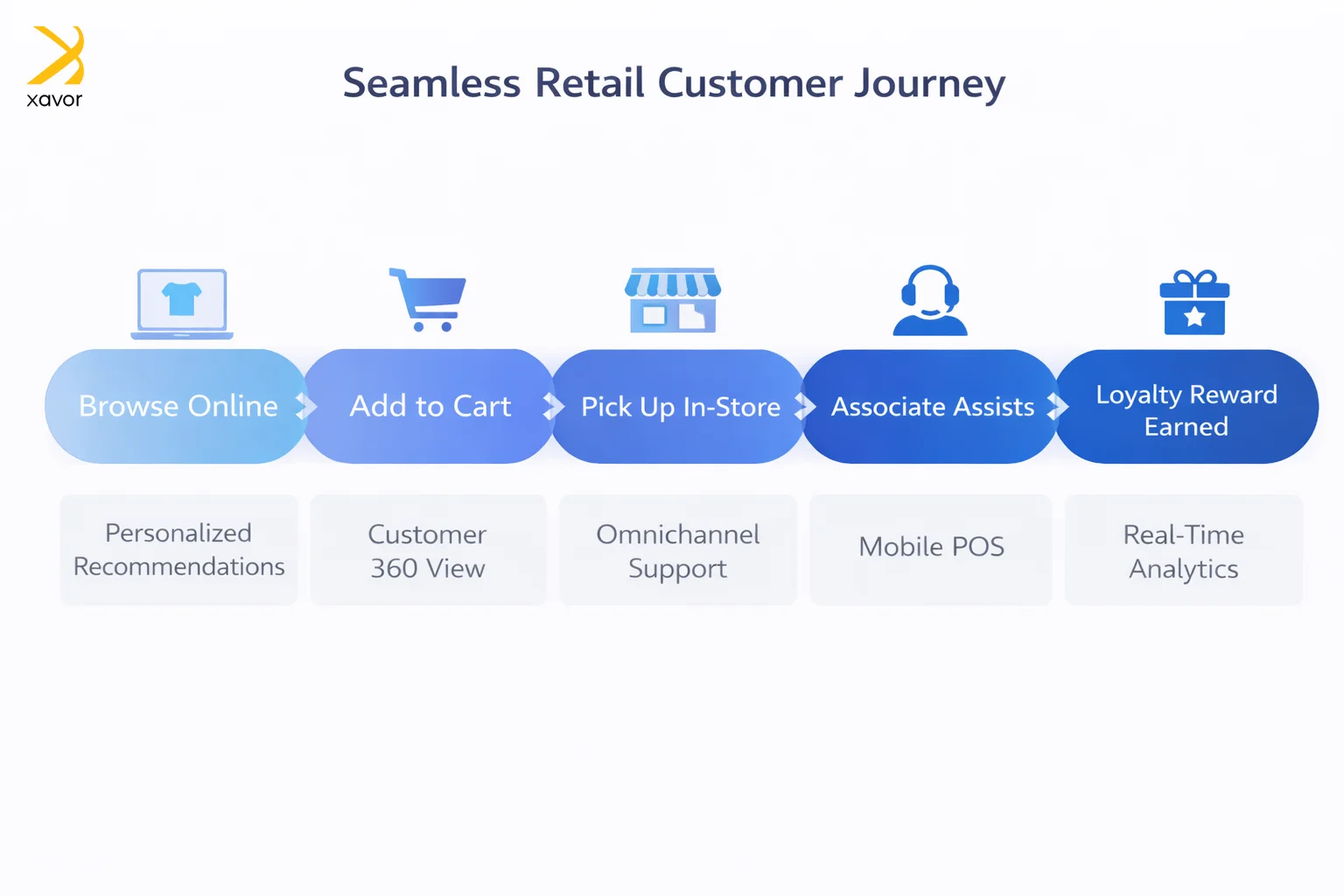
Seamless omnichannel experience: Customers expect continuity across every touchpoint. Retail Cloud helps connect online and in-store journeys to provide a unified experience.
Real-time data access: Retailers can view current inventory and customer information instantly, improving accuracy and enabling faster, better-informed decisions.
AI-based personalization: With Einstein AI, retailers can deliver more relevant product recommendations and engagement based on customer behavior and preferences.
Faster Retail Cloud POS: The POS system supports self-checkout, curbside pickup, and streamlined in-store payments to reduce wait times and improve checkout speed.
Higher associate productivity: Store associates can access customer profiles and product details on mobile devices, helping them support customers more effectively and confidently.
Key business benefits of Salesforce Retail Cloud
Salesforce Retail Cloud helps retailers improve both customer experience and operational performance by bringing key retail capabilities onto one connected platform. It supports more informed decision-making, better customer engagement, and stronger execution across channels.
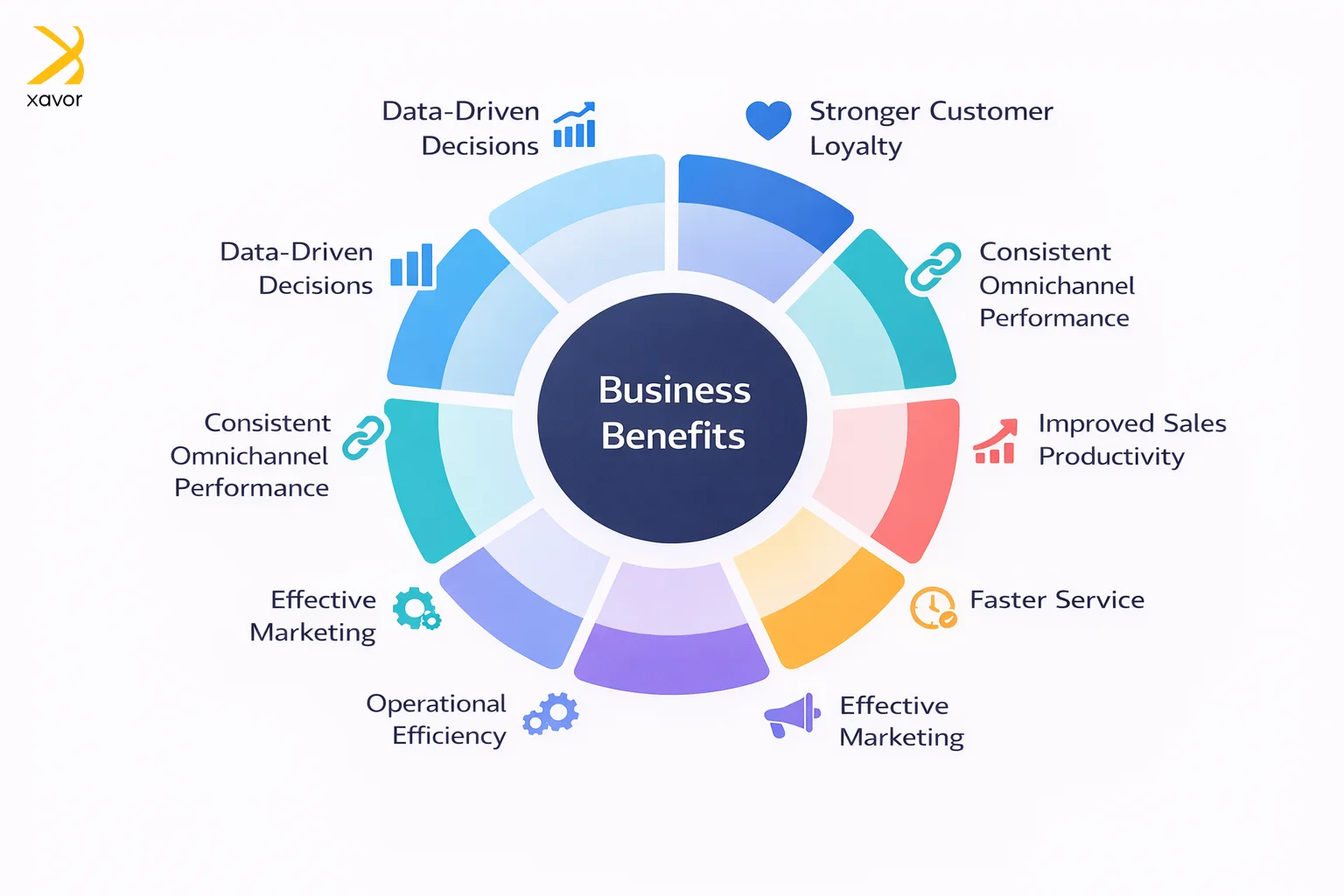
- Stronger customer loyalty: A unified customer view helps brands deliver more relevant experiences, which can improve retention and repeat purchases.
- Consistent omnichannel performance: Better alignment between online and in-store activity supports a smoother customer journey and reduces channel gaps.
- Improved sales productivity: Teams can work faster with shared customer data, clearer opportunities, and streamlined selling processes.
- Faster service and higher satisfaction: Service teams get better visibility into customer history, which helps resolve issues more quickly and improves overall experience.
- More effective marketing: Centralized customer data enables more targeted campaigns and better engagement across email, mobile, and other channels.
- Better operational efficiency: Real-time visibility into inventory and store activity helps reduce errors, improve planning, and support day-to-day execution.
- Data-driven decisions: Reporting and analytics help retailers identify trends, measure performance, and act faster on insights.
Integrations with Salesforce Retail Cloud
Salesforce Retail Cloud connects smoothly with other Salesforce products to build a single, end-to-end retail ecosystem. For instance, integration with Salesforce CRM helps retailers tap into rich customer insights, manage sales pipelines, and strengthen long-term relationships, all within one platform.
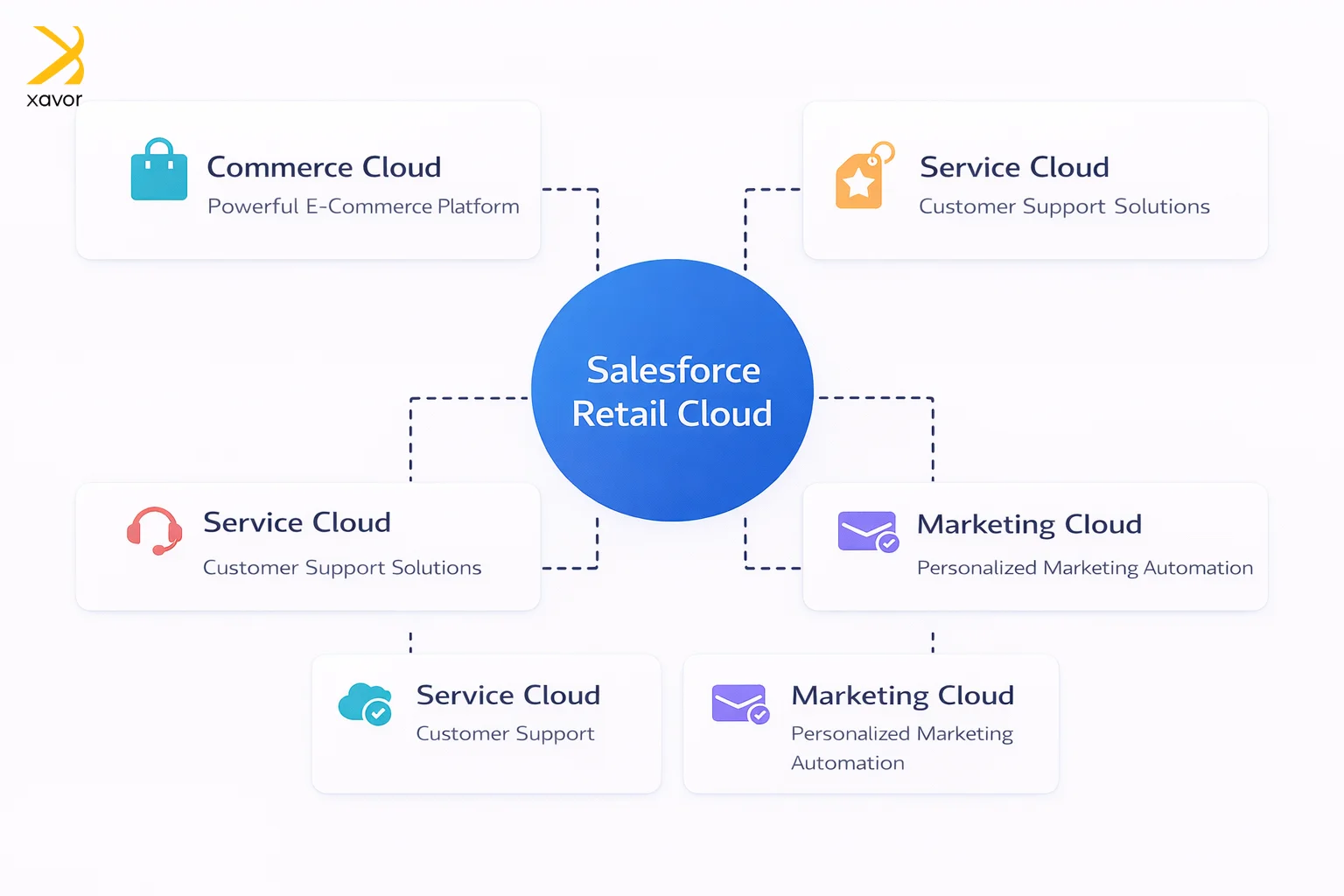
- Salesforce Commerce Cloud: Enables efficient management of both online and in-store channels, delivering a consistent customer experience across every touchpoint.
- Salesforce Service Cloud: Enhances customer support by streamlining case management and providing a complete view of customer interactions, improving service quality and satisfaction.
- Salesforce Marketing Cloud: Powers personalized marketing by using customer data to deliver relevant promotions and communications, increasing engagement and loyalty.
- Loyalty Management: Supports the setup and optimization of loyalty programs, including tracking rewards and creating initiatives that improve retention and customer lifetime value.
Use cases of Salesforce Retail Cloud
Salesforce Retail Cloud supports practical, high-impact retail scenarios that connect store, digital, marketing, and service operations on one platform. Unifying customer data and operational workflows helps retailers deliver consistent experiences while improving efficiency. Below are some of the most common real-world use cases.
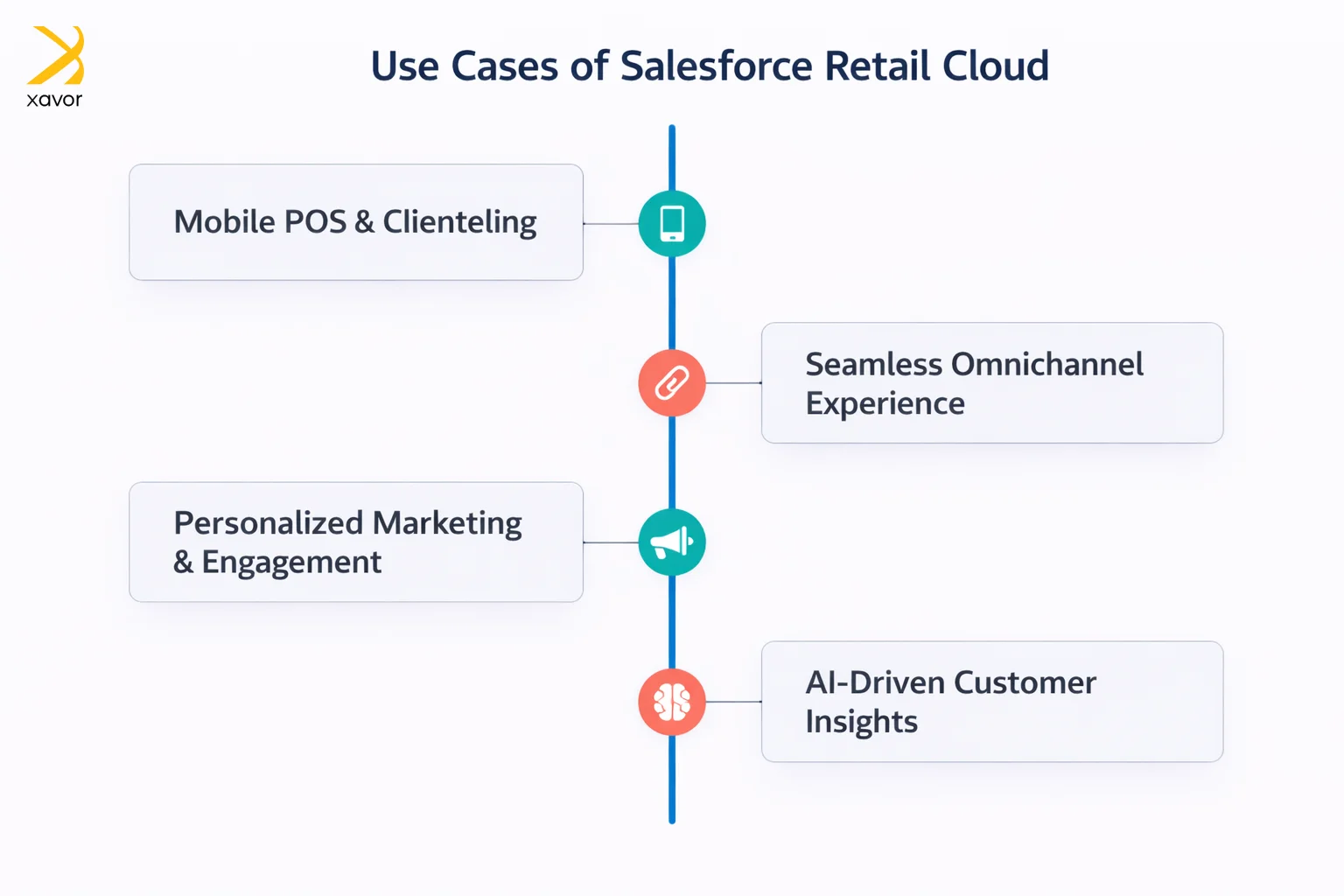
- Modernizing in-store shopping with mobile POS and clienteling
Retailers equip store associates with mobile POS devices that allow them to complete transactions anywhere on the floor, check real-time inventory, and access customer profiles instantly. Associates can view purchase history and preferences to make personalized recommendations, build stronger relationships, and reduce lost sales due to stockouts. This improves checkout speed, increases conversion rates, and enhances overall in-store experience.
- Delivering seamless omnichannel experiences
Retailers connect online and in-store operations to support journeys such as buy online, pick up in store, curbside pickup, and cross-channel returns. With unified inventory and order visibility, teams can manage fulfillment more accurately and provide customers with consistent pricing, promotions, and service across every touchpoint. This reduces friction and strengthens customer trust in the brand.
- Personalizing marketing and customer engagement at scale
Retailers build a Customer 360 view by unifying purchase, browsing, and engagement data into one profile. This enables targeted promotions, AI-driven recommendations, and automated campaigns across email, mobile, and digital channels. The result is higher engagement, improved retention, and stronger customer lifetime value.
Conclusion
Retail organizations face increasing pressure to deliver consistent experiences while maintaining operational control and efficiency. Success depends on the ability to coordinate teams, streamline processes, and make informed decisions based on accurate and timely information.
Salesforce Retail Cloud provides a unified foundation that supports these objectives. By connecting key retail functions and enabling greater visibility across the business, it helps organizations strengthen execution, improve customer engagement, and drive measurable performance outcomes. In a competitive market, this level of alignment and operational clarity is essential for sustained growth and long-term stability.
At Xavor, we deliver specialized retail CRM services designed to help brands successfully implement and optimize Salesforce Retail Cloud. Our team works closely with retailers to ensure seamless integration, scalable architecture, and long-term value realization. Reach out to us at [email protected].

FAQs
Salesforce Retail Cloud is used to unify retail customers, orders, inventory, marketing, and service data so teams can deliver a consistent experience across online and in-store channels. It helps retailers reduce channel gaps (like mismatched promotions or inventory visibility) and improve personalization, fulfillment, and support with a shared data foundation.
Key Salesforce Retail Cloud features include order and inventory management, omnichannel support, a customer 360 view, AI-driven personalization and insights, mobile POS, in-store clienteling, marketing automation, customer service tools, and real-time analytics. Together, these capabilities help retailers improve store execution and provide more relevant experiences at every touchpoint.
Salesforce Retail Cloud commonly integrates with Commerce Cloud (for online and storefront commerce), Service Cloud (for case management and customer support), Marketing Cloud (for personalized campaigns and automation), Salesforce CRM (for customer insights and relationship management), and Loyalty Management (for rewards and retention programs). These integrations help create an end-to-end retail ecosystem on Salesforce.