
OpenShift and Kubernetes are two heavyweights of container orchestration software. If you’re at the crossroads of choosing between them, wait a little while. Understand their differences first before you make a decision. After all, it’s your money that you’ll be investing in these technologies.
But as you vet OpenShift vs Kubernetes, some first-hand experience of using Kubernetes and OpenShift will be of great value. Our DevOps services team is well-versed in using both of these tools for container orchestration.
In this article, we’ll share our insights about both of these platforms, their differences, pros and cons, and which one is better for your business.
What is Kubernetes?
Kubernetes, also known as K8s, is an open-source container orchestration platform. It was originally developed by Google for breaking down software into smaller, self-contained packages. Container orchestration is widely popular in cloud computing, DevOps, and microservices architecture because it gives applications speed and portability.
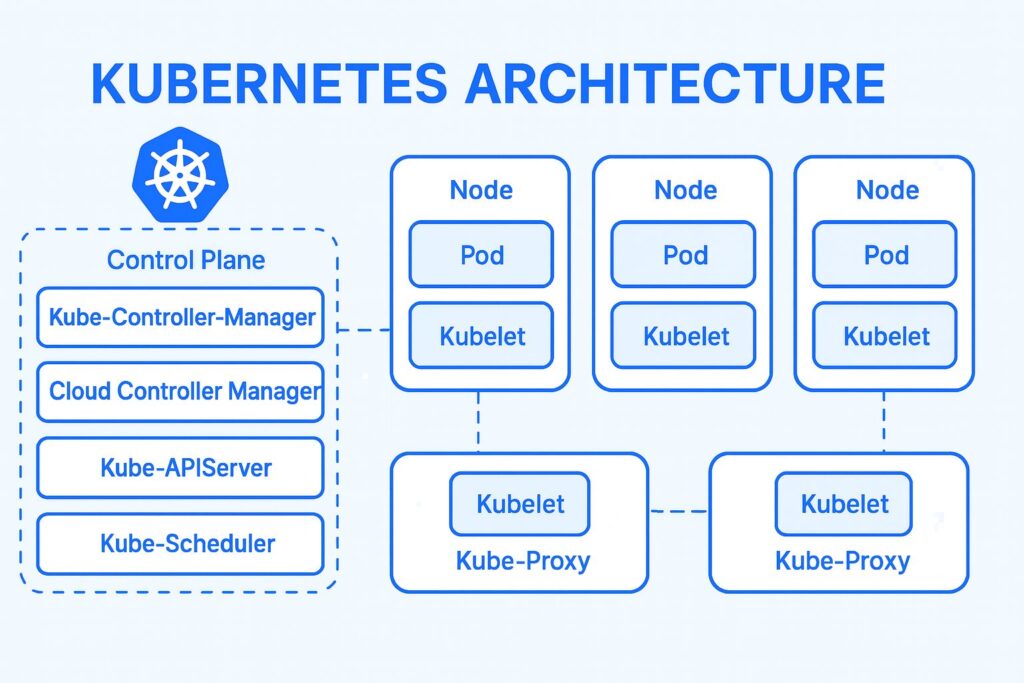
Using Kubernetes, you can automatically deploy, scale, and manage containerized applications. In 2015, Google donated Kubernetes to the Cloud Native Computing Foundation (CNCF), which is part of the Linux Foundation. However, that doesn’t mean it’s not open source anymore.
It remains a community-driven, open-source project rather than a proprietary tool. Therefore, Kubernetes is the de facto standard for container orchestration. All major cloud providers have launched their separate managed Kubernetes services, such as:
- Google Kubernetes (GKE)
- Amazon Elastic Kubernetes Service (EKS)
- Azure Kubernetes Service (AKS)
What is OpenShift?
Red Hat’s OpenShift is an enterprise-grade container platform built on top of Kubernetes. OpenShift builds upon this foundation to offer enhanced container solutions. Kubernetes clusters are basically the computing unit for OpenShift.
OpenShift includes the platform features of Kubernetes and Docker. It adds extra tools for optimizing CI/CD pipelines and security features for building and running applications. Additionally, OpenShift supports both cloud and on-premises implementations.
Is OpenShift open source like Kubernetes? Yes, the core of the platform is open source through the community-driven upstream version called OKD (Origin Community Distribution of Kubernetes).
However, is OpenShift free? Not entirely, it also has a commercial version offered as a Platform as a Service (PaaS) product that you need a subscription to use. And like Kubernetes, major cloud providers offer managed services for OpenShift, like:
- Red Hat OpenShift Service on AWS (ROSA)
- Azure Red Hat OpenShift (ARO)
- OpenShift Online
- OpenShift Dedicated
OpenShift vs Kubernetes: 5 key differences
Kubernetes and OpenShift share some common roots. While they are both container orchestration platforms, they part ways when it comes to enterprise capabilities, functionalities, and user interface.
Let’s take a closer look at the differences between OpenShift and Kubernetes:
1. Delivery mode
This is the core difference between OpenShift and Kubernetes. As mentioned above, Kubernetes is an open-source project that you can download from GitHub as a free service.
On the other hand, OpenShift is open source at its core, but for enterprise use most developers need to buy its commercial product. It comes with a license, subscription fee, and SLAs.
2. User interface
OpenShift container orchestration is much easier to use than Kubernetes. It has a user-friendly web console with a one-click login page. You can easily modify and add resources to OpenShift. Moreover, there are pre-configured templates in OpenShift that you can use to monitor and configure your application.
Kubernetes requires users to manually configure the deployment and management of containers. Users have to work with the CLI tool kubectl or the Kubernetes Dashboard, which are basic and require additional configurations. This complexity bogs down many users who are new to the platform.
That ease of use is a major advantage for OpenShift in the OpenShift vs Kubernetes discussion.
3. Security
Container orchestration has a set of best practices for cloud security, especially for applications that handle sensitive data. In this domain, Kubernetes has a lenient security approach. It gives a baseline of security features, such as role-based access control (RBAC) for secure information exchange.
But to beef up the app’s security for enterprise settings, you will need to do a lot of work by adding extra application security layers.
Contrarily, OpenShift has a stronger security posture. It’s designed so that containers can’t run with full system privileges unless an administrator specifically allows it. Furthermore, the platform offers integrated security tools, such as:
- Red Hat Advanced Cluster Security (RHACS)
- Container Security Operator (CSO)
- Security Context Constraint (SCC)
4. OpenShift Route vs Ingress
There are different mechanisms for networking and routing in Kubernetes and OpenShift. Kubernetes traffic routing is done through Ingress, while OpenShift Route does the same job on Red Hat’s platform.
However, how they route traffic differs. OpenShift Route is a built-in router based on HAProxy, which is a load balancer, allowing users outside the cluster to reach apps running inside it. But you can use other load balancers for routing in OpenShift as you prefer.
Kubernetes has no built-in routing system. Every pod in Kubernetes has its own internal IP address, but those are only reachable inside the cluster. To let people outside connect to an app, Kubernetes uses an Ingress object.
Ingress defines which services should be accessible externally. You can also customize how incoming traffic is routed with the Ingress Controller.
5. Scalability and community support
Kubernetes is very flexible. It can scale both horizontally by adding ore removing pods, and vertically by adjusting resources within a pod. The Kubernetes tools that make this possible are:
- Horizontal Pod Autoscaler (HPA)
- Vertical Pod Autoscaler (VPA)
Also, if you want scalability for better Kubernetes multi-cluster management, Cluster Autoscaler is the best option. Kubernetes also offers built-in load-balancing mechanisms to evenly distribute incoming traffic.
OpenShift is designed for enterprise settings. It includes all of Kubernetes’ scaling capabilities and adds automation layers that simplify the process for enterprise users. You can adjust workloads based on usage of metrics, like CPU or memory, using built-in tools and dashboards.
In terms of community support, the OpenShift vs Kubernetes discussion clearly favors the latter. Kubernetes has the largest and most active community in container orchestration. You can avail yourself of extensive resources, collaboration opportunities, and support for your Kubernetes projects.
On the other hand, the OKD project does have an active community, but the commercial version is driven mainly by Red Hat and its enterprise customers. So, unless you’re integrated with the broader Red Hat ecosystem, you may find OpenShift’s community support relatively limiting.
OpenShift vs Kubernetes: Pros and cons
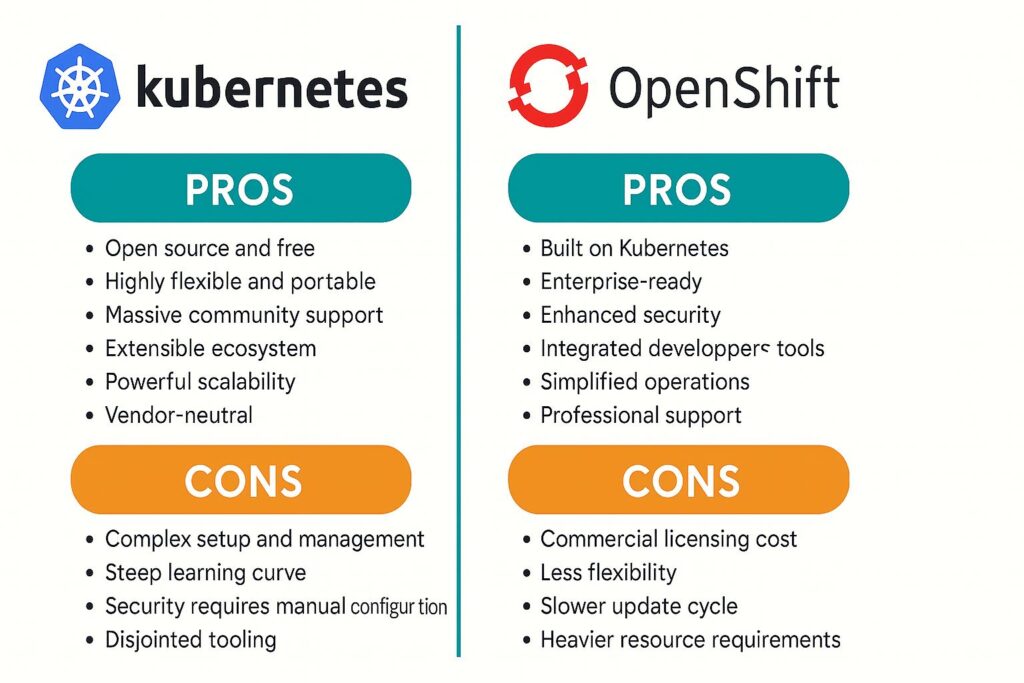
Analyzing the pros and cons of Kubernetes and OpenShift could go on and on depending on which side of the fence you are. But let’s save you all that hassle with this simple table.
OpenShift vs Kubernetes: Which is better?
So, you’re probably eager to know our verdict on this one? Now it is a very tough choice because we have worked with Kubernetes and OpenShift for different use cases. Kubernetes is fantastic if you have a strong DevOps team like ours. Our developers love the full control the platform gives them in container orchestration. Not to mention its zero licensing costs and external support.
That said, most organizations don’t have that kind of in-house DevOps expertise. OpenShift is the better option for businesses in this situation. It is basically Kubernetes with enterprise-level features.
OpenShift container orchestration is a lot easier since you won’t have to spend time stitching together a myriad of third-party tools, which you will find irksome as a newbie to the world of container orchestration.
The user-friendly web console of OpenShift will also make your life easier. And lastly, if you’re already using Kubernetes, you can run your workloads on OpenShift with APIs or migrate to OpenShift smoothly.
Conclusion
The question of OpenShift vs Kubernetes comes down to your specific requirements. Kubernetes and OpenShift are both excellent at container orchestration. Kubernetes is ideal for veteran DevOps teams that want to control the minutiae of their workflows. But are you ready to handle the complexities that come with this level of freedom?
Thought not so, OpenShift does a great job at doing everything Kubernetes can do, minus the irksome work. Moreover, 90% of businesses don’t really need that much tinkering with their containers anyway. They care about uptime, security, and simplicity, all of which are OpenShift’s forte.
Xavor helps you make the most of Kubernetes and OpenShift with its DevOps services. Whichever platform you choose, you need to pair it with the necessary DevOps workflows and practices to get the most out of these solutions.
To learn more about how Xavor can help you with container orchestration, drop us a line at [email protected] to get in touch with our experts.