

When you hear DevOps, what’s the first thing that comes to your mind? It’s probably building software, right? Well, you have the right image because DevOps emerged in the software world to solve some problems that nagged developers. But DevOps is now adopted in many different settings beyond the sleek, quiet storeys of tech companies.
It is now applied in the rough, noisy floors of factories. DevOps implementation services are now an important partner of a manufacturing firm to help them use this set of principles for their unique engineering-computational processes. The collaborative culture of DevOps makes it the perfect solution for the fast-paced, structural industrial world.
In this blog, we’ll discuss just how important DevOps is in manufacturing, how it helps reduce IT downtime and release risk, and what the best DevOps implementation strategy is for manufacturing production.
What exactly is DevOps?
You will find a lot of buzzwords if you Google what DevOps is. “It’s a software development methodology”, “It’s a cultural philosophy”, or our favorite from Amazon: “DevOps is the combination of cultural philosophies, practices, and tools…” All of these definitions are right in their own context, but people often find them a bit too vague.

In a nutshell, DevOps is a way to find and resolve the pain points in the development process. And that requires working at the intersection of development and operation. Usually in software development, the development team writes the code, and the IT operations team deploys and runs the program. And they do this separately.
But in DevOps, they work next to each other and are involved in each other’s decision-making. The codebase is shared between both teams, and they take mutual responsibility. This means IT folks need to learn code, and developers need to learn infrastructure, aka a DevOps engineer.
We recommend reading the book “The Phoenix Project” if you want to understand DevOps in a fun way. It’s a business fiction (yes, it’s a real genre) novel that explains the concept through the story of a struggling IT department at a company.
Where does DevOps fit in manufacturing?
Tesla claims that 95% of car production at its Gigafactory in Shanghai is automated, and it produces a Model Y every 30 seconds. That claim is pretty believable because automation is everywhere in modern manufacturing. Industrial units use AI applications, industrial robotics, and many other technologies to perform the work of hundreds, if not thousands, of human workers.
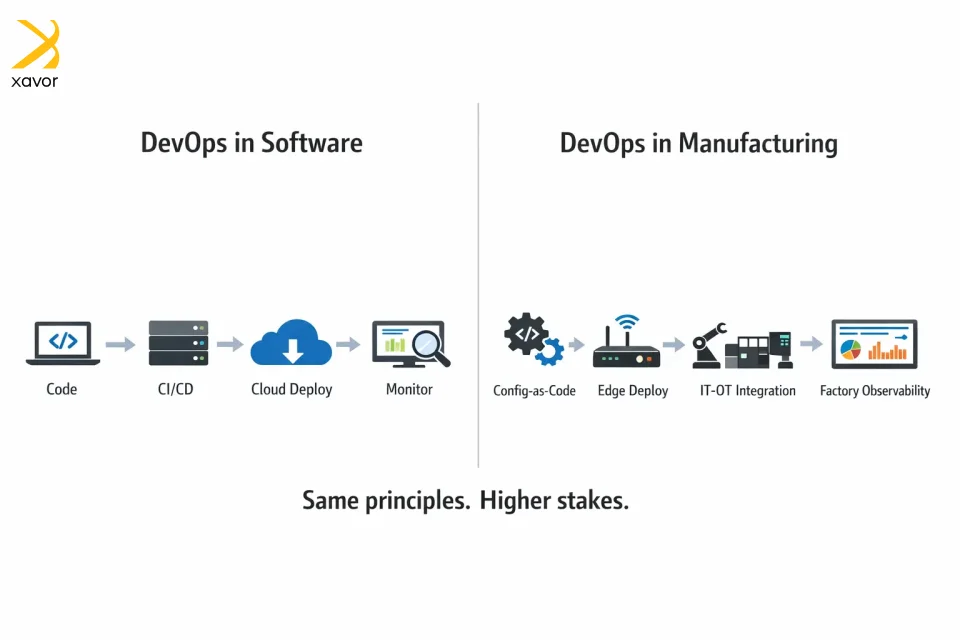
So, there is a lot of software and IT operations involved in keeping all these platforms up and running. However, IT downtime in factories is not uncommon, and it has serious consequences. When a software or code behind a machine glitches in a factory, it may stop a production line or disrupt a whole supply chain. And according to Siemens, unplanned IT downtime causes Fortune Global 500 industrial companies a loss of almost 11% of their annual revenues.
This makes DevOps essential for reducing downtime and keeping the manufacturing unit’s technology ecosystem running smoothly.
Industrial DevOps is a term coined around 2018 for this phenomenon. It is a stricter version of DevOps designed for industrial and cyber-physical systems where software interacts with machines, lines, and physical processes.
5 ways DevOps implementation services reduce downtime and release risk
In natural ecosystems, even little things that no one pays attention to play an important role in maintaining the delicate balance. Like the fig wasp that pollinates fig trees so that they can produce their fruit.
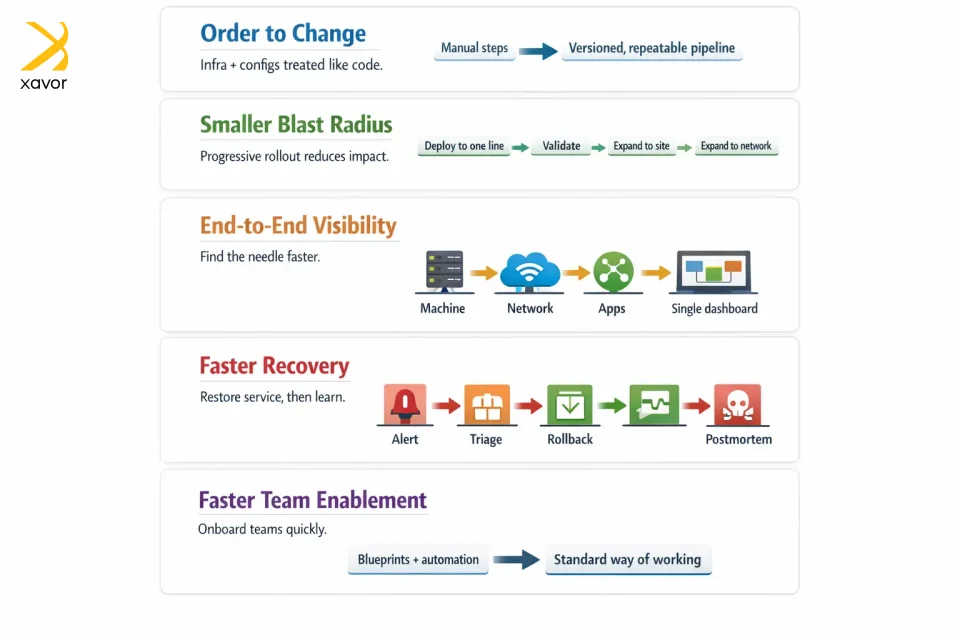
DevOps as a service kind of works like that wasp in manufacturing plants. They use DevOps to keep the IT ecosystem in balance, which lets the unit create products smoothly.
1. They bring order to change
Most IT downtime in industrial situations comes from predictable patterns: manual deployments and inconsistent configurations that slip through everyone’s eyes. DevOps implementation services convert these manual changes into repeatable systems, such as:
- Infrastructure and configurations are stored and reviewed like source code
- Documented, tested rollback procedures that work under pressure
When the process is consistent, the surprises become rarer. When surprises do happen, you can trace them to their origin.
2. They shrink the blast radius
In manufacturing, the most responsible change is often the smallest one. In 1999, Hershey implemented their ERP system during the peak Halloween season. Things didn’t go as expected with the IT system, and it caused major supply chain disruptions with unfilled orders for the confectionery giant.
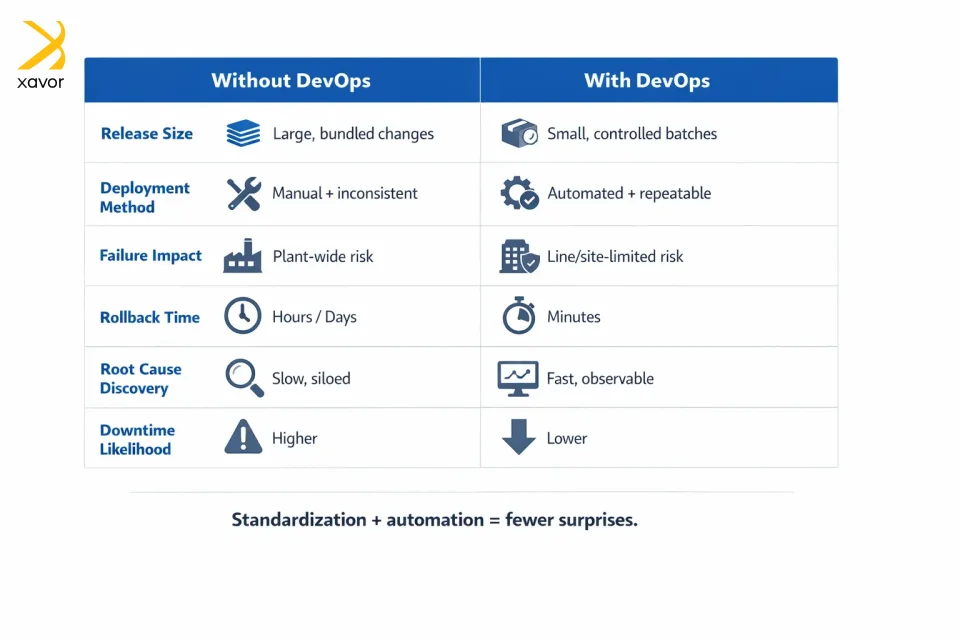
DevOps implementation services tend to introduce safer release patterns that limit how far failures like these can spread. With a well-thought-out DevOps implementation strategy, changes can be rolled out to a single line or site before expanding. And if something breaks, the previous version can be kept on stand-by to return in moments.
Failures in manufacturing are common. But DevOps limits the scope of failure, which reduces the time and cost of recovery.
3. They present a holistic system
There are thousands of robots, AI/ML systems, and other automation platforms in modern factories. If one of them is glitching or causing a problem, it can stop the whole production line. And finding the exact faulty part is like finding a needle in a haystack.
DevOps implementation services improve your observability of the factory. They give you a bird’s eye view of what’s happening across applications, networks, integrations, and edge systems before a minor fault becomes a production stop.
How do they do that? Well, the technical term for that is IT-OT integration. It means converging IT systems with operational systems for real-time insights. With clear signals, you don’t wait for the line to stop to learn that something is wrong.
4. They make recovery easy
Factory workers are often given training on what to do if a fire erupts. Running aimlessly and panicking doesn’t help anyone. It requires cool and calm nerves under pressure to get the fire under control, and after that, to do a complete investigation into what caused the fire.
This exact approach is required if an IT incident happens during manufacturing. DevOps implementation services define clear roles and paths to fix an ongoing issue:
- Incident commander: Runs the response, keeps everyone aligned
- Technical lead: Diagnoses and applies fixes
- Comms owner: Updates stakeholders at every moment
- Escalation path: Who to call next if it’s not solved within the prescribed time
After normalcy is restored, DevOps implementation services do a proper audit and investigation into what exactly happened, what was the root cause, and other contributing factors to make sure the IT incident doesn’t happen again.
5. They train workers faster
Most manufacturing plants do have competent internal IT teams. But they already have too much on their plate to map out a comprehensive DevOps implementation strategy all on their own. Like they can’t pause operations to re-architect everything.
Therefore, executives and team leads opt for DevOps implementation consulting to get things done faster. DevOps implementation services typically come with tested blueprints and proven practices, allowing teams to realize the wider business benefits of DevOps—such as faster releases, improved reliability, and tighter collaboration—without reinventing the wheel. They require far less time to develop a DevOps implementation strategy that fits the client’s manufacturing reality.
And they do that with complete security and automated builds. Let’s say that if it takes you 12 months to implement DevOps in a factory, DevOps implementation services can do that in 3–4 months.
7 principles for devising a DevOps implementation strategy
There isn’t a single DevOps strategy that will work for all types of manufacturing settings. However, there are some core principles that the best DevOps implementation services also follow.
1. Organize around value
Structure teams around the entire chain of work instead of departments, so work moves with fewer handoffs and less delay.
2. Plan short
Most DevOps implementation services keep long-range planning for hardware, but they pair it with mid- and short-term cycles to update the plan continuously based on what they learn.
3. Use data to decide
Prioritize using real data indicators and actionable business intelligence so decisions are evidence-based and outcomes can be measured.
4. Architect for change
Design modular, well-interfaced systems that teams can evolve independently and service safely, so updates don’t require risky, all-or-nothing changes.
5. Move in small batches
Deliver in small increments to reduce queues and late surprises, making integration and problem detection faster and less painful.
6. Integrate frequently
Top DevOps implementation services often learn early, adapt the frequency to physical constraints, and improve it over time with automation.
7. Growth mindset
Build a learning culture that treats failures as feedback, improves systems over blame, and sustains continuous improvement across all the other principles.
Conclusion
Small compromises quietly accumulate into dramatic failures in manufacturing. And the fast-paced speed of the industrial world makes it difficult to manually keep a check on every IT system and technology.
Xavor’s DevOps implementation services bring a production-grade discipline where change is engineered with the same seriousness as the product itself. We use DevOps to build systems that stay reliable while complexity grows. Software, integrations, networks, and automation platforms are a living production system that deserves the same rigor as the assembly line.
Contact us at [email protected] to book a free consultation session with our DevOps experts.

FAQs
DevOps is a way of working where software developers and IT operations teams collaborate closely to build, release, and run systems. It uses automation, shared responsibility, and continuous improvement to deliver updates faster with fewer errors and less downtime.
Manufacturing relies on software to run machines, production lines, and plant systems. DevOps helps teams deliver updates safely and fix issues faster, which reduces unplanned downtime and production disruption.
Industrial DevOps is DevOps adapted for factories, where software updates affect real machines, production lines, and safety. It combines IT and operational technology (OT) to deliver controlled releases, better monitoring, and faster recovery without disrupting production.